






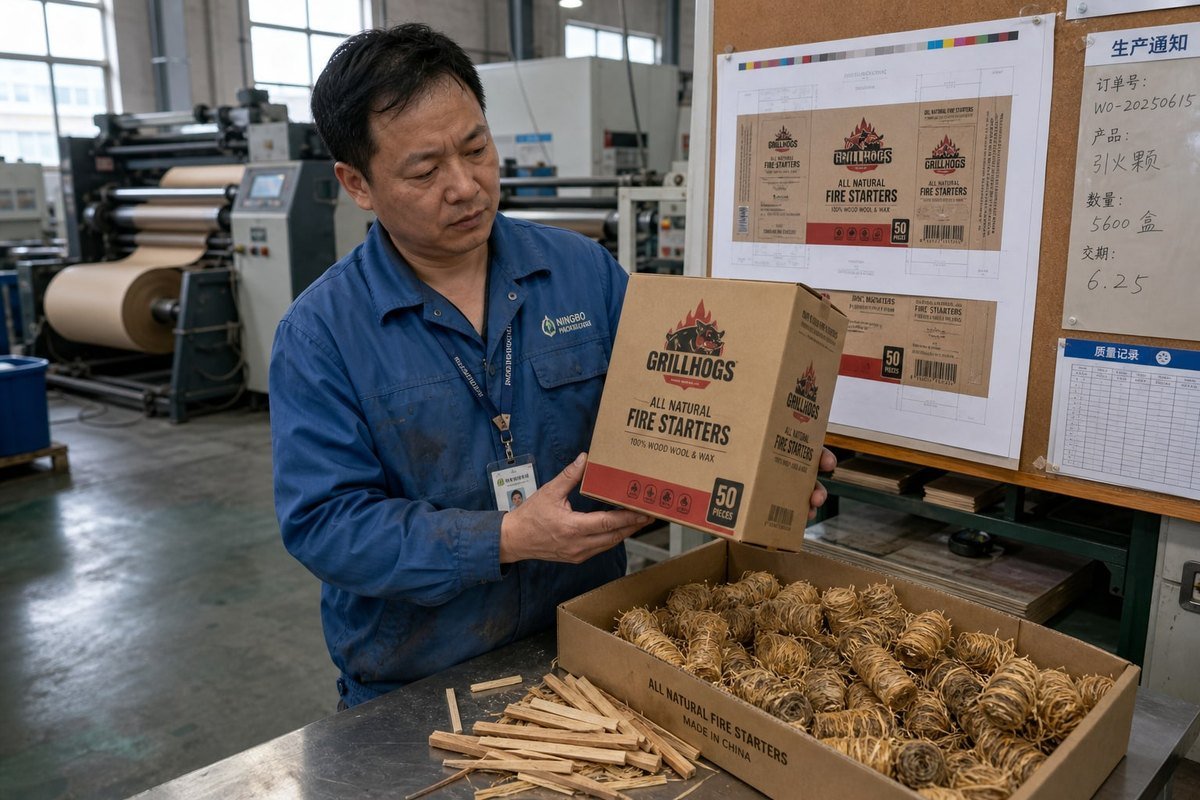
Adding your grill brand's logo to wood fire starter packaging sounds simple — until artwork files bounce, print colors shift, and safety labels crowd out your brand CE marking 1. I've watched buyers lose whole retail seasons over this at our factory.
To add your grill brand's logo to wood fire starter packaging, supply vector artwork (AI, EPS, or PDF) to your supplier, choose a print method — flexographic, digital, or labels — approve a pre-production sample, and confirm safety warning labels and compliance text fit alongside your branding before mass production.
That is the short version. The real work sits in the details: certifications, per-unit costs, minimum order quantities, and sample timelines Intertek 2. Let me walk you through each one, based on what actually happens on our production lines.
What certifications should I check before private labeling wood fire starters?
After 17+ years shipping wax-dipped wood rolls and wood wool fire lighters to 30+ countries, I can tell you this: the logo is the easy part vector artwork 3. Certification is where private-label deals live or die.
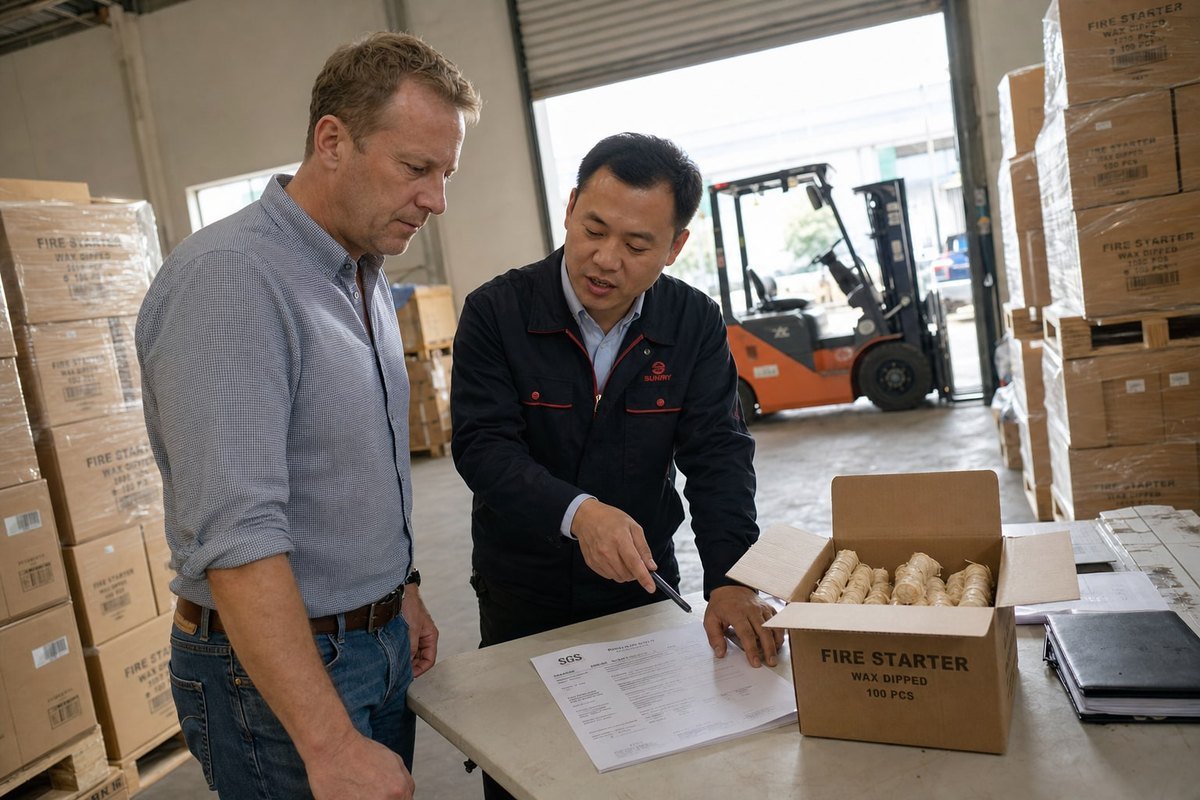
Before private labeling wood fire starters, verify the manufacturer holds ISO 9001 for quality management, BSCI for social compliance, CE marking for European markets, and third-party test reports from SGS or Intertek confirming the product is free of harmful chemicals and meets flammable-goods labeling rules.

Here is why this matters so much for private label fire starters. Once your grill brand's logo goes on the box, your brand owns the liability in the eyes of the retailer and the consumer. If the product fails a customs inspection or a retailer audit, the supplier's name is nowhere on the packaging — yours is. So you need documentation before you need artwork.
The core certificates and what each one covers
| Certificate | What it proves | Who asks for it |
|---|---|---|
| ISO 9001 4 | Consistent quality management system | Most US and EU importers |
| BSCI | Ethical factory and labor conditions | Large retail chains and sourcing offices |
| CE | Conformity for the European market | EU distributors and customs |
| SGS 5 / Intertek reports | Independent lab testing, no harmful chemicals | Retail buyers, insurers, marketplaces |
When our team in Ningbo prepares a private-label order, we hand over these documents at the quotation stage, not after payment. If a supplier hesitates to share current test reports, treat that as a red flag. Also check that the report matches the exact product — wax-dipped wood rolls tested last year do not automatically cover a new paraffin blend or a new wood wool source.
One more point buyers often miss: your packaging itself needs compliant safety warning labels. Flammable-product warnings, usage instructions, and country-specific pictograms must appear in the correct language and size. We keep template layouts for the US, Germany, UK, France, and other main markets, so the compliance text is designed into the box from day one instead of squeezed in later.
How much does custom logo packaging add to my per-unit cost?
A German distributor once asked me to quote the same wood fire starter three ways: plain box, stickered box, and fully custom printed packaging. The spread surprised him — and it usually surprises everyone.
Custom logo packaging typically adds $0.03 to $0.25 per unit depending on method and volume. Adhesive labels cost the most per unit but need no plates; flexographic printing adds one-time plate fees of $100–$500 but drops unit costs sharply at scale.
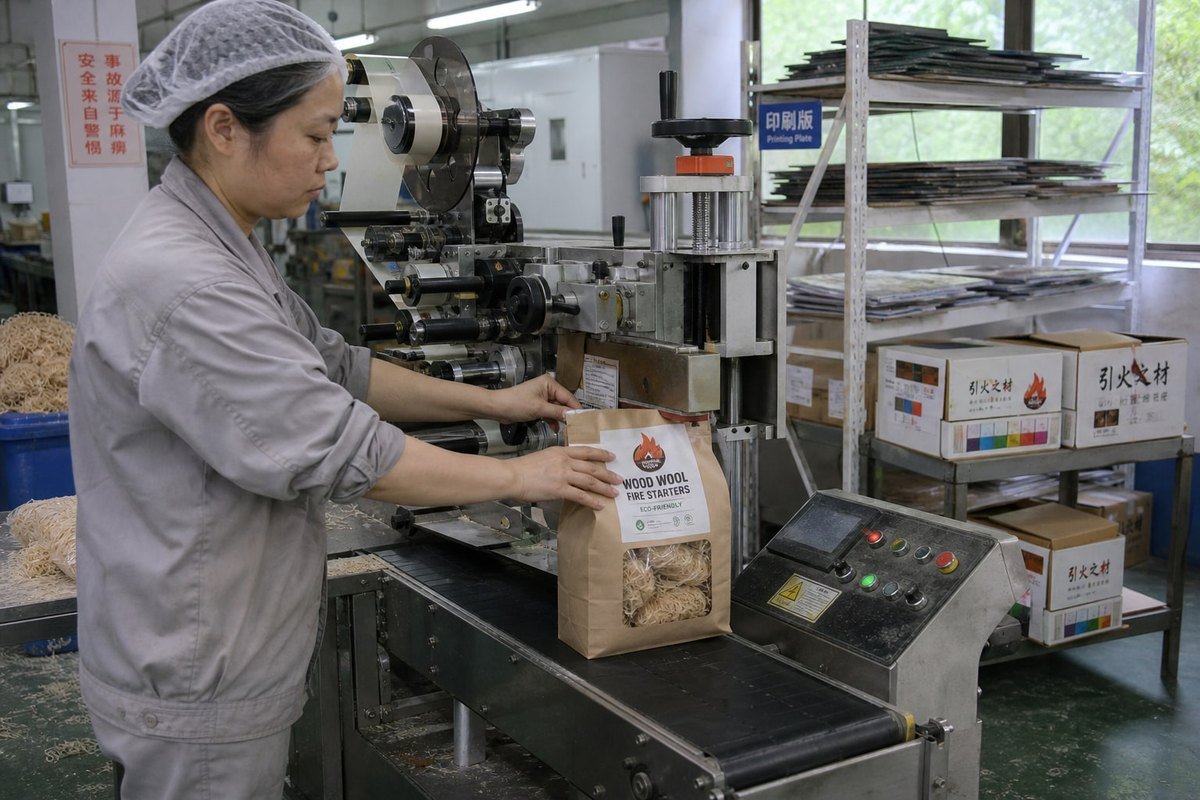
Let me break the cost down the way we quote it, because the structure matters more than any single number.
Where the money actually goes
Custom printed packaging has three cost layers. First, one-time setup: printing plates for flexographic printing 6, or dielines for a new box shape. Second, the per-unit print cost, which falls as volume rises. Third, hidden costs people forget — artwork revisions, extra samples, and inventory risk if you over-order printed cartons for a design you later change.
| Branding method | Setup cost | Per-unit add | Best for |
|---|---|---|---|
| Adhesive labels / stickers | Very low | $0.08–$0.25 | Trial orders, seasonal tests |
| Digital print | Low | $0.06–$0.15 | Short runs, multiple SKUs |
| Flexographic print | $100–$500 plates | $0.03–$0.08 | Large repeat orders |
| Kraft bag with 1-color print | Low–medium | $0.04–$0.10 | Eco-positioned brands |
A few practical notes from our lines. Single-color printing on eco-friendly kraft bags is the most economical branded option, and it suits the natural, rustic look most fire starter buyers want anyway. Full-color retail display boxes cost more but earn their keep on shelves at Home Depot–type retailers, where shelf impact drives sell-through. Heat-sealed pouches with a printed label sit in the middle: low setup, decent shelf presence, good moisture protection for wax-dipped products.
My honest advice: do not chase the cheapest print method. Chase the method that matches your sales channel. A promotional BBQ products giveaway can use a simple stamped kraft sleeve. A retail launch cannot.
What's the minimum order quantity for branded fire starter packaging?
The trade-off we weigh most often with new buyers is simple: lower MOQs mean higher unit costs, and full custom printing demands volume. Getting this balance right decides whether a trial order makes sense.
Most suppliers require 1,000 to 5,000 boxes for fully custom printed fire starter packaging, while labeled or stickered options can start at 300 to 500 units. Flexible manufacturers offer stepped MOQs so brands can test the market before committing to large printed runs.
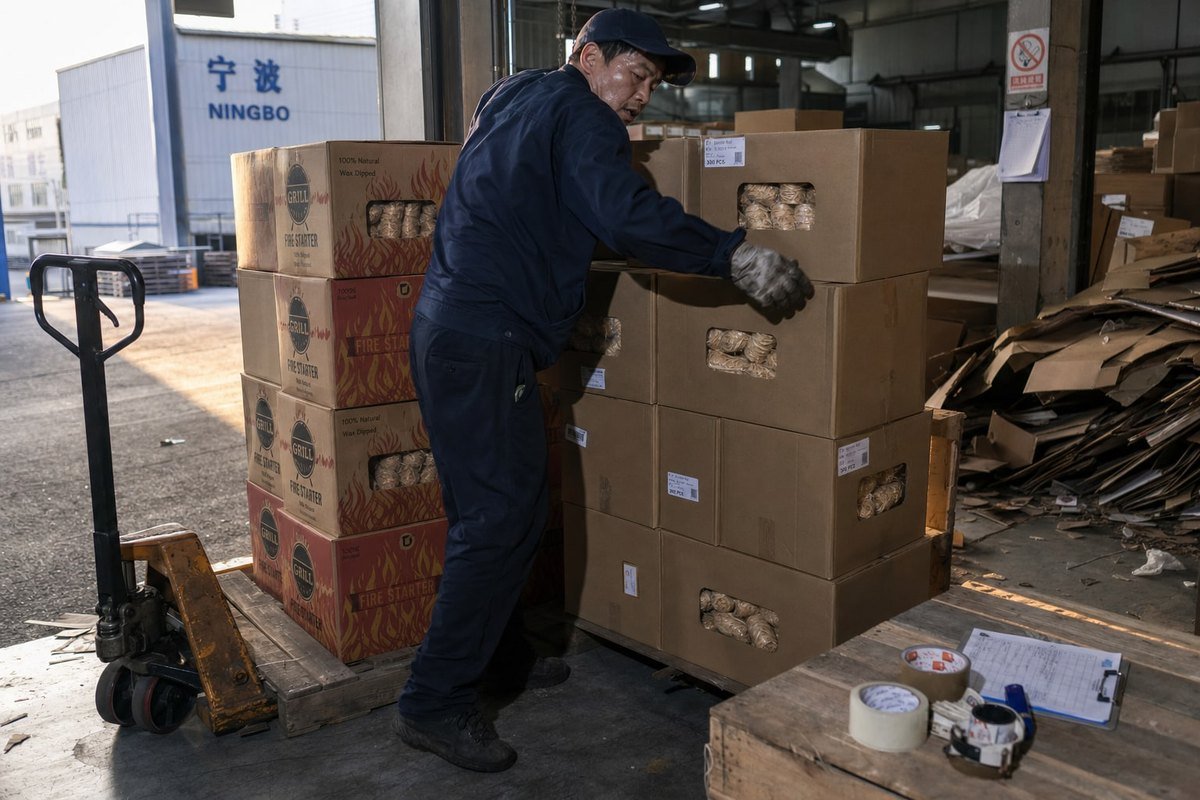
Why do MOQs exist at all? They are not arbitrary. Printed cartons come from carton factories with their own minimum press runs. Flexographic plates only pay off across long runs. And changing over a packing line — new boxes, new safety warning labels, new barcodes — costs the same whether you order 500 units or 50,000. Industry listings in this category commonly cite around 1,000 boxes as the floor for a customized logo, and that matches what we see across the market.
A stepped path most buyers follow
- Trial order with labels. Use our standard packaging with your printed label or hang tag. Low risk, fast turnaround, MOQs from a few hundred units.
- First branded run on kraft. Move to single-color printing on eco-friendly kraft bags or sleeves. Moderate MOQ, strong natural positioning.
- Full retail packaging. Commit to custom retail display boxes with flexo or offset printing, barcodes, and multilingual compliance text. MOQs of 3,000–5,000+ units, but the lowest per-unit cost.
At our factory, we deliberately keep trial MOQs flexible because we would rather win a long-term partner than a single big order. A US camping brand we work with started at 500 labeled units, validated sell-through in one season, then scaled to full custom printed packaging with sustainable packaging materials 7 the following year. That path protected their cash and our production planning at the same time.
One caution: do not over-order printed packaging for an unproven design. Leftover cartons for a discontinued layout are pure waste. Step up as your data supports it.
How long does it take to get private-label samples approved before mass production?
A lesson I learned early in our export business: buyers rarely lose time on production itself. They lose it in the sample loop — vague artwork, slow feedback, and skipped pre-production checks.
Private-label sample approval typically takes 2 to 4 weeks: 3–5 days for digital artwork proofs, 7–14 days to produce and ship a physical pre-production sample, and a few days for buyer review. Mass production of 25–35 days begins only after written sample approval.
Let me map the full timeline the way we run it for wood fire starter orders, because knowing each stage helps you compress it.
The approval timeline, stage by stage
| Stage | Typical duration | What you should do |
|---|---|---|
| Artwork submission | 1–2 days | Send vector files with color codes |
| Digital proof review | 3–5 days | Check text, barcode, warning placement |
| Physical sample production | 7–14 days | Wait; supplier prints and assembles |
| Sample shipping (express) | 3–5 days | Inspect print quality and box strength |
| Written approval | 1–3 days | Sign off in writing, keep a golden sample |
| Mass production | 25–35 days | Schedule inspection before shipment |
Two things speed this up dramatically. First, artwork quality. Send vector files with Pantone references and alternate logo versions — full color, black, and reversed white. A white or single-color logo often reads better on dark boxes or kraft substrates, and having those versions ready saves a full revision cycle. Second, decide your packaging format before sampling. Switching from a heat-sealed pouch to a retail box mid-process restarts the clock.
Because we run complete production lines with strict batch-to-batch quality control, the approved sample genuinely reflects mass-production quality — same wax coating, same wood wool density, same print finish. That is the whole point of the golden sample: it becomes the contractual reference both sides inspect against. If your calendar targets a Q4 grilling or fireplace season, work backward: sea freight plus production plus sampling means your artwork should be final by late spring.
Conclusion
Weak branding gets your fire starters ignored on the shelf; rushed branding gets them stopped at customs. The fix is a disciplined process, and it is worth every step.
Adding your grill brand's logo to wood fire starter packaging works best when you treat it as a production decision first: verify certifications, pick the print method that fits your channel, start with a realistic MOQ, and never skip the physical sample. From our lines in Ningbo, we have helped BBQ distributors and outdoor brands across the US and Europe move from a first 500-unit labeled trial to full custom printed packaging programs. Get the compliance and sampling right, and your logo does exactly what it should — turn a small consumable into a product buyers recognize, trust, and reorder.
Footnotes
1. Wikipedia background explains CE conformity marking referenced for European market compliance. ↩︎
2. Official Intertek site verifies the independent testing body referenced for fire starter compliance. ↩︎
3. Wikipedia background clarifies the vector file format required for logo artwork submission. ↩︎
4. Official ISO standard page verifies quality management certification requirement discussed for private labeling. ↩︎
5. Official SGS site verifies the third-party lab testing organization named for compliance verification. ↩︎
6. Wikipedia entry explains the flexographic print method referenced multiple times in cost comparisons. ↩︎
7. Current EPA resource for sustainable packaging and materials management. ↩︎



 English
  Spanish
  German
  French
  Arabic
  Portuguese
Join the Conversation