







Buyers ask me about gift-boxed vs bagged fireplace colored pine cones almost weekly ISO 9001 factory certification 1. Pick wrong, and margins shrink, shipping costs climb, and shelf appeal suffers. Our production line taught us better.
Gift-boxed fireplace colored pine cones contain the same color-flame product as bagged versions; the difference is packaging, positioning, and price point. Boxes target premium gifting with higher margins, while bags target refills, bulk value, and lower per-unit shipping costs for wholesale distribution.
That short answer hides a lot of sourcing detail MSDS / SDS sheet 2. Below, I break down certifications, margins, private labeling, and logistics for both formats, so you can order the right one.
What certifications should I check before importing either packaging format?
A German distributor once asked us for SGS reports before he even asked for a price. That conversation shaped how we present compliance documents for every packaging format we run.
Before importing either format, verify ISO 9001 factory certification, BSCI social audits, CE marking where applicable, and third-party SGS or Intertek test reports. Both gift boxes and bags need compliant warning labels, ingredient disclosure, and market-specific safety documentation regardless of packaging type.

The chemistry inside the cone is what regulators care about, not the box around it. Colored-flame products typically use mineral salts, and the classic copper sulfate 3 coating that creates blue and green flames must be tested for safe household use. In our experience exporting to 30+ countries, customs officers and retail compliance teams look at the same core documents whether the product ships in a rigid box or a burlap sack.
The core document checklist
Here is what we hand buyers on day one, and what you should demand from any supplier:
| Document | What It Proves | Applies To |
|---|---|---|
| ISO 9001 certificate | Consistent quality management | Factory-wide, both formats |
| BSCI audit report 4 | Ethical labor and social compliance | Factory-wide, both formats |
| SGS / Intertek test report | No harmful chemicals, safe combustion | The cones themselves |
| CE documentation | EU market conformity | EU-bound shipments CE marking 5 |
| MSDS / SDS sheet | Chemical composition and handling | Freight and customs clearance |
Packaging-specific labeling differences
The one place where format changes compliance is the label itself. A gift box has more printable surface, so warning text, barcodes, and usage instructions fit easily on the back panel. A drawstring bag often needs a sewn-in tag or hang card to carry the same information. We pre-print warning labels in English, German, and French for our main markets, and we adapt the layout for each format. Also confirm that labels state the product is for wood-burning fires only. Indoor wood stove safety language matters, because residue from color-changing fire crystals can damage gas log units, and retailers in the US and EU increasingly require that disclaimer on the front of the pack.
Which packaging format offers better margins for retail versus wholesale distribution?
Pricing structure is a trade-off we walk buyers through constantly. One US fireplace distributor of ours runs both formats side by side, and his numbers tell a clear story.
Gift boxes deliver better retail margins, typically supporting a 3–5x markup thanks to higher perceived value and giftable presentation. Bags win in wholesale distribution, where lower packaging cost per unit, larger fill weights, and faster case-pack handling protect margin at volume pricing.
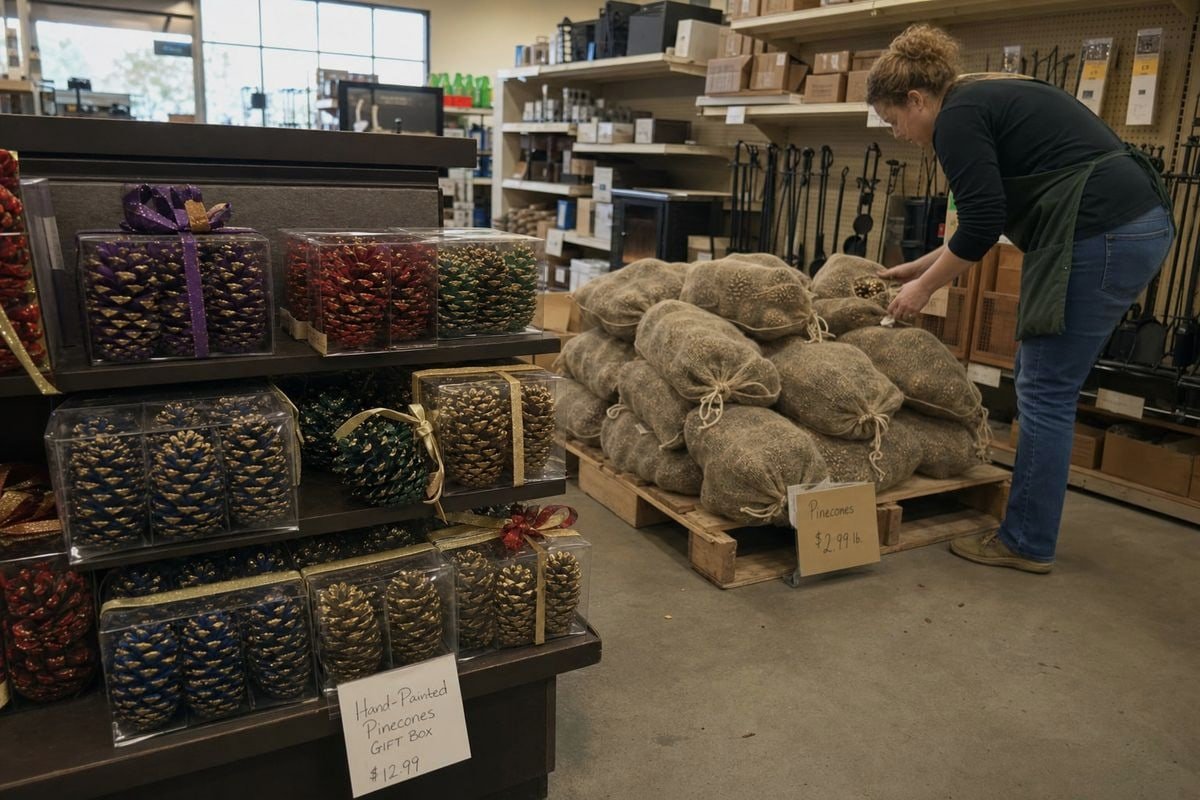
Perceived value is the engine behind the boxed format. A curated set of five hand-finished cones, sitting in decorative gift packaging with a ribbon and window lid, reads as holiday hearth decor. Shoppers accept a premium for that unboxing moment, especially in Q4 when they hunt for stocking stuffer ideas and hostess gifts. The bag, by contrast, is bought on price per pound. A 2 lb or 5 lb refill sack signals value, and repeat customers compare it against their last purchase.
How the economics stack up
| Factor | Gift Box | Bag |
|---|---|---|
| Packaging cost per unit | Higher (rigid board, inserts, print) | Lower (burlap, kraft pouch) |
| Typical retail markup | 3–5x landed cost | 2–3x landed cost |
| Best channel | Gift shops, garden centers, holiday displays | Hardware chains, camping retail, online refills |
| Reorder behavior | Seasonal, occasion-driven | Year-round, replenishment-driven |
| Shelf role | Display item on hearth or endcap | Stacked bulk fireplace accessories |
Match the format to your channel
If you sell into boutique retail, the box justifies its extra packaging cost many times over. If you supply hardware chains or e-commerce refill programs, the bag's lower cost basis and flexible fill weights from 1 lb up to 6 lb keep you competitive. The smartest buyers we work with order both: boxes for Q4 gifting demand, bags for the January-through-March refill season when gift recipients come back for more.
Can I get custom branding and private-label options for both gift boxes and bags?
Our design team once turned a UK camping brand's logo sketch into print-ready kraft pouch artwork in under a week. Private labeling is where format choice gets genuinely creative.
Yes, both formats support full private-label customization. Gift boxes allow custom box structures, inserts, window lids, and premium finishes, while bags support printed burlap sacks, branded kraft stand-up pouches, sewn labels, and hang tags. Barcodes, warning labels, and multilingual text can be applied to either.

Customization depth differs by format, though, and that affects your minimums and timelines. A rigid gift box involves structural dieline design, printing plates, and sometimes foil stamping or embossing. That setup cost means slightly higher MOQs, but the result is a shelf-ready gift set that carries your brand at a premium price point. Bags are faster and cheaper to brand. A one-color logo screen-printed on natural burlap, or a full-color kraft pouch with a clear product window, can move from artwork approval to production quickly.
What we typically customize for each format
- Box structure: lid-and-base, magnetic closure, or window box, sized to your cone count.
- Bag style: drawstring burlap, resealable kraft stand-up pouch, or poly-lined sack for moisture control.
- Product spec: cone size, coating intensity, and long-lasting burn time targets of roughly 5–15 minutes per cone.
- Compliance elements: market-specific warning labels, barcodes, and batch codes.
- Bundling: gift boxes can include eco-friendly fire starters like wax-dipped wood rolls, creating a complete fireplace gift set.
That last point deserves emphasis. The bundled "fireplace experience" box, combining colored cones with wood firestarters and long matches, consistently outperforms cones-only boxes in gift channels. Because we produce firestarters and wax torches on the same site, we assemble those bundles in one factory instead of coordinating three suppliers. For trial orders, we keep MOQs flexible so you can test a boxed SKU and a bagged SKU in the same container before committing to volume.
How do gift-boxed and bagged pine cones compare in shipping cost and logistics efficiency?
A lesson we learned early: a beautiful box that arrives crushed is worthless. Seventeen years of container loading taught us how each format really behaves in transit.
Bags win on shipping cost, packing more product weight per cubic meter with lower dimensional waste. Gift boxes cost more to freight but protect fragile cone scales better and arrive shelf-ready. Boxes suit smaller premium shipments; bags maximize container utilization for bulk orders.
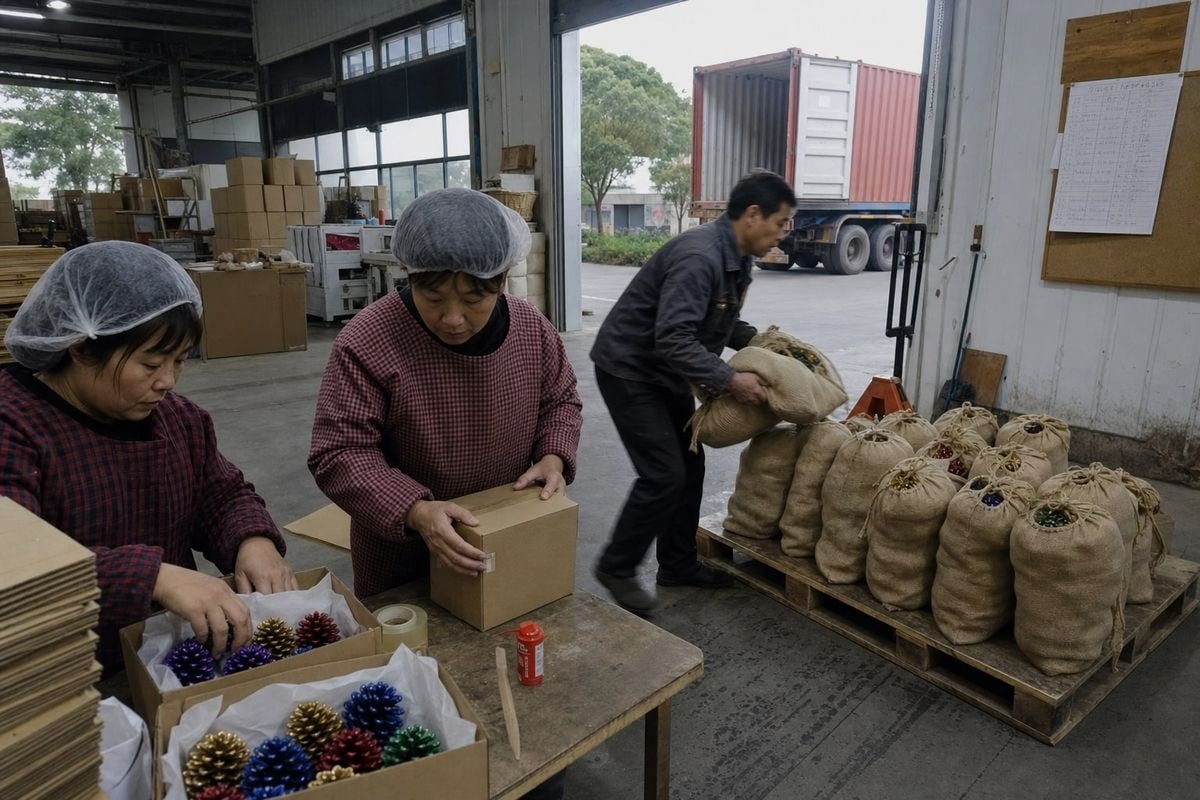
Colored pine cones are light but bulky, so dimensional weight 6 drives your freight bill more than actual weight. Bagged cones compress slightly and nest into master cartons efficiently. Boxed cones cannot compress at all; the rigid structure holds air, and you pay to ship that air across the ocean. On the other hand, that rigid structure prevents snapped scales, which is the most common transit damage complaint with flexible packaging. Broken tips do not affect the rainbow flame colors, but they hurt the premium look a gift buyer expects.
Logistics comparison at a glance
| Logistics Factor | Gift Box | Bag |
|---|---|---|
| Container space efficiency | Lower (rigid, air-filled) | Higher (nests and compresses) |
| Transit damage risk | Low (structural protection) | Moderate (scales can snap) |
| Moisture control | Breathable board keeps cones dry | Needs breathable or vented material |
| Retail handling | Shelf-ready, no repack | May need display bin or shelf tray |
| Best order profile | Mixed premium SKUs, seasonal | Full-container bulk refills |
Moisture and storage in transit
One overlooked detail: sealed plastic bags can trap humidity during a long sea voyage, and wax-coated cones may sweat or develop sticky residue. We solve this with breathable kraft pouches, vented burlap, or desiccant packs, and cartons rated for ocean humidity. Cardboard boxes naturally wick moisture, which helps the cones stay dry for vibrant ignition. Whichever format you choose, we optimize carton dimensions against pallet and container specs before production starts, because a few centimeters saved per carton compounds into real freight savings on bulk fireplace accessories.
Conclusion
Choosing wrong between formats wastes margin and freight budget. Match boxes to gifting channels, bags to refill volume, and partner with a certified factory that runs both.
Footnotes
1. The official ISO site often returns 403 errors; Wikipedia is a stable, authoritative alternative. ↩︎
2. The previous specific SDS subpage is 404; the main OSHA HazCom landing page is the live source. ↩︎
3. Copper sulfate is the chemical compound creating blue-green flames, needing background reference. ↩︎
4. BSCI is a specific social compliance audit program referenced as a required document. ↩︎
5. CE marking is an EU regulatory requirement mentioned for compliance documentation. ↩︎
6. Dimensional weight is a logistics concept central to the shipping cost discussion. ↩︎



 English
  Spanish
  German
  French
  Arabic
  Portuguese
Join the Conversation