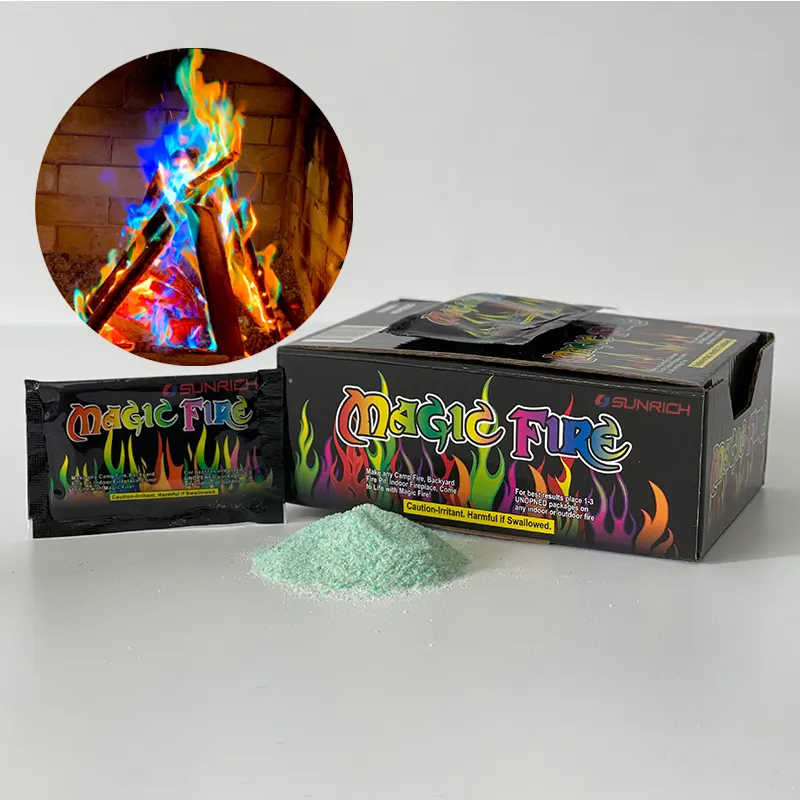




Whether distributors should request a GCC from suppliers for Magic Fire Powder comes up constantly on our production line in Ningbo. Buyers ask because a missing certificate can freeze an entire shipment at US Customs. That single gap can wipe out a season's margin. The good news: with the right document package, the risk is manageable.
Yes, distributors should request a GCC from suppliers for Magic Fire Powder as part of due diligence. However, US law requires the importer of record — not the foreign supplier — to issue the GCC, so supplier documents serve as supporting evidence, not the legal certificate itself.
That distinction between supplier paperwork and legal certification trips up many buyers. Let me walk you through what actually protects your business, step by step.
Why do I need a GCC when importing Magic Fire Powder into the US?
Last year, a US camping brand came to us after their previous supplier's shipment sat in customs for six weeks. The missing piece? Proper certification paperwork tied to CPSC regulations 1.
A General Certificate of Conformity (GCC) is required whenever a consumer product is subject to a CPSC safety rule. Magic Fire Powder, as a campfire colorant containing regulated chemicals, typically falls under the Federal Hazardous Substances Act, which triggers the GCC requirement for US imports.

The Consumer Product Safety Act 2 gives the CPSC authority over consumer products sold in the US market. A GCC is not a product-name requirement — it is a rule-driven requirement. That means the question is never "Does fire powder need a GCC?" but rather "Which CPSC safety rule applies to this exact formulation?" For most flame-coloring packets sold for campfires and fire pits, the answer runs through hazardous materials classification under the FHSA.
What a compliant GCC must contain
Under CPSC regulations, a valid GCC must include seven core data elements. We prepare all of these for our buyers as a standard document package, because their customs brokers ask for them at entry.
| GCC Element | What It Means for Magic Fire Powder |
|---|---|
| Product identification | Exact product name, SKU, and formulation variant |
| Applicable safety rule citation | The specific CPSC rule, e.g., 16 CFR 1500 3 provisions |
| Certifier identity and contact | The US importer of record, with address |
| Test-record keeper contact | Who holds the test files, and how to reach them |
| Date and place of manufacture | Factory location and production date |
| Date and place of testing | When and where compliance testing occurred |
| Third-party testing laboratory | Lab name and address, if one was used |
Who issues the GCC for imported goods
Here is the point most ranking articles gloss over. For imported products, the US importer must issue the GCC. A foreign factory like ours cannot legally be the certifier. What we can do — and what serious factories should do — is supply the test reports, Safety Data Sheet 4 (SDS), and formulation records that let your importer issue an accurate certificate. The certificate must also accompany each shipment, though electronic access satisfies that requirement if the document is uniquely tied to the shipment. And note the upcoming change: under the CPSC eFiling mandate taking effect in July 2026, certificate data must be filed electronically in the Automated Commercial Environment (ACE) at the time of entry, not just kept in a drawer.
What compliance risks am I taking if my supplier can't provide a GCC?
One trade-off we discuss with nearly every new US buyer is speed versus paperwork. A supplier who ships fast but cannot back a GCC is not saving you time — they are transferring risk onto your books.
If your supplier cannot support a GCC with valid test data, you face shipment seizures at Customs, forced recalls, civil penalties, and full supply chain liability. Distributors who private-label the product assume manufacturer-level responsibility for certification accuracy under CPSC rules.

The risk is not abstract. Customs and the CPSC can demand the certificate at entry. If it is missing, incomplete, or names the wrong certifier, the consequences cascade through every party in the distribution chain. We have seen buyers switch to us after exactly this scenario: a low-cost supplier promised "certificates available," then delivered a one-page PDF with no rule citation, no testing dates, and no lab identity. That document was worthless at the border.
The risk ladder for distributors
| Risk Level | Scenario | Likely Consequence |
|---|---|---|
| Low | Importer-issued GCC backed by third-party testing laboratory reports | Smooth entry; documents survive audit |
| Medium | Supplier provides raw test data but importer never issues a formal GCC | Detention delays; scramble to certify retroactively |
| High | Certificate exists but names the wrong certifier or wrong product variant | Rejected paperwork; possible penalty exposure |
| Severe | No test data exists for the shipped formulation | Seizure, recall exposure, civil penalties |
Private labeling raises the stakes
Many of our OEM clients rebrand our Magic Fire packets under their own name. That is a smart commercial move, but understand the legal effect: a distributor who private-labels assumes the compliance posture of a manufacturer. Your name is on the pouch, so the accuracy of the product safety certification and the underlying reasonable testing program becomes your direct responsibility. This is why we hand OEM buyers the complete file — SGS or Intertek reports, SDS, formulation confirmation, and batch records — rather than a bare certificate. Incomplete or misattributed paperwork is the single most common failure we see, and it is entirely preventable at the sourcing stage.
How do I verify that a supplier's GCC and test reports are genuine?
A German distributor once emailed us a test report from another factory and asked, "Is this real?" It took us ten minutes to spot the problem: the report described a different chemical formulation than the powder in the photos.
Verify a GCC by checking all seven required data elements, confirming the certifier is the actual importer of record, matching the report's formulation to your exact product variant, and contacting the third-party testing laboratory directly to validate the report number.

Verification is not complicated, but it must be systematic. Fraudulent or recycled test reports circulate widely in low-cost sourcing channels. In our experience exporting to 30+ countries over 17 years, the buyers who never get burned follow a repeatable checklist rather than trusting a glossy PDF.
A five-step verification process
- Match the product exactly. The certificate must name the same SKU, formulation, and packaging format you are buying — a foil pouch, kraft bag, and jar can be separate variants.
- Check the rule citation. A genuine GCC cites the specific CPSC regulation. Vague language like "meets US standards" is a red flag.
- Validate the lab report. Reputable labs such as SGS and Intertek 5 offer report-verification services. Send them the report number and confirm it is authentic and unaltered.
- Confirm the certifier's identity. If the "GCC" names the foreign factory as certifier for a US import, it does not satisfy import documentation requirements. Your importer must issue it.
- Trace the dates. Manufacturing dates and testing dates should logically align. A 2019 test report attached to a 2025 production batch tells you the reasonable testing program has lapsed.
Watch the classification question
There is one technical trap worth flagging: the oxidizer classification question. Depending on formulation, a flame-effect product could be evaluated as a pyrotechnic article under 16 CFR 1507 6 or as a hazardous substance under 16 CFR 1500. These categories carry very different testing and labeling of hazardous substances protocols. Ask your supplier which classification their testing was performed under, and confirm it matches how your customs broker will classify the goods. When we calibrated our own color-flame formulations, we worked with our labs to document exactly this point, because a mismatch here invalidates otherwise genuine paperwork.
Which other certifications should I request alongside the GCC for Magic Fire Powder?
When we onboard a new US or EU distributor at our Liuyang headquarters, the document conversation always goes beyond the GCC. A single certificate never tells the full compliance story for a chemical consumer product.
Beyond the GCC, request a Safety Data Sheet, third-party lab test reports, heavy-metal screening results, proof of proper hazard labeling, transport classification documents, and — where relevant — child-resistant packaging evidence, plus factory-level credentials like ISO 9001 and BSCI audits.

Think of the GCC as the top sheet of a file, not the file itself. A serious supplier should hand over a coherent package where every document cross-references the same product and formulation. Here is the package we prepare for our own Magic Fire buyers, and why each piece matters.
| Document | Purpose | Why Distributors Need It |
|---|---|---|
| Safety Data Sheet (SDS) | Chemical hazard communication | Required for transport, warehousing, and retailer onboarding |
| Third-party lab reports | Proof of compliance testing | The evidence behind the GCC; verifiable with the lab |
| Heavy-metal screening | Checks lead and cadmium impurities | Industrial-grade copper salts from low-cost sources often carry contaminants |
| Hazard labeling review | FHSA cautionary labeling compliance | Wrong or missing warnings can trigger recalls on their own |
| Transport classification | Shipping and DG documentation | Determines sea/air freight handling and cost |
| Child-resistant packaging proof | PPPA-standard packaging where applicable | Mitigates attractive-nuisance liability even for adult-use products |
| ISO 9001 / BSCI audit reports | Factory quality and ethics credentials | Confirms batch-to-batch consistency and a real production site |
Why heavy-metal screening deserves special attention
Colored flames come from metal salts. The quality of those salts varies enormously between suppliers. Industrial-grade copper compounds can carry lead or cadmium impurities 7 that a standard compliance test may not flag. Requesting supplemental heavy-metal screening costs little and protects your brand from a contamination headline. We use eco-friendly formulations with no harmful chemicals precisely because our retail-channel buyers demand it — for them, campfire colorant safety is a shelf-placement requirement, not a marketing slogan.
Put it in the contract
Finally, lock the paperwork into your purchase agreement. Specify that each shipment must be accompanied by batch-linked test records, that the supplier warrants formulation consistency with the tested sample, and that certification support survives for the product's retail life. Our long-term OEM clients do this as standard practice, and it turns compliance from a yearly scramble into a routine checkbox.
Conclusion
Missing paperwork sinks shipments and margins fast. Request GCC support from suppliers, confirm the importer issues the certificate, verify every document, and partner with factories that treat compliance as standard.
Footnotes
1. Official government portal for the Consumer Product Safety Commission's regulatory actions and rules. ↩︎
2. Authoritative Wikipedia entry providing a comprehensive overview of the Act's history and provisions. ↩︎
3. Official federal regulation defining hazardous substance requirements applied to the product. ↩︎
4. Background reference explaining the chemical hazard communication document mentioned in the process. ↩︎
5. Points to a leading third-party testing laboratory named as an example verification resource. ↩︎
6. Direct regulatory text for the pyrotechnic article classification referenced in the compliance discussion. ↩︎
7. EPA resource on lead contamination risks relevant to the heavy-metal screening discussion. ↩︎



 English
 Spanish
 German
 French
 Arabic
 Portuguese
Join the Conversation