






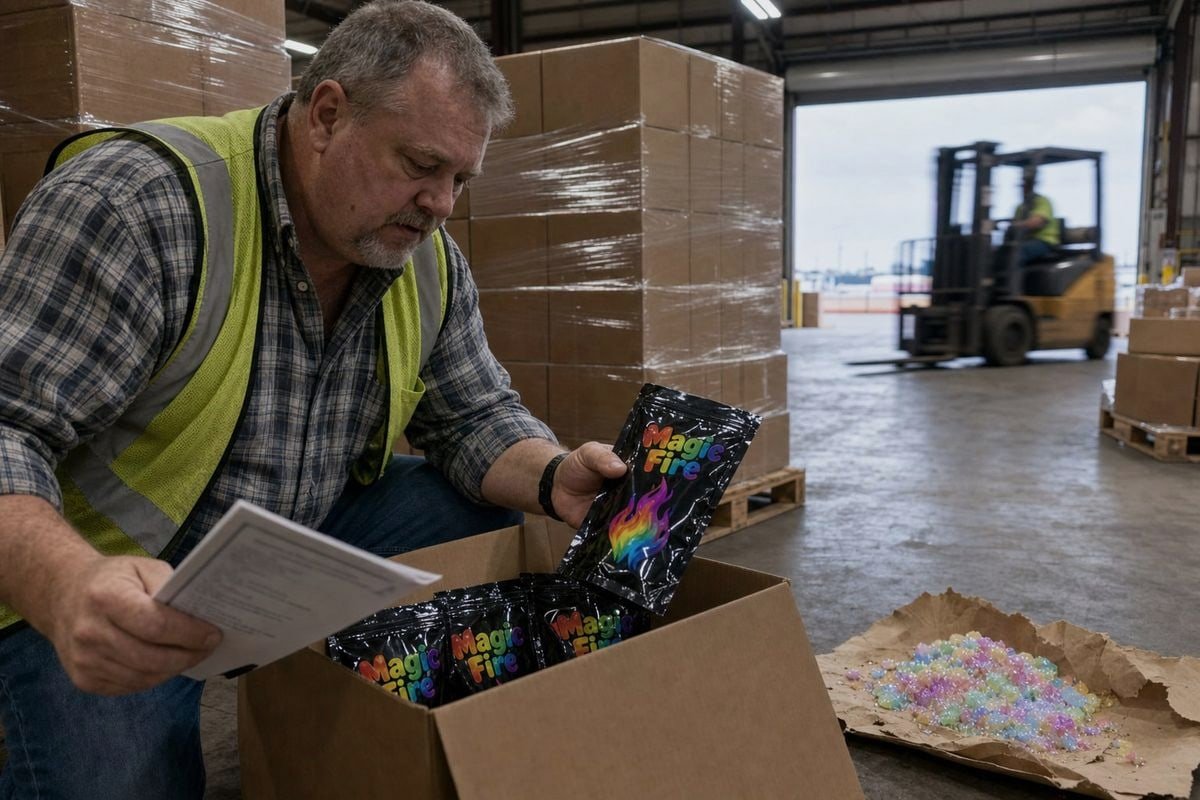
Getting the Magic Fire Powder GCC for US export wrong can freeze a shipment at customs. On our production line in Ningbo, I have watched buyers panic over one missing document.
For Magic Fire Powder made outside the US, the US importer of record must legally issue the General Certificate of Conformity, not the foreign factory. The factory supplies test reports, SDS, and composition data; the buyer signs the GCC citing applicable CPSC rules under the FHSA.
That single sentence settles most of the debate. But the details matter. Below, I walk through who issues what, which documents to request, and how to protect a private-label launch.
How do I know whether my factory or I need to issue the GCC for Magic Fire Powder imports?
A US distributor once asked us to sign his GCC "so it looks official." After 17 years exporting color-flame packets from Liuyang and Ningbo, I had to explain why that would backfire.
If Magic Fire Powder is manufactured abroad and imported into the US, the US importer of record issues the GCC. If it is made in the US, the US manufacturer issues it. A foreign factory can draft and support the certificate, but it cannot be the legal certifier.

The confusion usually starts with wording. Many buyers hear "factory-issued certificate" and assume the paperwork burden sits in China. Under the Consumer Product Safety Improvement Act, that is not how responsibility flows. The certifier must be a US entity that CPSC and Customs and Border Protection 1 can actually hold accountable. A factory in Zhejiang is outside that enforcement reach, so a GCC signed only by us carries no legal weight at the border.
A simple decision tree
Work through these questions before your shipment leaves port:
- Is the product a regulated consumer item under CPSC safety regulations? Flame colorants generally fall under the Federal Hazardous Substances Act 2, so yes.
- Where is it made? Made abroad means the importer certifies. Made in the US means the US manufacturer certifies.
- Who is the importer of record on the entry documents? That name goes on the GCC.
- Do you hold valid test evidence tied to the exact SKU? If not, stop and test first.
Who does what, in practice
| Party | Role in the GCC process | Legal certifier? |
|---|---|---|
| Foreign factory (like us) | Provides test reports, SDS, composition data, draft GCC language | No |
| US importer of record | Reviews evidence, issues and signs the GCC | Yes, for imported goods |
| US manufacturer | Issues the GCC for domestically made product | Yes, for US-made goods |
| Accredited testing laboratory | Runs the tests, issues reports | No, testing only |
| Private labeler | May be named, coordinates branding | Not the default certifier |
One more point people miss: "for US export" is slightly misleading language. The GCC is an import-side compliance document for the US market. It is not a general export paper. If you later re-export from the US, different regimes may apply, especially if the powder is ever classified near pyrotechnics or controlled chemicals.
What test reports and certifications should I request to complete a compliant GCC?
There is a trade-off we discuss with every new US buyer: test once and ship fast, or build a proper testing program and ship safely for years. The second option always wins.
Request an SGS or Intertek test report against 16 CFR 1500 under the FHSA, a Safety Data Sheet, a chemical composition analysis, heavy-metal screening, and evidence of an ongoing Reasonable Testing Program. Each report must reference the exact SKU and batch being shipped.

A GCC is not a standalone label. It is the front page of an evidence package. When we run compliance testing for our Magic Fire packets, we treat the certificate and the test file as one unit. If CPSC or CBP requests the records, the importer must produce them, and the product identity on the report must match the product identity on the certificate and the packing list. Any gap between those three documents is a red flag at entry.
The core document set
| Document | What it proves | Who provides it |
|---|---|---|
| FHSA test report (16 CFR 1500 3) | Labeling and hazard compliance | Accredited testing laboratory such as SGS or Intertek |
| Safety Data Sheet 4 (SDS) | Handling, hazards, first aid | Factory, verified by lab data |
| Chemical composition analysis | Exact formula, no banned substances | Factory plus lab |
| Toxicological Risk Assessment | No chronic-illness risk from ingredients | Toxicologist or lab, increasingly expected |
| Reasonable Testing Program record | Ongoing batch testing, not a one-off | Factory and importer jointly |
Why a single old report is not enough
Certification must rest on a Reasonable Testing Program. That means a documented schedule of recurring tests, not a lab report from three years ago. Our batch-to-batch quality control exists precisely for this reason: the powder tested must chemically match the powder shipped. Also plan for record retention. Compliance documents, including the GCC and supporting test records, should be kept for at least five years from the last shipment. And note the 2026 shift: CPSC eFiling through the Automated Commercial Environment 5 will require digital certificate data at entry, so static PDFs alone will not carry you forward.
Can my supplier provide CPSC-ready documentation to support US customs clearance?
Early in our export history, a container of color-flame packets sat at a US port for eleven days over a mismatched lot number. That lesson shaped how we assemble every documentation packet today.
Yes, a capable supplier should deliver a CPSC-ready packet: accredited lab reports, SDS, composition summary, manufacturing dates and location, product tracking labels, and a draft GCC template. The importer then verifies, completes, and signs the certificate before or upon arrival.

Customs and Border Protection does not only check tariff codes. Officers look at actual product characteristics, packaging, and marketing claims to decide classification and which controls apply. A CBP ruling on a similar flame-colorant product showed exactly this: the formula, the intended use, and even the wording on the pouch shaped how the item was treated. That means your supplier's documentation must describe the real product, not a generic "fire additive."
The seven mandatory GCC elements
Whoever signs the certificate, it must contain all of the following:
- Product identification detailed enough to match the certificate to the exact covered SKUs.
- Citation to each applicable CPSC rule or ban, primarily 16 CFR 1500 6 for this category.
- Name, full mailing address, and phone number of the certifying US importer or manufacturer.
- Contact details, including email, for the person maintaining test records.
- Date and place of manufacture, at least month, year, and city or region and country.
- Date and place of testing.
- Identity of the third-party accredited testing laboratory, if one was used.
What we hand the importer before shipment
From our side, the packet includes the full specification sheet, ingredient summary, lab report numbers tied to the shipped lot, factory address and production dates, and a packing list that maps line by line to the certified product. Product tracking labels on cartons and pouches let everyone trace a sachet back to a batch. One warning: do not treat small-parcel shipments as a loophole. De minimis Section 321 entries now face active CPSC and CBP enforcement, and direct-to-consumer parcels can be asked for GCC data too. The certificate must accompany the shipment in English, though a unique URL or electronic access satisfies that requirement.
What details should I confirm before private-labeling Magic Fire Powder under my own brand's GCC?
When a German outdoor brand first asked us for private-label kraft pouches, their compliance manager spent more time on the warning label than the logo. He was right to.
Confirm the exact SKU list, packaging artwork and warning labels, the CPSC rules cited, the named US importer of record, test report validity for your branded version, manufacturing dates, and lot traceability. Your brand's GCC must match the branded product precisely, not the factory's generic version.

Private labeling changes the compliance picture more than most buyers expect. The moment your brand name goes on our glossy black pouch, the product identity changes. A test report issued for our generic Magic Fire packet may not cleanly cover your branded SKU if the formula, fill weight, or packaging differs. As a one-stop OEM/ODM factory, we handle custom sizes, burn times, boxes, display packaging, barcodes, and warning labels, but the GCC still names your US entity as certifier.
Packaging is now an enforcement target
CPSC actively pursues flame colorants with attractive nuisance packaging, meaning designs that resemble candy or snack wrappers. Our pouches use bold flame graphics, clear instructional text, and a visible caution label for exactly this reason. Bubble lettering and rainbow colors are fine for shelf appeal, but the hazard communication 7 must be unmistakable, in English, and compliant with FHSA labeling rules. Misbranded hazardous substance seizures are real, and they land on the importer.
Private-label confirmation checklist
| Item to confirm | Why it matters |
|---|---|
| Exact SKUs and fill weights covered | GCC must match the shipped product one-to-one |
| Warning label text and placement | FHSA misbranding is a seizure risk |
| ASTM safety standards or CPSC rules cited | Wrong citation invalidates the certificate |
| US importer of record name and address | This entity signs and owns the GCC |
| Test report tied to branded version | Generic reports may not cover your SKU |
| Lot codes and product tracking labels | Enables recalls and record matching |
| Five-year record retention plan | Required for GCC and test evidence |
Before your first branded shipment, ask us six questions: which SKUs are covered, which rule applies, who is your importer of record, what tests ran and when, what are the full manufacturing dates and location, and can you issue the GCC the moment the goods ship. If all six have clean answers, clearance is usually smooth.
Conclusion
The factory prepares the evidence; the US importer issues the Magic Fire Powder GCC. Get the documents, citations, and product identity aligned, and your shipments clear without drama.
Footnotes
1. Primary agency for managing international trade and enforcing US import regulations. ↩︎
2. Guidance on the FHSA, which regulates hazardous substances in consumer goods. ↩︎
3. eCFR text provides the exact hazardous substance labeling regulation cited. ↩︎
4. OSHA standards for safety data sheets used to communicate chemical hazards. ↩︎
5. The electronic system used by CBP to process import and export data. ↩︎
6. Federal regulations detailing hazardous substances labeling and testing protocols. ↩︎
7. Standards for communicating chemical hazards through labels and safety data sheets. ↩︎



 English
  Spanish
  German
  French
  Arabic
  Portuguese
Join the Conversation