






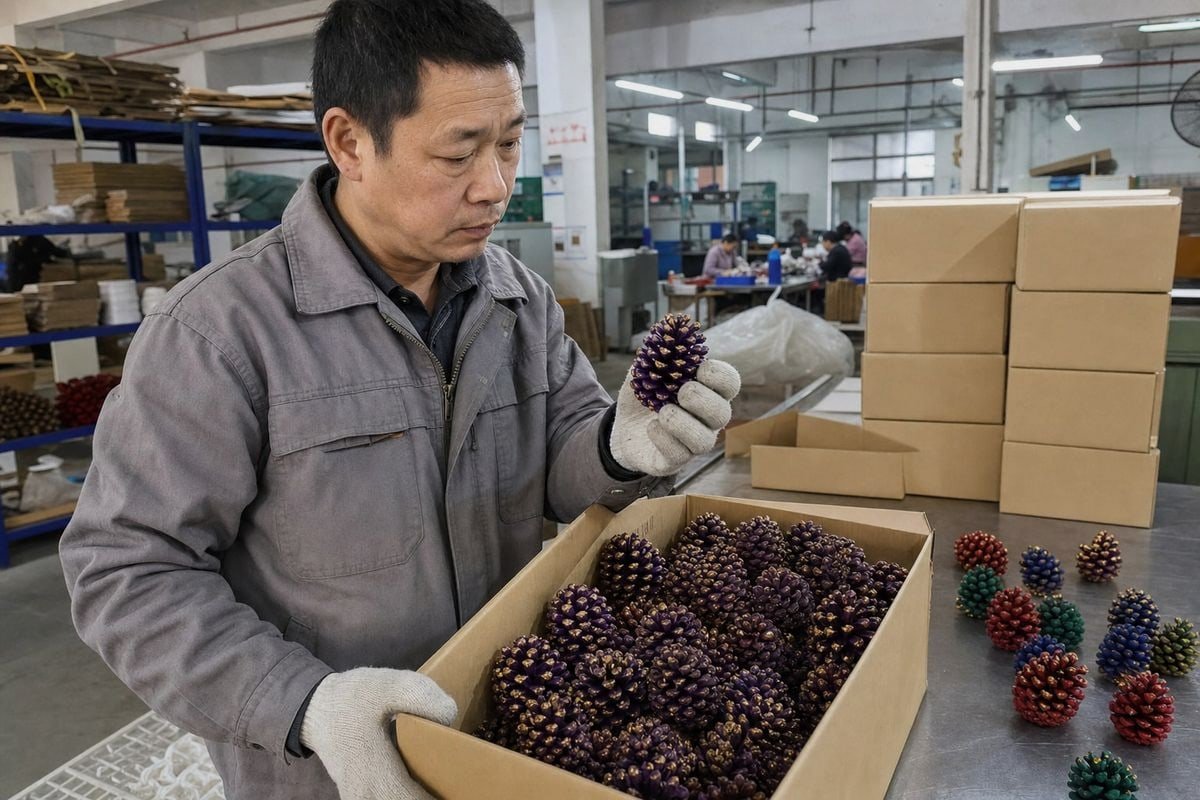
Colored pine cones look simple, yet on our production lines in Ningbo we have seen one skipped sample turn a full container into unsellable stock BSCI audits 1. That risk is real, and it grows every peak season.
Skipping pre-production sample approval for colored pine cones risks bulk color mismatch, coating flake-off, unsafe or non-compliant dyes, customs rejection, weeks of delay, and lost contractual leverage. A physical approved sample is the cheapest control point before defects multiply across thousands of units.
Below, I walk through what actually goes wrong, how a proper pre-production sample protects you, and exactly what to check before you sign off on bulk production.
What Could Go Wrong If I Approve My Colored Pine Cone Order Without a Pre-Production Sample?
A buyer once asked us to skip sampling to save ten days before Christmas. We refused, ran a fast sample instead, and caught a sealant issue that would have ruined the run.
Without a pre-production sample, colored pine cones can arrive with wrong color saturation, patchy spray coverage, flaking or bleeding coatings, substituted materials, inconsistent flame performance, and odor or dust problems. Every flaw gets replicated across the entire order, turning a small fix into a shipment-wide defect.
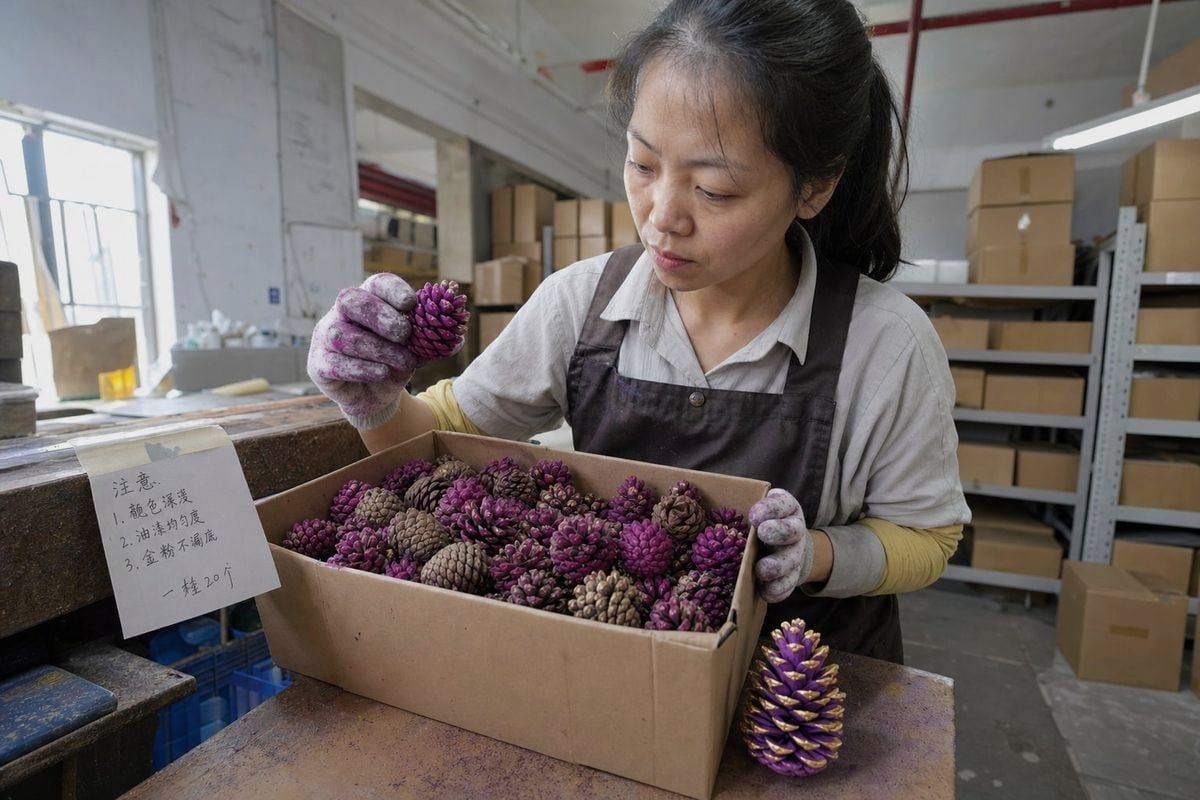
Decorative and color-flame pine cones are deceptively hard to scale. Appearance depends on process variables 2: dye load, spray pressure, drying time, sealant thickness, and even ambient humidity on the production floor. A photo of an early prototype tells you almost nothing about how ten thousand cones will look coming off a real line. In our 17-plus years making color-flame products, the pattern is always the same. Problems that seem invisible in one sample cone become glaring when a retailer opens forty cartons under store lighting.
The Most Common Bulk Failures
Here is what we see when buyers skip formal approval, either with us during trial orders or with previous suppliers they left behind:
| Failure Type | What It Looks Like in Bulk | Root Cause |
|---|---|---|
| Color mismatch | Cones lighter, darker, or duller than the listing photo | No physical color standard was locked in |
| Patchy coverage | Bare scales, drips, uneven saturation box to box | Spray settings changed between prototype and line |
| Flake-off and rub-off | Pigment dust in cartons, chipped tips | Sealant recipe or drying time altered |
| Material substitution | Smaller cones, cheaper dyes, weaker fixatives | Vague spec with no approved benchmark |
| Flame performance drift | Weak or short-lived colored flames | Chemical load per cone not verified at scale |
Every one of these failures is cheap to fix at the sample stage. A recipe adjustment takes a day or two. The same defect found after mass production means scrapped batches, missed retail windows, and hard conversations with your own customers. There is also a subtler risk: without an approved sample, "acceptable quality" becomes a matter of opinion. When a dispute happens, you have no agreed physical reference to point to, and the negotiation tilts toward the factory.
How Do Pre-Production Samples Help Me Verify Compliance and Quality Before Mass Production?
Compliance is not optional in our world. When we ship color-flame pinecones to the US and EU, buyers demand SGS or Intertek reports before a single carton moves.
A pre-production sample lets you verify the exact dyes, coatings, and treatments against regulations like CPSIA, REACH, and Prop 65, confirm test reports match the real product, and lock a physical quality benchmark that the factory must replicate in every bulk batch.
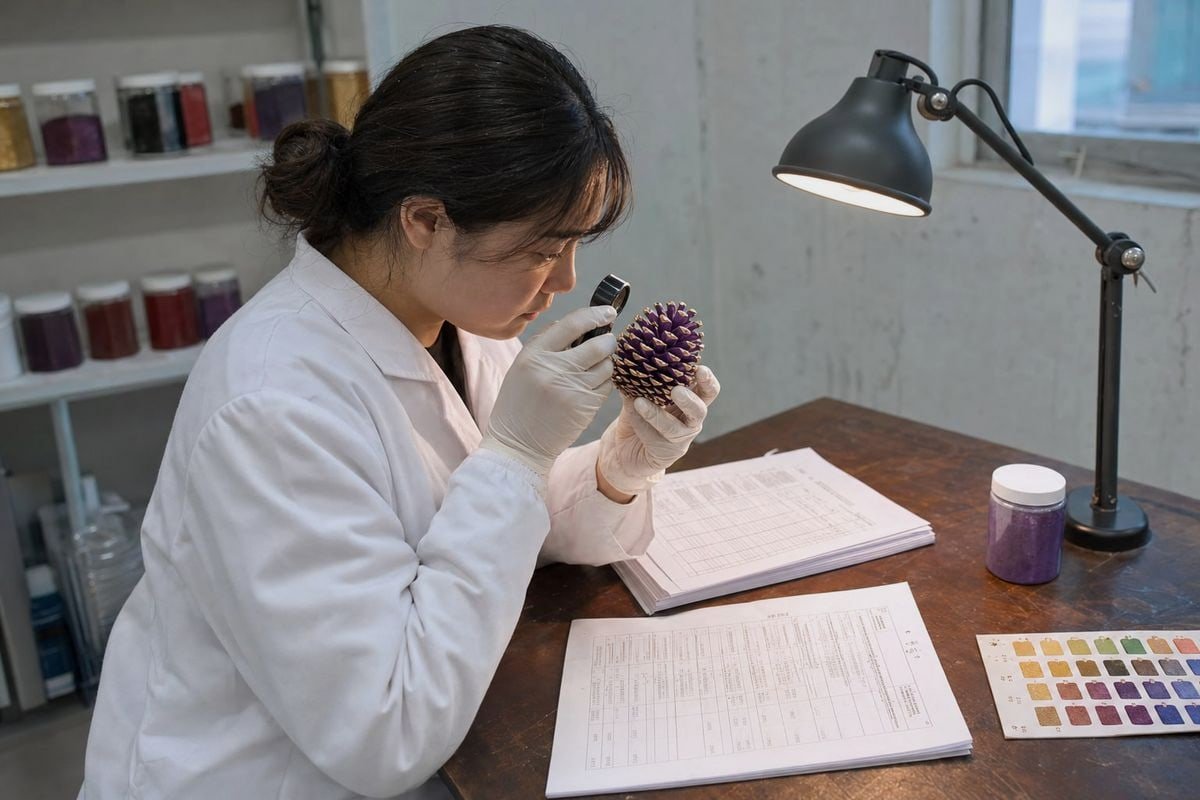
There is an important distinction many buyers miss: a sales sample or prototype is not a pre-production sample. Early samples exist for design review. They are often hand-finished, sometimes with materials that will never be used at scale. The pre-production sample is different. It must be made with the actual production materials, the actual coloring recipe, and the actual line processes that will run your bulk order. That is why it is the only sample that can genuinely verify compliance.
What the Sample Confirms That Paperwork Cannot
Test reports are essential, but a report is only as good as its link to your real product. The pre-production sample closes that gap in three ways. First, it confirms the chemicals in your actual order match what was tested. Colorants and fixatives 3 can change between development and production, and only a physical sample from the real line proves consistency. Second, it verifies performance claims. For our color-flame pinecones, that means burning sample cones and checking flame color, intensity, and duration under real fire conditions, not lab assumptions. Third, it validates labeling: warning text, barcodes, country-of-origin marks, and any market-specific safety language on the packaging.
A Simple Verification Sequence
- Request the pre-production sample from the actual production line, not the R&D bench.
- Cross-check the sample's materials against the certified test report batch.
- Burn-test or use-test the sample exactly as an end customer would.
- Review packaging, warning labels, and barcodes against your market's rules.
- Sign, date, and photograph the sample; keep one sealed reference unit.
At our factory, ISO 9001 4 and BSCI audits force this discipline on us internally. But the buyer-side approval is your protection, and no supplier certification replaces it. Customs authorities do not accept "the factory said it was fine" when a coloring agent fails inspection at the border.
Can Skipping Sample Approval Lead to Costly Delays or Failed Shipments for My Business?
Every autumn, we weigh the same trade-off with buyers: sample approval adds roughly one to two weeks, but skipping it moves all the risk downstream into peak season.
Yes. Skipping approval routinely causes halted production lines, weeks of rework delay, missed retail delivery windows, customs rejections for non-compliant coloring agents, markdowns or total inventory loss, and weakened claims against the supplier because no documented quality benchmark exists.

Let me address the objection directly, because I hear it often: "We are under time pressure. Can we skip the sample and start bulk now?" I understand the instinct. Seasonal décor lives and dies by delivery dates, and a week saved in October feels valuable. But the math almost never works. Sample costs are tiny relative to bulk exposure. One widely cited sourcing example 5 showed a sample cycle worth roughly one-fifteenth of the inventory value it protected. When the sample is skipped and the bulk fails, you do not lose a week. You lose the season.
Sample-Stage Fix vs Bulk-Stage Fix
| Factor | Caught at Sample Stage | Caught After Bulk Production |
|---|---|---|
| Time to fix | 1–2 days | Weeks of rework or full reproduction |
| Cost exposure | Cost of one sample cycle | Entire order value plus freight |
| Retail window | Preserved | Often missed entirely |
| Inventory outcome | Nothing scrapped | Markdowns, rework, or total write-off |
| Supplier leverage | Full — nothing shipped yet | Weak — goods produced and often paid |
| Brand impact | None | Complaints, bad reviews, lost repeat buyers |
There is a second-order cost too. Failed shipments poison the relationship on both sides. The buyer blames the factory; the factory points to the missing approval; nobody has a signed reference to settle it. In our export experience 6 across 30-plus countries, the disputes that turn ugly are almost always the ones with no documented sample sign-off. The disputes that resolve quickly are the ones where both parties can hold up the same approved cone and compare. Documentation is not bureaucracy. It is the cheapest insurance in the entire sourcing process, and it protects the supplier's reputation as much as the buyer's margin.
What Should I Check in a Pre-Production Sample to Ensure Consistent Batch Quality?
Our QC team burns cones from multiple cartons of every batch, not just one showcase unit. That habit came from a hard early lesson about "golden samples" years ago.
Check color match against your approved reference, coverage uniformity across multiple cones, surface finish and rub-off resistance, odor and dusting, structural integrity after drying, flame performance if applicable, packaging protection, labeling accuracy, and consistency across cartons — then document approval with a signed, dated sealed sample.
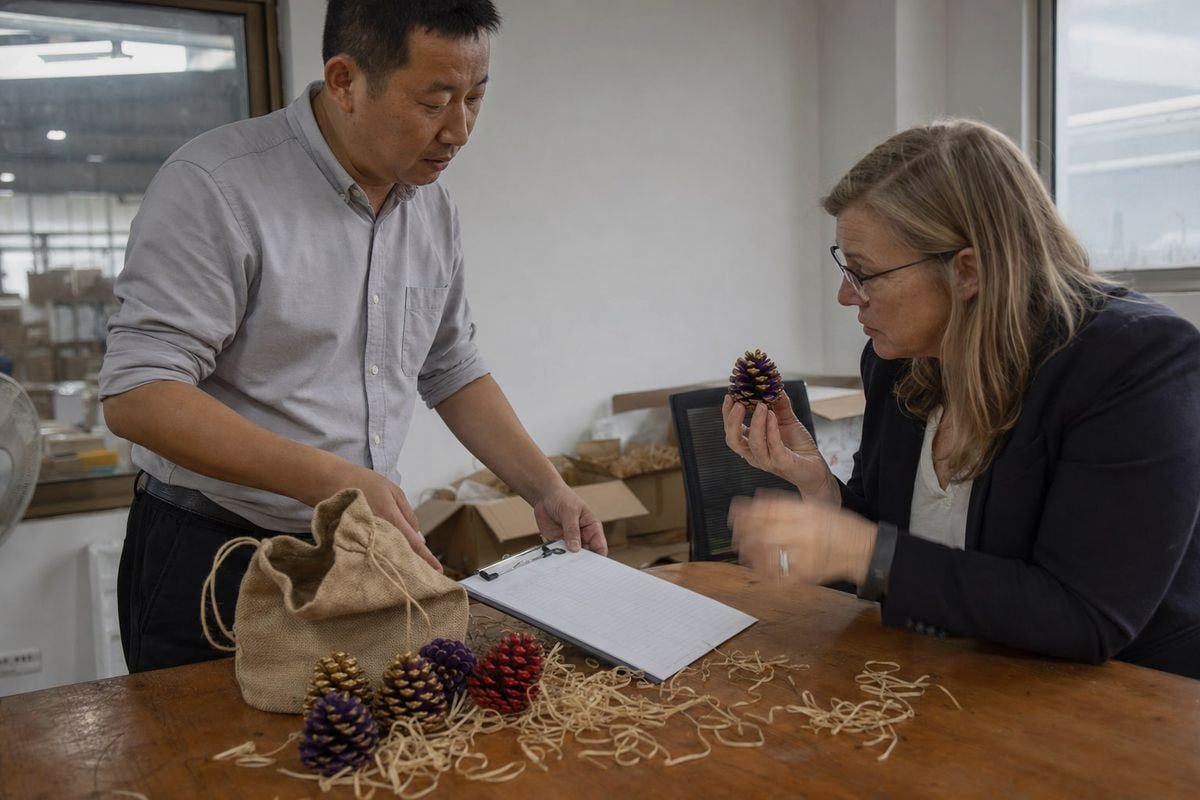
A single beautiful sample proves very little. What you are really approving is a production recipe and the factory's ability to repeat it. So your inspection should be designed to expose variation, not admire one cone. Ask for several sample units pulled from different points of the trial run, and evaluate them side by side under the lighting your customers will actually see — retail shelf lighting 7 and daylight, not just factory fluorescents. Colors that match under one light source can shift noticeably under another, which is why e-commerce sellers get stung by "the photo looked different" complaints.
Your Practical Inspection Checklist
| Check Point | What to Look For | Pass Standard |
|---|---|---|
| Color accuracy | Compare against signed color reference under multiple light sources | No visible shift from approved standard |
| Coverage uniformity | Bare patches, drips, oversprayed tips across several cones | Consistent saturation cone to cone |
| Rub-off and flaking | Rub scales firmly with a white cloth; shake in a bag | No pigment transfer or dust |
| Odor | Smell inside a sealed bag after 24 hours | No chemical or solvent smell |
| Structural integrity | Handle, drop-test, check scale attachment after drying | No loose scales or cracking |
| Flame performance | Burn-test in a real fireplace or fire pit | Correct colors, stable burn, expected duration |
| Packaging | Simulate transit shaking and stacking | No scuffing, crushing, or color transfer |
| Labeling | Warning text, barcodes, origin marks | Matches your market's legal requirements |
Document the Approval Properly
Once the sample passes, sign and date it, photograph it from multiple angles, and require the factory to keep a sealed counter-sample. Reference the approved sample explicitly in your purchase order. Then make one rule non-negotiable: any change to dye, sealant, cone source, or packaging triggers a new sample and a fresh approval cycle. Small adjustments have outsized effects in bulk, and this single rule prevents most "translation errors" between what you thought you approved and what the line actually produces.
Conclusion
Skipping approval saves days but risks your whole order. Never authorize bulk colored pine cones without a signed, documented pre-production sample — it is your cheapest, strongest quality control point.
Footnotes
1. Amfori BSCI is the official body behind the social compliance audits mentioned in the article. ↩︎
2. Explains the industrial concept of process variables affecting manufacturing consistency. ↩︎
3. Background reference explaining what colorants are and how they behave in coatings. ↩︎
4. Official ISO standard referenced as the quality management framework the factory follows internally. ↩︎
5. Alibaba is a major B2B sourcing platform relevant to the trade-off example described. ↩︎
6. International Trade Centre supports exporters, relevant to cross-border experience discussed here. ↩︎
7. Background on how lighting conditions affect perceived color, relevant to shelf inspection. ↩︎


 English
  Spanish
  German
  French
  Arabic
  Portuguese
Join the Conversation