







Magic fire powder color fade is the top complaint I hear from new buyers OEM/ODM 1. It kills reviews, triggers returns, and damages brands. After 17 years making flame colorant packets, I know why.
Magic fire powder color fades fast for two reasons: chemical degradation before use (moisture, oxidation, heat aging) and optical washout during combustion (glowing solid particles overpowering the metal-ion color). Fix it with sealed moisture-proof packaging, fresh stable formulations, and cleaner-burning compositions that maximize vapor-phase color.
That is the short answer. Below, I break down the root causes, the compliance checks, the QC steps, and how to pick a supplier who solves this before you commit to a container load.
What Causes My Magic Fire Color Flame Packets to Lose Vibrancy So Quickly?
A German distributor once shipped us a competitor's faded sachets for analysis. Our lab found clumped, partially oxidized granules inside a poorly sealed foil pouch. The chemistry had died on the shelf.
Color flame packets lose vibrancy when moisture and oxygen degrade the metal salts during storage, or when the formulation produces incandescent solids and excessive combustion temperature that wash out the intended color. Both problems trace back to formulation quality and packaging integrity, not normal cosmetic fading.

Let me explain the science in plain terms, because once you understand it, supplier claims become much easier to judge.
The Chemistry Behind the Color
Flame color comes from metal salts 2. When heated, the metal cations get excited and emit specific wavelengths of light. Copper compounds give blue and green. Strontium chloride 3 gives red. This chemical flame reaction is precise. So if the color looks weak, something is interfering.
There are two main interference paths:
| Failure Mode | What Happens | Where It Starts |
|---|---|---|
| Chemical aging | Moisture and oxygen degrade the metal salts; granules clump; reactivity drops | Storage and packaging |
| Optical washout | Hot solid particles (oxides, carbon) glow white and drown out the color | Formulation and fire conditions |
| Thermal masking | Excessive combustion temperature shifts light toward white and pale blue | Formulation balance |
| Spectral competition | High-resin wood produces strong yellow-orange light that masks the effect | End-user fire setup |
Why Storage Matters So Much
Many metal salts are hygroscopic. They pull moisture straight out of the air. Damp powder clumps, ignites slowly, and burns unevenly. On our production line in Ningbo, we control humidity in the filling room and heat-seal every sachet, because we learned early that even a small seal defect can ruin a batch in a humid warehouse.
Why the Fire Itself Matters
Even perfect powder can look weak in the wrong fire. Wood moisture content, resin-heavy pine, and thick ash layers all fight against the color. Ash buries the granules before they reach the active combustion zone. We put simple usage guidance on our packaging for exactly this reason, and it cuts end-user complaints noticeably.
How Can I Verify My Supplier's Formula Meets Compliance Standards Like SGS and CE?
Compliance is where trial orders live or die. Last year, a UK importer came to us after customs held their previous shipment because the supplier's test report did not match the actual product.
Verify compliance by requesting current SGS or Intertek test reports tied to the exact formula and batch, confirming CE marking documentation, checking the report's issue date and lab authenticity, and auditing the factory's ISO 9001 and BSCI status. Then test-match a random sample against the report.

Here is the hard truth I share with every new buyer: a PDF certificate proves nothing by itself. Reports get borrowed, expire, or describe a different formula than the one in your container. You need a verification process, not a file folder.
A Practical Verification Checklist
- Ask for the full test report, not just the certificate page. The report should list the tested composition, heavy metals screening 4, and the applicable standard.
- Match the report to the product. The formula description, packaging type, and product name must correspond to your actual SKU. A report for a jar product does not cover a foil sachet with a different fill.
- Verify with the lab directly. SGS and Intertek 5 both let you confirm report numbers. It takes ten minutes and filters out most bad actors.
- Check dates. Formulas change. A three-year-old report may not reflect current production.
- Audit the factory system. ISO 9001 6 confirms a quality management system exists. BSCI 7 covers social compliance, which large retail channels increasingly demand.
- Confirm labeling. CE-relevant markets require correct warning labels, usage instructions, and traceable batch codes on the retail packaging.
| Document | What It Proves | Common Gap to Check |
|---|---|---|
| SGS/Intertek report | Formula safety, heavy metals | Report matches your exact SKU and batch |
| CE documentation | EU market conformity | Correct product category and labeling |
| ISO 9001 | Quality system in place | Certificate scope covers the actual factory |
| BSCI audit | Social compliance | Required by big-box retail sourcing |
When we onboard a new buyer at Sunrich, we send this full document set upfront, because our customers in the US, Germany, and France treat it as a hard requirement — and honestly, so do we.
What Quality Control Steps Should I Require to Ensure Consistent Color Performance Across Batches?
Batch consistency is a trade-off we manage daily: tighter raw-material specs cost more, but loose specs mean one purple batch and one pale-pink batch under the same label. We chose tight specs long ago.
Require incoming raw-material testing of metal salts, controlled-humidity mixing and filling, in-process burn tests on every batch, seal-integrity checks on packets, retained reference samples, and documented batch records. Consistent color demands controls at every stage, from copper sulfate purity to final heat-sealing.

Color performance is only as consistent as the weakest control point. In my experience running production lines for 17+ years, most batch-to-batch color drift traces back to three sources: raw material variation, moisture exposure during processing, and inconsistent granule size.
The QC Points You Should Write Into Your Contract
| Stage | Control Point | Why It Protects Color |
|---|---|---|
| Incoming materials | Purity and moisture testing of metal salts | Impure copper sulfate or degraded strontium chloride shifts or dulls the hue |
| Mixing | Humidity-controlled room, calibrated ratios | Prevents clumping and uneven colorant distribution |
| Granulation | Particle size within a defined range | Granule size controls burn time duration and evenness; fines flash, coarse granules smolder |
| Filling and sealing | Fill-weight tolerance, seal-integrity testing | A weak seal lets humidity destroy shelf life before retail |
| Final inspection | Live burn test per batch, retained samples | Confirms the flame effect matches the approved golden sample |
Ask for Burn-Test Evidence
Paper records are good. Video is better. We film burn tests of production batches so buyers can compare the flame against their approved sample before shipment. If a supplier cannot show you a batch burn test, they probably are not doing one.
Golden Samples Prevent Drift
Insist that the factory retains sealed reference samples from your approved trial order. Every future batch gets compared against that reference. This one habit is why our buyers say the first sample reliably reflects mass production — the comparison is built into our process, not left to memory.
How Do I Choose a Manufacturer Who Can Fix Color-Fade Issues Before I Place a Bulk Order?
A lesson from our early export years: buyers who tested us hardest before ordering became our longest partners. So now I actively encourage prospects to stress-test us — and every other supplier they shortlist.
Choose a manufacturer with a real factory, current SGS/Intertek and CE documentation, in-house formulation control, moisture-proof packaging expertise, small trial MOQs, and transparent batch burn-test evidence. Then run an accelerated aging test on samples yourself before committing to bulk volume.
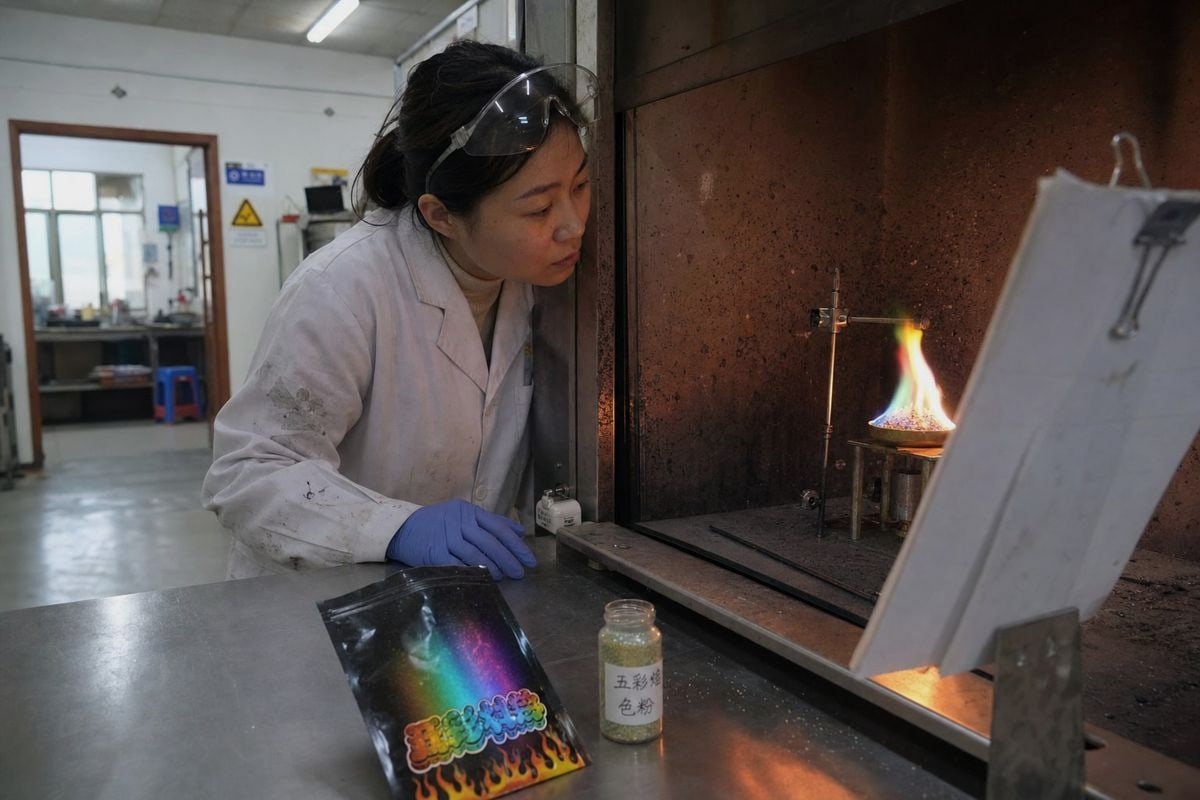
Color fade is usually a supplier-capability problem in disguise. A trading company reselling generic powder cannot adjust the formula, upgrade the foil barrier, or tighten granulation specs. A genuine factory can. So your first filter is simple: does this supplier actually control production?
A Five-Step Vetting Process
- Verify the factory exists. Ask for a live video walkthrough of the mixing, filling, and sealing lines. We give these regularly from our Ningbo facility, and legitimate factories will not hesitate.
- Run your own aging test. Store samples in a hot, humid place for several weeks, then burn them next to fresh ones in outdoor fire pits or a fireplace. Weak packaging and unstable formulas reveal themselves fast.
- Test the engineering response. Describe a color-fade scenario and ask how they would fix it. A capable manufacturer talks about barrier packaging, salt purity, granule sizing, and reducing incandescent solids. A reseller talks about discounts.
- Start with a trial MOQ. Flexible small first orders let you validate vibrant rainbow flames, burn duration, and shelf stability in your real market before scaling.
- Check OEM/ODM depth. If you need private-label pouches, kraft bags, jars, display boxes, warning labels, and barcodes, confirm they handle all of it in-house. Split responsibility between a powder supplier and a packaging vendor is where seal defects sneak in.
At Sunrich, we position ourselves as a long-term manufacturing partner rather than a low-price supplier, because fixing color fade properly costs slightly more upfront and saves enormously in returns, reviews, and reorders.
Conclusion
Magic fire powder color fade comes from storage degradation and combustion washout. Verified compliance, strict batch QC, and a capable factory partner fix it before your bulk order ships.
Footnotes
1. Defines the manufacturing arrangement discussed for private-label production. ↩︎
2. Explains how metal salts produce characteristic flame colors via ion excitation. ↩︎
3. Background on the compound responsible for red flame coloration. ↩︎
4. Authoritative background on heavy metals testing relevant to product safety. ↩︎
5. Links to one of the major testing labs cited for verification. ↩︎
6. Authoritative Wikipedia entry for the international standard on quality management systems. ↩︎
7. Official source explaining the social compliance audit program referenced. ↩︎



 English
  Spanish
  German
  French
  Arabic
  Portuguese
Join the Conversation