







Ambient humidity is one of the sneakiest threats to Magic Fire powder color effects. Our production team in Ningbo learned this the hard way during one muggy July shipment season.
Ambient humidity affects Magic Fire powder color effects mainly through moisture absorption. Hygroscopic metal salts absorb water vapor, which causes clumping, slower ignition, lower combustion temperature, and visibly duller, less saturated flame colors — especially above roughly 60% relative humidity during storage.
Let me break this down properly. In the sections below, I will cover which humidity levels cause trouble, how to store packets correctly, packaging options for humid climates, and how we test for this at our factory.
What humidity levels cause my Magic Fire powder to lose its color intensity?
A few years back, a distributor in Florida sent us photos of packets that had sat in an un-air-conditioned warehouse all summer. The flames still changed color, but the effect looked washed out. That case taught our team a lot.
Color intensity typically stays stable below 40% relative humidity. Between 50% and 60% RH, unsealed powder begins absorbing moisture within 24 hours, softening color output. Above 70–80% RH, clumping, sputtering, and noticeably muted flame saturation can appear within a few days of exposure.

The key concept here is hygroscopic properties. The pyrotechnic colorants used in color-flame products are metal salts — compounds like copper sulfate 1 for blue-green tones and strontium chloride for reds. Many of these salts naturally pull water out of the surrounding air. That is exactly what "hygroscopic" means. The higher the relative humidity, the faster this moisture absorption happens.
Why moisture dims the color
Water in the powder does three things. First, it steals heat. Water has a high latent heat of vaporization 2, so it lowers the combustion temperature before the color chemistry can even start. Second, it causes clumping. Clumped granules burn unevenly, so the color appears in patchy bursts instead of a steady glow. Third, cooler and dirtier combustion weakens spectral emission. The metal salts still emit the same wavelengths, but the flame is not hot enough or clean enough to make those colors vivid.
Practical humidity thresholds
Here is how we frame it for our B2B buyers, based on our own batch testing experience:
| Relative Humidity | Exposure Time | Likely Effect on Color Performance |
|---|---|---|
| Below 40% RH | Weeks (unsealed) | Negligible change; stable flame saturation |
| 50–60% RH | 24–72 hours (unsealed) | Slight moisture uptake; softer, slower color onset |
| 70–80% RH | 1–3 days (unsealed) | Visible clumping; muted colors, sputtering ignition |
| Above 80% RH | Under 24 hours (unsealed) | Significant degradation risk; unreliable performance |
One important nuance: humidity affects visibility too, not just the powder. On a muggy night, water vapor in the air scatters light. Even a perfectly dry packet will look slightly less crisp because the colored light diffuses before it reaches your eyes. So a humid evening softens the show a little, but real damage comes from humid storage.
How can I store color-flame packets to protect them from moisture damage?
Storage advice is something I repeat in almost every buyer call. During 17+ years of exporting fire products to 30+ countries, poor warehouse storage has caused more customer complaints than any factory defect ever has.
Store color-flame packets in their original sealed foil sachets, inside a closed container, in a cool, dry place below 60% relative humidity. Keep them off concrete floors, away from exterior walls, and never open a packet until immediately before use.

The single-use foil sachet is your first and best defense. We heat-seal each packet on both ends specifically to create a vapor barrier. Once that seal is broken, the clock starts. The powder inside begins moisture absorption within hours in humid air. This is why we design our Magic Fire packets as single-throw units — you toss the whole sachet into the fire, so the powder never meets ambient air at all.
A simple storage checklist
For warehouses, retail stockrooms, and end users, I recommend this order of operations:
- Keep packets sealed until the moment of use. Never decant powder into open containers.
- Store cartons in a climate-controlled space where possible. Target under 60% RH.
- Elevate boxes on pallets or shelves. Concrete floors wick moisture upward.
- Avoid temperature swings. Moving stock from a cold warehouse to a warm shop causes condensation inside cartons.
- Rotate stock first-in, first-out. Older inventory should ship before newer batches.
- Inspect before shipping. Clumped or hardened granules inside a damaged sachet signal moisture intrusion.
Warning signs of moisture damage
Clumping is the clearest red flag. Fresh powder flows like fine sand. Powder that has absorbed water forms lumps or a crust. Another sign is chemical oxidation 3 — some metal salts can shift slightly in color or texture after prolonged damp exposure. If a retailer reports either symptom, the batch has likely been stored badly, and its flame performance will be inconsistent.
For end consumers, the message is simpler. Keep packets indoors, not in a damp shed or an open camping bin. A packet stored dry will perform the same on day one and day three hundred.
Should I request humidity-resistant packaging for shipments to humid climates?
One trade-off we discuss constantly with importers is packaging cost versus climate risk. When a Brazilian wholesaler and a German distributor order the same product, we do not always recommend the same packaging spec.
Yes, if your market has sustained humidity above 60–70% RH — such as coastal Brazil, the Gulf states, Southeast Asia, or the US Gulf Coast — request upgraded barrier foil, desiccant-packed cartons, or jar packaging. For dry or temperate climates, standard sealed sachets are usually sufficient.
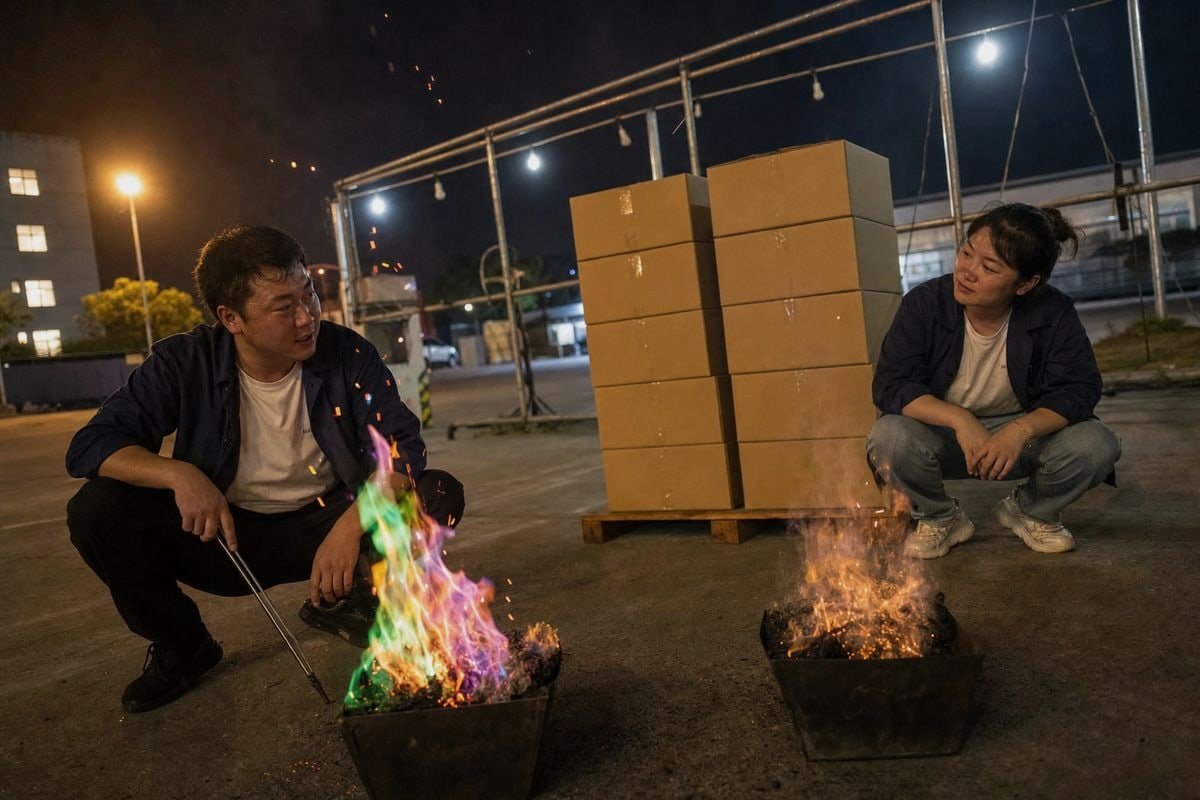
Sea freight is where humidity risk concentrates. A container crossing the equator can experience internal humidity spikes and "container rain" — condensation dripping from the ceiling onto cartons. Even well-sealed sachets benefit from an extra protective layer during a six-week voyage through tropical waters.
Packaging options we offer by climate risk
As a one-stop OEM/ODM factory 4, we adapt the packaging spec to your destination market. Here is how we typically frame the choice:
| Packaging Option | Barrier Level | Best For | Cost Impact |
|---|---|---|---|
| Standard foil sachet | Good | Temperate markets (UK, Germany, Canada) | Baseline |
| High-barrier laminated foil sachet | Very good | Humid coastal markets (Brazil, Gulf Coast) | Modest increase |
| Kraft stand-up pouch with inner liner | Good | Eco-positioned retail brands | Modest increase |
| Sealed plastic jar with induction liner 5 | Excellent | Very humid or long-storage markets | Higher |
| Desiccant sachets added to master cartons | Supplemental | Any sea-freight shipment | Minimal |
Questions to ask before deciding
Think through three factors. First, transit route: does the container cross tropical waters or sit in a humid port? Second, destination storage: will your warehouse be climate-controlled, or is stock held in ambient conditions? Third, shelf life expectations: products intended to sit in retail for a year need stronger barriers than fast-turning seasonal stock. In our experience exporting to the Middle East and Brazil, adding desiccants to master cartons is the cheapest insurance available, and upgrading the sachet foil is the next logical step. We also print climate-appropriate storage guidance and warning labels on private-label packaging, so your end customers get the same protection message.
Does Sunrich test color-flame products for performance under varying humidity conditions?
A purchasing manager from the Netherlands once asked me point-blank: "How do I know your sample will match the container I receive six months later?" It is the right question, and humidity testing is a big part of our answer.
Yes. Sunrich runs batch-level quality control that includes humidity-exposure checks, seal-integrity verification, and burn tests, backed by ISO 9001 processes and SGS/Intertek test reports. This ensures first samples reliably reflect mass-production quality, even after shipment through humid climates.

Consistency is the whole point of our quality system. Color-flame chemistry is sensitive: if the pyrotechnic colorants absorb moisture between mixing and sealing, the finished packet burns cooler and the spectral emission weakens. So we control humidity at every stage, not just at the end.
How humidity control fits into our QC flow
Our process, refined over 17+ years in production, follows a clear sequence:
- Incoming material checks. We verify raw metal salts for moisture content and signs of chemical oxidation before they enter the mixing line.
- Controlled production environment. Mixing and filling happen quickly to minimize the powder's exposure to ambient air in our Ningbo facility.
- Seal integrity testing. Sampled sachets from each batch are checked to confirm the heat-sealed foil forms a true vapor barrier.
- Humidity-exposure burn comparison. We burn samples from each batch and compare flame color, ignition speed, and burn duration against our reference standard, including samples that have been held in damp conditions to confirm the packaging protects the powder.
- Documentation. Batch records tie every shipment back to its QC results, supporting the SGS and Intertek reports 6 our compliance-focused buyers require.
Why this matters for your purchasing decision
For a buyer, humidity performance is really a proxy for supplier discipline. A factory that controls moisture at every step will also control colorant ratios, fill weights, and seal quality. That is why we lead with certification — ISO 9001, BSCI, CE, and third-party test reports 7 — rather than price. When your Home Depot–style retail channel audits your supply chain, "we tested it and here is the report" is the only acceptable answer. And because we are a real factory in Liuyang and Ningbo, not a trading company, we can adjust the humidity spec for your specific market without renegotiating with a hidden third party.
Conclusion
Humidity quietly steals color from fire products through moisture absorption and cooler combustion. Sealed packaging, dry storage, climate-matched specs, and tested QC keep Magic Fire flames vivid — batch after batch.
Footnotes
1. Explains the chemical compound responsible for blue-green pyrotechnic flame coloration. ↩︎
2. Defines the thermodynamic property explaining why moisture lowers combustion temperature. ↩︎
3. Background on oxidation reactions affecting metal salt color and stability in storage. ↩︎
4. Trade platform reference explaining the OEM/ODM manufacturing model discussed for buyers. ↩︎
5. Explains induction sealing technology used for humidity-resistant jar packaging described in the article. ↩︎
6. Official site of a major third-party testing firm cited for compliance verification. ↩︎
7. International trade body context for compliance testing buyers rely on for verification. ↩︎



 English
  Spanish
  German
  French
  Arabic
  Portuguese
Join the Conversation