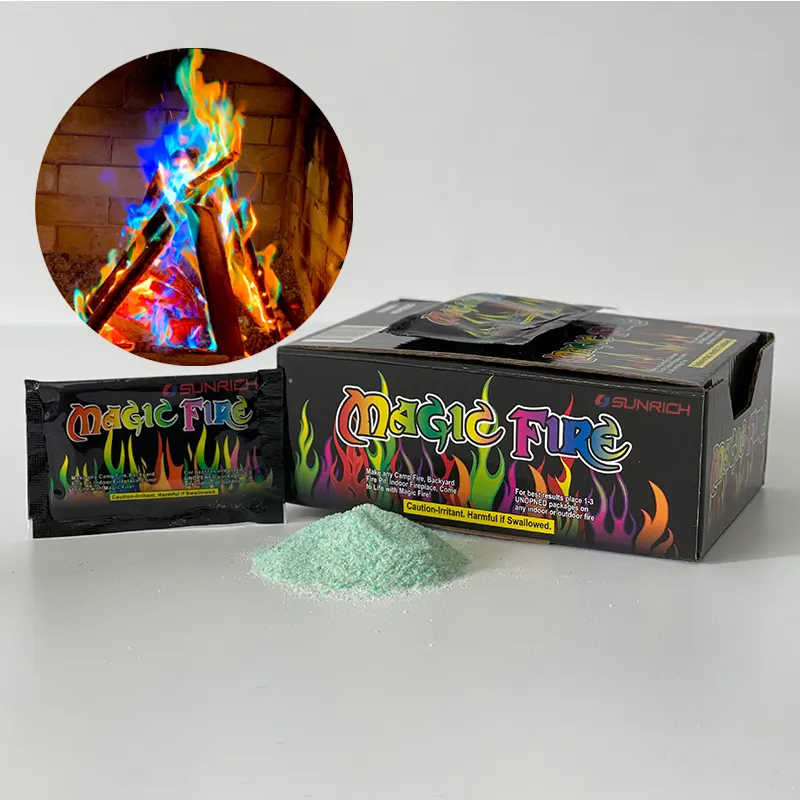

Magic fire powder labels promise anything from 20 minutes to a full hour of color. On our production line in Ningbo 1, we see why buyers get confused. One importer told me he received samples claiming "up to 60 minutes" that faded after twelve. That gap kills consumer trust, triggers returns, and damages your brand. The fix is a fair, repeatable verification method — and knowing exactly what to demand from your supplier before you commit to a container order.
To verify magic fire powder burn duration, run a controlled burn test: use a consistent seasoned-hardwood fire, add the label-specified number of unopened packets, start timing at first color, and stop when the color effect is no longer distinct. Repeat at least three times and compare against the label claim.
That is the short answer. But real verification takes more than a stopwatch. Below, I walk through the testing methods, the certifications to request, the batch controls that keep results consistent, and what to do when a sample falls short.
What Testing Methods Can I Use to Confirm Actual Burn Duration Before Placing a Bulk Order?
Before any of our campfire colorant packets leave the factory, our QC team burns samples from the batch in a standardized fire pit. Buyers can — and should — do the same on their end.
Run a controlled burn test: build a medium seasoned-hardwood fire, let it reach a steady flame stage, add the exact packet quantity the label specifies (unopened), and time from first visible color to the point where color is no longer clearly distinct. Repeat three to five trials and log every variable.
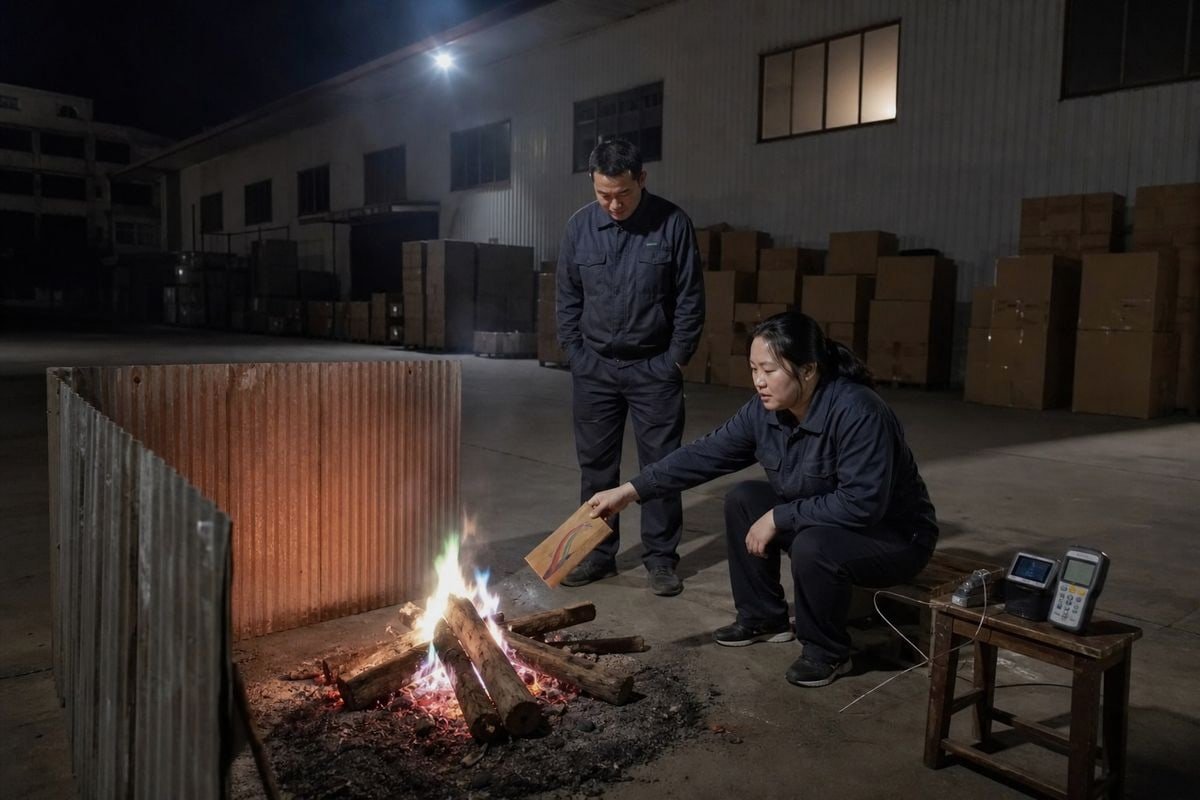
The biggest mistake I see buyers make is treating one backyard burn as proof. Fires vary. Wind varies. Judgment of "when the color ended" varies. A fair test controls those variables, because the label claim itself is conditional — most product pages say duration depends on fire size, packet count, and placement.
Step-by-Step Verification Protocol
- Standardize the fire. Use seasoned hardwood 2 only. Softwoods and resinous logs burn at inconsistent temperatures and can exhaust the color-emitting metal salts prematurely.
- Wait for the right burn stage. Add packets to a healthy, established fire — ideally over glowing coals with moderate flames, not a roaring blaze that disperses the salts too fast.
- Keep packets sealed. A punctured pouch lets powder spill and flash instead of releasing slowly. Never open the packet.
- Test in low wind. Excess airflow accelerates combustion and blows color-emitting ions 3 away from the flame zone.
- Define the endpoint. Time from first color to when the effect drops below a clear visibility threshold. A simple 0–3 scoring scale works; a digital lux meter is even more objective.
- Repeat and average. Three to five trials tell you whether the product usually meets the claim or just did once.
A Simple Scoring Rule
| Score | What You See | Counts Toward Duration? |
|---|---|---|
| 3 | Strong, widespread color across the fire | Yes |
| 2 | Clear color effect, clearly distinct from orange | Yes |
| 1 | Weak color in isolated spots only | Borderline — note the time |
| 0 | No distinct color visible | No — stop the clock |
Also check the powder itself before burning. Weigh the packet against the labeled net weight, and inspect for clumping. Hygroscopic salts 4 that absorbed moisture will not release evenly into the flame, which shortens the visible flame color duration significantly. Granularity matters too: fine dust gives instant brilliance but a short show, while larger crystals meter out a slower, longer release. When we develop custom burn times for OEM clients, granule size is one of the first levers we adjust.
Which Certifications or Test Reports Should I Request From a Magic Fire Powder Supplier?
A German distributor once asked us for our full documentation pack before he would even look at pricing. That request did not offend us — it told us he was a serious buyer.
Request ISO 9001 quality-system certification, third-party test reports from labs like SGS or Intertek, a complete Safety Data Sheet, CE-relevant compliance documentation for your market, and a factory audit report such as BSCI. Also ask for batch-specific burn-time test records, not just generic certificates.

Paperwork is where trading companies and real factories separate. At Sunrich, compliance is a hard requirement for the retail channels we supply in the US, Germany, and the UK — so we maintain ISO 9001 5, BSCI, CE, and SGS/Intertek documentation as standard. If a supplier hesitates on any of these, treat it as a red flag.
The Document Checklist
| Document | What It Proves | Why It Matters for Burn Duration |
|---|---|---|
| ISO 9001 certificate | A functioning quality management system | Consistent processes lead to burn time consistency across batches |
| SGS / Intertek test report | Independent lab verification of composition and safety | Confirms pyrotechnic chemical safety and that no restricted substances are present |
| Safety Data Sheet 6 | Full chemical disclosure and handling guidance | Lets you verify the active salts and check for cheap fillers |
| BSCI audit report | Social and factory compliance | Confirms you are dealing with a real production facility |
| Batch QC burn logs | Internal burn tests per production lot | Direct evidence the labeled duration was verified on your batch |
Read the SDS Carefully
The Safety Data Sheet tells you more than safety information. It reveals whether the formula relies on a genuine copper sulfate 7 reaction or copper chloride chemistry for blues and greens, or whether the mix is padded with excessive carrier filler. A high filler-to-salt ratio may sustain a flame while color intensity drops below visible thresholds long before the packet is consumed. When we quote OEM projects, we share the carrier-to-salt logic openly, because the ratio directly determines how long the effect stays visible. A supplier who cannot explain that ratio probably does not control the formula — which usually means they do not manufacture it.
Also confirm the test report matches the exact product and packaging format you are buying. A report for a plastic jar formula does not automatically cover a sachet version with different granule sizing.
How Do Batch-to-Batch Quality Controls Affect Whether Burn Times Stay Consistent?
Seventeen-plus years in this industry taught our team one uncomfortable truth: the sample is easy, the tenth container is hard. Consistency is where most fire pit accessories suppliers quietly fail.
Batch-to-batch controls — raw material verification, fixed granule sizing, moisture limits, weight tolerances, and per-lot burn testing — determine whether every packet performs like the approved sample. Without documented lot-level QC, burn times can drift 30 to 50 percent between shipments.

Think of burn duration as the output of four inputs: salt purity, granule size, moisture content, and fill weight. If any one drifts, the flame color duration drifts with it. Our production lines in Ningbo run checks at each stage, because a distributor's second order must match the first sample — that is the entire promise of working with a factory instead of a middleman.
The Four Variables That Drift
| Variable | If It Drifts | Effect on Burn Duration |
|---|---|---|
| Salt purity | Supplier switches raw material grade | Weaker color, effect fades early |
| Granule size | Milling not calibrated per lot | Fine dust flashes fast; coarse mix burns unevenly |
| Moisture content | Poor drying or humid storage | Clumped salts fail to release, cutting visible time |
| Fill weight | Loose filling tolerances | Underweight packets simply run out sooner |
What Good Lot Control Looks Like
A capable factory verifies incoming metal salts against specification, mills to a fixed granule range, dries and stores powder in humidity-controlled conditions, and checks fill weight on the line. Then — critically — it burns samples from every production lot and records the observed duration against the labeled range. We keep those burn logs so a buyer in Poland or Canada can trace their shipment back to a tested lot.
Packaging matters too. Heat-sealed foil sachets protect hygroscopic salts during ocean freight. A weak seal lets humidity in during six weeks at sea, and the buyer inherits a moisture problem that looks like a formula problem. When you audit a supplier, ask to see seal-integrity checks, not just the formula sheet.
What Should I Do If a Sample's Burn Duration Doesn't Match the Manufacturer's Claims?
Not long ago, a UK buyer emailed us convinced a sample batch had failed — his test showed 18 minutes against a 30–45 minute label. We reviewed his video together and spotted the issue in seconds: he had torn the packets open and dumped the powder into a small, roaring softwood fire.
First, re-test under label-compliant conditions: correct packet count, unopened sachets, healthy hardwood fire, low wind. If the shortfall persists across three trials, document everything with video and timestamps, send the evidence to the supplier, and request a formula review, replacement samples, or a revised label claim before ordering.

A failed test is not always a failed product. Before escalating, rule out testing errors — then hold the supplier accountable with evidence, not impressions.
Eliminate Test Error First
Run through this checklist honestly:
- Did you use the recommended number of packets for your fire size? Too few packets in a large pit dilutes the color below visibility.
- Were the packets sealed and unopened? Opened packets flash instead of sustaining.
- Was the wood seasoned hardwood, and was the fire at a steady stage?
- Was wind minimal? Outdoor fire safety guidance aside, wind also wrecks measurement accuracy.
- Did you time to the end of distinct color, or to the last faint trace? Define the endpoint before you burn.
Escalate with Evidence
If the product still falls short after clean re-tests, document your controlled burn test: fire setup, wood type, packet count, video with a visible timer, and your scoring notes. Send that package to the supplier and ask three things. First, does their own lot burn log match your result? Second, was this lot tested before shipping? Third, will they adjust the formula, the granule sizing, or the label claim?
How a supplier responds tells you everything. When buyers bring us data, our engineers can usually trace the cause — moisture exposure in transit, a fire-condition mismatch, or a genuine lot issue — and fix it before mass production. A supplier who deflects or blames your fire without reviewing evidence is not a long-term partner. And remember: for private-label programs 8, you can often specify the burn time you want. We routinely tune formulas so the label claim reflects realistic home use, not a best-case marketing maximum, because an honest "30 minutes" earns better reviews than an optimistic "up to 60."
Conclusion
Unverified burn claims lead to returns, bad reviews, and lost shelf space. A controlled burn test, full certification pack, and documented batch QC protect your brand — demand all three before ordering.
Footnotes
1. Background on Ningbo, a major Chinese manufacturing hub referenced as the factory's production base. ↩︎
2. EPA's wood-burning program covers proper fuel choice and combustion quality relevant to controlled fire testing. ↩︎
3. Flame test chemistry explains how metal ions produce visible color changes during combustion. ↩︎
4. Background on hygroscopy explains why moisture absorption during shipping affects powder performance. ↩︎
5. Authoritative and globally accessible reference for the ISO 9001 quality management standard. ↩︎
6. OSHA's hazard communication page explains what a Safety Data Sheet must disclose about chemical composition. ↩︎
7. NIH chemical database confirms the compound's identity and combustion properties behind blue-green flame color. ↩︎
8. Alibaba.com is a major B2B sourcing platform for private-label manufacturing arrangements like this one. ↩︎



 English
 Spanish
 German
 French
 Arabic
 Portuguese
Join the Conversation