







Every week, buyers ask me about the safety data sheet for colored pine cones. Many receive a generic sheet, cannot decode it, and risk shipments stuck at customs.
A safety data sheet for colored pine cones includes 16 standard sections covering product identification, GHS hazard classification, chemical composition, first aid procedures, fire-fighting measures, handling and storage requirements, exposure controls, toxicological information, disposal, and transport data. Read it by matching Section 1 to your exact product first.
I have prepared hundreds of these documents at our factory in China. Below, I will walk you through each part in plain English, section by section.
What sections should I expect to find in a colored pine cone SDS?
A shipment once sat in Rotterdam for eleven days because a buyer's SDS was missing Section 14 transport data. That single page cost more than the freight itself.
A colored pine cone SDS follows the 16-section OSHA and GHS format: identification, hazard identification, composition, first aid, fire-fighting, accidental release, handling and storage, exposure controls, physical properties, stability, toxicology, ecology, disposal, transport, regulatory information, and revision date.
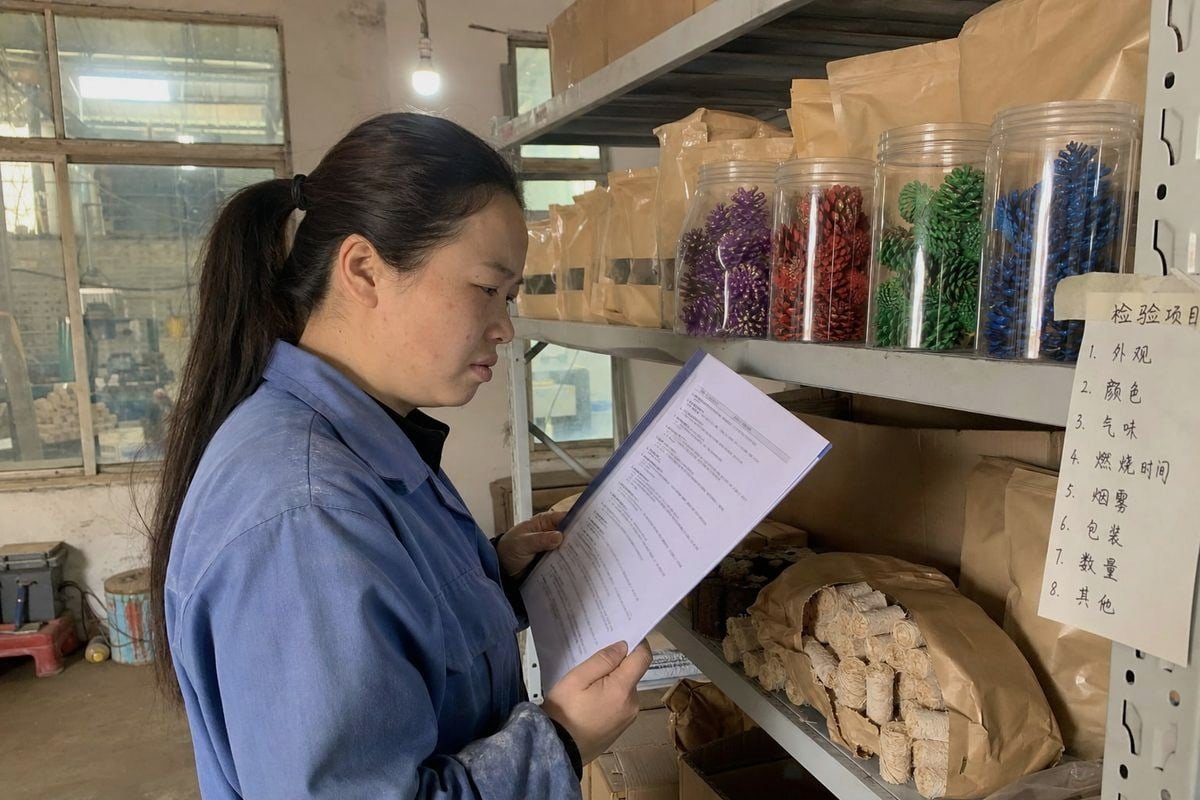
Colored pine cones are not treated as simple decorations in safety documentation. They are classified as chemical-treated mixtures. That surprises many first-time importers. But once you understand the structure, the document becomes easy to scan.
The 16 sections at a glance
| Section | What It Covers | Why It Matters for Pine Cones |
|---|---|---|
| 1 | Identification | Confirms the SDS matches your exact product and lists emergency contacts |
| 2 | Hazard identification | GHS pictograms, signal words, precautionary statements |
| 3 | Composition | Hazardous ingredients, CAS numbers, flame colorants |
| 4 | First aid measures | Steps for skin, eye, inhalation, and ingestion exposure |
| 5 | Fire-fighting measures | Extinguishing media and combustion hazards |
| 6 | Accidental release | Spill cleanup and containment |
| 7 | Handling and storage | Humidity, temperature, and container guidance |
| 8 | Exposure controls | Personal protective equipment and ventilation |
| 9–10 | Physical properties, stability | Appearance, reactivity, decomposition risks |
| 11–12 | Toxicology, ecology | Health effects and environmental toxicity |
| 13–15 | Disposal, transport, regulatory | Ash handling, shipping class, local rules |
| 16 | Other information | Revision date and version control |
In our experience, the sections buyers skip most are 14 and 16. Yet transport classification 1 decides whether your container clears port smoothly, and the revision date tells you whether the sheet reflects the current formula. Formulas change. Regulations change faster. An SDS dated three years ago may describe a product that no longer exists on the production line. When we update a colorant blend in Ningbo, we reissue the SDS within the same quarter, because our EU distributors audit revision dates during onboarding.
One more practical point. An SDS for "pine cones" could describe a fragrance-treated craft cone, a painted ornament, or a flame-coloring campfire product. These are three different chemistries. Always read Section 1 first and confirm the product name, intended use, and supplier match what is physically in your warehouse.
How do I verify the chemical ingredients listed are actually safe and compliant?
During a factory audit last year, a German buyer spent two full hours on Section 3 2 of our SDS alone. He was right to. Composition is where compliance lives or dies.
Verify ingredients by checking Section 3 for CAS numbers and concentration ranges, cross-referencing each substance against restricted lists like EU REACH and TSCA, confirming metal salt additives are copper- or non-toxic-based, and requesting third-party test reports from SGS or Intertek to validate the declared composition.

Section 3 tells you what actually creates the colored flame effect. In most quality products, the flame colorants are metal salt additives such as copper compounds, which produce blue and green tones. Cheaper suppliers sometimes use questionable substitutes. The SDS is your first filter for spotting them.
What to cross-check, step by step
- Match CAS numbers. Every hazardous ingredient should carry a Chemical Abstracts Service number. Search each one against your market's restricted substance list.
- Watch for red-flag substances. Barium, lead, and certain strontium compounds 3 raise concerns in consumer fire products. If they appear at meaningful concentrations, ask hard questions.
- Compare declared ranges to test reports. An SDS is a self-declaration. A third-party SGS or Intertek report verifies it. We provide both to every B2B buyer, because our clients treat this as a hard requirement, not a nice-to-have.
- Check trade-secret gaps. SDSs may legally withhold exact percentages under proprietary provisions. That is normal. But the hazard classification must still reflect the full formula, so Section 2 and Section 11 should be complete even where Section 3 is partial.
- Confirm regulatory anchors. Look for references to OSHA compliance in the US, CLP in the EU, or WHMIS in Canada, depending on your destination.
Some buyers object that a "natural" product should not need this scrutiny. I understand the instinct, but it is a costly assumption. Treated cones can still present skin irritation 4, sensitization, and combustion hazards regardless of their organic base material. Our own eco-friendly formulations avoid harmful chemicals entirely, and we still document them fully — because the paperwork protects the buyer, not just the product.
Which SDS hazard statements matter most for customs clearance in my country?
Shipping the same color-flame pinecones to the US, Germany, and Australia means preparing three slightly different documentation packs. I learned this through delays, not textbooks.
For customs clearance, focus on Section 2 GHS hazard classification and signal words, Section 14 transport classification (UN number and packing group, if any), and market-specific precautionary statements. Products classified as non-dangerous goods with documented proof clear fastest in most countries.

Customs officers rarely read the whole SDS. They scan for specific triggers. If Section 2 carries a flammable-solid pictogram 5 or Section 14 assigns a UN number, your shipment may need dangerous-goods handling, which adds cost and time. If the product is properly formulated and classified as a non-dangerous good, the SDS becomes your proof of that status.
Hazard statements by destination market
| Market | Key Framework | Statements Customs Scrutinizes | Practical Tip |
|---|---|---|---|
| United States | OSHA HazCom / DOT | Flammability class, oral toxicity (H302), skin sensitizer (H317) | Align SDS language with DOT shipping description |
| Germany / EU | CLP / ADR | Environmental toxicity (H400 series), sensitization phrases | Provide the SDS in the destination language on request |
| UK | UK REACH / GB CLP | Same as EU plus post-Brexit supplier address rules | List a UK-based responsible party where required |
| Canada | WHMIS 2015 | Bilingual labeling, hazard pictogram consistency | English and French SDS versions may both be needed |
| Australia | GHS Rev. 7 | Signal word accuracy, transport class | AQIS also checks the botanical material for biosecurity |
Two statements deserve special attention for colored pine cones. First, "harmful if swallowed" — some decorative fragrance-treated cones carry this classification, and it affects labeling requirements 6 for consumer retail. Second, skin sensitizer warnings, which trigger mandatory precautionary statements on packaging in the EU. If your SDS shows either, your retail label must match it exactly. Mismatched label-versus-SDS claims are one of the most common reasons inspections escalate.
From our export experience across 30+ countries, the cleanest path is a consistent documentation set: SDS, third-party test report, CE marking 7 where applicable, and packaging whose warning labels mirror the precautionary statements word for word. When those four align, clearance is usually routine.
Can I request an SDS matched to my specific product batch before placing an order?
A US distributor once told me his previous supplier sent the same PDF for every order — even after the formula changed color chemistry twice. That conversation shaped how we handle documentation today.
Yes. Any credible manufacturer can issue an SDS matched to your specific product batch, formula version, and packaging configuration before you order. Request the sheet alongside your sample, verify the revision date in Section 16, and confirm the product name in Section 1 matches your SKU.

Batch-matched documentation matters more with private-label products. If you brand our color-flame pinecones under your own name, Section 1 of the SDS should carry your product name and your responsible-party details for your market. A generic factory sheet will not satisfy a retail chain's compliance desk. Our OEM/ODM process builds this into the order flow: custom warning labels, barcodes, and an SDS versioned to the exact formula in your production run.
What a batch-matched SDS request should include
- Your exact SKU or product name as it will appear on retail packaging
- The destination market, so the SDS follows the correct regulatory format
- The packaging type — kraft bag, jar, or pouch can affect handling and storage requirements
- Language requirements for the destination country
- A request for the current revision date and version history
Questions worth asking your supplier
Ask how often they reissue the SDS after formula updates. Ask whether their personal protective equipment recommendations in Section 8 reflect actual production practice or copied boilerplate. Ask whether fire-fighting measures in Section 5 were reviewed for the finished product, not just raw ingredients. Suppliers who answer quickly and specifically usually run real production lines. Suppliers who stall usually resell someone else's goods with someone else's paperwork.
One buyer objection I hear: "Requesting custom documentation will delay my trial order." In practice, the opposite is true. We prepare batch-matched sheets during sampling, so documentation and product arrive together. Because our first sample reliably reflects mass-production quality, the SDS you approve at sampling stays valid through the production run — with strict batch-to-batch quality control keeping the chemistry consistent.
Conclusion
An outdated or mismatched SDS can stall shipments and expose your brand. Read all 16 sections, verify ingredients, match hazard statements to your market, and demand batch-specific documentation before ordering.
Footnotes
1. Official OSHA Hazard Communication page providing guidance on the 16-section SDS format and transport data requirements. ↩︎
2. Explains the importance of Section 3 for identifying chemical substances via CAS registry numbers. ↩︎
3. Scientific overview of strontium and its various chemical compounds used in industrial applications. ↩︎
4. Medical and scientific definition of skin irritation and its causes in chemical exposure. ↩︎
5. Authoritative OSHA guide illustrating GHS pictograms, including the flame symbol for flammable solids. ↩︎
6. Explains the mandatory labeling requirements for chemical mixtures under the CLP regulation. ↩︎
7. Official European Commission page explaining the requirements and process for CE marking compliance. ↩︎


 English
  Spanish
  German
  French
  Arabic
  Portuguese
Join the Conversation