






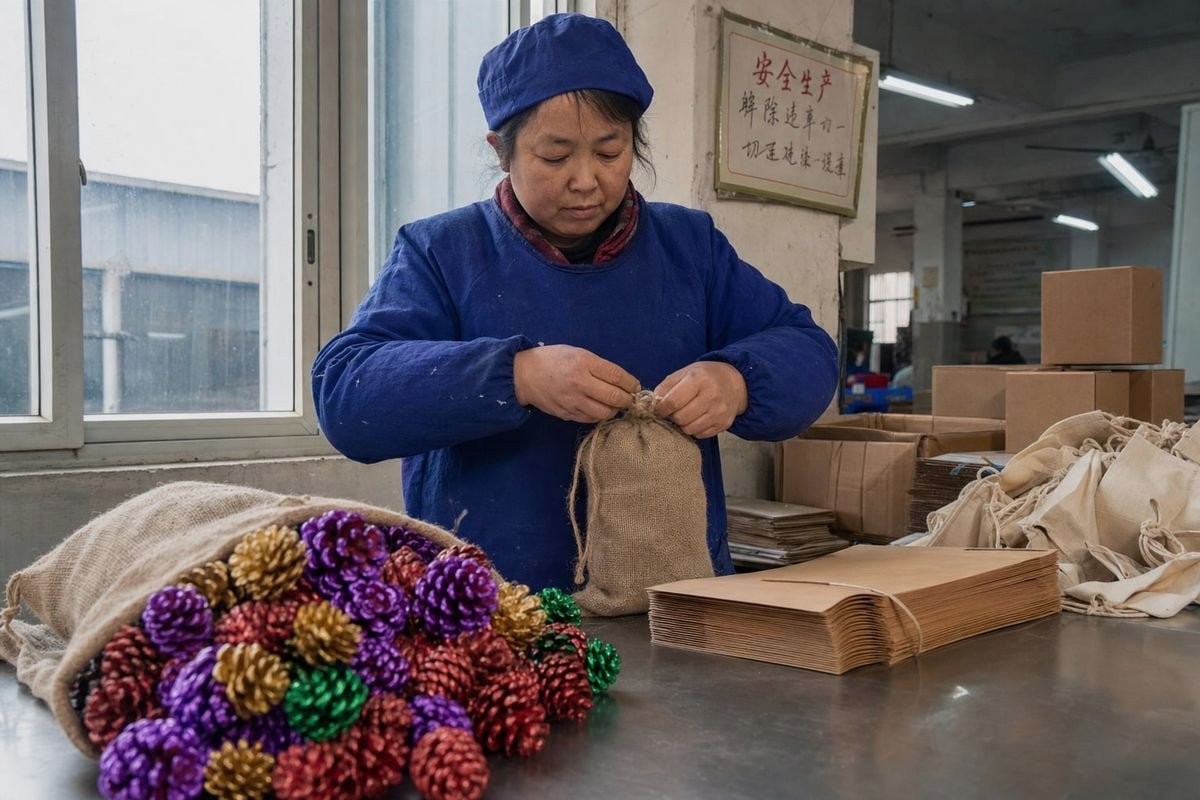
Buyers ask me about packaging material for fireplace colored pine cones constantly. One wrong choice can mean toxic fumes, melted residue, or a recalled shipment — problems our factory learned to prevent years ago.
Fireplace colored pine cones are typically packaged in burlap sacks, kraft paper pouches, cotton drawstring bags, or polybags. The packaging is for storage and display only and should never be burned. Only the treated pine cones themselves are designed to burn safely in wood fires.
That short answer hides a lot of detail. Packaging choice affects safety, compliance, and shelf appeal. Let me walk you through what we actually use, why we use it, and what happens if the wrong material meets a flame.
What materials do you use for packaging colored pine cones, and are they food-safe or eco-certified?
A German distributor once rejected an entire sample round from another supplier because the polybag had no material declaration. That moment shaped how our factory documents every packaging component we ship.
Colored pine cones are commonly packed in natural burlap sacks, kraft paper stand-up pouches, cotton drawstring bags, or food-grade polybags. Reputable manufacturers use eco-certified or food-contact-grade materials, backed by SGS or Intertek test reports, even though the packaging itself is never meant to be burned.
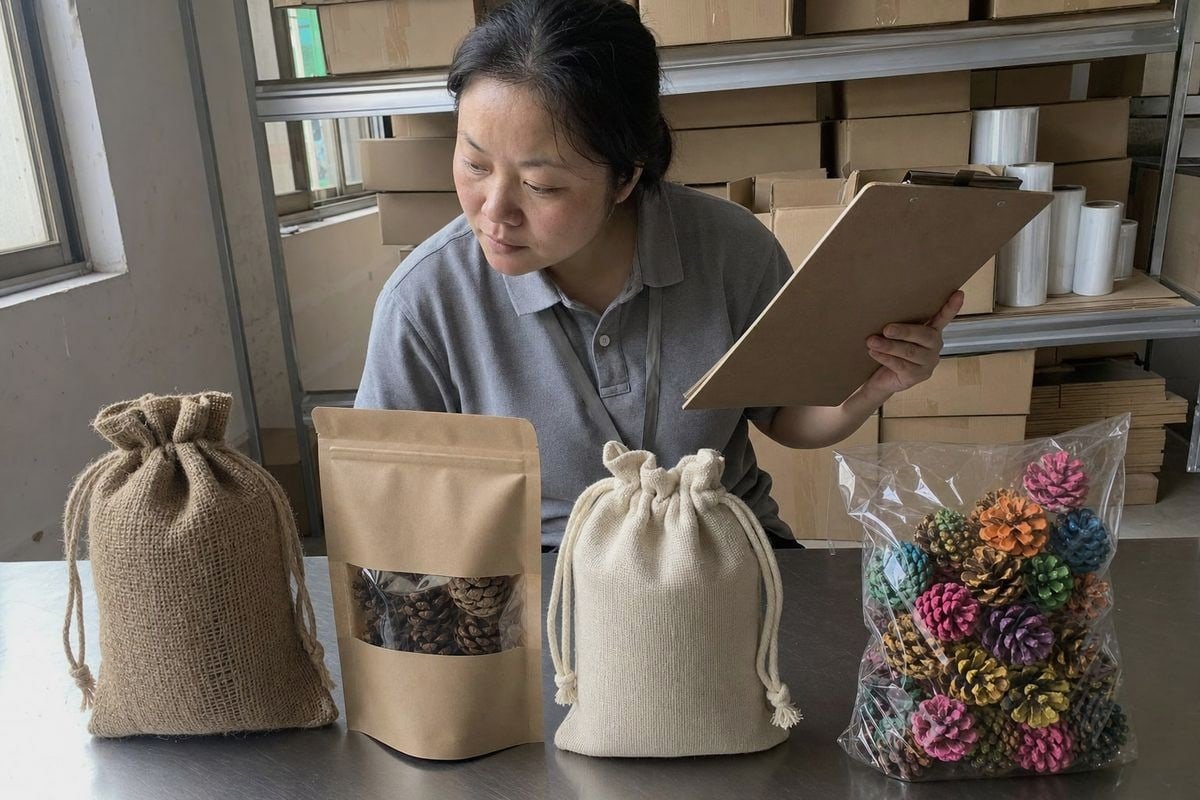
Packaging for fire-colorant products has to do three jobs at once. It must protect the coated cones during ocean freight. It must look good on a retail shelf 1 or in a gift basket. And it must satisfy the compliance teams of importers in the US and Europe. In our 17+ years of exporting to more than 30 countries, we have settled on four main formats.
The four packaging formats we produce
| Packaging Type | Material | Best Use Case | Eco Profile |
|---|---|---|---|
| Burlap drawstring sack | Natural jute fiber | Rustic fireplace retail, gift sets | Biodegradable, plastic-free |
| Kraft stand-up pouch | Kraft paper with window | Camping and outdoor brands | Recyclable, matte eco finish |
| Cotton drawstring bag | Woven cotton | Premium private-label lines | Biodegradable, reusable |
| Polybag | Food-grade PE film | Bulk refills (2 lb, 5 lb, 6 lb) | Recyclable where accepted |
Burlap is the classic choice. Retail listings across the US market lean heavily on the rustic burlap aesthetic, and our buyers in the fireplace and hearth channel prefer it for that reason. Kraft pouches with a clear window work better for camping brands because they reseal and show the natural cones inside. Cotton drawstring bags sit at the premium end. Polybags are the economical refill option.
On the food-safe question, I want to be precise. Our packaging films meet food-contact-grade standards, and our color-flame formulations avoid harmful chemicals. But the product itself is a decorative flame colorant 2, not a food item. No colored pine cone — ours or anyone's — should ever be used on a cooking fire or BBQ grill, because flame colorants can leave residue on food surfaces. Food-safe packaging grade and food-safe burning are two completely different claims, and honest suppliers keep them separate.
Some high-end brands are also moving toward biodegradable cellulose-based films. These are chemically inert and behave more safely if accidentally exposed to heat than petroleum-based plastics. We track this trend closely for our European buyers, where plastic-reduction rules keep tightening.
Can I get test reports or safety certifications proving your packaging is safe to burn?
Here is a trade-off I discuss with almost every new buyer: certification adds cost and lead time, but skipping it can stop your container at customs. We choose certification every time.
Yes — reputable suppliers provide SGS or Intertek test reports, ISO 9001, BSCI, and CE documentation covering both product and packaging materials. However, no honest certificate declares packaging "safe to burn," because packaging is certified for storage safety, not combustion. Only the treated cones are tested for burning.

Let me explain what these documents actually cover, because I see confusion here every month. Buyers sometimes ask us for a certificate stating the burlap bag is "burn-safe." We decline, and I explain why. Packaging certification and combustion certification answer different questions.
What each certificate proves
| Certification | What It Covers | Why B2B Buyers Need It |
|---|---|---|
| ISO 9001 | Factory quality management system | Confirms batch-to-batch consistency |
| BSCI | Social and ethical audit of the factory | Required by major retail sourcing channels |
| CE | Product conformity for the EU market | Legal requirement for European distribution |
| SGS / Intertek reports | Heavy metals, restricted substances, emissions | Proves the flame colorants avoid harmful chemicals |
The SGS and Intertek third-party reports are the documents our compliance-focused buyers in the US, Germany, and the UK request first. These reports test the color-flame coating itself — the compounds that produce the colored flames — for restricted heavy metals 3 and harmful emissions. Our formulations use carefully controlled metal salts as flame colorants, and the reports verify that what burns in your customer's fireplace stays within safe limits when used as directed in a well-ventilated wood fire.
Packaging gets tested separately. Test reports for the polybag or kraft pouch confirm material composition 4 and food-contact-grade compliance for storage. They do not — and should not — claim the bag can be thrown into the fire. A supplier who promises a "burn-safe packaging certificate" is either confused or cutting corners, and both are red flags in this industry.
One more practical point. Our first sample reliably reflects mass-production quality because we run complete production lines with strict batch QC. That matters for certification too: the batch that gets tested is chemically identical to the batch that ships. When a trading company sources from rotating factories, that link breaks, and the test report on file may not describe the goods in your container.
Do you offer custom packaging designs, like kraft bags or private-label boxes, for bulk orders?
Last year a Canadian fireplace distributor came to us with only a logo file and a Pantone code. Twelve weeks later, their private-label colored pine cones were on shelves in three provinces.
Yes — full OEM/ODM customization is standard for bulk orders. Options include branded kraft bags, burlap sacks with printed logos, private-label boxes, display-ready packaging, custom warning labels, barcodes, and tailored sizes. Established factories handle design, compliance labeling, and logistics as one integrated service.

Custom packaging is where a real factory separates itself from a reseller. At our production sites in Ningbo, private-label work is not an add-on; it is most of what we do for our brand customers across the US, Europe, and Australia. Here is how the process typically runs.
Our standard OEM/ODM workflow
- Brief and format selection. You choose the base format — burlap sack, kraft stand-up pouch, cotton drawstring bag, polybag refill, or rigid gift box.
- Design and artwork. We adapt your branding, or our team drafts artwork from your logo and color guidelines.
- Compliance layer. We add market-correct warning labels, usage instructions, barcodes, and required legal text for your destination country.
- Pre-production sample. You approve a physical sample that matches mass-production quality — not a hand-made mockup.
- Production and QC. Batch-level quality control checks coating consistency, burn performance, and packaging seal integrity.
- Logistics optimization. We plan carton sizes and pallet loading to cut your freight cost per unit.
A few details buyers often overlook. First, warning labels are not decoration. US and EU markets expect clear instructions: wood-burning fires only, do not use in gas fireplaces, do not cook over the flames, keep out of reach of children. We print these correctly the first time so your goods clear inspection. Second, package weight matters. Common retail sizes run from small gift sacks up to 2 lb, 5 lb, and 6 lb refill formats, and the packaging structure must match — a 6 lb load will tear a lightweight cotton bag in transit. Third, display packaging sells. Counter display boxes that hold a dozen burlap sacks consistently outperform loose bin placement for our fireplace-channel customers.
We also keep MOQs flexible for trial orders. Most of our long-term partnerships started with a modest first container, and we would rather earn the reorder than force a big initial commitment.
Will the packaging release harmful fumes or residue when I burn the pine cones in a fireplace?
Early in my career, I watched a demo where someone tossed an entire polybag of cones — bag and all — into a fire pit. The acrid black smoke taught everyone present a permanent lesson.
The packaging must always be removed before burning. Plastic polybags and synthetic mesh release toxic fumes and leave melted residue when burned. Even natural burlap or kraft paper is not intended fuel. Only the treated pine cones should go into a wood-burning fireplace, one at a time.
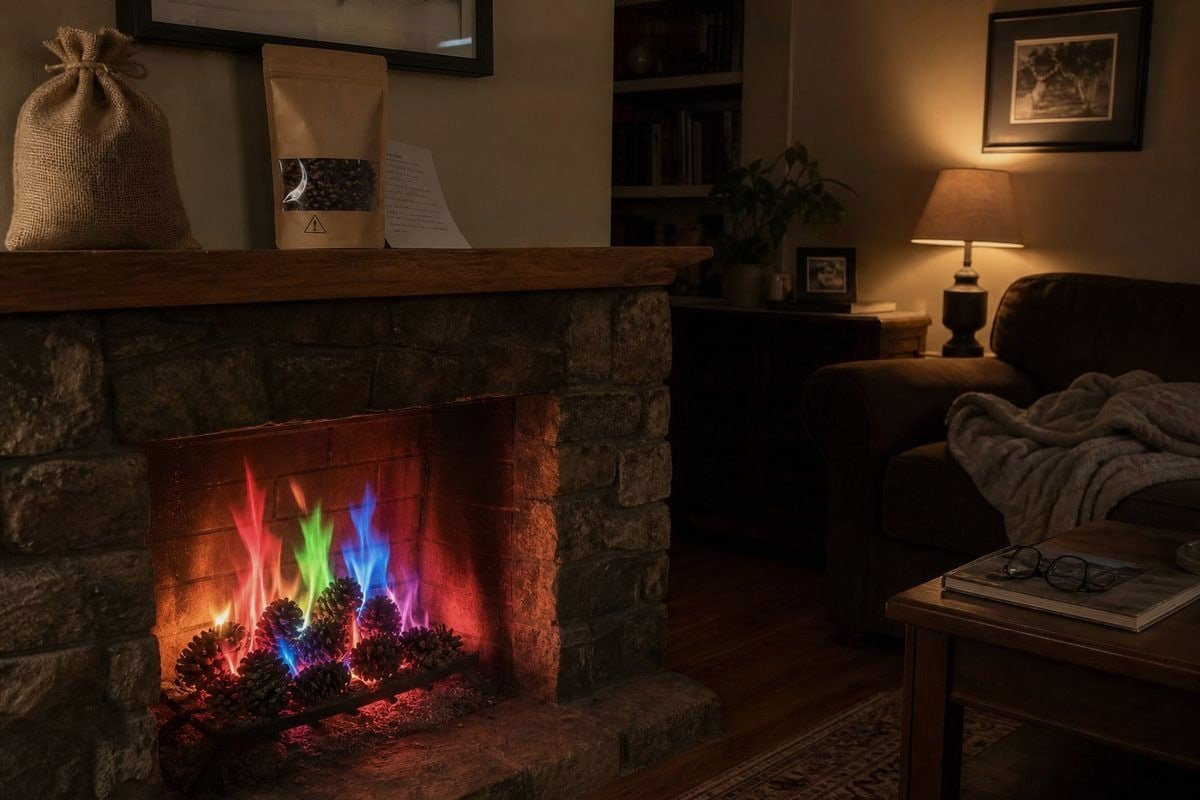
This is the question where I have to be most direct, because the safety stakes are real. The bag is a container. The cones are the product. Never confuse the two.
What happens when each material burns
| Material | If Burned | Risk Level |
|---|---|---|
| Polybag (PE plastic) | Toxic fumes, melted plastic on the grate | High — never burn |
| Synthetic mesh | Airborne microplastics, plastic embedded in ash | High — never burn |
| Burlap (jute) | Fast flare, loose ash, unpredictable embers | Moderate — not intended fuel |
| Kraft paper | Quick flame, floating ash flakes | Moderate — remove before use |
| Treated pine cones | Controlled colored flames for about 10–15 minutes | Designed for wood fires only |
Burned plastic is the worst case. Beyond the immediate toxic fumes, synthetic mesh and polybag fragments can end up as microplastic particles in your fireplace ash. If that ash goes into a garden, the plastic goes with it. This is one reason we push natural-fiber and kraft formats, and why our polybags carry clear "remove before use" instructions.
The cones themselves behave very differently, because they are engineered to burn. The color effect comes from the coating, not the packaging. Commercial products use controlled flame colorants — the same chemistry family that makes copper sulfate 5 burn green-blue and strontium chloride 6 burn red — locked into a wax or crystal coating on natural cones. Some formulations also include boric acid or borax-type compounds, which carry a side benefit: they can help break down creosote buildup 7 in the chimney during the burn. Properly cured commercial cones go through a seasoning period so no moisture-trapped chemical pockets remain; that curing step is what prevents dangerous popping or spitting in the fire. DIY wax-dipped versions skip this control, which is why homemade fire starters vary so much in behavior.
Three usage rules protect your end customers. Use the cones only in wood-burning fireplaces, fire pits, or campfires — never in gas fireplaces, gas logs, or ventless units, where ash and residue can clog the pilot and burner orifices, and where metal salt vapors can accelerate corrosion in stainless steel chimney liners 8 with heavy repeated use. Keep the area well-ventilated and use a fire screen. And never cook food over a colored flame.
Conclusion
Wrong packaging choices create fume risks, compliance failures, and returns. The fix is simple: certified materials, clear labeling, and burning only the cones. That is exactly how we build every order.
Fireplace colored pine cones ship in burlap sacks, kraft pouches, cotton drawstring bags, or polybags — all meant for storage and shelf appeal, never for the fire. The treated cones alone are the product, formulated with controlled flame colorants and tested by third-party labs for wood-fire use only. For importers and distributors, the practical checklist is short: demand SGS or Intertek reports, verify ISO 9001 and BSCI credentials, insist on correct warning labels, and choose packaging formats that match your channel. Partner with a factory that documents everything, and your colored-flame line arrives shelf-ready, compliant, and safe for the families who light it.
Footnotes
1. Wikipedia entry for retail, explaining the environment where packaging presentation is critical for consumer products. ↩︎
2. Wikipedia page describing pyrotechnic colorants, the chemical compounds used to create colored flames in pine cones. ↩︎
3. Authoritative NIEHS page on heavy metals, which are regulated and tested for in flame-colorant products. ↩︎
4. Wikipedia entry for chemical composition, relevant to the material testing of packaging and product coatings. ↩︎
5. PubChem database entry for copper sulfate, a common chemical used to produce blue and green flames. ↩︎
6. Background reference on the chemical compound used to produce red flame coloration. ↩︎
7. EPA FAQ on fireplace safety and creosote, explaining the risks of buildup in wood-burning systems. ↩︎
8. Michigan State University extension article on chimney safety and the importance of maintaining proper chimney liners. ↩︎



 English
  Spanish
  German
  French
  Arabic
  Portuguese
Join the Conversation