







Buyers often ask us about surface-dyed vs flame-coloring pine cones after receiving samples that looked right but burned wrong BSCI 1. One mislabeled container can trigger returns, failed audits, and lost shelf space. Our production line in Ningbo has helped many importers avoid exactly that trap.
Surface-dyed pine cones are coated with paint or craft dye purely for decoration and should never be burned. Flame-coloring pine cones are infused with mineral salts that stay dormant until ignition, then release colored flames. One is décor; the other is a functional fire product.
The two products look similar in a catalog photo SGS/Intertek documentation 2. In practice, they differ in chemistry, compliance, performance, and labeling. Let me walk you through each difference so your next purchase order lands correctly.
How can I tell if pine cones are surface-dyed or genuinely flame-coloring before I place an order?
During a factory tour last year, a German distributor showed me a competitor's sample Copper-based salts 3. It was gorgeous — purple with gold tips. I told him it was a craft cone, not a fire product. He was surprised, and that conversation shaped how we now brief every new buyer.
Check the appearance first: surface-dyed cones show visible glossy or painted color, while genuine flame-coloring pine cones look natural or lightly frosted. Then request a burn video, an SGS or Intertek test report, and an ingredient declaration before committing to any order.
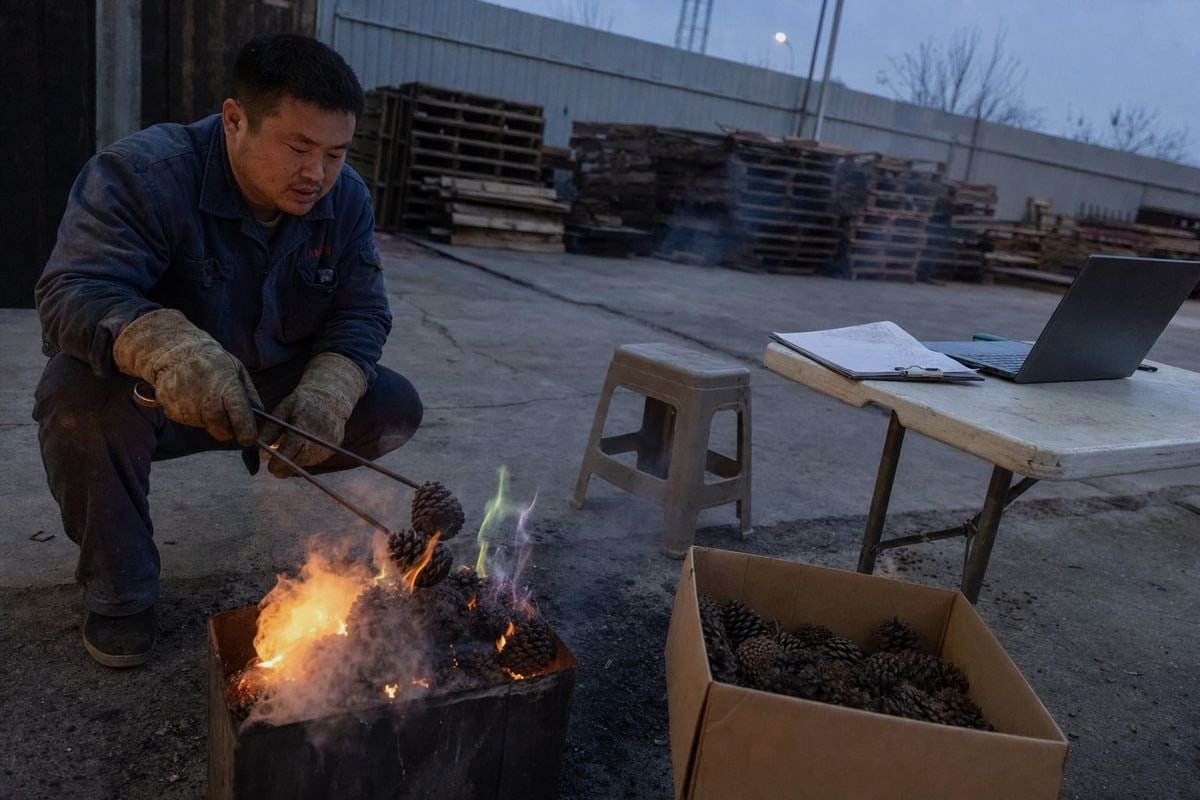
The confusion is understandable. Many suppliers list both products under the same keyword, "colored pine cones." But the color logic is opposite. On a dyed cone, the color sits on the cone. On a flame-coloring cone, the color hides inside the cone and only appears in the fire. Here is the quick screening checklist I share with purchasing managers.
A pre-order verification checklist
| Verification step | Surface-dyed cone | Flame-coloring cone |
|---|---|---|
| Visual look | Vivid painted color, glossy or lacquered sheen | Natural brown, sometimes a faint salt frost |
| Smell | Paint, lacquer, or dye odor | Neutral, woody |
| Burn video available | Rarely, and flames stay orange | Yes, showing blue, green, or purple flames |
| Test reports | Craft-material safety only | Combustion and heavy-metal test reports |
| Label warnings | "Not for burning" or none | Burn instructions and hazard warnings |
| Intended placement | Wreaths, centerpieces, gift baskets | Fireplaces, fire pits, campfires |
Ask these three questions
First, ask for a live burn demonstration on a video call. A genuine flame-coloring cone shows color within seconds of the scales catching. Second, ask which salts are used. A serious factory answers clearly; a trading company usually stalls. Third, ask for the batch test report, not a generic certificate. At our facility, every production batch is checked so the sample you approve matches the container you receive. That batch-to-batch discipline is the single most reliable signal that you are dealing with a real fire-product manufacturer rather than a craft-goods reseller.
Why do surface-dyed pine cones often fail compliance tests that flame-coloring ones pass?
Compliance is where I spend a surprising amount of my week. Our team in Liuyang reviews test protocols for the US, Germany, the UK, and France, and the failure pattern for dyed cones sold as fire products is remarkably consistent across all those markets.
Surface-dyed cones fail combustion compliance because craft paints and dyes were never formulated for burning; they release unlisted fumes and residues under heat. Flame-coloring pine cones pass because their mineral salts are selected, tested, and documented specifically for controlled combustion.

The core issue is intended use. A craft dye is tested for skin contact and handling safety. It carries a "non-toxic craft material" claim, which sounds reassuring. But that claim says nothing about what happens at several hundred degrees. When acrylic paint, lacquer, or fabric dye burns, it can release fumes that no craft-safety test 4 ever measured. Labs testing a fire product will flag exactly that gap.
Flame-coloring cones follow the opposite path. The mineral salts are chosen because they behave predictably in fire. The whole formulation is designed around combustion, so testing for combustion is straightforward. In our experience with SGS and Intertek protocols, a properly made color-flame cone passes emissions and heavy-metal screening because nothing in it was hidden from the test scope.
Where each product type gets tested
| Compliance area | Surface-dyed cone (as fire product) | Flame-coloring cone |
|---|---|---|
| Combustion emissions | Typically fails or untested | Tested and documented |
| Heavy metals in residue | Unknown, dye-dependent | Screened per batch |
| Hazard labeling | Absent or mismatched | Warnings, instructions, barcodes |
| CE / market conformity | Not applicable for burning | Achievable with proper files |
| Retailer audit readiness | Weak documentation trail | Full test-report package |
I raise one objection buyers often bring up: some DIY guides suggest any colored cone burns fine outdoors. That advice ignores that older recipes circulating online involve chemicals never intended for casual combustion. For retail, the standard is not "it probably burns okay." The standard is a test report a retailer's compliance team will accept. Dyed cones cannot produce that report for burning, and that is why they fail.
Which type delivers more consistent flame color and burn performance for my customers?
We once ran side-by-side burns for a Canadian fireplace distributor who was comparing our cones against a cheap "rainbow cone" he'd sourced elsewhere. His sample flared orange with black smoke. Ours held a steady green-blue for minutes. He signed that afternoon.
Flame-coloring pine cones deliver far more consistent color and burn performance, because emission-tested mineral salts produce predictable flame hues every time. Surface-dyed cones burn like plain wood with ordinary orange flames, and their coatings can smoke, flare, or char unevenly.

The science here is simple. Heat excites the atoms in mineral salts, and as those atoms return to a lower energy state, they emit light at characteristic wavelengths 5. Copper-based salts trend green to blue-green. Strontium compounds 6 trend red. Potassium salts trend purple. Sodium gives yellow. This is the same chemistry behind fireworks colors — a fitting detail, since our headquarters sits in Liuyang, China's fireworks cluster.
But knowing the chemistry is not the same as controlling it. DIY guides disagree on exact salt-to-color mappings, and community discussions note that trace sodium contamination can overpower greens and reds. That is exactly why home-treated or loosely made cones burn inconsistently. Consistency comes from process control, not from the recipe alone.
What actually drives batch-to-batch consistency
- Cone preparation. Cones must be cleaned and dried so sap, moisture, and debris don't distort the flame.
- Solution concentration. Salt concentration must be held within a tight tolerance in every soaking tank.
- Soak time. DIY guides suggest 8–24 hours; production requires a fixed, monitored window.
- Drying. Incomplete drying causes smoke and weak color. We dry until moisture is fully controlled.
- Contamination control. Keeping sodium out of green and blue lines protects color purity.
- Batch burn testing. A sample from every batch is burned and compared to the approved reference.
For your customers, the payoff is repeatability. The fifth cone from the bag performs like the first. When we develop a custom burn time for an OEM client, that spec is documented so mass production matches the approved sample. A dyed cone can never offer that, because its "performance" was never designed in the first place.
Does choosing flame-coloring pine cones over surface-dyed ones affect my private-label and safety certification requirements?
A recurring lesson from 17+ years of exporting to 30+ countries: the product decision and the labeling decision cannot be separated. Choosing the wrong cone type doesn't just change your artwork — it changes your entire regulatory pathway.
Yes, it changes everything on the label. Flame-coloring pine cones require hazard warnings, burn instructions, combustibility statements, and combustion test reports for retail. Surface-dyed cones are labeled as craft décor and must explicitly state they are not for burning. Mixing these frameworks risks recalls.
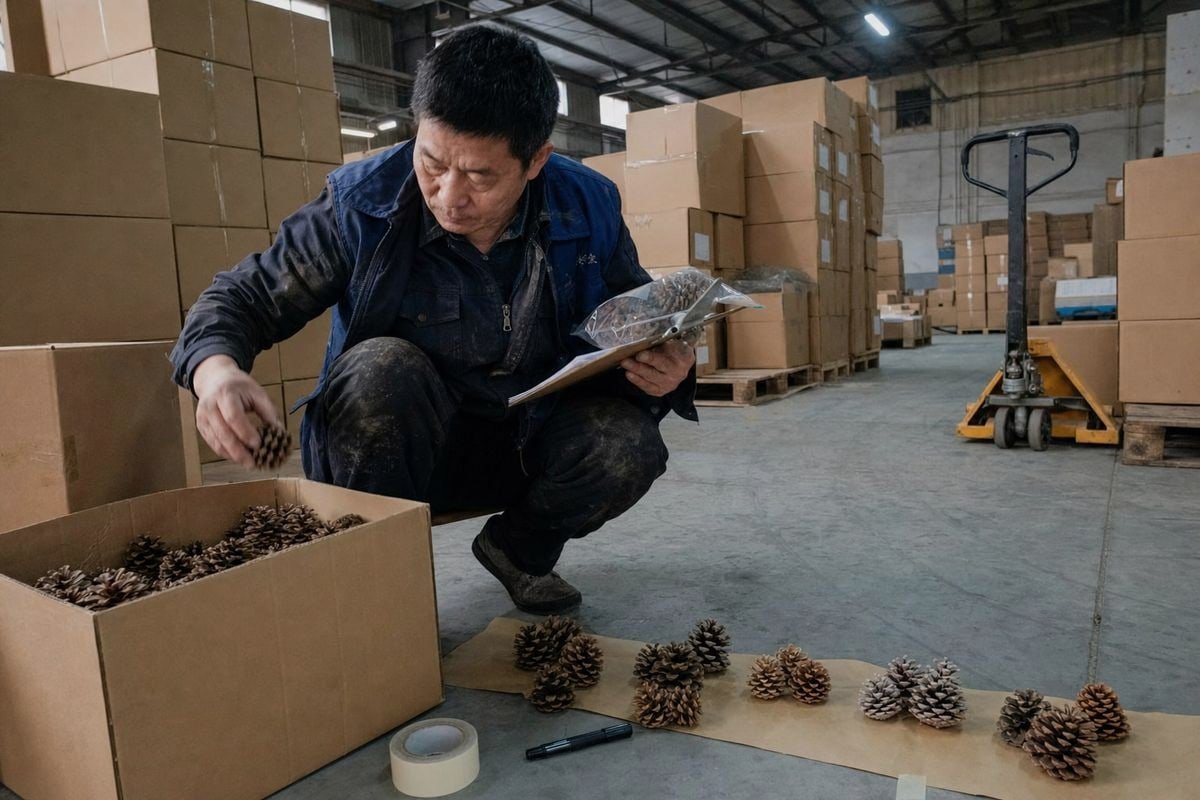
Here is why this matters commercially. If you private-label a dyed cone with fireplace imagery — a cozy hearth, dancing flames — you have implied a use case the product cannot legally support. Retail compliance teams in the US and EU catch this, and the listing gets rejected or, worse, pulled after launch. I have seen importers lose an entire seasonal window over one packaging photo.
Flame-coloring cones move you into the fire-product framework, which is more demanding but far more defensible. Under our one-stop OEM/ODM program, we build the full compliance package alongside the product itself: warning labels in your market's language, barcodes, custom boxes, display packaging, and the ISO 9001 7, BSCI, CE, and SGS/Intertek documentation retailers ask for during onboarding. For Home Depot–type sourcing channels, that paperwork is a hard requirement, not a nice-to-have.
Private-label requirements at a glance
| Requirement | Surface-dyed cone | Flame-coloring cone |
|---|---|---|
| Product classification | Craft / décor item | Fire-starting / novelty fire product |
| Mandatory warnings | "Not for burning" | Burn instructions, ventilation and hazard notes |
| Test documentation | Handling safety only | Combustion, emissions, heavy-metal reports |
| Packaging imagery allowed | Décor scenes only | Fireplace and campfire scenes |
| Customization scope | Color, finish | Flame color, burn time, size, packaging, branding |
| Retail audit exposure | High if misused | Low with a full compliance file |
One more objection worth resolving: some buyers ask whether they can sell one cone for both décor and burning. In theory, a cone can be dyed and salt-treated. In practice, we advise against it, because the dye adds untested combustion variables and muddies your compliance file. Keep the two products separate, label each honestly, and both lines will survive an audit.
Conclusion
Surface-dyed pine cones decorate; flame-coloring pine cones perform. Getting the distinction wrong risks compliance failures and returns. Our certified factory helps buyers source tested, private-label-ready color-flame cones with confidence.
Footnotes
1. BSCI (now amfori) is the social compliance auditing scheme cited for retailer onboarding requirements. ↩︎
2. SGS is a leading testing and certification body referenced for combustion and compliance verification. ↩︎
3. Flame test chemistry explains why copper-based salts produce green to blue-green flame colors. ↩︎
4. CPSC oversees consumer product safety testing standards relevant to craft materials versus combustion products. ↩︎
5. NIST's atomic spectra database explains the emission wavelengths behind mineral-salt flame coloring.



 English
  Spanish
  German
  French
  Arabic
  Portuguese
Join the Conversation