







Buyers ask me weekly about composition documentation and safety data for magic fire powder GHS 16-section Safety Data Sheet 1. Too many suppliers dodge the question, and that silence has sunk more than one import deal I've watched.
Request a GHS 16-section Safety Data Sheet, a full composition disclosure with CAS numbers and concentration ranges, third-party test reports from labs like SGS or Intertek, a batch-specific Certificate of Analysis, heavy-metal screening results, and transport classification documents before purchasing magic fire powder.
That is the short answer. Below, I break down each document type, what it must contain, and how to spot a supplier who cannot actually back up their claims.
What Certifications and Test Reports Should I Ask My Supplier to Provide?
A German distributor once emailed our Liuyang office with a one-line question: "Send certificates or we don't talk." I respected that. It is exactly the right first move.
Ask for an ISO 9001 quality management certificate, a BSCI social compliance audit, CE marking documentation where applicable, and third-party test reports from SGS or Intertek covering composition, heavy metals, burn behavior, and packaging safety for the exact magic fire powder SKU you intend to buy.

The certification question separates real factories from trading companies fast EU REACH 2. In our seventeen-plus years exporting color-flame packets to more than thirty countries, I have seen buyers burned by suppliers who forwarded borrowed or expired certificates. So verify everything. Do not just collect PDFs.
The Core Document Set
Each document answers a different question. A quality certificate tells you the factory runs controlled processes. A test report tells you what is actually in the pouch. You need both.
| Document | What It Proves | Red Flag If Missing |
|---|---|---|
| ISO 9001 3 certificate | Factory has a working quality management system | Inconsistent batches, no traceability |
| BSCI audit report | Ethical labor and factory conditions | Retailer rejection, brand risk |
| SGS/Intertek test report | Independent verification of composition and safety | Self-declared data only |
| CE documentation | Conformity for the EU market | Customs holds in Europe |
| Burn behavior test | Ignition, flame color, and burn duration data | Unpredictable product performance |
How to Verify, Not Just Collect
First, check the certificate number on the issuing body's website. SGS and Intertek both offer online verification. Second, confirm the certificate names the actual production site, not a trading office. Our buyers often video-call our Ningbo production line for exactly this reason. Third, check dates. Test reports older than two years should be refreshed, because formulas and raw material sources change. Finally, match the product name and code on the report to the SKU you are buying. A test report for a jar product does not automatically cover a sachet version with different packaging materials. Understanding which safety standards magic fire powder must meet for certification makes it far easier to judge whether a supplier's document set is complete.
How Do I Verify That the Chemical Composition Meets My Country's Import Regulations?
There is a trade-off I weigh on every new formulation: richer flame colors versus cleaner regulatory profiles. Some salts produce stunning effects but fail import screening in key markets, so we design around them.
Cross-check the SDS Section 3 ingredient list and CAS numbers against your country's restricted substance rules, such as EU REACH, US CPSC guidance, and national fireworks laws. Then confirm with a third-party lab test that the declared composition matches the actual powder.

Here is the uncomfortable truth about this product category. The name "magic fire powder" is not a standardized term. It can describe an eco-friendly campfire color packet, a decorative flame powder, or a genuine pyrotechnic mixture with oxidizers and metal fuels. Those three products face completely different rules at your border. Your first job is to establish which one you are actually importing.
Match Ingredients to Your Market's Rules
Start with Section 3 of the SDS. Pull every CAS number listed. Then run each one against your market's restricted substance databases. Copper salts, strontium salts, and boron compounds are common color agents and are generally acceptable in consumer flame-color products in most markets. Barium compounds and lead compounds deserve much closer scrutiny because of toxicity concerns. Anything containing metal powders plus oxidizers may be classified as an energetic material and regulated like fireworks.
| Market | Key Framework | What Border Officials Look For |
|---|---|---|
| United States | CPSC 4, DOT hazmat rules | Hazard classification, labeling, SDS availability |
| European Union | REACH, CLP regulation 5 | SVHC screening, GHS labels, EU-format SDS |
| United Kingdom | UK REACH | Post-Brexit registration and labeling |
| Canada | WHMIS, CCPSA | Bilingual labels, hazard communication |
| Australia | AICIS | Chemical introduction notification |
Close the Gap Between Paper and Powder
Declared composition and actual composition are not always the same thing. When we ship to Germany or the Netherlands, buyers often commission their own spot testing on arrival. I encourage this. Ask your supplier if they will accept independent verification as a contract term. A factory confident in its formulation will agree immediately. A supplier who hesitates is telling you something important.
What Safety Data Sheets Do I Need Before I Can Clear Customs and List This Product?
One of our Polish buyers learned this lesson the expensive way before working with us. His previous supplier sent a generic one-page "safety note." Customs held the container for six weeks. The demurrage fees erased his entire margin.
You need a complete GHS-format SDS with all sixteen sections for the exact product name and code, written in your market's required language and format, plus transport documentation covering UN number status, packing group, and a declaration confirming whether the product is classified as dangerous goods.

An SDS is not a marketing brochure. It is a legal hazard communication document, and customs brokers, freight forwarders, and retail platforms all rely on it. A generic template SDS is nearly worthless. It must name your exact product, your exact formulation, and your exact packaging.
The Sixteen Sections That Matter Most
Every section has a purpose, but four sections decide whether your shipment moves or sits. Section 2 gives the hazard classification and GHS pictograms. Section 3 discloses composition with CAS numbers and concentration ranges. Section 9 covers physical properties like ignition temperature and particle behavior. Section 14 covers transport information, including whether a UN number 6 applies.
For a well-designed consumer color-flame product like the packets we produce, Section 14 should show the product is not classified as dangerous goods for transport. That single line changes your freight cost, your carrier options, and your storage requirements. If a supplier cannot state the transport classification clearly, assume the worst until proven otherwise.
Beyond Customs: Retail Listing Requirements
Clearing the border is only half the job. Major retailers and marketplaces demand the SDS before listing any fire-related product. Amazon's hazmat review, for example, will ask for it. Big-box sourcing teams, the Home Depot–type channels we supply, require it during vendor onboarding. In our experience, buyers who arrive at those conversations with a complete, current, product-specific SDS close listings months faster than those who scramble afterward. Prepare the document package before you negotiate the retail deal, not after.
Which Documents Should I Require to Confirm Batch-to-Batch Consistency?
Our QC team once rejected an entire raw material lot because the flame color in the burn test drifted slightly toward yellow-green instead of pure green. That decision cost us production time. It also taught me why buyers should demand batch-level proof, not factory promises.
Require a batch-specific Certificate of Analysis showing lot number, assay, moisture content, particle size, and impurity limits, plus retained sample records, incoming raw material inspection logs, and burn test results per production run, so every shipment can be traced and compared against your approved golden sample.
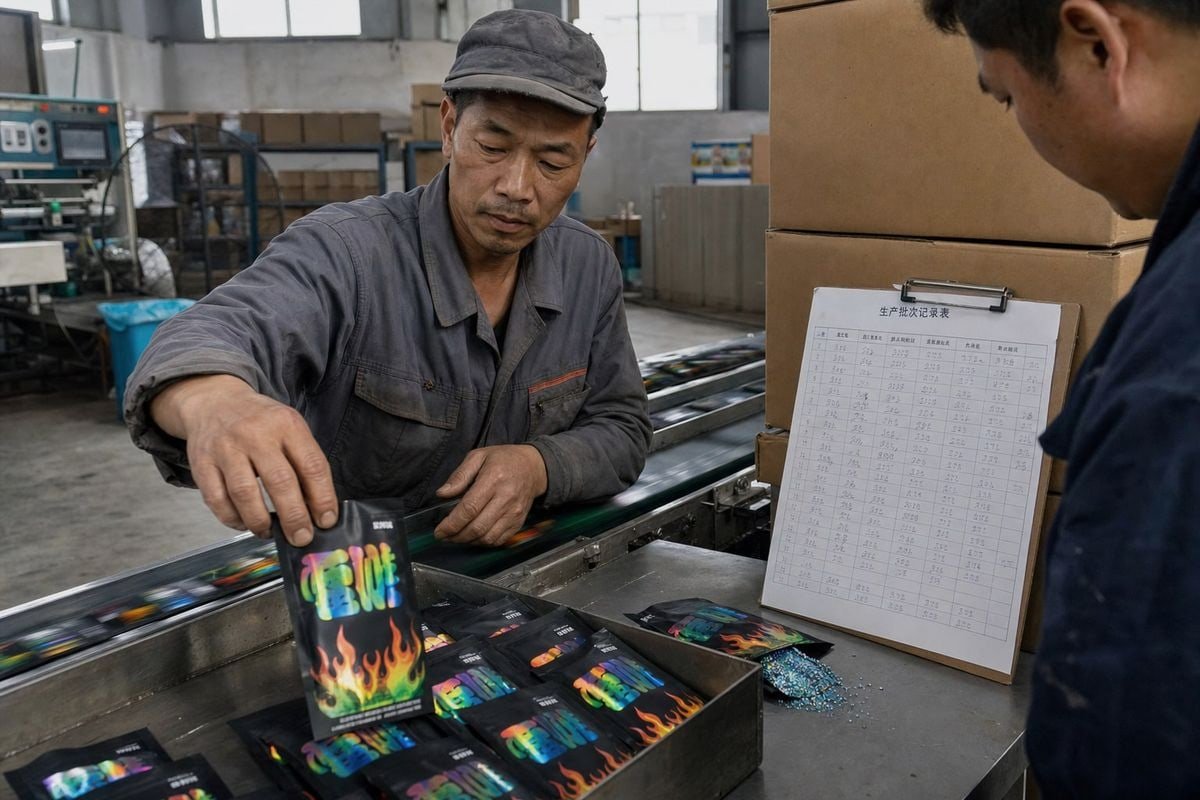
Consistency is where real factories separate themselves from resellers. A trading company can send you one beautiful sample. Only a factory with complete production lines and disciplined process control can send you the same product on the tenth container. After seventeen years running our own lines, I can tell you that consistency is built through documentation, checked at every stage.
The Batch Documentation Chain
Think of it as a chain with four links. If any link is missing, traceability breaks.
| Stage | Document | What to Check |
|---|---|---|
| Raw material intake | Incoming inspection record | Supplier lot ID, purity check, moisture reading |
| Mixing and production | Batch production record | Formula version, equipment, operator sign-off |
| Finished product | Certificate of Analysis (CoA) | Assay, moisture, particle size 7, impurities vs. limits |
| Pre-shipment | Burn test report and retained sample log | Flame color, burn duration, ignition behavior |
How to Use These Documents as a Buyer
First, approve a golden sample and have both sides sign it. Every future CoA gets compared against that baseline. Second, write CoA delivery into your purchase contract as a shipment condition. No CoA, no payment release. Third, ask whether the factory keeps retained samples from each lot. We hold ours so that if a customer reports drift in color or burn time, we can test the exact batch side by side with the complaint sample. Fourth, request particle size data specifically. Powder that is milled too fine creates dusting and inhalation concerns; too coarse, and the color effect weakens. A supplier tracking this per batch is a supplier actually controlling the process.
Conclusion
Colored flames sell themselves; undocumented powder sinks businesses. Demand the full SDS, verified certifications, regulatory cross-checks, and batch CoAs, and partner only with factories that provide them without hesitation.
Footnotes
1. Explains globally harmonized SDS structure referenced throughout the article ↩︎
2. Official EU chemical regulation referenced for import compliance screening ↩︎
3. Official ISO source defining the quality management certification discussed ↩︎
4. US Consumer Product Safety Commission oversees hazard classification cited in the article ↩︎
5. Official EU classification and labeling framework mentioned in the compliance table ↩︎
6. Background on transport classification codes referenced for dangerous goods documentation ↩︎
7. Technical background on particle size measurement relevant to batch consistency testing ↩︎



 English
  Spanish
  German
  French
  Arabic
  Portuguese
Join the Conversation