






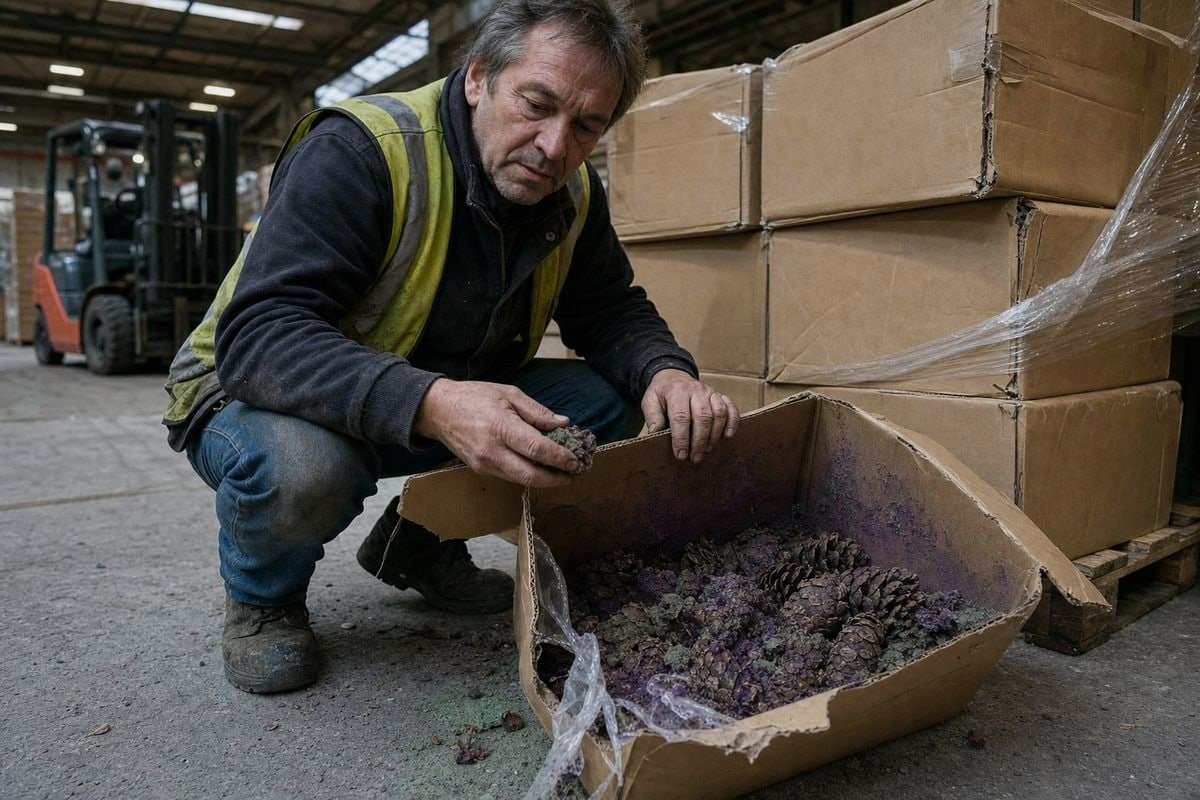
Fireplace colored pine cones look sturdy, but our shipping records tell a different story final-mile delivery 1. Early in our export business, I watched a whole pallet arrive in Germany covered in colored dust.
Fireplace colored pine cones commonly suffer crushing, broken scales, coating abrasion, colorant powder leakage, and moisture-induced clumping during shipping. Brittle natural cones, chemical flame colorants, and weak packaging combine to cause dusting, staining, and residue transfer unless sealed inner bags, cushioning, and crush-resistant cartons are used.
The buyer who received that dusty pallet nearly canceled a long-term contract. Since then, we have rebuilt our packaging process from the ground up. Below, I will walk you through the exact standards, checks, and tests that protect a container of colored pinecones from factory floor to your warehouse.
What packaging standards should I require to prevent color-flame pinecone leakage during long-distance shipping?
Years ago, a Dutch distributor sent me photos of green powder coating the inside of a master carton. That single claim taught our team more about fragile item packaging than any textbook could.
Require sealed inner pouches or heat-sealed bags for each retail unit, food-grade desiccant inside master cartons, double-wall corrugated boxes rated for stacking, void fill to stop movement, and moisture-resistant barriers such as PE liners. These five layers prevent both physical breakage and colorant powder leakage.
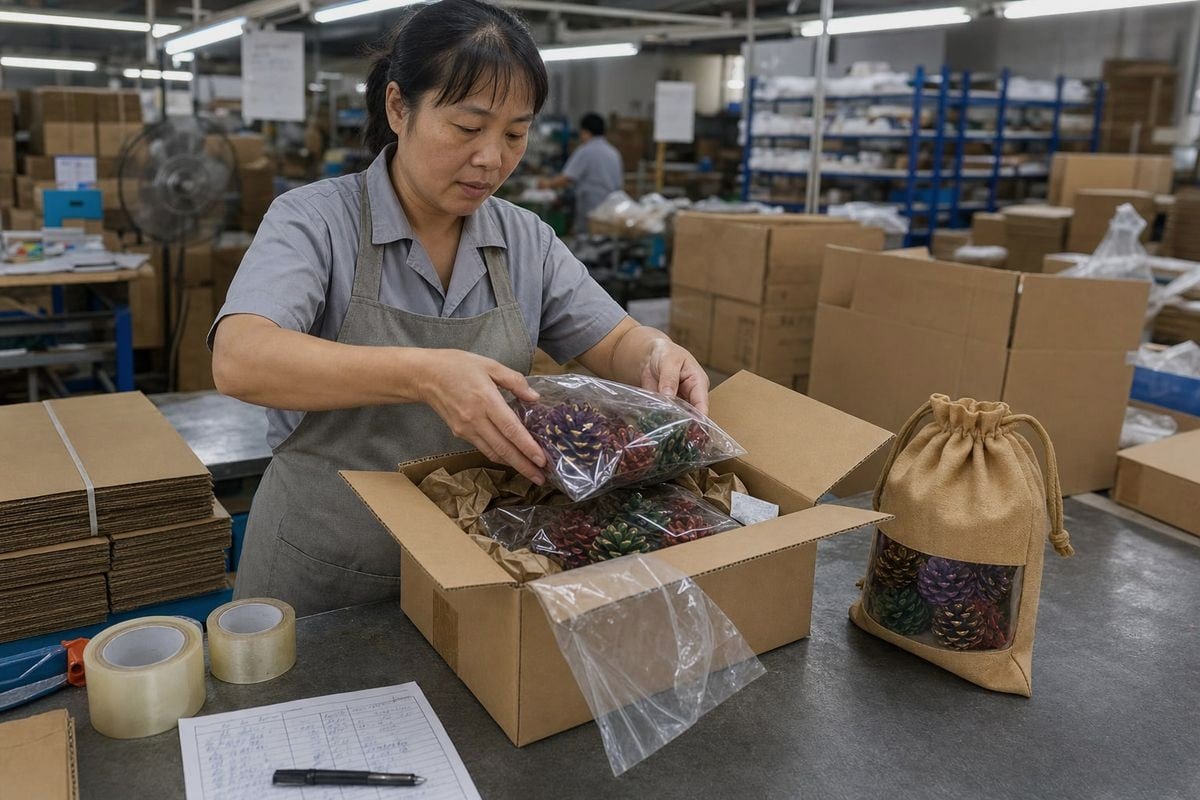
Leakage from colored pinecones almost never comes from one failure. It comes from a chain of small weaknesses. The cone sheds a little dust from vibration. A thin bag develops a pinhole from a sharp scale tip. Humidity makes the chemical flame colorants 2 slightly tacky. Then a drop during final-mile delivery bursts the weakened seal. To stop the chain, you need to break every link.
The five packaging layers you should specify
In our Ningbo production facility, we apply a layered standard to every export order. I recommend you write these requirements directly into your purchase order:
| Layer | Requirement | What it prevents |
|---|---|---|
| Primary bag | Heat-sealed PE or resealable pouch, minimum 8-wire thickness | Colorant dust escaping, moisture entry |
| Inner cushioning | Paper or air pillow void fill around cones | Abrasion, rattling, broken scales |
| Retail packaging | Kraft pouch, jar, or burlap sack with sealed liner | Residue staining the display packaging |
| Master carton | Double-wall corrugated, edge crush tested | Compression from pallet stacking |
| Pallet protection | Stretch wrap plus corner boards | Shifting, rain exposure, forklift damage |
Why moisture control matters as much as cushioning
Many buyers focus only on impact-resistant boxes 3 and forget humidity. That is a mistake. Some chemical salts used in flame colorants are hygroscopic. They pull water from the air. In a sea container 4 crossing the equator, condensation cycles 5 can turn a dry coating into a damp, smearing residue. Desiccant packs and PE liners cost pennies per carton. A claim for staining from chemical dyes across five hundred cartons costs far more. We learned this the hard way on an early Brazil shipment, and we have shipped with desiccant ever since.
Ask about scale-tip protection
Brittle pine cone scales act like tiny knives inside a bag. Sharp tips puncture thin film during vibration. A good factory either tumbles cones to remove loose scales before coating or uses thicker film. Ask your supplier which method they use.
How can I verify a supplier's quality control process reduces damage rates before placing a bulk order?
A UK fireplace brand once asked me to video-call directly from our coating line before signing. That request was smart, and honestly, I wish more purchasing managers made it.
Verify quality control by requesting the supplier's QC checklist, batch inspection records, drop-test and vibration-test videos, coating adhesion test results, and a live factory video audit. A real factory with strict batch-to-batch controls can show documented evidence within days, not weeks.
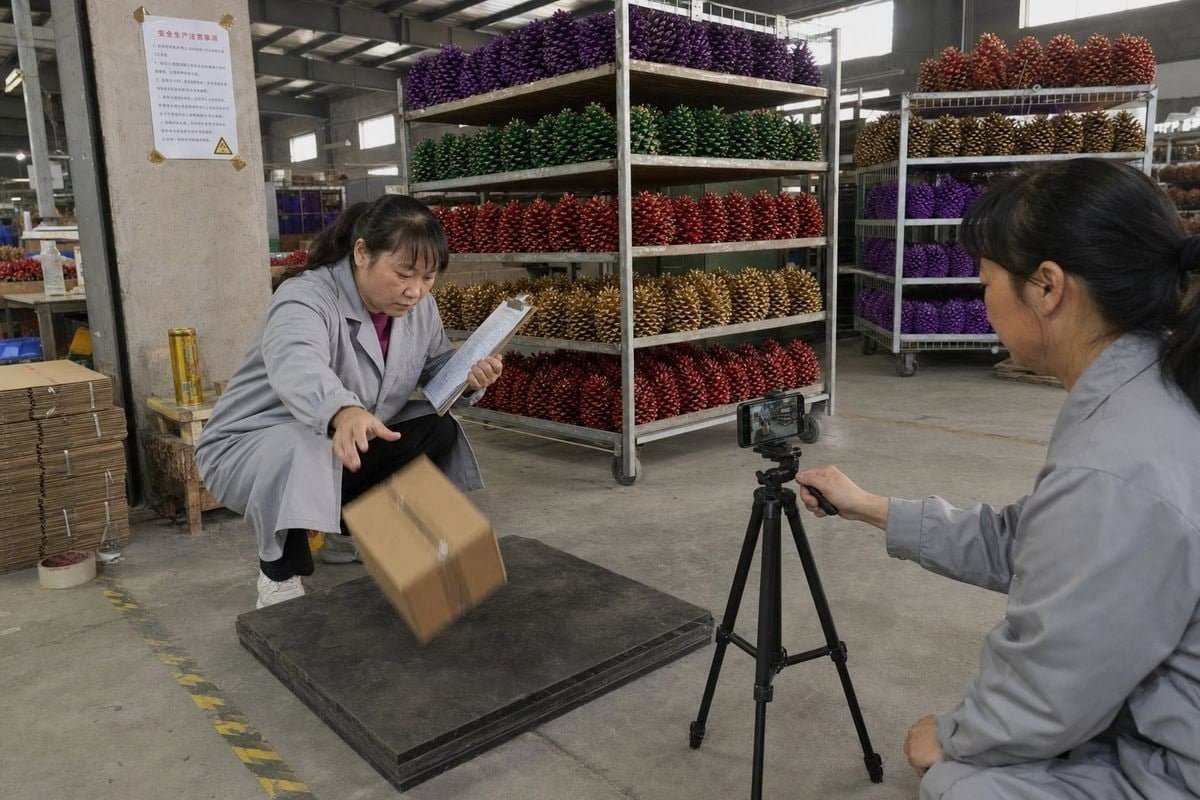
Damage rates are decided long before a container reaches the port. They are decided at the coating tank, the drying rack, and the packing table. So your verification should target those exact points. After 17+ years running color-flame production lines, I can tell you the difference between a factory and a trading company shows up fastest in QC documentation. A trading company sends you a brochure. A factory sends you inspection sheets with dates, batch numbers, and inspector signatures.
A practical verification sequence
- Request the written QC flow. It should cover raw cone selection, coating application, drying time, moisture testing, and pre-pack inspection. Vague answers are a warning sign.
- Ask for adhesion and dusting test evidence. We shake sample bags for a fixed time and weigh the loose powder. If the supplier has no dusting metric, they have no leakage control.
- Check moisture testing before packing. Cones packed damp will clump, close up, and stain the bag. Ask what moisture level triggers a rejection.
- Watch a recorded or live drop test. A packed master carton should survive corner and edge drops without inner bag rupture.
- Review batch consistency records. Color cross-contamination between treated batches leads to inconsistent flame colors. Separate coating batches and labeled drying racks prevent it.
- Confirm final random inspection. Ask what AQL sampling level they apply and whether you can appoint a third-party inspector such as SGS or Intertek.
What consistent QC looks like in practice
On our lines in Ningbo, every batch gets a traceable code. If a buyer in Poland reports excess dusting, we can pull the retained sample from that exact batch and compare. That traceability is what actually reduces damage rates over repeated orders, because problems get fixed at the process level, not argued over by email. When your first sample matches mass production, you know the factory controls its variables. When it does not, no packaging will save the relationship.
What certifications or test reports confirm my colored pinecones will pass customs and safety inspections after transit?
Compliance paperwork is where we see importers get burned most often. One prospective buyer came to us after customs held his previous supplier's shipment for six weeks over missing safety documentation.
Request SGS or Intertek test reports covering heavy metal content, an MSDS for the flame colorant formula, transport classification confirming the product is not a regulated flammable solid, plus supplier certifications such as ISO 9001, BSCI, and CE where applicable. These documents satisfy most US and EU customs checks.
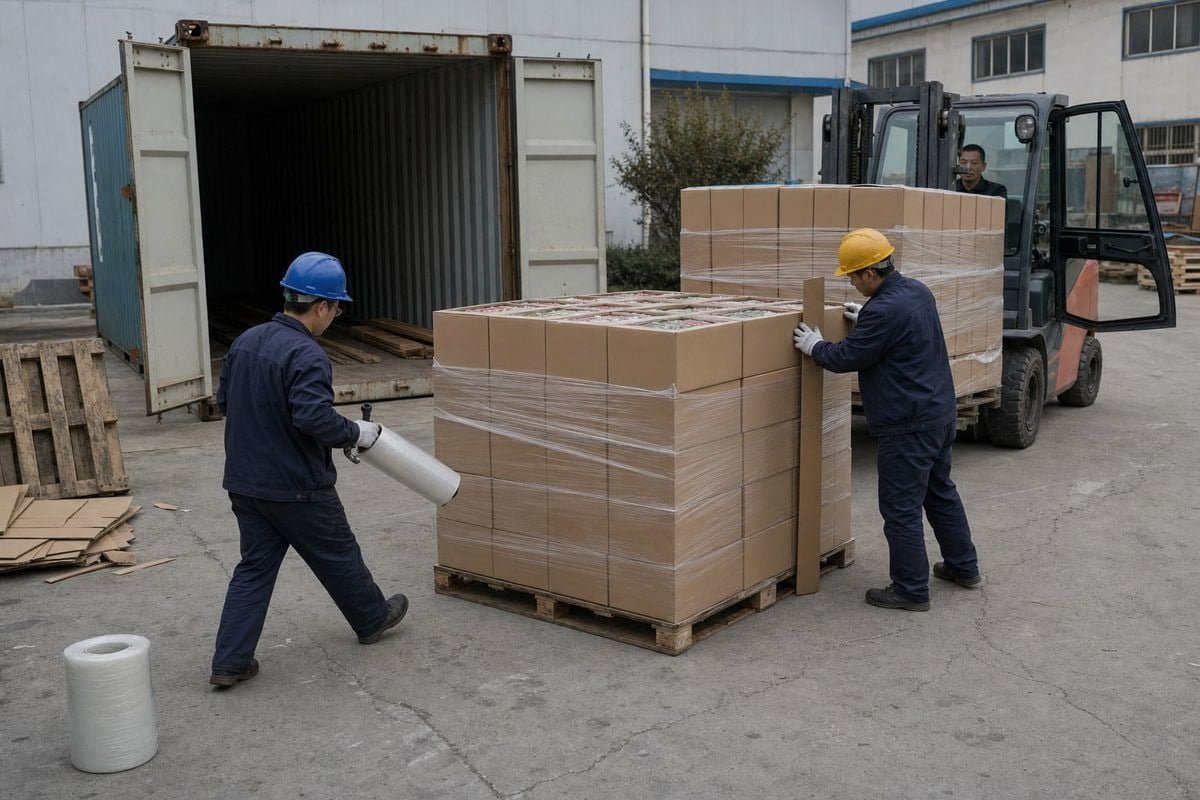
Customs officers do not open every carton. They open the ones with incomplete or suspicious paperwork. Color-flame products sit in a gray zone for some inspectors: the product contains chemical flame colorants, so officials may ask whether hazardous material shipping regulations apply. Your job is to make the answer obvious and documented before the container ships.
The core document set
| Document | What it proves | Who issues it |
|---|---|---|
| SGS / Intertek test report | Heavy metal limits, chemical safety of the coating | Third-party lab |
| Material Safety Data Sheets | Composition, handling, and transport data for the colorant | Manufacturer, lab-verified |
| Transport classification statement | Not classified as a flammable solid 6 or dangerous good | Manufacturer with lab support |
| ISO 9001 certificate | Consistent quality management system | Certification body |
| BSCI audit report | Ethical and social compliance of the factory | Audit body |
| CE documentation | EU market conformity where applicable | Manufacturer / notified process |
Why the formula itself matters for clearance
Some low-cost suppliers still use copper sulfate residue or other heavy metal salts 7 in raw, uncoated form. Those formulations can trigger flammable solid classification questions, higher freight surcharges, or outright rejection. Eco-friendly formulations without harmful chemicals — the standard we hold across all our Magic Fire packets, wax torches, and colored pinecones — clear customs cleanly precisely because the test reports show nothing to worry about. We provide the full document set with every export order, because for our buyers in the US, Germany, and the UK, compliance is a hard requirement, not a nice-to-have.
Do not forget pest documentation
Natural pinecones are a plant product. Some markets require heat-treatment or fumigation evidence to rule out wood-boring pests. Ask your supplier how cones are treated before coating, and get it in writing.
Should I request a trial shipment to check packaging durability before committing to a full container order?
The trade-off here is real, and I discuss it with buyers every season: a trial shipment adds weeks to your timeline, but it removes the single biggest risk in this category.
Yes. Order a trial shipment of 50 to 200 units through your actual freight route before a full container. It reveals real-world crushing, dusting, and moisture problems that samples cannot, and it costs a fraction of one damaged container claim.

A trial shipment is not a bigger sample. It is a stress test of the entire logistics chain — the same cartons, the same palletization, ideally the same shipping lane your bulk order will travel. Air-freighted samples skip the exact conditions that break colored pinecones: weeks of low-frequency container vibration, stacked pallet pressure, and temperature swings that cause condensation inside cartons.
How to run a trial shipment that actually tells you something
Do not just receive the boxes and glance inside. Inspect systematically:
- Photograph everything before opening. Document carton condition, corner crush, and tape integrity for future claims.
- Weigh the loose powder. Empty one inner bag over white paper. Visible colored dust means abrasion protection failed.
- Check for staining. Look for chemical dye marks on the retail pouch, the clear display window, and the master carton interior. Static-clinging dust on display windows kills retail presentation.
- Test the cones. Burn a handful. Confirm the flame color matches the sample batch and that no clumping or fusing occurred in transit heat.
- Count broken scales. Set an acceptance threshold, for example no more than a small percentage of cones with visible scale loss.
The cost logic
| Option | Upfront cost | Risk exposure |
|---|---|---|
| Skip trial, order full container | Lowest initial spend | One packaging flaw multiplied across thousands of units |
| Trial shipment first | Small extra cost and 3–5 weeks | Flaws found and fixed at 200-unit scale |
We keep MOQs flexible for exactly this reason. A buyer who tests our packaging on a small run in October becomes a repeat container customer by the next season, because both sides have proof the system works. In my experience exporting to 30+ countries, the buyers who skip trials are the ones filing claims in December — their peak sales window.
Conclusion
Colored pinecones fail in transit through crushing, dusting, and moisture leakage. Demand layered packaging, documented QC, full compliance reports, and a trial shipment — then ship with confidence.
Footnotes
1. Explains the logistics of the final stage of delivery where goods face the highest handling risk. ↩︎
2. Technical details on chemical compounds used to produce colored flames in consumer products. ↩︎
3. The international standard for corrugated board packaging design and structural classifications. ↩︎
4. Official safety and regulatory standards for the use and transport of intermodal sea containers. ↩︎
5. Scientific explanation of the phase change from gas to liquid, critical for understanding container rain. ↩︎
6. Official safety criteria for classifying solid materials that pose a fire hazard during transport. ↩︎
7. Scientific overview of heavy metals, the chemical basis for flame-coloring agents. ↩︎



 English
  Spanish
  German
  French
  Arabic
  Portuguese
Join the Conversation