







REACH do Reino Unido 1 SVHC notification for wood fire starters trips up many importers. One missing document at customs, one outdated declaration — and a whole container sits frozen. I've watched buyers panic over this. After 17+ years running our fire-starter production lines, I can tell you the fix is a clear, repeatable checking process.
To check UK REACH SVHC notification for wood fire starters, break the product into components, confirm no HSE Candidate List substance exceeds 0.1% w/w in any part, verify annual tonnage stays under 1 tonne per SVHC, and collect supplier declarations plus SGS or Intertek test reports as proof.
That is the short answer. Now let me walk you through each step, the exact documents to request, and what happens if a product fails.
What documents do I need to verify UK REACH SVHC compliance for my supplier?
A UK distributor once emailed our team a single question: "Send me your REACH certificate." The problem is, no such single certificate exists. Compliance for articles like our wax-dipped wood rolls is proven through a documentation package, not one magic paper.
You need an SVHC declaration referencing the current HSE Candidate List, component-level material declarations, third-party test reports from labs like SGS or Intertek, safety data sheets for any mixture components such as paraffin wax, and a signed supplier compliance statement with dates and batch references.

Let me be blunt with you: many suppliers will send an old EU REACH statement and hope you do not notice. Since January 2021, the UK Lista de Candidatos 2 maintained by HSE has diverged from the ECHA list. A substance added by ECHA may not yet appear on the HSE list, and vice versa. So the first thing I check on any declaration is which list it references and the date it was screened.
A lista de verificação de documentos principais
Here is the exact package we prepare for our UK buyers, and what each document proves:
| Documento | O que prova | Red flag to watch for |
|---|---|---|
| SVHC declaration (HSE list) | No Candidate List substance above 0.1% w/w per component | References only the ECHA/EU list |
| Component material declaration | Full breakdown: wood fiber, wax, packaging, inks | Only covers the finished product |
| Relatório de teste SGS ou Intertek | Independent lab screening of actual samples | Report older than the latest list update |
| SDS for wax or gel components | Hazard data for mixture parts like paraffin | Missing GB CLP alignment |
| Signed compliance statement | O fornecedor aceita responsabilidade legal | No date, batch, or signature |
Why the date on every document matters
The HSE updates the Candidate List periodically. New SVHCs, including groups such as brominated flame retardants 3, get added. A declaration screened against last year's list may already be incomplete. Our compliance team re-screens our wood firestarter materials whenever the list changes, then reissues declarations to our distributors. Ask your supplier when they last did this. If they cannot answer, that silence tells you everything.
Keep every document filed. HSE audits can request historical composition records, and the general guidance is to retain SVHC compliance records for at least 10 years after last supply.
How do I know if my wood fire starters contain restricted SVHC substances?
During product development for our wax-dipped wood rolls, we learned early that regulators do not see a "simple fuel product." They see an article made of separate components — and each one gets judged on its own. That mindset changes how you check everything.
Identify every component — wood fiber, wax binder, coatings, inks, adhesives, and packaging — then screen each against the current HSE UK REACH Candidate List using CAS or EC numbers. Any Candidate List substance above 0.1% w/w in any single component triggers legal information duties.
O 0.1% threshold 4 is the heart of this check. But here is what most first-time importers get wrong: the threshold applies at the individual article level, not the finished product level. A tiny printed label or a plastic film wrap is its own article. If that small part contains an SVHC above 0.1% of its own weight, the duty applies — even if the substance is a rounding error in the total product.
Break the product down first
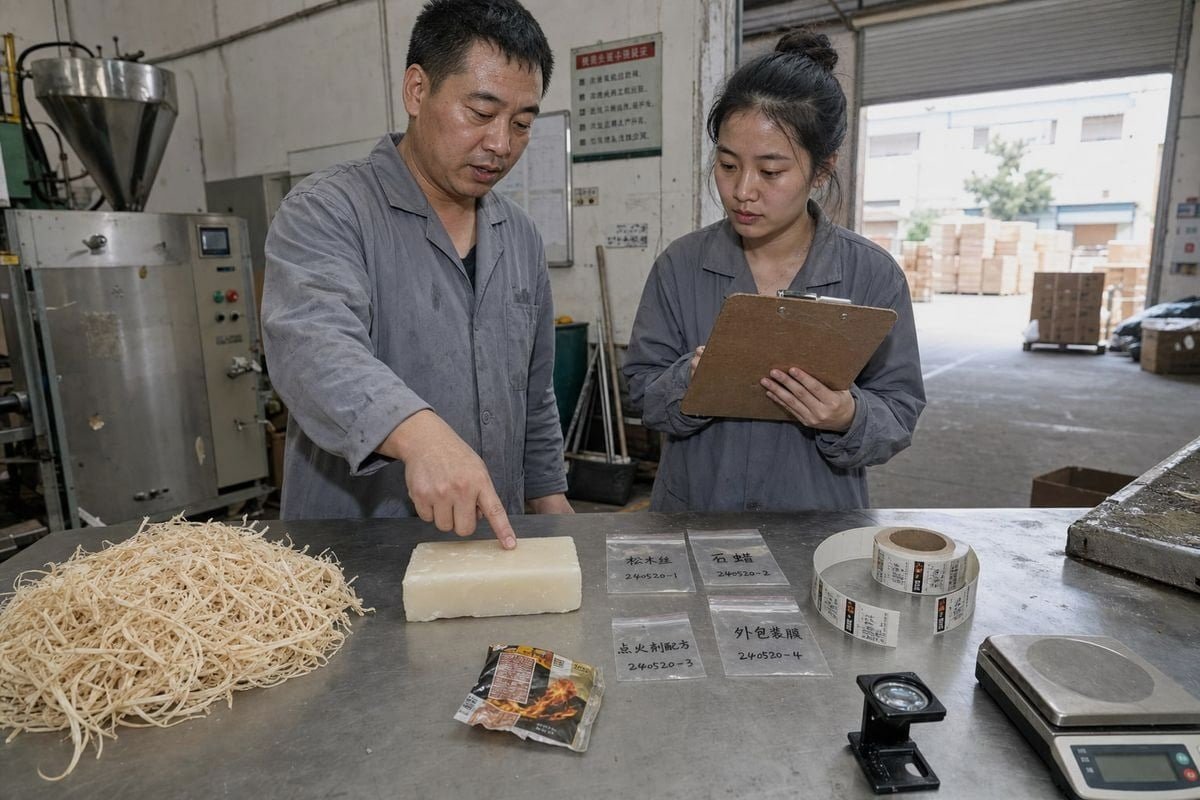
For a typical wood fire starter like ours — 50% wood fiber, 50% paraffin by composition — the components to list usually include:
- The wood wool or wood shaving core
- The wax or paraffin binder
- Any wood treatment or preservative (if used)
- Printing inks on the retail box
- Adhesives on labels or packaging seams
- Plastic film, sleeves, or display packaging
Screen by CAS number, not trade name
Supplier terminology for waxes, resins, and treatments varies wildly. One supplier's "food-grade wax" is another's "paraffin blend 52/54." So we always match by CAS or EC number 5 against the HSE database. Trade names prove nothing.
Pay particular attention to treated wood. If any accelerant or preservative is used, screen specifically for hidrocarbonetos aromáticos policíclicos 6 such as anthracene oil or coal tar-derived compounds — these are known SVHCs associated with treated wood products. Our own approach avoids the problem at the source: we use untreated natural wood and clean paraffin, with no preservatives added. But you should never assume that. Ask, and get it in writing.
Watch the packaging too
Packaging components can be separate articles. Plasticizers in films and certain flame retardants in synthetic parts are realistic screening targets. Do not let a compliant core product fail because of a non-compliant blister pack.
Can my supplier provide valid SGS or Intertek test reports for UK REACH?
Here is a trade-off we weigh constantly at our Ningbo facility: de terceiros costs real money per batch, but it is the only proof that survives a customs query or a retailer audit. That is why SGS e Intertek 7 reports sit at the core of our export files, alongside our ISO 9001, BSCI, and CE credentials.
A capable supplier can and should provide SGS or Intertek test reports showing SVHC screening of actual product samples against the current HSE Candidate List. Valid reports include the lab's letterhead, report number, tested sample description, test methods, screening date, and results per substance.

Not every document with an SGS logo is worth your trust, though. Over the years, buyers have forwarded us "reports" from competitors that fell apart under thirty seconds of scrutiny. So let me show you how we teach our own distributors to verify a report before they rely on it.
How to validate a test report
| Verificação | What a valid report shows | What a weak report shows |
|---|---|---|
| Report number | Unique ID verifiable with the lab directly | No number, or number the lab cannot confirm |
| Sample description | Matches your exact product and materials | Generic description or a different product |
| Test scope | SVHC screening against the current HSE Candidate List | Only older list versions, or EU-only scope |
| Date | Recent, ideally after the latest list update | Several years old |
| Applicant | Your actual supplier's legal name | An unrelated trading company |
Both SGS and Intertek let you verify report authenticity through their official channels using the report number. We encourage every buyer to do this — it costs nothing and filters out fabricated paperwork instantly.
One report is not forever
A test report is a snapshot of one sample at one date. Two things can invalidate it: the HSE adds new substances to the Candidate List, or the supplier changes a raw material. This is where manufacturing depth matters. Because we run complete production lines with strict batch-to-batch quality control, the material recipe your tested sample used is the same recipe in mass production. When we do change a material — say, a new wax source — we retest before shipping. Ask your supplier how they handle both scenarios. A vague answer means the report on your desk may already describe a product that no longer exists.
What happens if my fire starters fail UK REACH SVHC notification requirements?
A European buyer once came to us after a bad experience elsewhere: goods held, retailer listing pulled, and a scramble to prove composition data he never collected. Watching him rebuild that paper trail taught me more about enforcement reality than any guidance document.
If a Candidate List SVHC exceeds 0.1% w/w, you must inform recipients with at least the substance name and answer consumer requests within 45 days. If your annual tonnage of that SVHC exceeds 1 tonne, you must notify HSE within six months of the substance's listing — or face enforcement, blocked shipments, and delisting.

Failing is not one single event. It unfolds in stages, and each stage has a different cost. Let me break down the two-part legal test first, because it decides which duties you actually hold.
The two-part test that decides your duties
| Condição | Duty triggered | Deadline |
|---|---|---|
| SVHC above 0.1% w/w in any component | Communicate substance name and safe-use info to customers | With supply; consumer requests within 45 days, free of charge |
| Same SVHC above 0.1% AND totaling over 1 tonne/year | Submit notification to HSE via the Comply with UK REACH system | Within 6 months of Candidate List addition |
Notice the direction of the logic. The communication duty stands alone — it applies even at low volumes. The notification duty stacks on top only when tonnage crosses 1 tonne per year per importer or producer. Small importers often owe communication duties but not notification. Large ones may owe both.
The real-world consequences of failure
If you miss these duties, expect problems in this order. First, commercial damage: major UK retailers audit SVHC files, and a missing declaration gets your product delisted fast. Second, supply chain freezes: downstream customers must pass information onward, so your gap becomes their gap, and they stop buying. Third, regulatory action: HSE can enforce against producers and importers who fail to notify, and unlike the EU's SCIP database, the UK has no public article database — meaning your private documentation trail is the only defense in an audit.
The practical fix is prevention. Choose suppliers who screen at component level, retest after list updates, and hand you a complete file before the goods ship. That is precisely how we structure our OEM and projetos de marca própria: compliance documents, warning labels, and barcodes are prepared alongside the packaging, so the product arrives shelf-ready and audit-ready at the same time.
Conclusão
Unchecked SVHC gaps can freeze shipments and kill retail listings. Break your wood fire starters into components, screen against the current HSE list, verify lab reports, and file everything — compliance becomes routine.
Notas de rodapé
1. Official HSE portal explains UK REACH regulatory framework and SVHC obligations for importers. ↩︎
2. HSE maintains the official UK Candidate List referenced throughout SVHC compliance checks. ↩︎
3. Background on this SVHC chemical group helps readers understand what gets added to Candidate Lists. ↩︎
4. HSE guidance clarifies how the 0.1% w/w SVHC threshold applies at the article level. ↩︎
5. Background on CAS numbering system used to identify substances during SVHC screening. ↩︎
6. Explains the chemical class linked to treated wood SVHC risks mentioned in the article. ↩︎
7. Official testing lab site lets buyers verify authenticity of SVHC compliance test reports. ↩︎



 English
  Spanish
  German
  French
  Arabic
  Portuguese
Participe da conversa