







Verifying supplier eco-friendly claims for colored pine cones sounds simple until a shipment lands and the paperwork falls apart FSC or PEFC chain-of-custody 1. On our production line, I've seen buyers burned by vague promises. One recall, one failed customs check, and a season's profit disappears — unless you verify before you buy.
To verify supplier eco-friendly claims for colored pine cones, request FSC or PEFC chain-of-custody numbers, Material Safety Data Sheets for dyes, third-party lab reports covering heavy metal testing and REACH compliance, then confirm every certificate in public registries and match its scope to your exact SKU and factory.
That answer covers the essentials. But each step has traps. Below, I walk through certifications, chemical checks, lab reports, and red flags — in the order a real sourcing process should follow.
What certifications should I request to confirm eco-friendly colored pine cone claims?
When we prepared our first color-flame pinecone export to Germany, our buyer rejected our initial documentation pack — not because it was wrong, but because it was too general. That lesson shaped how we handle certification requests today.
Request FSC or PEFC chain-of-custody documentation for the forest-based material, ISO 9001 for quality management, BSCI for social compliance, and CE marking where applicable. Always ask for certificate numbers, scope statements, and validity dates, then verify them in public registries like the FSC Certificate Search.

A logo on a box means nothing by itself. What matters is the certificate behind it, and whether that certificate actually covers the product in your purchase order. In our experience exporting to 30+ countries over 17 years, buyers who verify scope save themselves the most trouble.
The certifications that actually matter
Not every certificate carries the same weight for colored pine cones. Here is how I would rank them for this product category:
| Certification | What It Proves | How to Verify |
|---|---|---|
| FSC / PEFC chain-of-custody | Cones and forest materials come from responsibly managed sources | FSC Public Certificate Search or PEFC database |
| ISO 9001 2 | The factory runs a consistent quality management system | Certificate number checked with the issuing body |
| BSCI audit | Labor and social conditions meet ethical standards | Audit report with recent date and site address |
| SGS / Intertek test reports | Product-level chemical and safety testing | Report number confirmed directly with the lab |
| CE marking (where relevant) | Product meets applicable EU requirements | Declaration of Conformity from the supplier |
Scope is everything
A valid ISO 9001 certificate for a supplier's candle line does not cover their pinecone line. A parent company's FSC certificate does not automatically extend to a subcontractor's site. When you request documents, ask three questions every time: Which legal entity holds this certificate? Which factory site does it cover? Does the scope statement name this product category?
At Sunrich, we hold ISO 9001, BSCI, CE, and SGS/Intertek documentation, and we send certificate numbers proactively because serious buyers will check registries anyway. If a supplier hesitates to share a certificate number, treat that hesitation as data. Third-party sustainability audits are also worth requesting for larger programs, since they connect environmental claims to an inspected site rather than a marketing page.
How can I verify the raw materials and chemicals used are actually non-toxic?
There is a trade-off I weigh constantly in product development: vivid, saturated color versus a clean chemical profile. Cheap pigments deliver bright color fast. Getting the same effect with safer inputs takes more formulation work — which is exactly why you should scrutinize this step.
Demand a full Material Safety Data Sheet for every dye and coating, confirm the colorants are non-toxic water-based dyes free from lead, cadmium, and other heavy metals, and request REACH or Prop 65 compliance statements. Written composition disclosure beats verbal reassurance every time.

The pine cone itself is rarely the risk. It is a natural, renewable material. The verification burden sits almost entirely on what gets applied to it: the colorants, any preservatives, sealants, and — for fire-use products like ours — the color-flame compounds. So your questions should target the coating process, not the cone.
Start with the Material Safety Data Sheet
An MSDS (or SDS) lists chemical composition, hazard classifications, and handling requirements. For colored pine cones, read it for three things. First, the base of the colorant — you want non-toxic water-based dyes or vegetable-based pigments, not solvent-heavy industrial paints. Second, any listed heavy metals. Third, VOC content, which matters for indoor décor products.
Then go one level deeper. An MSDS is supplier-provided, so it should be backed by independent heavy metal testing 3 on the finished product. A document describing an ingredient is not the same as a lab result on the item you will actually sell.
Match the chemistry to the use case
This matters more than most buyers realize. Decorative pine cones and fire-use pine cones have completely different safety questions:
| Use Case | Key Chemical Question | Relevant Evidence |
|---|---|---|
| Decorative ornament | Does the coating off-gas or leach during handling? | VOC data, Prop 65 4 statement, migration testing |
| Fireplace / campfire product | What does the coating release when burned? | Combustion emission testing, SGS/Intertek reports |
| Compostable / garden claim | Does the finish qualify as a biodegradable decorative coating? | ASTM D6400 5 or EN 13432 documentation |
Our color-flame pinecones fall into the second row, which is the strictest. When something is designed to burn in a home fireplace, "no harmful chemicals" cannot be a slogan — it has to be a tested property. That is why we build REACH 6 compliance standards into formulation from the start rather than treating them as an export afterthought.
What test reports or lab results should I ask my supplier to provide?
A UK distributor once asked us for our full test file before placing even a trial order. I respected that. It took us one email to send the pack — and that speed itself told them something about how we operate.
Ask for third-party lab reports covering heavy metal testing, REACH SVHC screening, VOC emissions, and — for fire-use pine cones — combustion safety testing from labs like SGS or Intertek. Reports must show the exact product, a recent test date, and a verifiable report number.

Not all evidence is equal. Before we look at specific reports, it helps to rank the evidence you might receive, from strongest to weakest:
- Third-party certification verified in a public registry
- Recent independent lab reports on the finished product
- Audited chain-of-custody records and traceability documents
- Supplier questionnaires backed by supporting documents
- Marketing statements and product-page claims with no documentation
Anything from level five alone should never support a claim you print on retail packaging.
The core test report checklist
For colored pine cones, I recommend requesting these reports and checking each one against three criteria — product match, date, and lab identity:
| Test Report | What It Confirms | Watch For |
|---|---|---|
| Heavy metal screening | No lead, cadmium, mercury, or chromium in coatings | Report tests the colored product, not raw cones |
| REACH SVHC screening | No restricted substances above thresholds | Current SVHC list version, not an outdated one |
| VOC / emissions testing | Safe for indoor display or burning VOC emissions 7 | Test conditions match real consumer use |
| Combustion emission test | Safe byproducts when burned in fireplace or campfire | Only relevant labs; essential for fire-use SKUs |
| Compostability (if claimed) | Meets ASTM D6400 or EN 13432 | Claim covers the coated cone, not bare cones |
Verify the report, not just receive it
Legitimate labs let you confirm a report number directly. Call or email SGS or Intertek with the number, and they will confirm it exists and what it covers. Also check the tested sample description word for word. We have seen buyers accept reports where the tested item was "natural pine cones" while the shipped item was painted — a meaningless match. Batch-to-batch quality control matters here too: a two-year-old report on a discontinued dye formula proves nothing about this season's production. Ask when materials, dye suppliers, or production sites last changed, and request re-testing after any change.
Which red flags suggest a supplier's eco-friendly claims aren't credible?
Over 17 years of exporting fire products, I've reviewed a lot of competitor listings when buyers asked us to quote against them. The pattern is consistent: the vaguer the green language, the thinner the evidence file behind it.
Major red flags include vague terms like eco-chic without documentation, refusal to share certificate numbers, MSDS documents that don't match the product, certificates covering a different entity or site, no supply chain transparency, and eco claims that appeared only after you asked about sustainability.
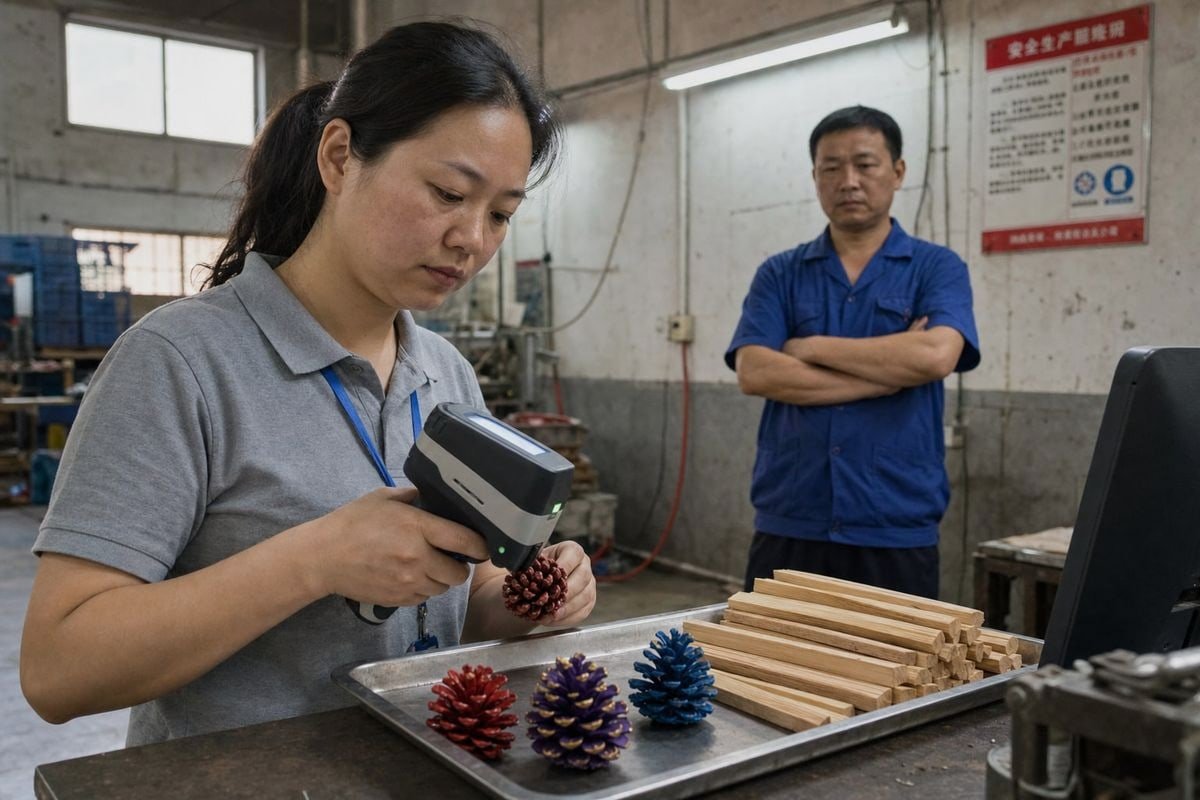
The fastest verification tool you have is a simple test: can the claim be rewritten as a checkable statement? "Eco-friendly" cannot. "Colored with water-based dyes, heavy-metal tested by SGS, report number available" can. If a supplier cannot survive that translation exercise, their claim is marketing, not fact — and regulators in both the US and EU increasingly treat unsubstantiated green claims as a legal liability for the seller, which means you, not just your supplier.
The red flag checklist
Here are the warning signs I would act on immediately:
- Vague language with no evidence pack. Terms like "earth-friendly" or "all-natural" with no specs, no MSDS, no reports.
- Certificate secrecy. They show a logo but will not provide the certificate number for registry checks.
- Scope mismatch. The certificate names a different company, factory, or product line.
- No traceability. They cannot tell you where cones were collected, processed, colored, and packed. Real supply chain transparency covers every step.
- No harvesting protocol. Wild-collected cones without documented sustainable harvesting practices can strip food sources from forest wildlife and deplete seed banks.
- Missing biosecurity treatment. No proof of heat treatment or ISPM 15 8-equivalent sterilization — an overlooked environmental risk that also creates customs exposure.
- Claims that shift under questioning. "Biodegradable" quietly becomes "made from natural materials" when you ask for standards.
One honest counterpoint
Some buyers push back: small artisan suppliers may not hold deep certification stacks, so shouldn't there be flexibility? I understand the instinct, but the answer is no — with a nuance. Flexibility can apply to which documents prove a claim, never to whether the claim is provable. A small workshop can still provide an MSDS, a harvesting description, and a single lab report. If a claim cannot be translated into testable language at any scale, it should not appear in your marketing. That is the standard we hold our own factory to, and it is the standard your customers' regulators will hold you to.
Conclusion
Vague green claims are a liability you inherit the moment you resell. Verify certificates in registries, demand product-specific lab reports, translate every claim into testable language — and partner with factories that document before you ask.
Footnotes
1. Authoritative source explaining chain-of-custody certification referenced repeatedly in the article. ↩︎
2. Official ISO page defining the quality management standard mentioned as a key certification. ↩︎
3. EPA resource on heavy metal and toxic chemical hazards relevant to lab testing requirements described. ↩︎
4. Wikipedia background on California's Proposition 65 chemical disclosure law mentioned in compliance context. ↩︎
5. Background on the standards body behind ASTM D6400 compostability standard referenced in the article. ↩︎
6. Official EU chemicals agency explains REACH compliance requirements cited multiple times in the article. ↩︎
7. EPA page on volatile organic compounds directly relevant to the VOC testing discussion. ↩︎
8. Background on the international phytosanitary standard for wood treatment referenced regarding biosecurity. ↩︎

 English
  Spanish
  German
  French
  Arabic
  Portuguese
Join the Conversation