







Verifying a supplier's delivery date for Magic Fire Powder orders sounds simple until a promised container misses your season. On our production floor, we've seen exactly how vague promises become missed shelf dates.
To verify a supplier's delivery date for Magic Fire Powder orders, request a written order acknowledgment tied to your PO number, confirm whether the date means dispatch or arrival, validate it against real production and shipping lead times, and document the confirmation in your tracker or ERP.
That is the short answer. The full process has more moving parts. Let me walk you through each step, from documents to shipping timelines, so you can verify dates with confidence.
What documents should I request to confirm a supplier's production timeline?
A buyer from Germany once asked our team for our production schedule before placing his first trial order. Smart move. Documents reveal what promises hide, and we respect buyers who ask.
Request a written PO acknowledgment with a line-item delivery date, a production schedule or milestone plan, a batch-specific Certificate of Analysis, raw material readiness confirmation, and packaging or labeling proofs. Together, these documents prove the timeline is real, not just a hopeful estimate.

Documents turn a verbal promise into a verifiable commitment. In my experience exporting color-flame products to 30+ countries, buyers who skip document checks almost always get surprised later. Buyers who insist on paperwork rarely do. Production schedule verification starts with one rule: every date must be written, dated, and tied to your PO number.
The core document checklist
Here is what I recommend you request, in order of priority:
| Document | What It Proves | When to Request |
|---|---|---|
| Written PO acknowledgment | Supplier accepted your order, quantity, and date | Within 24–48 hours of PO issue |
| Production schedule / milestone plan | Factory has slotted your order into real capacity | Before deposit payment |
| Batch Certificate of Analysis (CoA) | The batch was produced for your window | At production completion |
| Packaging and label proofs | Private-label artwork won't stall the line | Before production starts |
| Pre-shipment inspection 1 report | Goods are palletized and labeled as ordered | Before final payment |
Why the acknowledgment matters most
The PO acknowledgment is your anchor. It should restate the item, quantity, price, Incoterms 2, and the confirmed delivery date. If a supplier only replies "OK, no problem" by chat, that is not verification. That is a placeholder. At our factory in Ningbo, we send formal acknowledgments because we know serious distributors file them. This paper trail also builds supply chain transparency 3 between both sides. If a date later slips, the acknowledgment defines who committed to what, and when. Save every version. A revised date without a revised written confirmation is a red flag, not an update.
How can I tell if a supplier's promised lead time is realistic?
Every quoting season, I weigh a hard trade-off: quote the fast lead time buyers want, or the honest one our lines can hold. After 17+ years, honesty wins every time.
A realistic lead time matches the supplier's actual capacity, raw material availability, and order queue. Break the quoted time into production, packing, and transit stages, then compare it against industry norms and the supplier's past on-time performance. Suspiciously short quotes usually signal overselling.
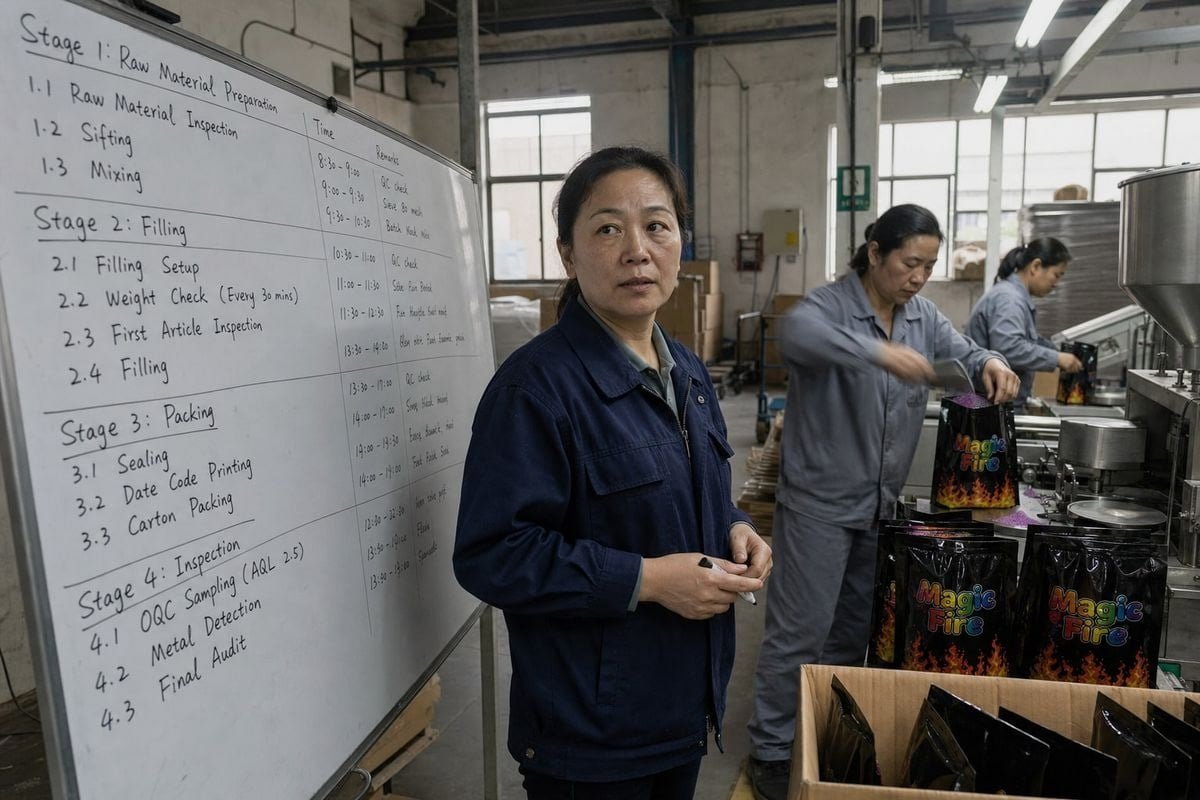
Lead time reliability is a supplier's most revealing trait. A factory that quotes honestly manages its schedule honestly. One that quotes whatever wins the order will keep improvising until your shipment slips. So how do you tell the difference before you pay a deposit?
Break the lead time into stages
Ask the supplier to split the total quote into stages. For a typical wholesale campfire colorant order, the breakdown looks like this:
| Stage | Typical Range | What Can Stretch It |
|---|---|---|
| Raw material preparation | 3–7 days | Ingredient shortages, regional supply issues |
| Production and sachet filling | 7–15 days | Order queue, line changeovers, custom formulas |
| Packing and private-label work | 3–10 days | Custom boxes, display packaging, barcode printing |
| Quality control and inspection | 2–5 days | Batch testing, third-party PSI scheduling |
| Booking and export handoff | 3–7 days | Vessel space, documentation, port congestion |
If a supplier cannot break down the timeline this way, they probably have not planned it. That alone tells you something.
Compare against context
Seasonality matters. Fire-product demand peaks before autumn and the holiday season, and fulfillment centers see heavy volume in specific months. I always advise buyers to add a 15–20% buffer during peak periods. Also ask whether your item is in-stock or a special order. In-stock goods might ship in days; a custom OEM run with private-label packaging is realistically weeks. Finally, ask about supplier performance metrics: what is their on-time delivery rate over the past year? A confident factory will share it. A vague answer is your answer.
What questions should I ask to check a factory's current production capacity?
During a video audit last year, a UK distributor asked to see our filling line running his neighbor's order. That single request told him more than any brochure could.
Ask how many production lines are running, what the current order backlog is, when your order enters the queue, whether raw materials for your batch are secured, and how many units per day the relevant line produces. Then request photo or video proof of your order's milestones.
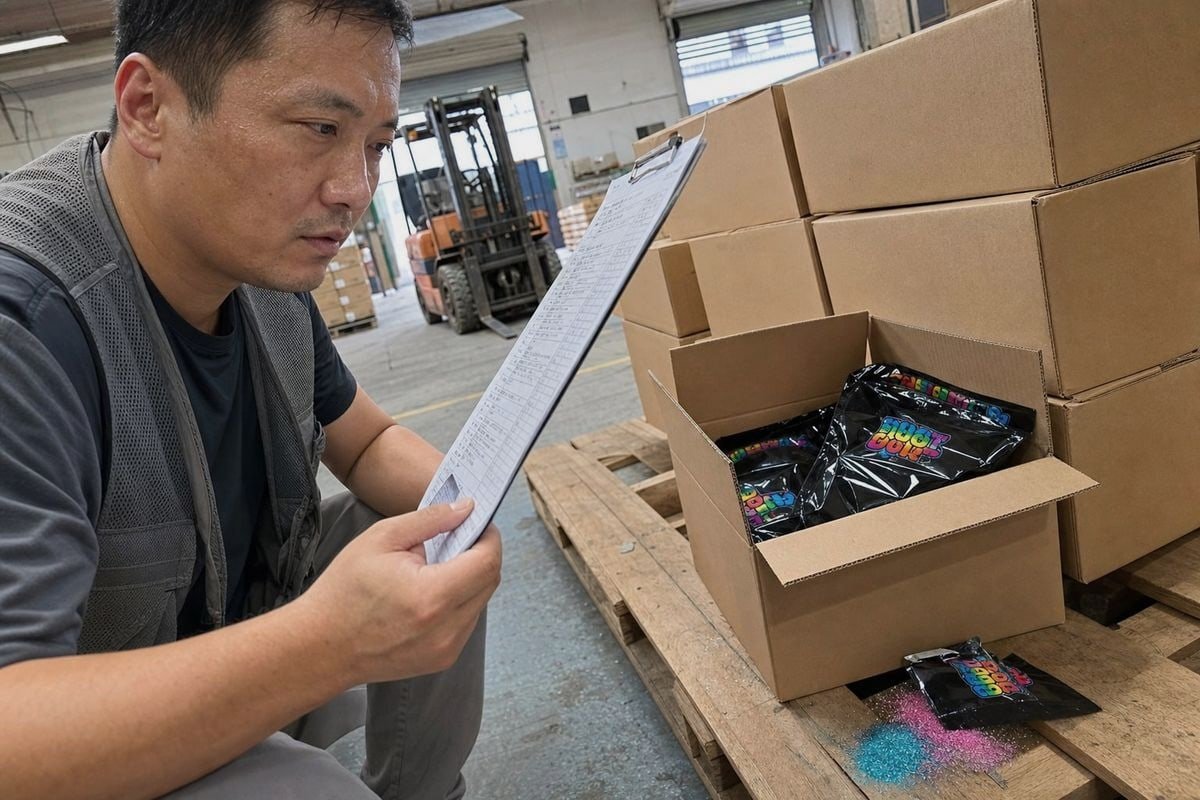
Capacity questions separate real factories from trading companies. A trading company can only relay answers. A genuine factory, like ours in Liuyang and Ningbo, can answer instantly and show you the floor. Here is the question set I would use if I were sitting on your side of the table.
The capacity question list
- How many lines produce this product, and how many are running now? This reveals real throughput, not theoretical maximums.
- What is your current backlog in weeks? A factory with a six-week queue cannot honestly promise three-week delivery.
- When exactly does my order enter production? Get a start date, not just an end date.
- Are raw materials for my batch already secured? Colorant compounds can face regional supply swings; confirmed materials mean the clock actually starts.
- What is your daily output for my SKU? Divide your order quantity by this number. Does the math support the promised date?
- Can you send milestone updates? Some buyers integrate ERP alerts via API; even simple photo updates at filling and packing stages keep order tracking status visible.
- Who handles QC, and can I book a third-party pre-shipment inspection? A confident factory welcomes SGS or Intertek at the door.
Verify the answers, don't just collect them
Answers are cheap. Cross-check them. Request a short live video of the line. Ask for the production schedule showing your slot. If the supplier holds ISO 9001 4 and BSCI certification, audit reports already document their capacity claims. We share ours with serious buyers precisely because it shortens this whole conversation. A supplier who resists visibility is asking you to buy on faith. In this product category, faith is not a sourcing strategy.
How do I verify shipping and customs timelines to avoid unexpected delays?
Years ago, a shipment to Rotterdam taught me a hard lesson: the factory finished early, but a misclassified shipping document held the container at port for two weeks.
Verify shipping timelines by confirming the product's transport classification, checking real vessel schedules with your freight forwarder, adding buffer for customs clearance at both ports, and clarifying whether the supplier's date means factory dispatch or arrival at your warehouse. Track milestones, not promises.
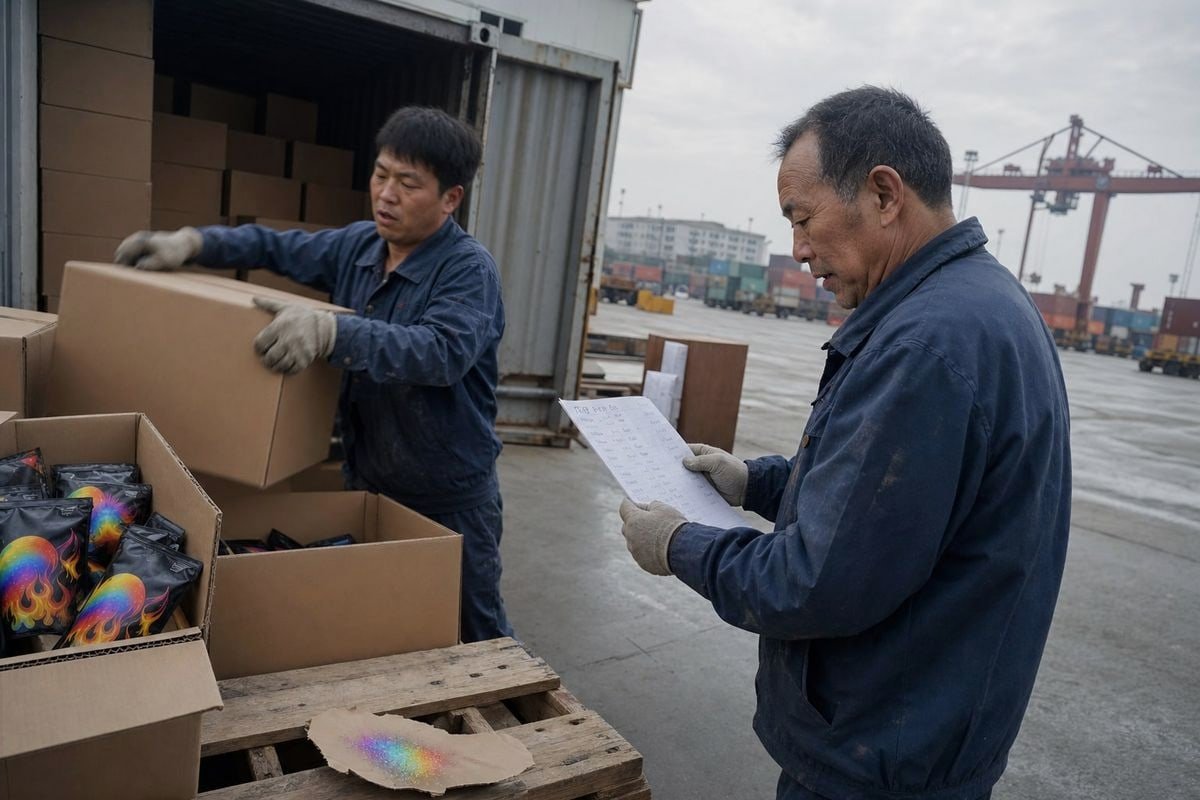
Factory readiness is only half the journey. The other half is transport, and this is where "delivery date" gets dangerously fuzzy. Always pin down which date the supplier means. Dispatch from the factory? Departure from port? Arrival at destination port? Delivery to your facility? These can differ by four to six weeks on international ocean freight.
The four dates that matter
| Date Type | What It Means | Who Controls It |
|---|---|---|
| Ex-factory / dispatch date | Goods leave the production facility | Supplier |
| Vessel departure date | Container sails from origin port | Carrier and forwarder |
| Estimated time of arrival (ETA) | Container reaches destination port | Carrier, weather, congestion |
| Delivered-to-door date | Goods arrive at your warehouse | Customs broker and trucker |
Classification and documentation
Confirm how your product is classified for transport before booking. Some novelty flame products face hazardous materials shipping 5 rules that restrict routes or require ground-only legs, which adds days or weeks. Our color-flame packets are made from eco-friendly materials without harmful chemicals, and we provide SGS and Intertek test reports so customs classification goes smoothly. Whatever supplier you use, get the test reports and MSDS upfront. Then check the shipping documentation package: commercial invoice, packing list, and Bill of Lading 6. Cross-reference the BoL weight against your ordered volume before accepting delivery. Finally, lean on professional freight forwarding services 7 for realistic transit quotes. Forwarders see actual port congestion and sailing schedules; suppliers often just repeat last quarter's transit times. Build in a customs buffer of three to seven days per port, and track the container yourself through the carrier portal so "label created" never gets mistaken for "on the water."
Conclusion
A missed delivery date can cost you a whole selling season. The fix is process, not hope. Verify documents, question capacity, split the lead time, and track shipping milestones in writing.
Footnotes
1. Explains the third-party inspection process referenced for verifying goods before shipment. ↩︎
2. Incoterms define delivery responsibilities referenced in the PO acknowledgment discussion. ↩︎
3. WTO resource on trade facilitation relevant to documentation-driven supply chain transparency. ↩︎
4. Official ISO page explaining the quality management certification mentioned in the article. ↩︎
5. US federal guidance on hazmat transport rules relevant to novelty flame product classification. ↩︎
6. Background on this key shipping document mentioned in the documentation package check. ↩︎
7. Background concept explaining the role of forwarders in verifying realistic transit times. ↩︎



 English
  Spanish
  German
  French
  Arabic
  Portuguese
Join the Conversation