







Verifying "natural" and "no chemical additives" claims on pine cone labels is harder than it looks volatile organic compounds 1. I learned this the hard way when auditing our own supply chain in Ningbo. Many suppliers print those words with zero documentation behind them. If you import a container of mislabeled pinecones, you inherit the legal risk, the recall cost, and the damage to your brand. The good news: with the right paperwork and a clear checklist, you can separate real claims from marketing fluff before you pay a deposit.
To verify "natural" and "no chemical additives" claims on pine cone labels, request a Safety Data Sheet, third-party lab testing reports from SGS or Intertek, a phytosanitary certificate proving heat treatment, and full ingredient disclosure. Then cross-check these documents against the supplier's actual production process and raw materials.
That is the short answer. Below, I break down each document, what it proves, what it does not prove, and the red flags I watch for after 17 years in this trade.
What certifications should I request to confirm pine cone fire starters are truly chemical-free?
A German distributor once asked me for eleven separate documents before placing his first trial order. At our Liuyang headquarters, we now keep that exact file ready for every buyer.
Request an SGS or Intertek third-party test report, a Safety Data Sheet, ISO 9001 factory certification, a phytosanitary certificate for the raw cones, and CE documentation where applicable. No single certificate proves "chemical-free" — the combination of test data plus process documentation does.

Here is the uncomfortable truth: there is no single global certificate called "chemical-free." The word "natural" is not a tightly regulated term for non-food products in the US or the EU. That is why smart buyers stack several documents together. Each one covers a different risk.
The core document stack
| Document | What it actually proves | What it does NOT prove |
|---|---|---|
| SGS / Intertek test report | Absence of heavy metals, restricted substances 2, pesticide residue in the tested batch | Consistency across future batches |
| Safety Data Sheet (SDS) | Full disclosure of chemical composition and hazards | That the SDS matches the real product (verify with testing) |
| Phytosanitary certificate | Pest treatment method for raw cones, ideally heat-based | Anything about coatings or additives applied later |
| ISO 9001 | The factory has a controlled, repeatable quality system | The product itself is safe |
| FSC / PEFC | Sustainable sourcing of the forest material | Chemical status of processing |
Note the distinction between "natural" and "organic." USDA organic certification is a strict, audited regime, but it applies to agricultural food products 3 — it rarely applies to decorative or fire-starter pinecones. If a supplier waves an "organic" logo at you for a fire product, ask exactly which standard and which certifying body issued it. Vague answers mean the logo is decorative, not legal.
For color-flame pinecones specifically, ask the supplier to name the colorants. Legitimate color-flame products use mineral salts that are disclosed on the SDS, not hidden behind the word "natural." When we run SGS testing 4 on our Magic Fire lines, the report lists the exact parameters tested. A supplier who refuses to share the full report — not just a certificate number — is telling you something.
How can I verify a supplier's "natural" claims match their actual raw materials and production process?
There is a trade-off I weigh constantly on our Ningbo production line: faster chemical processing versus slower physical methods. The choice a factory makes here decides whether its "natural" label is honest.
Audit the process, not just the label. Ask for a documented production flow chart, raw material specifications, and supplier attestations. Confirm cones are kiln-dried or heat-sterilized rather than fumigated, and that colorants and binders match the Safety Data Sheet exactly.
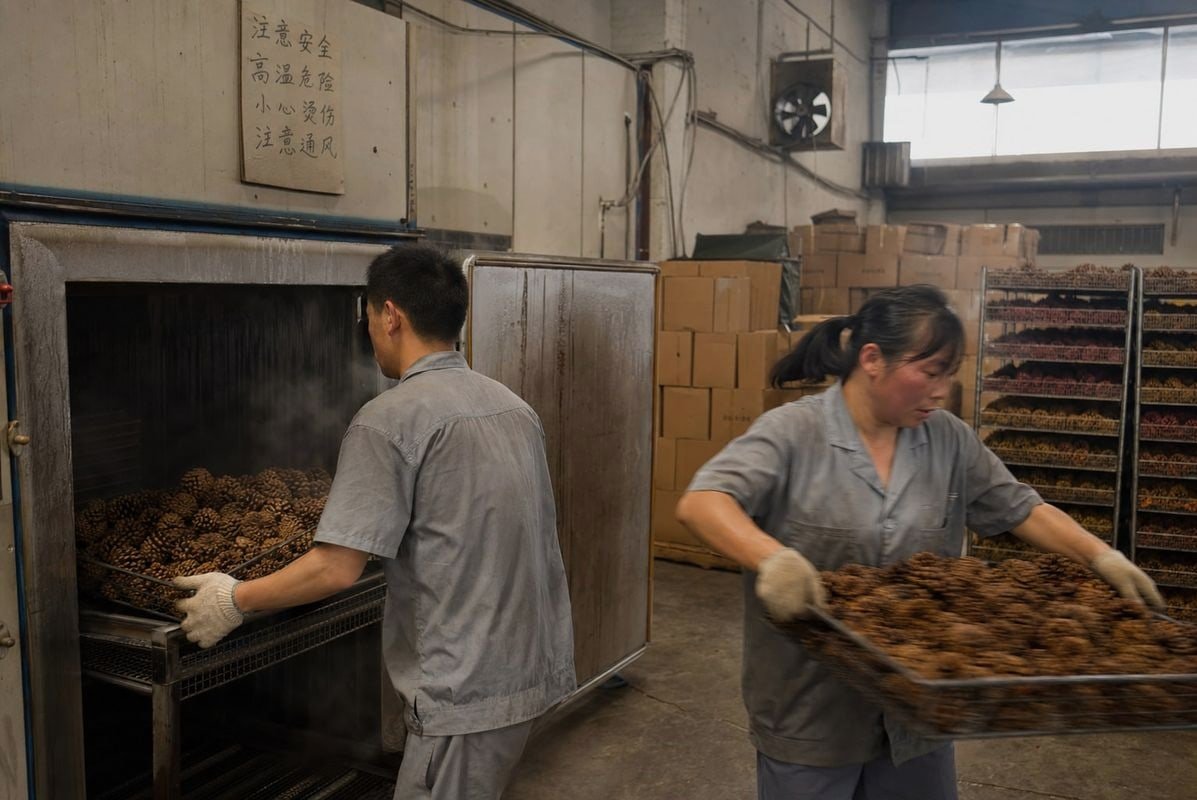
A "natural" claim can fail at four different stages. You need visibility into each one.
The four-stage verification workflow
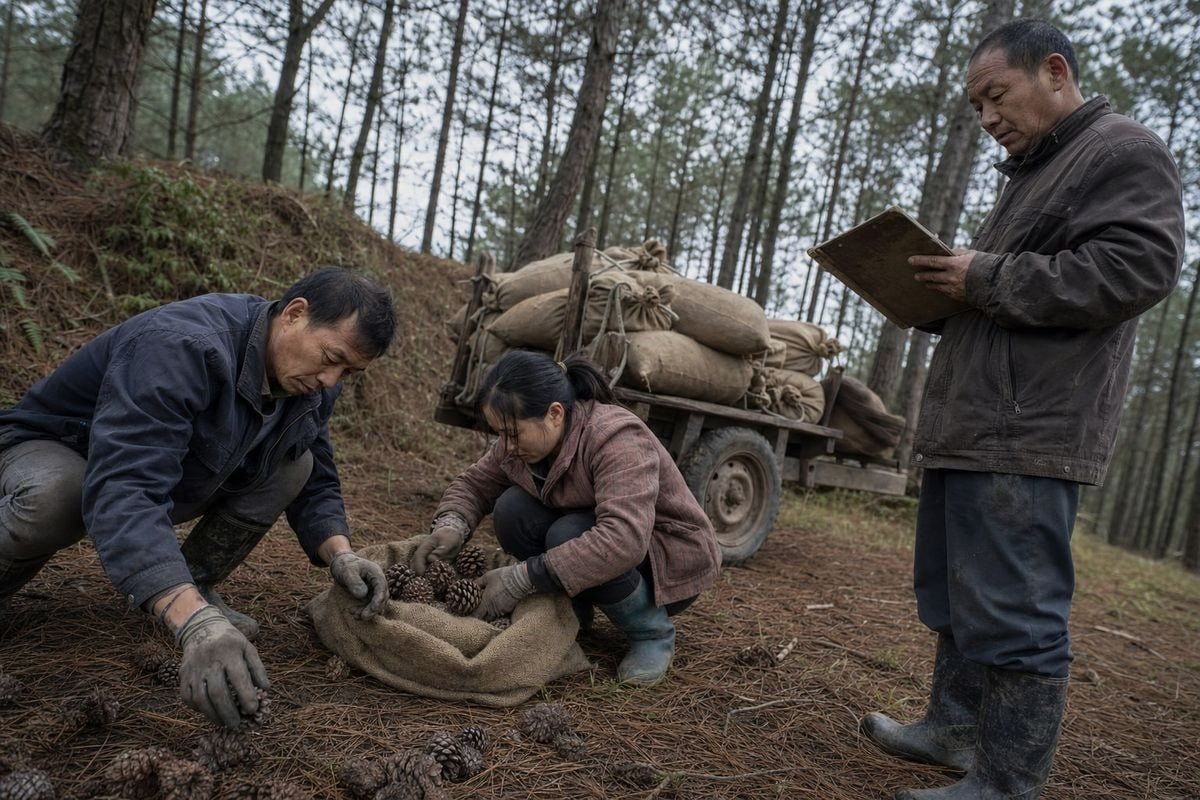
- Harvesting. Where do the cones come from? Managed forests with FSC or PEFC oversight support both the natural claim and sustainable sourcing. Roadside or industrial-zone collection raises contamination risk 5 from pesticide residue 6 and pollutants.
- Pest treatment. This is the biggest hidden gap. Cones must be sterilized. Heat treatment and kiln-drying are physical methods. Fumigation methods — especially methyl bromide treatment 7 — are chemical, and they rarely appear on the front label. Ask the direct question: "Heat or fumigation?" Then ask for the record.
- Cleaning and finishing. Some processors use bleaching agents to lighten cones, or solvents to strip natural sap. Here is a practical field check I share with buyers: visible natural resin on the cone is a good sign. Heavily de-sapped, uniformly pale cones often went through a chemical bath. Also watch for "fragrance" on any spec sheet — artificial fragrances 8 can carry phthalates that have no place in a fire product.
- Additive application. For color-flame pinecones, the coating is the product. The mineral salts, the wax, and the binder must all appear on the SDS with CAS numbers. If the supplier says "it's just natural," that is not an answer. It is an evasion.
When buyers visit our factory — and I encourage every serious buyer to visit or send an inspector — we walk them through each stage physically. A factory that offers only a showroom tour, not a production-floor tour, is usually a trading company reselling someone else's untraceable cones.
Batch consistency matters as much as the process itself. A supplier can run one clean pilot batch for your sample and switch inputs for mass production. This is why we tie every batch to a QC record, so the first sample reliably reflects the shipped goods. Ask your supplier how they do the same. If there is no batch traceability system, the "natural" claim expires the moment your sample approval does.
What test reports or lab results prove there are no harmful chemicals in color-flame pinecones?
Early in our export history, a UK buyer rejected a competitor's shipment because the "test report" turned out to be a photocopied certificate for a different product. That episode shaped how we handle documentation to this day.
Request a batch-specific Certificate of Analysis plus third-party lab testing from SGS, Intertek, or an equivalent accredited lab. The report should cover heavy metals, pesticide residue, volatile organic compounds, and restricted substances, and its listed composition must match the Safety Data Sheet.

Not all lab paperwork is equal. Buyers often accept a one-page certificate when they should demand the full multi-page report. Here is what each test actually tells you.
Reading the report like an inspector
| Test parameter | Why it matters for color-flame pinecones | Red flag if missing |
|---|---|---|
| Heavy metals (lead, cadmium, mercury, chromium) | Cheap colorants can contain toxic metal compounds released during burning | High — this is the core burn-safety test |
| Pesticide residue | Cones from treated plantations carry residues into the flame | Medium — depends on cone origin |
| VOCs / emissions | Solvent-based coatings off-gas during storage and combustion | High for indoor fireplace use |
| Restricted substances (REACH-relevant for EU) | EU market access depends on it | High for European buyers |
| Flash point / burn behavior | Confirms safe ignition characteristics | Medium — safety, not chemistry |
Three verification habits will protect you. First, check that the report is batch-specific and recent — a five-year-old report proves nothing about this year's production. Second, verify the report directly with the lab. SGS and Intertek both let you confirm a report number is genuine. We give buyers our report numbers precisely so they can do this without asking our permission. Third, match the tested composition against the SDS. If the SDS lists a wax-and-mineral-salt system but the test report describes a different matrix, someone swapped materials.
One honest caveat: lab tests prove the absence of specific harmful substances in a specific batch. They do not prove the broad philosophical claim "100% natural." That is why the test report works alongside — never instead of — the process documentation from the previous section. A credible supplier will say exactly that. A supplier who claims one certificate proves everything is overselling.
How do I spot misleading "natural" labeling before I commit to a bulk pinecone order?
A Dutch purchasing manager once told me she filters suppliers with a single email: she asks one precise technical question and watches how they answer. Vague replies end the conversation. I have adopted her method for judging our own competitors' claims.
Watch for broad claims with no asterisk or backup, missing SDS documents, "fragrance" or "varnish" in specs, refusal to disclose the pest-treatment method, borrowed or expired certificates, and prices too low to support heat treatment. Any two of these together signal mislabeling.
Misleading labels are rarely outright lies. More often, they are technically true statements that invite you to assume more than the supplier can prove. "Natural pinecones" may be true of the cone and silent about the coating. "No chemical additives" may exclude additives while permitting chemically processed inputs under another name. Regulators treat these as objective claims requiring substantiation — which means your supplier must be able to hand you the evidence, or the claim is just decoration.
Red flags versus green flags
| Red flag | Green flag |
|---|---|
| "100% natural" with no qualifier or document | Narrow claim: "cones heat-treated, no fumigants; colorants disclosed on SDS" |
| Certificate PDF with mismatched product name or old date | Batch-specific COA you can verify with the lab directly |
| "Fragrance," "varnish," or unnamed "gloss coating" in the spec | Full ingredient disclosure with CAS numbers |
| No answer on fumigation methods | Documented kiln-drying record and phytosanitary certificate |
| Trading company with no factory audit trail | Verifiable factory with ISO 9001 and BSCI audits |
| Price far below the market for treated cones | Price consistent with heat treatment and testing costs |
Some buyers push back on me here: "Isn't 'natural' still a useful shorthand when the product genuinely comes from a forest?" Fair point — the cone itself is natural. But your customer reads the label as a promise about the whole product, including the coating, the drying method, and the packaging. If any stage contradicts the front label, the claim is misleading in the eyes of the consumer and, increasingly, the regulator. The safest commercial position is a narrow, documented claim, not the broadest one your marketing team can defend in court.
My practical five-minute filter before any bulk order: ask for the SDS, ask "heat or fumigation," ask for the latest third-party report number, and ask who applied the colorant. A supplier with real answers replies within a day with documents attached. A supplier with a story replies with adjectives.
Conclusion
Labels promise; documents prove. Mislabeled pinecones can cost you a recall and your reputation. Stack the SDS, batch-specific lab reports, phytosanitary records, and a real factory audit — then buy with confidence.
Footnotes
1. Technical explanation of VOCs and their impact on indoor air quality. ↩︎
2. Official EU database for chemicals restricted under the REACH regulation. ↩︎
3. Official USDA AMS page for organic labeling and standards. ↩︎
4. Leading global provider of inspection, verification, and laboratory testing services. ↩︎
5. Overview of chemical and environmental contamination risks in raw material sourcing. ↩︎
6. International health guidelines regarding the risks associated with pesticide residues. ↩︎
7. Information on the environmental and health impacts of methyl bromide fumigation. ↩︎
8. Updated FDA resource on fragrance labeling and safety. ↩︎
 English
  Spanish
  German
  French
  Arabic
  Portuguese
Join the Conversation