






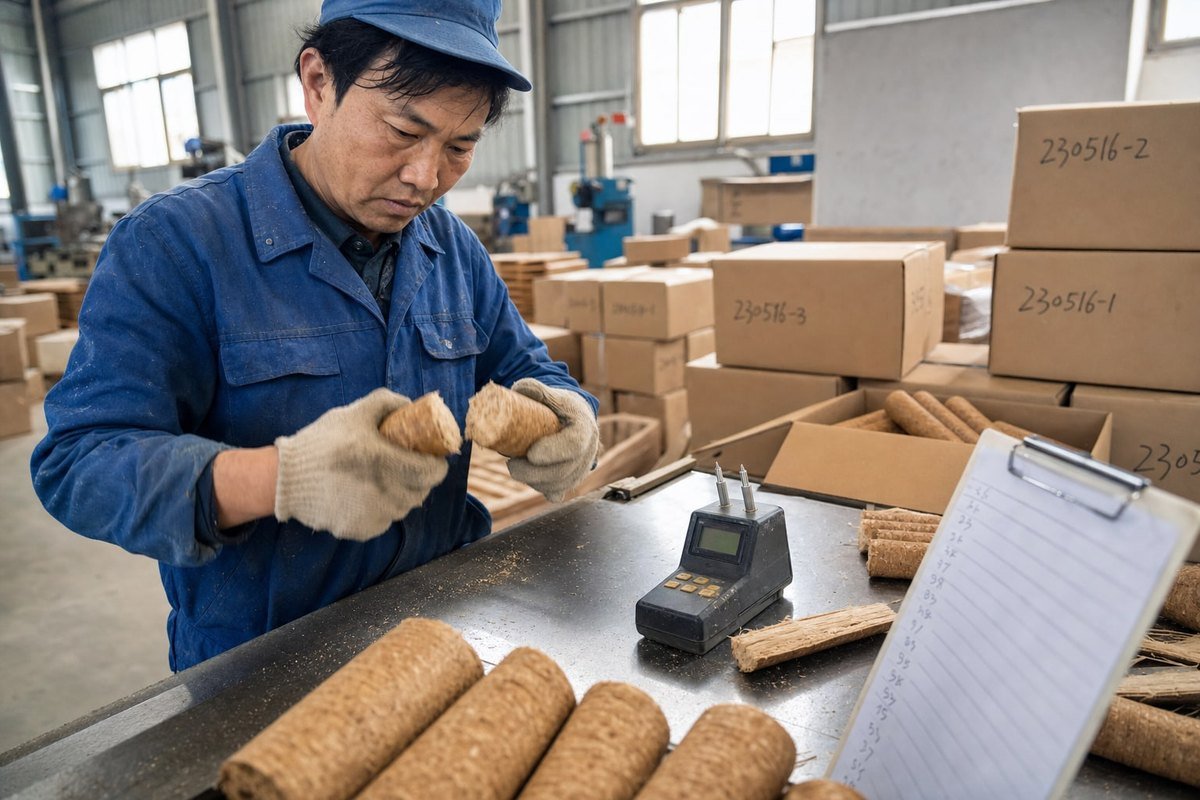
Buyers ask me about moisture content labels on wood fire starters more than any other spec. One inflated number can ruin a season's inventory. On our production line, we treat that label as a promise — and I'll show you how to test whether your supplier keeps it.
To verify moisture content labels on wood fire starters, split sample pieces and test the fresh interior with a pin-type moisture meter, average readings across multiple units, and confirm results against oven-dry testing or third-party lab reports such as SGS or Intertek documentation.
That is the short answer. Below, I break it into four practical steps: how to test, what documents to demand, [why moisture drives burn quality](https://sunrichfire.com/how-moisture-content-affect-wood-fire-starter-ignition-performance/), and how to enforce consistency.
What testing methods can I use to confirm moisture content claims on wood fire starters?
During a QC audit last year, our team split open fifty wood rolls from a single batch before dipping. The interior readings told a very different story than the surface ones — and that lesson shapes everything I recommend here.
Use a pin-type moisture meter on freshly split interior wood, take readings from at least five random pieces, and average them. For disputed claims, run the oven-dry testing method: weigh a sample, dry it until weight stabilizes, then calculate moisture from the weight loss.

The biggest mistake buyers make is testing the outside of the product. Wood fibers dry from the surface inward, so internal vs surface moisture can differ by ten percentage points or more. A fire starter can feel bone-dry in your hand while its core still holds water. That is why you must split the piece and probe the newly exposed face within a minute or two, before it starts equalizing with the air.
Step-by-step meter method
- Randomly select five to ten pieces from different parts of the carton — never just the top layer.
- Split each piece open lengthwise.
- Insert the pin-type moisture meter 1 into the center of the fresh face, following the grain direction your meter's manual specifies.
- Set the meter for the correct wood species, because wood species density 2 changes electrical resistance and skews readings.
- Record all readings and calculate the average. One favorable number proves nothing; the average and the spread tell the real story.
When the meter is not enough
Meters typically read only about a quarter-inch deep, and wax coatings complicate things. Our wax-dipped wood rolls, for example, carry a paraffin layer that can interfere with electrical sensors. In those cases, we cut past the wax and test bare fiber, or we fall back on the oven-dry testing method.
| Method | Accuracy | Cost | Best Use Case |
|---|---|---|---|
| Pin-type moisture meter | Good (±1–2%) | Low | Routine incoming inspection |
| Oven-dry testing method | Excellent (reference standard) | Medium | Disputed claims, lab verification |
| Microwave weight-loss test | Fair | Very low | Quick field estimate |
| Sound and weight check | Rough screening only | Free | First-glance triage |
The oven-dry method is the gold standard. Weigh the sample, dry it at low heat until the weight stops changing, then compute moisture as the lost water divided by the dry weight. It is slower, but no supplier can argue with it.
Which certifications or lab reports should I request to verify my supplier's moisture data?
A German distributor once told me he'd been burned — figuratively — by a supplier whose "kiln-dried" claim came with zero paperwork. When he asked us for documentation, we sent our full test file the same week. That conversation changed his sourcing checklist permanently.
Request third-party lab reports from SGS or Intertek showing measured moisture percentage and test method, kiln-dried certification with batch traceability, ISO 9001 quality-system documentation, and — for UK buyers — Ready to Burn scheme registration confirming moisture below 20%.

Words like "dry," "seasoned," or "kiln-dried" on a box mean nothing without evidence. What you need is a paper trail that connects a specific number, measured by a specific method, to a specific production batch. In our seventeen-plus years exporting fire-starting goods to more than thirty countries, we have learned that serious buyers in the US and Europe treat this as a hard requirement, not a nice-to-have.
The document checklist
| Document | What It Proves | Red Flag If Missing |
|---|---|---|
| SGS or Intertek test report | Independently measured moisture % and method | Claim is self-declared only |
| Kiln-dried certification | Wood passed through a controlled drying schedule | "Kiln-dried" may be marketing language |
| ISO 9001 certificate | A functioning quality management system exists | No systematic batch control |
| BSCI audit report | Factory is a real, audited production site | Possible trading company reselling |
| Ready to Burn registration (UK) | Moisture verified below 20% under the scheme | Product may not be legal to sell in the UK |
| Batch QC records | Moisture tracked lot by lot, not once ever | Single old test used for all shipments |
Questions to ask before signing a PO
Ask which test method produced the labeled number — meter or oven-dry. Ask when the test was performed relative to your shipment date, because wood is hygroscopic and re-absorbs humidity in storage. Ask whether the lab tested interior fiber or whole coated pieces. A supplier who answers quickly, in clear English, with documents attached, is telling you something about how the rest of the relationship will go. Compliance paperwork is also increasingly tied to EPA wood smoke regulations 3 and European fuel standards, so it protects your retail listing, not just your conscience.
Why does moisture content affect burn time and quality consistency in my fire starter orders?
There is a trade-off we weigh constantly in production: dry the wood fiber further and burn performance improves, but drying costs time and energy. Understanding why we still hold the line on low moisture will help you judge any supplier's priorities.
Water in wood must evaporate before the fiber can ignite, so excess moisture steals heat, delays ignition, shortens effective burn time, lowers thermal efficiency, and produces smoky, inconsistent flames plus creosote buildup in stoves and chimneys.

Physics does not negotiate. Every gram of water inside a fire starter absorbs energy as it boils off — energy that should be lighting your customer's kindling. A starter labeled at 12% moisture but actually sitting at 22% will light slower, flame weaker, and sometimes fail entirely in cold, damp conditions. For a camping brand, that means one-star reviews. For a fireplace distributor, it means returns.
The performance chain
Here is the cause-and-effect chain in plain terms:
- Higher moisture means slower ignition, because the flame first has to dry the fiber.
- Slower ignition means longer exposure time needed from a match, which frustrates end users.
- Wet combustion means lower flame temperature, which reduces thermal efficiency 4 and leaves fuel partially burned.
- Partial combustion means more smoke and creosote buildup 5, which is a genuine safety issue in wood stoves and a compliance concern under EPA wood smoke regulations 6.
- Piece-to-piece moisture variation means inconsistent burn times across one retail box, which end users notice immediately.
Why consistency matters more than the average
An order averaging 14% moisture sounds fine. But if that average hides pieces ranging from 8% to 25%, half your product performs beautifully and half disappoints. On our lines, we control the drying stage and the wax-dipping stage separately, precisely because the wax coating seals in whatever moisture the fiber holds at dipping time. Seal in wet fiber, and no amount of paraffin fixes it later. That is why the moisture spec matters most at the moment of coating, not just at final packing. When we develop custom burn-time targets for OEM clients, moisture tolerance is the first parameter we lock, because burn time cannot be consistent if moisture is not.
How can I hold my manufacturer accountable for batch-to-batch moisture consistency?
Early in my export career, a Dutch buyer taught me a lesson: he wrote moisture tolerances directly into his purchase contract, with a re-test clause. We welcomed it — and factories that resist that kind of clause are telling you why.
Write a maximum moisture percentage and test method into your purchase contract, require batch-level QC records with each shipment, perform random incoming inspections with your own calibrated meter, and reserve the right to third-party re-testing with defined remedies for failures.

Accountability starts with specificity. "Dry wood" is unenforceable. "Maximum 15% moisture content, measured by pin-type meter on freshly split interior faces, averaged across ten random pieces per batch, verified by oven-dry method in case of dispute" is enforceable. Put the method in writing, because a supplier testing surface moisture will always produce prettier numbers than one testing the core.
A practical accountability framework
| Stage | Your Action | Supplier's Obligation |
|---|---|---|
| Contract | Define moisture spec, method, and sampling plan | Accept spec in writing with tolerances |
| Pre-production | Approve a sealed golden sample | Match mass production to the sample |
| In production | Request in-process QC photos and readings | Log moisture at drying and dipping stages |
| Pre-shipment | Commission third-party inspection if needed | Provide batch QC records per lot |
| Arrival | Split-test random pieces from random cartons | Honor remedy clause on failures |
| Ongoing | Track results shipment over shipment | Show trend data, not one-off tests |
Keep your own instruments honest
Your incoming inspection is only as good as your meter. Check your device against a known reference block periodically, the same way labs handle hygrometer calibration 7, and record temperature during testing since cold wood reads artificially dry. We calibrate our own instruments on a fixed schedule under our ISO 9001 system, and we encourage buyers to do the same on their side. When both parties measure the same way, disputes almost disappear.
Finally, judge the response, not just the result. A factory with genuine manufacturing depth will investigate a failed reading, trace it to a drying-schedule or storage cause, and show you the corrective action. A trader reselling someone else's stock can only apologize. The first sample you approve should reliably predict every carton that follows — and moisture consistency is where that promise is proven or broken.
Conclusion
Moisture labels are claims, not facts. Test split interiors with a calibrated meter, demand batch-level lab reports, and contract your spec. We build to that standard — expect it from every supplier.
Footnotes
1. Explains the pin-type sensing technology buyers rely on for interior wood readings. ↩︎
2. USDA Forest Products Laboratory research on how species density affects moisture measurement. ↩︎
3. Official EPA program covering wood-burning emissions and moisture-related compliance standards. ↩︎
4. Defines the combustion efficiency concept affected by wood moisture during burning. ↩︎
5. Background on the combustion byproduct linked to excess wood moisture and chimney safety. ↩︎
6. Links to official EPA program governing wood smoke emissions and safety compliance standards. ↩︎
7. NIST guidance on instrument calibration practices relevant to accurate moisture testing. ↩︎



 English
  Spanish
  German
  French
  Arabic
  Portuguese
Join the Conversation