







Every autumn, our loading dock in Ningbo fills with pallets of color-flame pine cones bound for Europe ISPM 15-stamped pallets 1. Choosing the wrong freight mode can quietly destroy a whole season's margin.
To ship colored pine cones to Europe, use sea freight for large, low-cost bulk orders planned months ahead, and the China-Europe railway for seasonal, time-sensitive shipments. Sea takes 30–45 days at the lowest rate; rail takes 18–25 days at a moderate premium.
That is the short answer. But the real decision involves cost per unit, transit risk, customs paperwork, and your retail calendar. Let me walk you through each factor the way I do with our own buyers.
What Are the Real Cost Differences Between Sea Freight and China-Europe Railway for My Order?
A German distributor once asked me why his rail quote was almost double his sea quote for the same pallets of color-flame pine cones. The answer is in the cost structure.
Sea freight typically costs 30–60% less per cubic meter than China-Europe rail. A full container of colored pine cones by sea offers the lowest landed cost, while rail charges a moderate premium — still far below air freight — in exchange for roughly half the transit time.
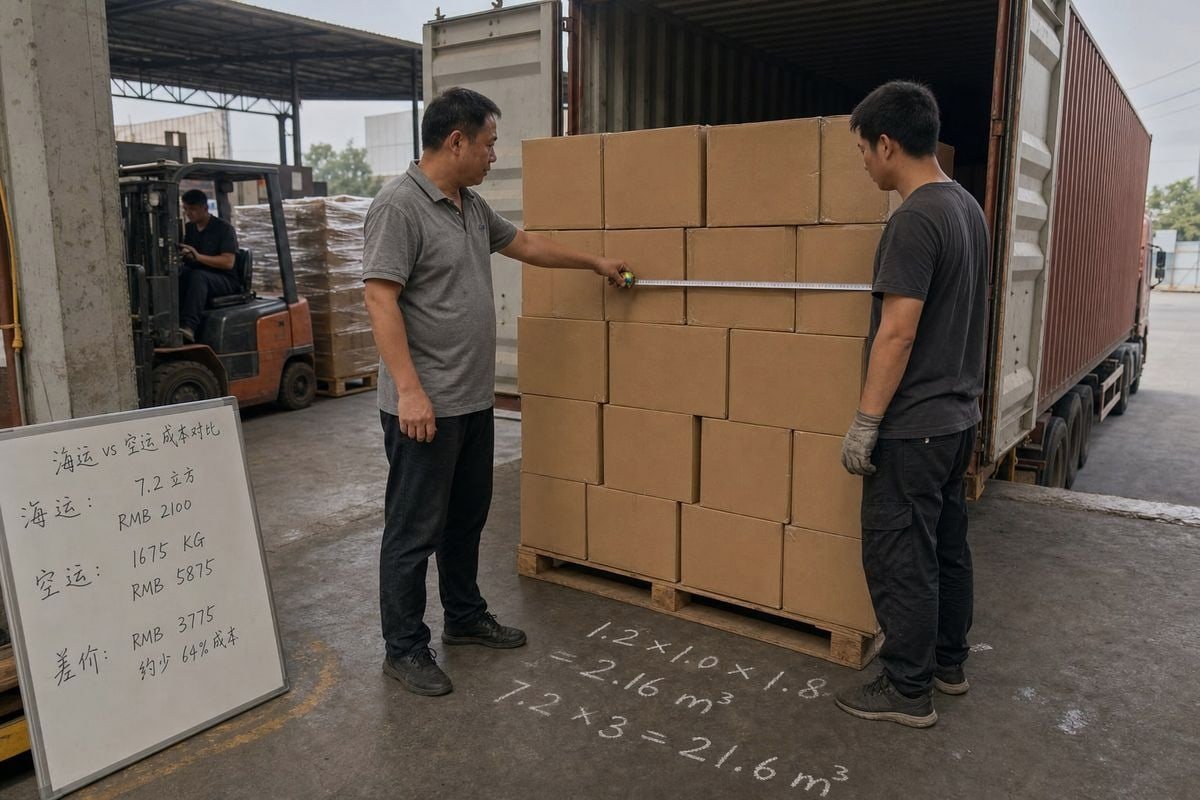
Pine cones are a volume product, not a weight product. A 40ft container 2 filled with our color-flame pine cones hits its volume limit long before its weight limit. So your freight cost is driven almost entirely by cubic meters, not kilograms. This matters, because it makes the per-CBM rate the number you should compare, not the per-kilogram rate.
Here is how the two modes typically stack up for a decorative-goods shipment from eastern China to central Europe:
| Cost Factor | Sea Freight (FCL/LCL) | China-Europe Railway |
|---|---|---|
| Relative cost per CBM | Lowest baseline | Moderate premium over sea |
| Best order size | Full container or large LCL | Mid-sized pallet loads |
| Peak-season rate stability | Volatile during Q4 congestion | Volatile; limited block-train slots |
| Booking flexibility | More flexible windows | Book 60–90 days ahead in peak season |
| Hidden cost exposure | Demurrage, port storage | Transshipment handling fees |
The Costs Buyers Forget
In my experience exporting to Germany, Poland, and the Netherlands, the quoted freight rate is only part of the picture. You should also budget for:
- Destination terminal handling and customs brokerage.
- Inland trucking from the port or rail hub to your warehouse.
- Insurance, which I strongly recommend for painted natural products.
- Buffer costs if inspection delays trigger storage fees.
One more point. If your warehouse sits near Duisburg 3 or Hamburg, a combined rail-plus-short-sea routing can trim costs while keeping most of rail's speed advantage. We have arranged this for buyers in the Benelux region, and it often lands in a sweet spot between the two pure modes.
For low-margin bulk orders, sea wins on math. For orders protecting a Christmas shelf date, the rail premium is cheap insurance.
How Long Will Each Shipping Method Take to Reach My Warehouse in Europe?
Lead time is where I have seen the most expensive mistakes. One buyer's October sea shipment arrived in late December — the product was flawless, but the season was gone.
Sea freight from Chinese ports to major European hubs takes roughly 30–45 days port-to-port, plus one to two weeks for clearance and inland delivery. China-Europe railway delivers in about 18–25 days, cutting total door-to-door time nearly in half.

Port-to-port time is not door-to-door time. That gap is where seasonal importers get hurt. After our containers land in Rotterdam 4 or Hamburg, you still need customs clearance, possible phytosanitary inspection, deconsolidation if it is an LCL shipment, and trucking to your warehouse. I tell our European buyers to plan the full chain, not just the ocean leg.
Realistic Door-to-Door Timelines
| Stage | Sea Freight | China-Europe Railway |
|---|---|---|
| Export clearance and loading in China | 3–5 days | 3–5 days |
| Main transit leg | 30–45 days | 18–25 days |
| Border/transshipment buffer | Port congestion risk | Gauge-change and customs checks |
| EU clearance and inspection | 3–10 days | 3–10 days |
| Inland delivery to warehouse | 2–5 days | 2–5 days |
Planning Backward from Your Sales Window
For Christmas and autumn décor demand, I advise working backward from your shelf date. If you need stock in your European warehouse by early October, a sea shipment should leave China by early August at the latest. A rail shipment buys you three to four extra weeks of production and decision time — which matters when you are still finalizing private-label packaging artwork with us in July.
There is one operational nuance worth flagging. Rail slots on popular corridors tighten from August through November. When we book rail for buyers in that window, we reserve capacity 60 to 90 days ahead. Sea bookings stay more flexible, though Q4 port congestion can quietly add a week or two. Neither mode is immune to delay; the difference is that rail's shorter baseline gives you more room to absorb it.
Build a two-week buffer into either plan. In seventeen-plus years of shipping fire products worldwide, I have never regretted a buffer. I have regretted its absence.
What Customs Documents and Compliance Certificates Do I Need for Color-Flame Pine Cones?
Compliance is the part of this trade that most new importers underestimate. It is also the reason our factory invested early in ISO 9001, BSCI, CE, and SGS/Intertek certification.
You need a commercial invoice, packing list, bill of lading or rail waybill, a phytosanitary certificate for the plant material, ISPM 15-compliant wooden packaging, and MSDS documentation showing the flame-colorant coating meets EU REACH requirements. Accurate HS classification is essential.

Here is a distinction that trips up many buyers: a natural dried pine cone and a coated or painted pine cone can be classified differently by customs. U.S. rulings, for example, have placed natural dried cones and painted-tip cones under separate tariff lines. EU authorities make similar distinctions between natural plant products and prepared or decorated goods. Our color-flame pine cones are treated cones — the coating is the whole point of the product — so the customs description must say so clearly. A vague description like "decorations" invites inspection holds.
The Core Document Checklist
| Document | Why It Matters | Common Failure Point |
|---|---|---|
| Commercial invoice & packing list | Basis for valuation and duty | Product description too vague |
| Phytosanitary certificate | EU plant-health rules for botanical material | Missing for "decorative" plant goods |
| MSDS for coatings/colorants | EU REACH scrutiny of dyes and paints | Supplier cannot provide test data |
| ISPM 15 pallet certification | Heat-treated, stamped wood packaging | Untreated pallets rejected at border |
| Bill of lading / rail waybill | Proof of carriage and title | Consignee details inconsistent |
Why the Coating Documentation Matters Most
EU customs are paying closer attention to dyes and surface treatments on natural decorative products. When we developed our color-flame formula, we deliberately used eco-friendly materials with no harmful chemicals, and we back that with SGS and Intertek 5 test reports. When a buyer's clearance agent in Germany requests an MSDS, we send it the same day. If your supplier hesitates on this request, treat it as a red flag before the goods ship, not after they are stuck at Hamburg.
Also confirm who acts as importer of record 6. If goods go to a fulfillment center rather than your own facility, clarify customs liability in writing before booking freight.
Which Shipping Method Works Best for My Order Size and Packaging Requirements?
Packaging is where our production team earns its keep. A color-flame pine cone that arrives moldy, crushed, or with coating rubbed onto the pouch is a returned pallet, not a sale.
Choose sea freight (FCL) for full-container, well-forecast bulk orders with robust moisture-protected packaging. Choose China-Europe railway for mid-sized pallet orders facing a retail deadline. Rail's shorter, drier transit also reduces mold and color-transfer risk for coated cones.

Some buyers push back here: if sea is cheapest, why ever pay more? My answer is that transit environment is a product-quality variable, not just a logistics one. A sea container can spend five weeks crossing humid climates. Dried botanical products absorb moisture. Coatings can soften and transfer. Rail transit is shorter and generally more stable in temperature and humidity, which is a genuine advantage for painted or coated natural goods — not just a speed perk.
That said, good packaging closes most of the gap. Here is what we build into every export order from our Ningbo line:
- Individual retail units sealed in resealable pouches, kraft bags, or jars, depending on your private-label format.
- Desiccant packs inside master cartons to control humidity.
- Moisture-barrier carton liners for sea shipments.
- Heat-treated, ISPM 15-stamped pallets 7, shrink-wrapped with corner protection against compression.
- Clear warning labels and barcodes applied at the factory, so cartons are shelf-ready on arrival.
A Simple Decision Matrix
Match your order profile to the mode:
- Full container, ordered five-plus months before season, lowest landed cost is the goal: sea freight, FCL.
- Ten to twenty pallets, needed within five to six weeks: China-Europe railway.
- Trial order or first private-label run: LCL sea if time allows; rail if you are testing for the current season.
- Mid-season replenishment after strong sell-through: rail, almost always — a stockout in November costs far more than the freight premium.
Many of our long-term distributors now split volume: the base forecast goes by sea in summer, and a rail-ready reserve ships in September once early sales data comes in. That mixed-mode approach has proven more resilient than betting everything on one lane.
Conclusion
Sea freight wins on cost; the China-Europe railway wins on speed and transit stability. Match the mode to your order size, season, and paperwork readiness — and partner with a certified factory that ships compliant, shelf-ready colored pine cones to Europe.
Footnotes
1. Official standard governing heat-treated wood packaging required for international shipments. ↩︎
2. Explains standard container dimensions and volume limits relevant to shipping calculations. ↩︎
3. Duisburg is Europe's key China-Europe Railway terminus, giving background on this routing hub. ↩︎
4. Rotterdam is Europe's largest seaport, relevant background for sea-freight destination handling. ↩︎
5. SGS is a leading third-party testing body verifying product safety compliance claims. ↩︎
6. Explains the customs-liability role buyers must confirm before shipping internationally. ↩︎
7. ISPM 15 is the international wood-packaging standard referenced for export pallets. ↩︎



 English
  Spanish
  German
  French
  Arabic
  Portuguese
Join the Conversation