







Fireplace colored pine cones look simple, yet on our production line they involve soaking, curing, drying, and compliance steps. Miss one deadline, and your booth stands empty. Backward scheduling solves this.
Schedule fireplace colored pine cones production 4–6 months before an international gift show. Confirm samples at T-16 weeks, run compliance testing at T-12 weeks, finish mass production at T-8 weeks, and ship by sea at T-6 weeks to clear customs safely.
That is the short answer. Below, I break each stage down, week by week, so you can build a schedule that actually holds up under real-world delays.
How far in advance should I place my order to have samples and mass production ready before the show?
Last spring, a German distributor called us in a panic. His gift show was nine weeks out, and he had no samples yet. We made it work — barely. Here is what we learned.
Place your order 4–6 months before the show. Allow 2–3 weeks for sampling, 1–2 weeks for approval, 4–5 weeks for mass production including soaking and 72-hour curing, plus a 2-week buffer for rework, packing, and unexpected batch failures.

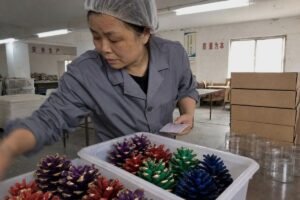
The gating step in any batch production workflow for color-flame pinecones is not painting or packing. It is moisture. After cones are treated with chemical flame colorants, they need a full curing and drying window — typically 72 hours minimum in a low-humidity environment. In humid seasons, that stretches longer. At our facility in Ningbo, we run climate-controlled drying rooms, but even so, we never compress this stage. Wet cones packed too early can mildew, clump, or burn with dull colors. That is a defect you only discover when the buyer opens the bag.
There is also a seasonal factor most first-time buyers miss. Raw pine cones are harvested in autumn. Bulk raw material sourcing outside that window means drawing from stored inventory, which is fine — but only if your supplier planned ahead. This is why seasonal demand forecasting matters. If your show is in January or February, you are competing for the same cone inventory as every other holiday buyer.
A backward calendar that works
| Milestone | Timing | What happens |
|---|---|---|
| Order placed | T-20 to T-24 weeks | Specs, colors, packaging confirmed |
| Pre-production sample | T-16 weeks | Burn test, color check, approval |
| Compliance testing | T-12 weeks | SGS/Intertek reports, SDS files |
| Mass production | T-8 to T-11 weeks | Soak, cure, dry, sort by lot |
| QC and packout | T-7 weeks | Batch burn tests, labeling |
| Sea freight departs | T-6 weeks | Booking made weeks earlier |
| Goods arrive | T-2 weeks | Customs cleared, buffer intact |
Two extra points. First, split production by color and lot number. We never mix treatments in one batch — mixed formulations produce muddy flames and inconsistent results. Second, always reserve rework capacity. A conservative schedule assumes one batch may fail QC. If everything goes right, you simply arrive early. That is a much better problem to have.
What lead time do I need to budget for compliance testing and certification documents like SGS or CE reports?
Compliance is the one stage buyers most often underestimate. In our experience exporting to 30+ countries, a missing test report delays shipments far more often than production ever does.
Budget 4–8 weeks for compliance documentation. Third-party lab testing through SGS or Intertek takes 2–4 weeks, Safety Data Sheets take 1–2 weeks, and phytosanitary certificates for natural forest products can require up to 6 weeks depending on the destination country.

Colored pine cones sit in a tricky regulatory category. They are a natural forest product treated with chemical flame colorants and intended for open-flame use. That combination triggers three separate documentation streams, and each one runs on its own clock.
The three documentation streams
First, combustion and chemical safety testing. Major international retailers require Safety Data Sheets 1 for any chemically treated product. Independent laboratory combustion testing should be commissioned around three months before the show. We keep standing SGS and Intertek 2 reports for our color-flame product lines, which means repeat buyers can often skip fresh testing — but a new private-label formulation or new destination market may need a new report.
Second, product marking. For European buyers, CE-relevant documentation 3 and correct warning labels are a hard requirement, not a nice-to-have. Our packaging team builds warning text, burn instructions, and barcodes into the artwork stage so labels never become a last-minute correction.
Third, plant-material paperwork. Because pine cones are a natural botanical product, many customs authorities ask for phytosanitary certificates 4 or heat-treatment declarations. Allow up to six weeks here. This stream surprises buyers most, because it has nothing to do with the flame chemistry at all.
| Document | Typical lead time | Who needs it |
|---|---|---|
| SGS / Intertek test report | 2–4 weeks | Retailers, customs, insurers |
| Safety Data Sheet (SDS) | 1–2 weeks | Big-box distributors |
| Phytosanitary certificate | Up to 6 weeks | Customs for natural products |
| CE documentation / labels | 1–3 weeks | EU market entry |
One objection I hear often: “These are just novelty items — do we really need all this?” Yes. Some sellers treat colored cones as harmless craft goods, but customs officers and retail compliance teams do not. A product that involves both chemical treatment and open-flame use will be checked. Work with a factory that already holds ISO 9001, BSCI, and current test reports, and this stage shrinks from a risk into a checklist.
Can I get a private-label sample approved quickly enough to match my show launch timeline?
A UK fireplace brand once asked us for a fully branded sample — custom burlap sack, printed logo, hang tag — in under three weeks. We hit the date, but only because their artwork arrived print-ready on day one.
Yes, if you start 14–16 weeks before the show. A private-label sample takes 10–15 days to produce once artwork is final. Approve it within one week, and mass production still fits comfortably inside a standard trade show lead time.

The sample stage is where OEM/ODM projects either accelerate or stall. In my experience, the product itself is rarely the delay. Our color formulations, burn times, and cone grading are already standardized after 17+ years of production. What slows samples down is packaging decisions — and those sit on the buyer's side of the table.
What we need from you, and when
A private-label sample 5 has four inputs: your logo and artwork files, your packaging format choice, your warning-label language, and your barcode data. If all four arrive together, we produce a gift-ready sample — mesh bag, drawstring burlap sack, kraft stand-up pouch, or custom display box — within two weeks. If artwork trickles in piece by piece, every revision adds days.
Here is the process we run for new private-label buyers:
- You choose the packaging format and send artwork. Kraft pouches with clear windows work well for outdoor and camping brands; burlap sacks suit fireplace and holiday gift positioning.
- We produce a physical sample, including printed packaging, correct warning labels, and barcodes.
- You burn-test the sample and check the packaging against your retail requirements.
- You approve in writing, and that sample becomes the QC reference for mass production.
One point worth stressing: with a real factory, the first sample reliably reflects mass-production quality, because the same lines, same colorant lots, and same batch controls produce both. Trading companies cannot promise that, and gift show buyers notice when booth samples and delivered goods differ. Finalize gift-ready packaging designs early — 120 days before the show is a safe target — so materials are printed and stocked before the main assembly phase. Exhibitor booth preparation also gets easier when your display packaging is locked early, since you can order extra units purely for the booth demo.
How do I plan shipping and customs clearance so my colored pine cones arrive before the exhibition dates?
The hardest lesson in supply chain logistics came to us via a Canadian buyer whose container sat at port for eleven days during peak season. His goods cleared — two days after his show opened.
Book freight 90 days ahead and ship 6–8 weeks before the show's move-in date. Sea freight takes 25–40 days plus 5–10 days for customs clearance. Prepare SDS, test reports, and phytosanitary documents in advance, and keep a 2-week buffer.

Always plan backward from the show's move-in date, not the public opening day. Move-in is usually two to four days earlier, and late freight cannot enter the hall once setup closes. Coordinate with an international freight forwarder 6 about 90 days in advance to secure container space and prepare customs documentation, especially around Q4 when holiday cargo squeezes capacity.
Sea, air, or split shipment?
| Method | Transit time | Best for | Trade-off |
|---|---|---|---|
| Sea freight (FCL/LCL) | 25–40 days | Full show inventory | Cheapest, needs longest buffer |
| Air freight | 5–8 days | Samples, urgent top-ups | 4–6x the cost |
| Split shipment | Both | Risk management | Slight cost premium |
For most buyers, we recommend the split approach: booth samples and demo stock go by air, and wholesale inventory travels by sea. If the sea shipment slips, your booth still opens fully stocked.
Customs is where international shipping regulations bite. Chemically treated natural products draw inspection attention, so your commercial invoice, HS classification 7, test reports, and phytosanitary paperwork must align perfectly. We pre-check this documentation package for every export market we serve, because a paperwork mismatch adds a week faster than any storm at sea.
Two more production-side safeguards matter here. First, hygroscopic stabilization: pine cones absorb moisture and can close their scales during humid maritime transit, so we pack in moisture-resistant bags with desiccant and hold finished goods in climate-controlled storage before loading. Second, batch-coded traceability labels go on during final packout. Big-box distributors require them for recall management, and they also help you match booth samples to specific production lots when buyers place orders at the show. Good order fulfillment capacity after the show depends on knowing exactly which lot performed in the demo.
Conclusion
Missed show deadlines kill seasonal revenue. The fix is backward planning: order 4–6 months out, cure fully, certify early, ship with buffer. Partner with a certified factory, and your booth opens ready.
Footnotes
1. Explains standardized documentation required for chemically treated products entering global trade. ↩︎
2. Leading third-party testing organizations cited for compliance and safety verification. ↩︎
3. Official EU guidance on CE marking requirements for products entering European markets. ↩︎
4. International body overseeing plant-health certification required for natural forest product exports. ↩︎
5. Major B2B trade platform relevant to private-label manufacturing sourcing discussed here. ↩︎
6. Clarifies the logistics role coordinating international shipping and customs documentation. ↩︎
7. Explains the global tariff coding system referenced for customs clearance procedures. ↩︎


 English
  Spanish
  German
  French
  Arabic
  Portuguese
Join the Conversation