







Fireplace colored pine cones look simple until a container arrives with no instructions SGS/Intertek testing 1. On our production line, we have seen buyers lose entire retail seasons because their supplier shipped cones without usage documentation, and customs or retail compliance teams rejected the goods. The fix is straightforward: request the right guidelines, in writing, before you order.
Request written usage and application guidelines before ordering fireplace colored pine cones: ask for an SDS, appliance compatibility statements, maximum cones per fire, burn duration, ventilation requirements, storage instructions, and non-food-use warnings. Confirm everything in writing and verify claims against a burn-tested sample.
That is the short answer. Below, I break down exactly which documents to request, how to check them against your market's rules, how to handle private-label instructions, and how to verify performance before you commit to a full order.
What Usage and Safety Documentation Should I Ask My Supplier to Provide?
A German distributor once emailed us in a panic. His previous supplier's cones had no chemical disclosure at all, and his retail chain refused the shipment. We rebuilt his documentation pack in ten days.
Ask your supplier for a Safety Data Sheet listing all chemical colorants, a product specification sheet, appliance compatibility statements, maximum-dose guidance per fire, burn time data, ventilation and chimney requirements, storage and disposal instructions, non-food-use warnings, and third-party test reports such as SGS or Intertek.
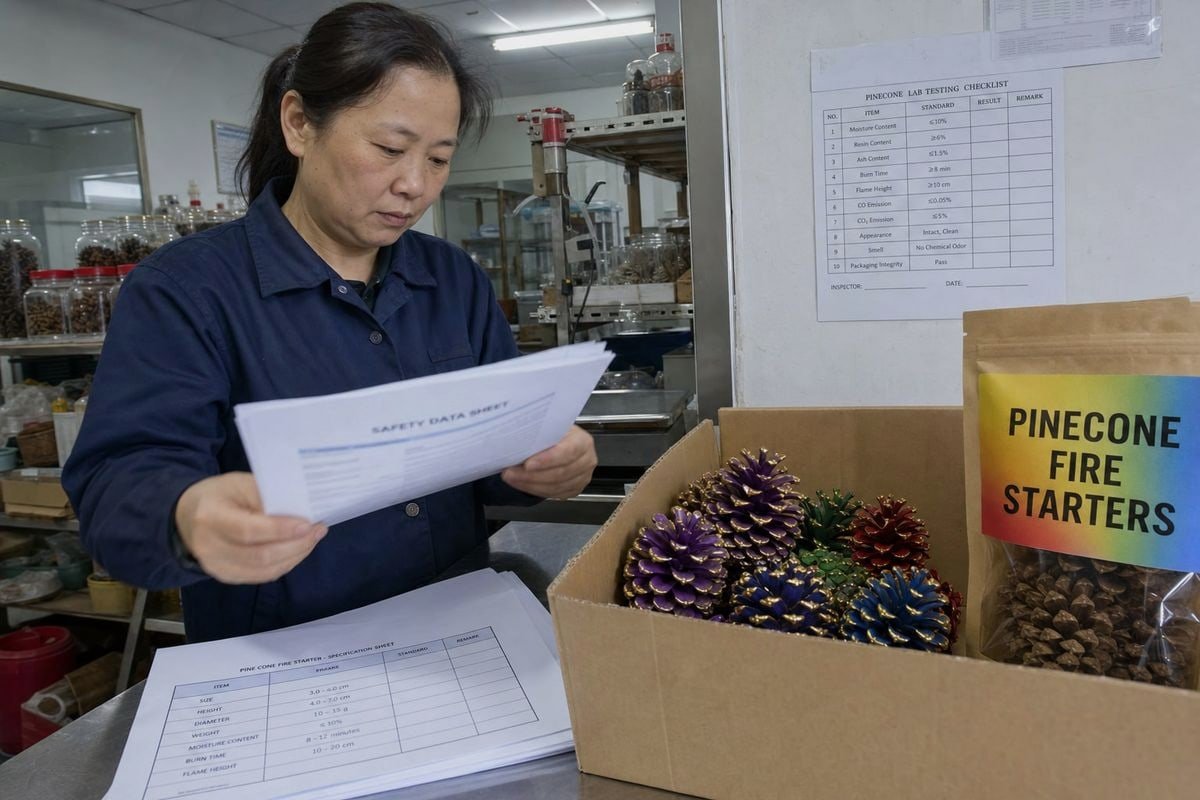
The documentation pack is the foundation of everything else in this article. In our experience exporting color-flame pinecones to more than 30 countries, buyers who ask for the full pack up front avoid nearly all downstream problems. Buyers who skip this step usually pay for it later, at customs, at the retailer's compliance desk, or in a customer complaint.
The Core Document Checklist
Here is the pack we prepare for every serious B2B inquiry. Use it as your request template.
| Document | What It Must Cover | Why It Matters |
|---|---|---|
| Safety Data Sheet (SDS) | All flame color changing chemicals, e.g., copper compounds; hazard classification | Legal requirement in most markets; retailers demand it |
| Product specification sheet | Cone size, coating type, burn time, color effect duration | Sets measurable quality standards for your PO |
| Appliance compatibility statement | Wood-burning fireplaces, wood stoves, fire pits, campfires; gas-log exclusions | Prevents misuse claims and liability exposure |
| Usage instructions | Cones per fire, established-fire-only rule, screen use | The actual "application guidelines" your end users need |
| Test reports | SGS, Intertek, or equivalent lab results | Independent proof, not just supplier promises |
| Storage guidance | Moisture control, child and pet safety, shelf life | Waxed and treated cones absorb humidity over time |
Chemical Disclosure Is Non-Negotiable
Some suppliers refuse to name their colorants, calling them proprietary. That is a red flag. A proper Material Safety Data Sheet 2 can protect trade secrets while still disclosing hazard classes. If a supplier cannot tell you whether they use a copper sulfate flame colorant 3 or a safer copper alternative, walk away. Published guidance on decorative fire products consistently tells users to read the manufacturer's instructions and chemical safety sheet before burning, and your end customers cannot do that if the sheet does not exist.
Ask About Dosage Limits Explicitly
Public advice on quantity varies wildly. Some guides suggest 2–3 cones producing color for 10–12 minutes. Older fire-safety guidance warns that anything beyond 8–10 cones, and certainly more than 15, can create an oversized hot flame that stresses a chimney. That disagreement is exactly why the supplier's own written limit must be the controlling number. When we develop a new formulation, we burn-test dosage limits in-house and print them on the packaging, because "throw a few in" is marketing language, not an application guideline.
How Do I Verify That Application Guidelines Meet My Market's Compliance Standards?
The hardest trade-off we weigh at our Ningbo facility is not cost versus quality — it is writing one instruction sheet that satisfies US, EU, and Australian expectations at the same time.
Cross-check the supplier's guidelines against your market's chemical regulations, labeling laws, and consumer product safety rules. Require CE marking references for the EU, SDS formats matching REACH or OSHA standards, and third-party test reports. Ask the supplier which markets they already export to.

Compliance is where good suppliers separate from cheap ones. Over 17 years of shipping color-flame products to the US, Germany, the UK, France, and Canada, we have learned that each market reads the same document pack differently. Your job as a buyer is to verify the supplier's guidelines translate into your regulatory language, not just any regulatory language.
Match the Document to the Market
| Market | What Reviewers Look For | Common Failure Point |
|---|---|---|
| United States | OSHA-format SDS, clear warning labels, non-food-use statements | Missing English hazard warnings on retail packaging |
| European Union | REACH-aligned SDS, CE-relevant conformity documents, local-language labels | SDS written only in Chinese or English for non-English markets |
| UK | Post-Brexit UKCA considerations, English SDS | Assuming EU documents automatically transfer |
| Australia / Canada | Local hazard classification, bilingual labels (Canada) | No French translation for Canadian retail |
Our factory holds ISO 9001 4 and BSCI certification, and we run CE and SGS/Intertek testing on our color-flame lines precisely because our buyers treat this as a hard requirement, not a nice-to-have. When you evaluate a supplier, ask a simple question: which of my target markets have you already cleared? A supplier who has shipped bulk fire starter wholesale orders into your region will have retailer-ready paperwork. A supplier who has not will be learning at your expense.
Verify, Don't Assume
Three practical verification steps work well. First, ask for the actual test report PDF, then check the lab's report number directly with SGS or Intertek. Second, compare the SDS chemical list against your market's restricted substances — request a heavy metal purity statement 5 confirming the absence of lead, cadmium, or arsenic, since industrial-grade colorants can carry trace contaminants. Third, confirm the guidelines address indoor fireplace safety precautions 6 in language your consumer protection agency would accept: established fires only, no cooking or roasting food over treated flames, no use in gas-log or vent-free systems, adequate ventilation, and adult supervision. If the supplier's instructions only say "enjoy the magic colors," the marketing is playful but the compliance file is empty.
What Should I Include When Requesting Custom Instructions for Private-Label Packaging?
Last winter, a US camping brand asked us to fit full usage guidelines onto a kraft stand-up pouch the size of a paperback. We managed it — with a fold-out insert and a QR code.
Specify your brand name, required languages, warning label text, appliance compatibility icons, dosage instructions, barcode placement, and regulatory statements. Provide your market's mandatory warning wording, request print proofs before production, and confirm the supplier can produce inserts, hang tags, or QR-linked instruction pages.

Private-label work is where application guidelines stop being the supplier's document and become yours. Once your brand is on the burlap sack, the resealable pouch, or the display box, your company carries the liability if the instructions are wrong or missing. So the request you send your supplier needs to be specific.
Build a Complete Packaging Brief
Send your supplier a written brief covering these elements:
- Brand assets. Logo files, color codes, and font requirements for the pouch, sack, or jar.
- Instruction text. The exact usage steps: toss into an established fire, use 2–3 cones at a time, never use to start a fire, never cook over the flames.
- Warning language. Your market's mandatory phrasing for chemical products, child safety, and supervision requirements.
- Languages. English alone works for the US; German, French, or Dutch versions matter for European hearth and patio accessories retailers.
- Compatibility icons. Simple graphics showing wood fireplace, fire pit, and campfire as approved; gas log and BBQ grill as prohibited.
- Barcodes and retail codes. EAN or UPC placement, plus any retailer-specific labeling.
- Format flexibility. Ask whether the supplier can do printed inserts, hang tags, or QR codes linking to full instructions when packaging space is tight.
Test the Supplier's OEM Depth
Our OEM/ODM clients customize everything from burn time to pouch material, and we produce warning labels and barcodes in-house, which shortens the proofing cycle. When you evaluate a supplier, ask for physical print proofs of the instruction panel, not just digital mockups. Ink density, panel readability, and label adhesion all behave differently on kraft paper versus burlap versus plastic jars. Also ask who legally owns the instruction text. You want your reviewed, approved wording on the package — not a generic template the supplier reuses for every client, because that template may contradict your market's rules. Finally, request a pre-production sample with final packaging so your compliance team can sign off before mass production begins.
How Can I Confirm the Supplier's Guidelines Match Actual Product Performance Before Ordering?
Early in my career here, I learned a lasting lesson: a spec sheet promising twelve minutes of blue flame means nothing until you watch a cone burn for yourself, stopwatch in hand.
Order burn-test samples and verify them against the written guidelines: time the color effect, count the stated cone dosage, check smoke, odor, and residue, and test in the actual appliance types listed. Then confirm the supplier guarantees batch-to-batch consistency between samples and mass production.

Verification is the step most buyers rush, and it is the step that determines whether the guidelines you fought to obtain are actually true. A document can claim anything. A burn test cannot lie.
Run a Structured Sample Test
Do not just toss a cone in a fire and admire the colors. Test against the supplier's own written claims, point by point.
| Guideline Claim | How to Verify | Pass Criteria |
|---|---|---|
| Burn duration (e.g., 10–12 min per 2–3 cones) | Time the color effect with the stated dose | Within roughly 20% of the stated duration |
| Color vibrancy | Burn in low light; photograph results | Colors clearly distinguishable, matching marketing images |
| Smoke and odor | Burn indoors with normal ventilation | No harsh chemical smell or excessive smoke |
| Residue and ash | Inspect the firebox and glass door after burning | No unusual sticky residue or heavy soot loading |
| Appliance compatibility | Test in a wood fireplace and fire pit as stated | Consistent performance across listed appliance types |
| Established-fire behavior | Add cones only after the fire is burning well | Cones ignite cleanly without flare-ups |
Check Consistency, Not Just One Sample
One good sample proves the supplier can make one good cone. It does not prove they can make fifty thousand. Ask directly how the factory ensures the mass-production batch matches the sample. At our facility, we run strict batch-to-batch quality control on colorant loading and coating weight, so the first sample reliably reflects production quality — and we encourage buyers to request samples from two different production runs to compare.
Also probe the harder technical questions. If your customers use modern high-efficiency stoves, ask for a wood-burning stove 7 compatibility statement covering catalytic combustors, since metallic salt residues can foul catalytic elements. Ask about long-term effects of salt-based combustion byproducts on stainless steel chimney liners. Ask whether the formulation uses non-toxic fire colorants and how the additives affect creosote accumulation 8 and glass-door cleaning frequency. A supplier who answers these questions with data has genuinely tested their product. A supplier who dodges them has not, and their application guidelines are guesswork.
Conclusion
Colored pine cones sell on delight, but they ship on documentation. Missing guidelines create liability, rejected shipments, and lost seasons.
The solution is disciplined sourcing: request the full SDS and specification pack, verify it against your market's compliance standards, lock your approved instructions into private-label packaging, and burn-test samples against every written claim. Treat the supplier's documented guidelines — not general internet advice — as the controlling authority for safe use. After 17 years of building compliant color-flame products for brands across the US and Europe, I can say the buyers who ask these questions up front are the ones whose fireplace colored pine cones reach shelves on time, pass every compliance desk, and keep end customers safe in front of the fire.
Footnotes
1. Official SGS service page for consumer product testing and retail compliance. ↩︎
2. Official OSHA hub for Hazard Communication Standard and safety data requirements. ↩︎
3. Technical details on copper sulfate, a common chemical used to produce green flames in fire products. ↩︎
4. Detailed Wikipedia entry for the ISO 9001 quality management system standard. ↩︎
5. FDA information on heavy metal contaminants like lead and cadmium, which are regulated in consumer products. ↩︎
6. NFPA safety guidelines for indoor fireplaces to prevent accidents and ensure proper home heating safety. ↩︎
7. EPA Burn Wise guide for selecting clean and efficient wood-burning appliances. ↩︎
8. Explanation of creosote, a byproduct of wood combustion that poses a fire hazard in chimneys. ↩︎



 English
  Spanish
  German
  French
  Arabic
  Portuguese
Join the Conversation