






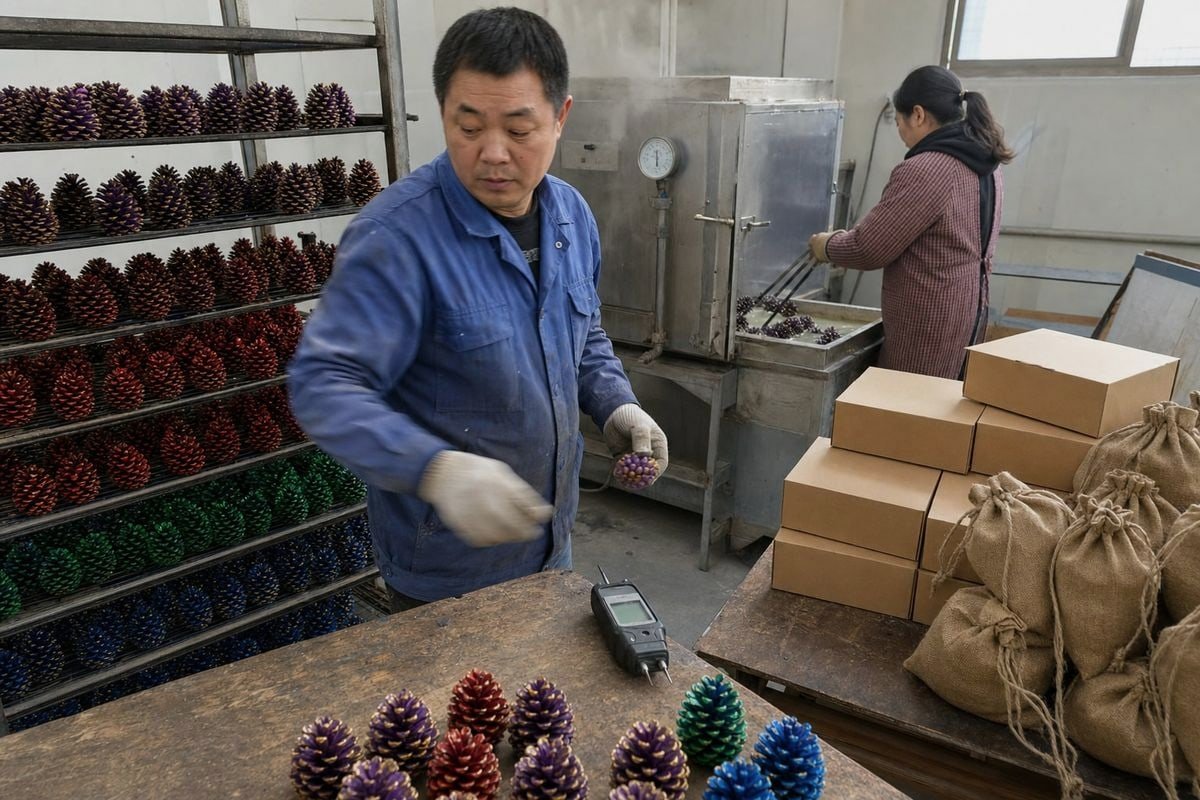
Requesting a moisture-proof anti-mold treatment for fireplace colored pine cones sounds simple — until a container arrives fuzzy with mildew batch QC records 1. On our production line, we learned that lesson early, and it changed everything.
To request moisture-proof anti-mold treatment for fireplace colored pine cones, specify a three-step process in writing: kiln-drying below 10% moisture content, an anti-fungal wash, and a clear mold-resistant sealer. Then require test reports, moisture-barrier packaging, and batch verification samples before bulk shipment.
That answer covers the basics. But each of those steps hides details that separate a reliable supplier from a risky one. Let me walk you through how to ask for each part correctly, based on what actually works when these cones cross an ocean in a shipping container.
What certifications should I ask for to confirm the moisture-proof treatment is reliable?
A German distributor once told me his previous supplier promised "professional anti-mold treatment" with zero paperwork. Half the shipment molded in a Hamburg warehouse. Our SGS reports closed that deal for us.
Ask for SGS or Intertek third-party test reports covering moisture content, mold resistance, and coating safety, plus ISO 9001 certification for process control. For fireplace use, also request compliance documentation for flame colorant chemicals under REACH (EU) or relevant US fire safety regulations.
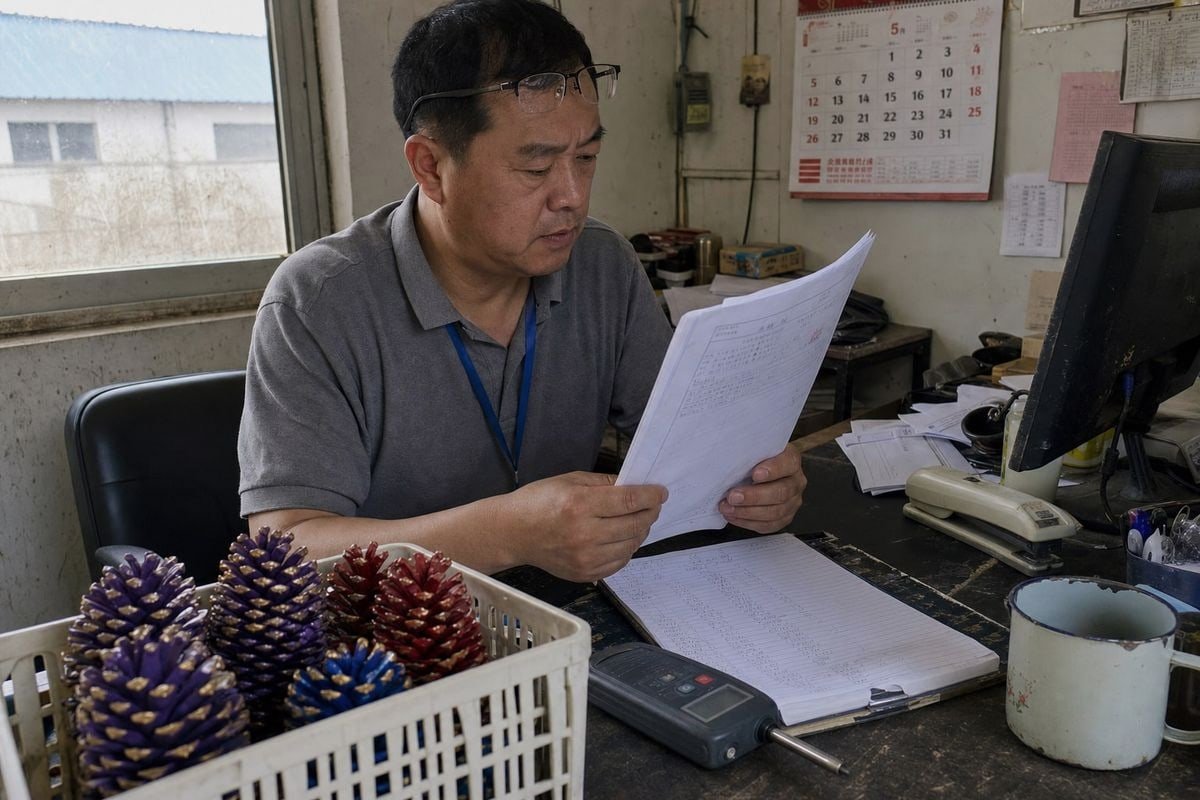
Certifications matter because pine cones are porous organic material. You cannot see internal moisture with your eyes. Only lab testing and documented process control can prove the treatment worked. In our seventeen-plus years exporting bulk fireplace accessories 2 to the US, Germany, and the UK, we have never seen a serious buyer skip this step twice.
The core documents to request
Here is what each document actually tells you, and why it matters for colored pine cones specifically:
| Document | What it proves | Why it matters for pine cones |
|---|---|---|
| SGS or Intertek test report | Independent lab verified moisture content and coating composition | Confirms the kiln-drying process 3 actually reached target dryness |
| ISO 9001 certificate | The factory follows a documented quality management system | Drying and sealing are repeated the same way every batch |
| BSCI audit report | Ethical, audited production conditions | Required by many large retail sourcing channels |
| REACH / CE compliance data | Flame colorant chemicals and coatings meet EU chemical rules | Colored cones burn — the chemistry must be legal in your market |
| Moisture content certificate | Internal moisture verified below a stated threshold (we target under 10%) | Mold cannot grow without moisture; this is the root-cause proof |
Watch for vague claims
Be cautious when a supplier says the cones are treated with "industrial wood preservatives" but cannot name the product family. Borate-based treatments, for example, are a legitimate reference point for cellulose materials. But heavy construction-grade anti-fungal washes can dissolve dye or leave residue that reacts badly with flame colorant chemicals. Ask the supplier to name the treatment category, confirm it suits decorative botanical treatments rather than structural timber, and back it with a test report. If they hesitate on any of those three points, that hesitation is your answer.
How do I specify anti-mold requirements clearly in my purchase order or contract?
There is a trade-off we discuss with almost every new buyer: loose specifications keep the PO short, but tight specifications keep the claim process short. We always recommend the second option.
Write the treatment as measurable custom manufacturing specifications: internal moisture below 10% verified by pin-type meter, an anti-fungal pre-wash, two coats of clear mold-resistant sealer, full curing before packing, and dye-color preservation. Add an inspection clause and a mold-related rejection remedy.

Vague language is the number one cause of disputes we see in this category. "Mold-free" means nothing in a contract. "Internal moisture content below 10%, verified by pin-type moisture meter on a random 2% sample, with records provided per batch" means everything. The difference is that one is an opinion and the other is testable.
The clauses that do the real work
Structure your PO or contract around these five elements:
- Drying standard. Name the method and the number. For example: "Cones kiln-dried; internal moisture content not to exceed 10% at time of packing." A kiln-drying process is more consistent than air drying, and it also melts sap and kills deep-seated fungal spores — two problems solved in one step.
- Treatment sequence. Specify clean, dry, then seal — in that order. A chemical coating application over uncleaned or damp cones fails. Require an anti-fungal wash first, then full drying, then the sealer.
- Sealer type. Request a clear, low-moisture, mold-resistant coating suitable for dyed decorative surfaces. State that the coating must not dissolve, lighten, or discolor the paint. If the cones will burn, state that the coating must be compatible with the flame effect and comply with applicable fire safety regulations.
- Curing requirement. Add: "All cones fully dried and cured before packing; no wet residue permitted." Cones packed even slightly tacky will sweat inside sealed packaging.
- Remedy clause. Define what happens if mold appears: replacement, credit, or refund, tied to photographic evidence within a stated window after arrival.
Sample request language you can copy
When buyers ask us how to phrase the request in plain English, we suggest wording like: "We need a clear mold-resistant treatment for colored pine cones. The treatment must be moisture-resistant, suitable for porous organic material, safe for the dyed finish, and fully cured before delivery. Please avoid any process that leaves the cones damp." That single paragraph, dropped into an email or PO annex, filters out unprepared suppliers within one reply.
What moisture-proof packaging options can I request to protect pinecones during shipping and storage?
Years ago, a shipment of ours crossed the Pacific during monsoon season. The cones were perfectly dry at loading. The packaging is what kept them that way — and that voyage shaped our current packing standard.
Request sealed inner poly liners or resealable stand-up pouches with desiccant packs, packed inside export cartons with moisture-barrier lining. For humid routes, add humidity indicator cards and specify container desiccant strips. Breathable outer bags like burlap should always contain a sealed inner layer.
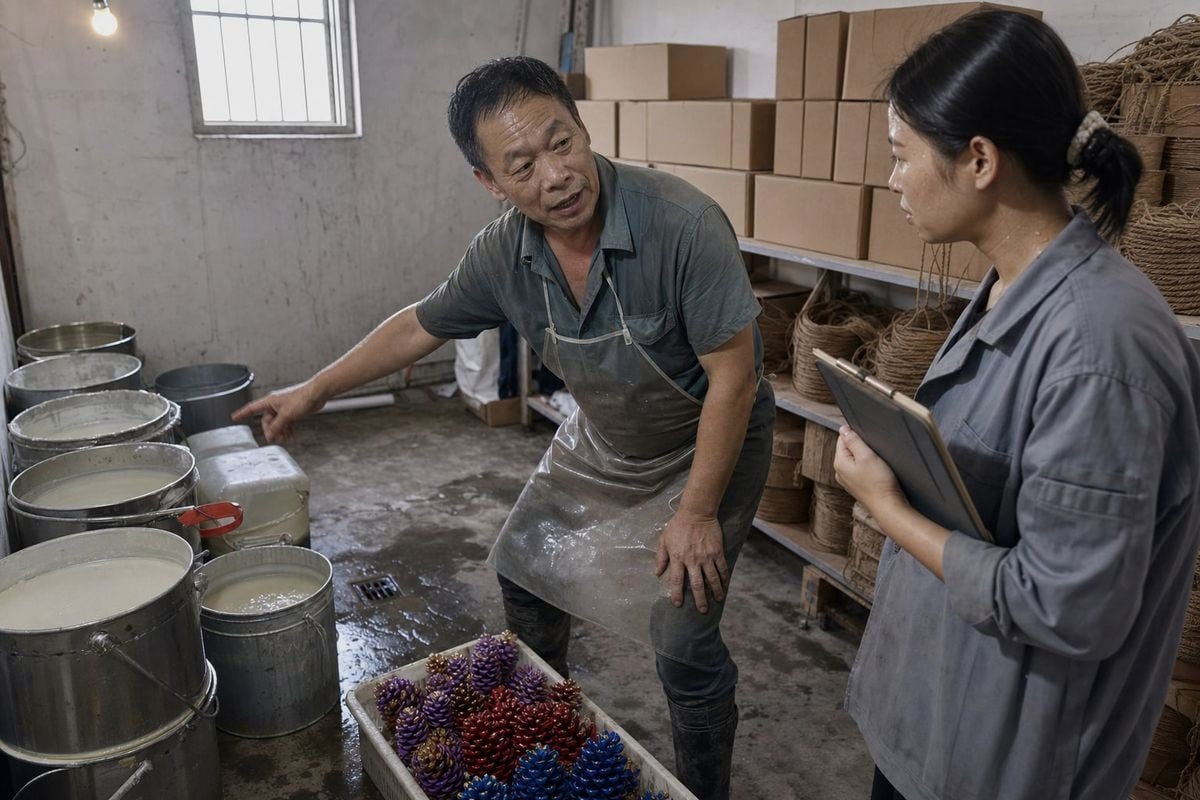
Packaging is where a good treatment either survives or dies. Even perfectly kiln-dried, sealed cones will reabsorb moisture if they sit in 85% humidity for six weeks at sea. Porous botanicals equalize with their environment. So the packaging must control the microclimate around the product, not just protect it from crushing.
Matching packaging to your retail format
We produce color-flame pinecones in several retail formats, and each needs a different moisture strategy:
| Packaging format | Moisture protection level | Best use case | What to specify |
|---|---|---|---|
| Resealable kraft stand-up pouch with clear window | High — barrier film plus reclosable zip | Outdoor and camping retail, campfire products | Food-grade barrier laminate behind the kraft layer, plus one desiccant pack per pouch |
| Drawstring burlap sack | Low on its own — burlap breathes | Rustic fireplace gift sets, hearth displays | Sealed inner poly bag hidden inside the sack |
| Plastic jar with lid | High — rigid and airtight | Fireplace distributors, long shelf display | Induction or gasket seal under the lid |
| Bulk carton with liner | Medium to high | Wholesale and importer repacking | PE liner sealed after packing, desiccant per carton, humidity indicator card |
Humidity control standards during transit and storage
Ask your supplier to state their humidity control standards 4 in writing: warehouse relative humidity 5 kept below 60%, desiccant quantity per unit and per carton, and container desiccant strips for sea freight on humid routes. Humidity indicator cards inside sample cartons cost almost nothing and tell you instantly whether the microclimate held. Also ask what product shelf life the supplier guarantees in unopened packaging — we state ours clearly, because a distributor's warehouse time counts against that clock. One more practical tip: request that warning labels and storage instructions ("store in a cool, dry place, below 60% humidity") be printed on the retail packaging. It protects the end customer's experience and reduces your return rate.
How can I verify batch-to-batch consistency of the treatment before placing a bulk order?
A UK fireplace brand once ordered three sample rounds from us over two months before committing to a container. We encouraged it. Their test was simple and smart — and it is a process any buyer can copy.
Order sealed pre-production samples from at least two separate batches, then run a humidity stress test: store them at 70–80% relative humidity for two to four weeks and inspect for mold, sweating, or color bleed. Require batch QC records and a golden sample agreement before bulk production.
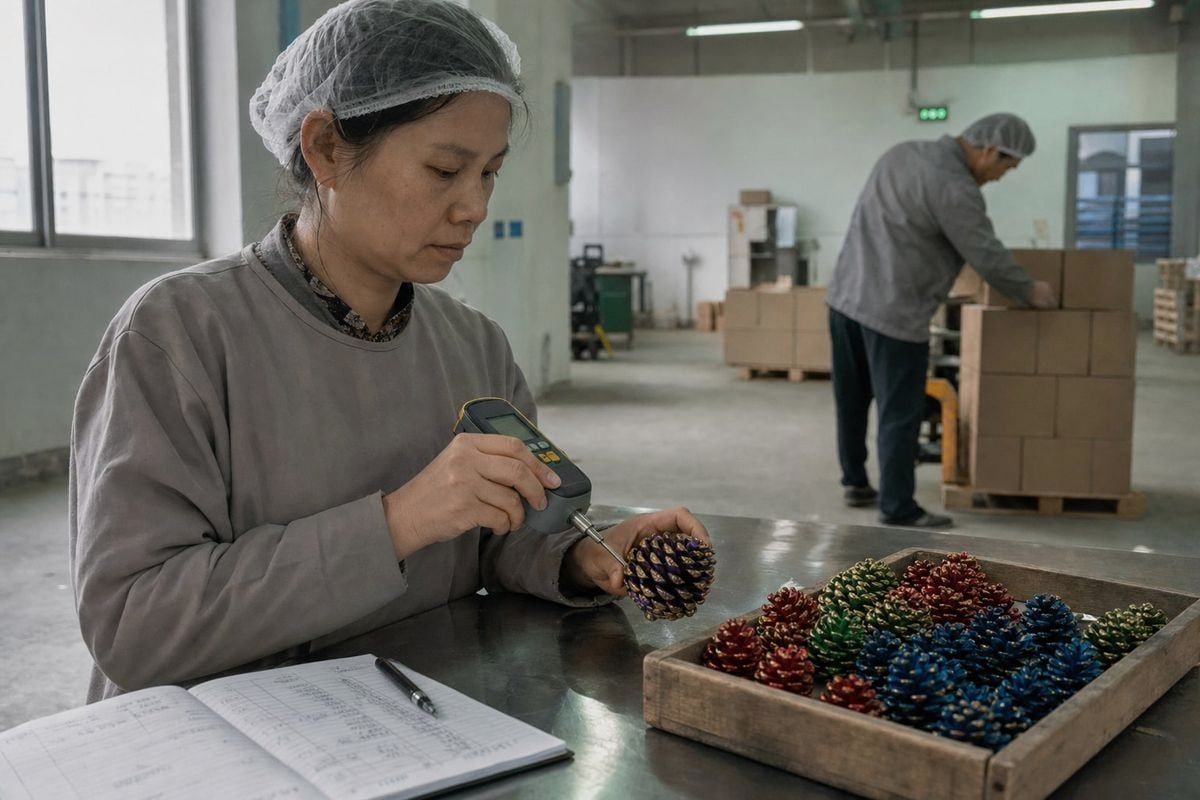
Consistency is where real factories separate themselves from trading companies. A trader can source one beautiful sample batch from anywhere. Only a factory with complete production lines and documented process control can repeat that result across ten thousand units. This is exactly why we hold ISO 9001 and run strict batch-to-batch QC at our Ningbo facility ISO 9001 certification 6 — the first sample must reliably predict mass-production quality, or the certification means nothing.
A five-step verification process
- Request samples from two or more production runs, not one. Ask for the batch codes. If the supplier cannot identify batches, they are not tracking the treatment process.
- Run your own humidity stress test. Place samples in a sealed container with a wet sponge nearby, or in a bathroom, for two to four weeks. Check for mold spots, tackiness, sweating, or dye migration. This crude test mimics a worst-case warehouse.
- Check moisture readings on arrival. A pin-type wood moisture meter 7 costs little. Split a sample cone and probe the core. Readings should sit below 10% and, critically, should match across batches.
- Review the batch QC records. Ask for drying logs, coating records, and per-batch moisture measurements. A factory doing the work has these files already; a middleman has to invent them.
- Sign off a golden sample. Both sides keep a sealed reference sample. Every future batch is compared against it for color, sheen, dryness, and burn performance.
Trial orders reduce your risk further
Before a full container, place a trial order. Flexible MOQs exist precisely for this. A single pallet through your actual logistics chain — port, customs, warehouse, shelf — reveals more than any lab report. In our experience, buyers who run one paid trial order almost never face a mold claim on the bulk order that follows, because every weak point surfaced early and cheaply.



 English
  Spanish
  German
  French
  Arabic
  Portuguese
Join the Conversation