






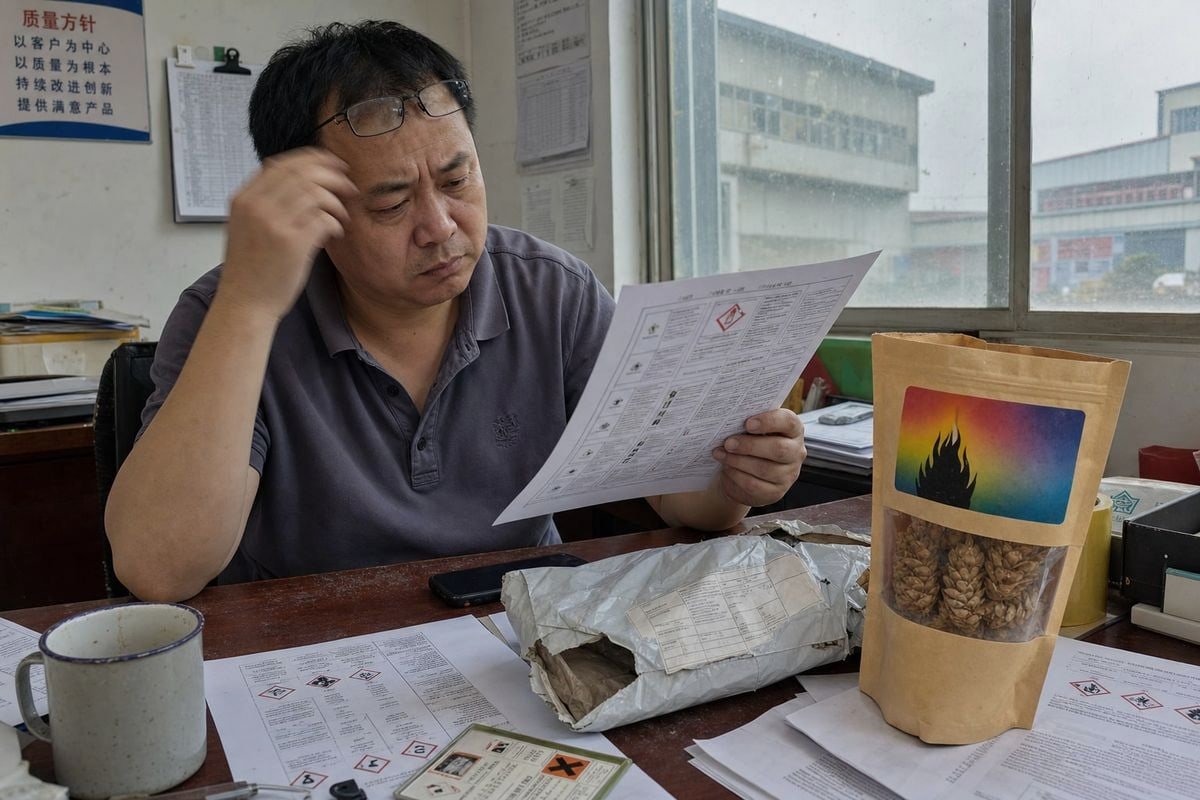
Multilingual instructions and warning labels for fireplace colored pine cones can make or break a shipment. On our production line, we have seen good products stopped at customs over one missing warning phrase.
To prepare multilingual instructions and warning labels for fireplace colored pine cones, list core fire and burn hazards, add GHS pictograms, translate warnings into each target market's official languages, follow EU CLP and US labeling rules, and verify everything through CE, SGS, or Intertek testing before printing.
That is the short answer. Now let me walk you through each step, using what we have learned shipping color-flame products to more than 30 countries.
What warning label content and safety symbols do I need to comply with EU and US regulations?
A German buyer once sent our sample label back with eleven corrections. Ten of them were about hazard wording, not design. That review changed how our team drafts every label today.
EU and US labels for fireplace colored pine cones need a fire hazard warning, burn and hot-surface cautions, child and pet safety warnings, ventilation guidance, a do-not-cook statement, disposal instructions, GHS hazard pictograms, and supplier contact details, formatted to meet CLP regulation compliance and US consumer product rules.

Colored pine cones are not simple décor. They are a combustion product. So regulators treat them closer to firelighters than to ornaments. Your label content should reflect that reality from the first line.
The core warning elements
In the EU, CLP regulation compliance 1 drives most of your label content. If the coloring agents are classified as hazardous mixtures, you need the correct signal word, hazard statements, precautionary statements, and GHS hazard pictograms 2. You will also need chemical safety data sheets available for the supply chain, even if consumers never see them. In the US, general consumer product safety standards 3 and FHSA-style cautionary labeling apply. The logic is similar: name the hazard, state how to avoid it, and tell people what to do if something goes wrong.
Here is how the two systems compare in practice:
| Label Element | EU Requirement | US Requirement |
|---|---|---|
| Signal word | "Warning" or "Danger" per CLP classification | "Caution" or "Warning" per hazard level |
| Pictograms | GHS hazard pictograms (flame, exclamation mark) | GHS-style symbols accepted; not always mandatory |
| Fire hazard precautions | Mandatory precautionary statements | Principal hazard statement required |
| Child safety | "Keep out of reach of children" | "Keep out of reach of children" |
| Supplier identity | EU-based responsible person and address | US importer or distributor details |
| First aid | Required if mixture is classified | Required for hazardous substances |
Warnings buyers often forget
Three items get missed most often. First, the "Do Not Cook Over These Flames" warning. Metal salt colorants are not food safe, and marshmallow-roasting families will not know that unless you tell them. Second, toxic fume ventilation guidance. Indoor fireplaces need a clear line about airflow and carbon monoxide awareness. Third, ash disposal. Treated ash should cool fully in a metal container and should never go into garden soil or waterways. We print all three on every export label, whether the destination legally demands them or not.
Which languages should I include on my packaging for my target export markets?
Space is the real enemy here. When our packaging team lays out a kraft pouch for five languages, every millimeter gets negotiated. Ambition says twelve languages; legibility says pick wisely.
Include the official language of every country where the product is sold: English and Spanish for the US, English and French for Canada, and local languages for each EU destination such as German, French, Dutch, and Polish, since most EU states mandate national-language safety warnings.
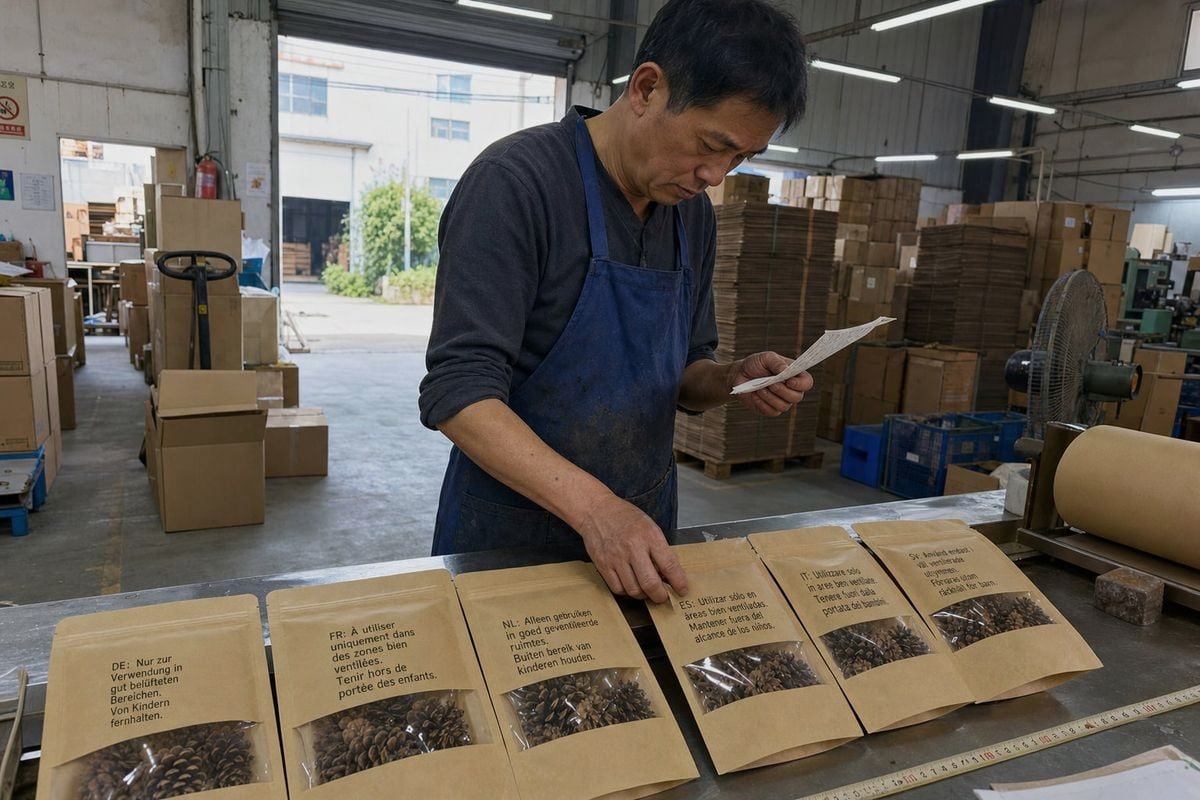
Language selection is not a marketing choice. It is a legal one. Localized regulatory requirements in most EU member states demand that safety warnings appear in the national language. English alone will not protect you in Germany, France, or Poland, no matter how clear the wording is.
Matching languages to markets
Based on our main export destinations, here is the language map we work from:
| Market | Required / Expected Languages | Notes |
|---|---|---|
| United States | English (Spanish strongly advised) | Spanish covers a large consumer segment |
| Canada | English + French | Bilingual labeling is mandatory |
| Germany / Austria | German | National-language warnings expected |
| France / Belgium | French (+ Dutch for Belgium) | Belgium often needs French and Dutch |
| Netherlands | Dutch | English tolerated commercially, not for warnings |
| Poland | Polish | Polish-language consumer information required |
| Middle East | Arabic + English | Arabic reads right-to-left; layout must adapt |
| Brazil | Portuguese | Brazilian Portuguese, not European |
Prioritize warnings, not everything
You do not need to translate every sentence into every language. We recommend a tiered system. Tier one is the top three to five warnings: fire hazard, keep away from children and pets, do not cook over the flames, ventilate the room, and safe disposal. These go on-pack in every market language. Tier two is the full instructions, which can live in a multilingual insert. Tier three is extended content, such as troubleshooting and storage detail, which a QR code can carry to a digital manual supporting twenty or more languages with real-time updates. This hybrid keeps the pack legible while nothing important gets lost. It also mirrors how fire departments handle multilingual outreach: short, direct messages on the visible surface, depth in supporting formats.
Font size matters too. Several markets set minimum legibility standards 4 for mandatory text. Shrinking the Polish warning to fit is not a solution; redesigning the panel is.
Can Sunrich help me design and print compliant multilingual labels as part of OEM packaging?
Last spring, a Dutch distributor came to us with nothing but a logo and a target shelf date. Eight weeks later, his color-flame pinecones shipped with trilingual labels, barcodes, and a retail display box. That project is a fair picture of how our OEM workflow runs.
Yes. Sunrich provides full one-stop OEM packaging, including compliant multilingual warning label design, GHS pictogram placement, translation coordination, barcode integration, and private-label printing on pouches, jars, kraft bags, and display boxes, all backed by CE, SGS, and Intertek documentation.

After 17+ years building fire-themed products in Liuyang and Ningbo, we have turned label compliance into a repeatable process rather than a per-order scramble. Here is how a typical multilingual label project moves through our factory:
- Market briefing. You tell us your destination countries and sales channels. We map the localized regulatory requirements for each one, drawing on our export history across the US, Germany, UK, France, Netherlands, Poland, Canada, Australia, Brazil, and the Middle East.
- Hazard content drafting. Our compliance team drafts the English master text: fire hazard precautions, child and pet safety warnings, ventilation guidance, the do-not-cook statement, and disposal steps. We align wording with the chemical safety data sheets 5 for the colorant formulation.
- Translation for comprehension. We work with technical translation services that handle safety copy, not literal word swaps. Terms like "damper" or "hearth" get simplified where a language lacks a clean equivalent. Back-translation by a native reviewer catches inverted meanings before print.
- Pictogram and layout design. We place GHS hazard pictograms and ISO safety symbols alongside the text, so low-literacy readers and language gaps are both covered. Icons reinforce; text carries the legal weight.
- Structural packaging. You choose the format: resealable stand-up pouch with a window, burlap-style drawstring sack, kraft bag, or jar. We add barcodes, batch codes, and your branding.
- Pre-production sign-off. You approve a physical proof. Because our batch-to-batch quality control is strict, the first sample reliably reflects what mass production will look like.
We position ourselves as a long-term manufacturing partner, not the cheapest print shop. The label is part of the product's safety system, and we treat it that way.
How do I make sure my labels meet CE, SGS, and Intertek testing requirements before shipping?
There is a trade-off we weigh on every order: test early and lock the label, or finalize artwork first and gamble on the results. We always choose early testing. A failed report after printing 50,000 pouches is an expensive lesson nobody needs twice.
Send your finished formulation and draft label to an accredited lab such as SGS or Intertek before mass production, verify hazard classification against the test report, confirm CE-relevant documentation, and only release print files after the lab confirms your warnings match the tested chemical profile.
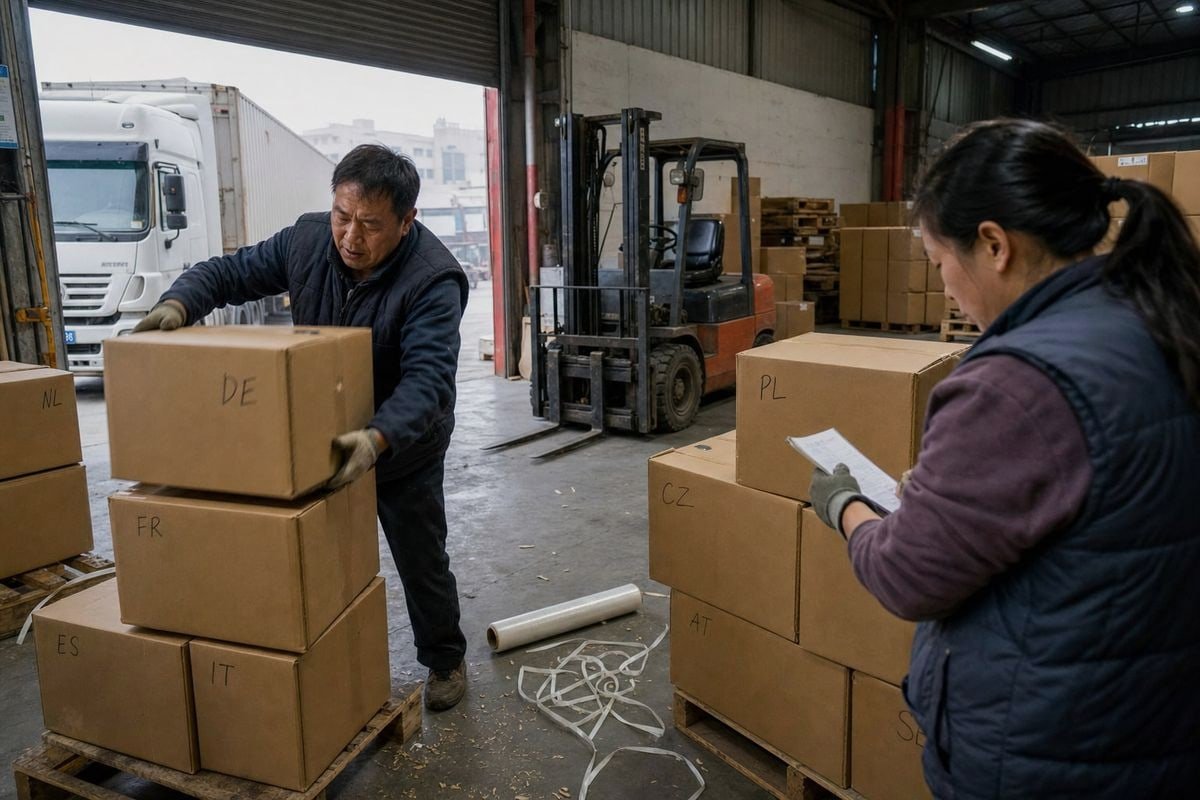
Testing and labeling are two halves of one system. The lab report tells you what your product actually is; the label tells the consumer. If those two disagree, you fail audits even with beautiful packaging. Our factory holds ISO 9001 6, BSCI, CE, and SGS/Intertek certification, and buyers in the US and Europe treat those reports as a hard requirement, so we build the label around the test, never the other way around.
The pre-shipment verification sequence
| Stage | What Gets Checked | Who Checks It |
|---|---|---|
| Formulation review | Colorant composition, chemical safety data sheets | Factory compliance team |
| Third-party testing | Combustion behavior, emissions, hazardous substance limits | SGS or Intertek lab |
| Classification match | Signal word and hazard statements vs. test results | Compliance team + buyer |
| Label proof audit | Languages, pictograms, font sizes, supplier details | Buyer's QA or importer |
| Pre-shipment inspection | Printed labels match approved proof, batch coding correct | Factory QC + optional third party |
Common failure points to avoid
Three mistakes cause most rejections. First, testing one formulation and shipping another; even a small colorant change can shift the hazard class, so retest after any reformulation. Second, printing labels before the report arrives; if the lab flags an irritant, your precautionary statements must change. Third, missing the responsible-person address for the EU market; consumer product safety standards there require a traceable EU contact on the pack. We keep test reports on file and share them with buyers upfront, because a distributor who can hand a full compliance dossier to a retail chain closes listings faster. That is the practical payoff of doing this in the right order.
Conclusion
Compliant multilingual labels turn colored pine cones from a customs risk into a shelf-ready product. Define hazards, translate properly, test early, and partner with a certified factory like ours.
Footnotes
1. Official ECHA page explaining the Classification, Labelling and Packaging (CLP) Regulation requirements. ↩︎
2. Official UN resource detailing the standardized hazard symbols used globally for chemical labeling. ↩︎
3. US CPSC portal providing guidance on mandatory safety standards for consumer goods. ↩︎
4. Official EU summary of the CLP regulation covering labeling, packaging, and legibility requirements. ↩︎
5. OSHA's primary landing page for Hazard Communication and Safety Data Sheet (SDS) standards. ↩︎
6. Official ISO page describing the international standard for quality management systems. ↩︎
7. Official OSHA regulation text detailing the legal criteria for chemical hazard classification. ↩︎



 English
  Spanish
  German
  French
  Arabic
  Portuguese
Join the Conversation