






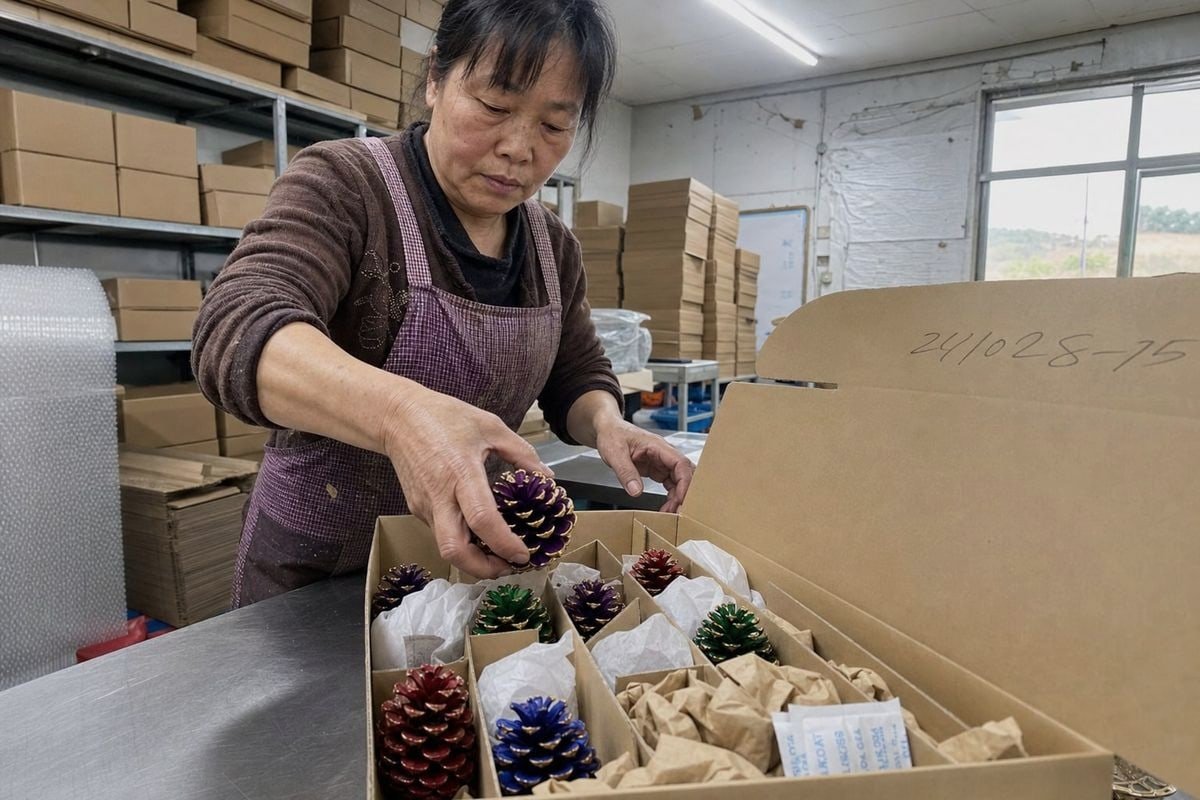
Crushed scales, powder loss, ruined finishes — I have seen entire containers of fireplace colored pine cones arrive damaged silica gel packets 1. On our production line, packaging failures cost buyers more than product defects ever do.
To package fireplace colored pine cones and prevent crushing, use rigid outer cartons with corrugated cardboard dividers, wrap cones individually in acid-free tissue paper, add cushioning materials on all sides, include silica gel packets for moisture control, and enforce strict stacking weight limits during storage.
That is the short answer. The details matter more. Below, I break down materials, carton design, supplier standards, and custom packaging options — the same framework we use when packing export orders for our B2B clients.
What packaging materials work best to protect fireplace pine cones from crushing during long-distance shipping?
A shipment we packed for a German distributor a few years back taught our team a hard lesson: soft wrap alone is never enough private-label branding 2. The outer structure decides whether cones survive.
The best materials are acid-free tissue paper for individual wrapping, corrugated cardboard dividers to create protective cells, foam sheets between layers, crumpled kraft paper for void fill, silica gel packets for moisture control, and a double-walled corrugated outer carton for structural strength.
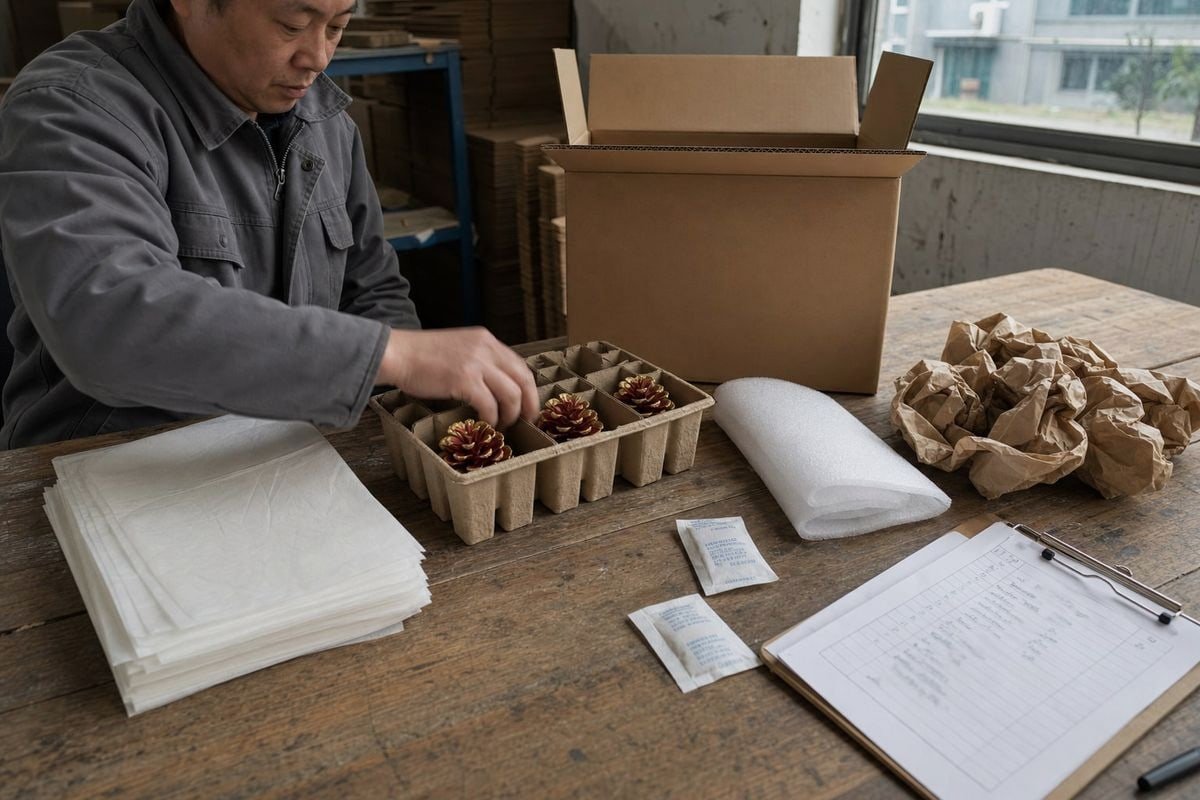
Pine cones are structurally fragile. Their layered scales bend, snap, or shed when compressed. Add a coating of flame colorant salts and a painted or lacquered finish, and you have a product that can lose both shape and function from one careless stack. In our experience exporting to the US and Europe, most damage happens in two places: during ocean freight 3 vibration and during warehouse stacking. Your material choices must address both.
The two-layer protection principle
We always recommend a two-layer system. The inner layer protects the surface finish. The outer layer resists crushing force. Neither works alone.
| Layer | Material | What It Protects Against |
|---|---|---|
| Individual wrap | Acid-free tissue paper or kraft paper | Scale interlocking, finish scratches, powder rub-off |
| Cell separation | Corrugated cardboard dividers 4 (egg-carton or wine-divider style) | Lateral crushing, cone-on-cone contact |
| Layer padding | Foam sheets or bubble wrap | Vibration, vertical impact between layers |
| Void fill | Crumpled or shredded kraft paper | Shifting inside the carton |
| Moisture control | Moisture-wicking silica packets | Softened wood fibers, coating degradation |
| Outer shell | Double-walled corrugated carton | Stacking pressure, handling drops |
A general rule from shipping best practice is about 8 cm of cushioning around fragile contents, with double-boxing for the most delicate items. We apply that standard to hand-painted display cones — like our gold-tipped decorative range — because their glossy finish scratches easily.
Why moisture control counts as crush protection
This surprises many buyers. Flame colorant salts are hygroscopic 5 — they pull moisture from the air. Damp cones develop softened wood fibers, and soft scales crush far more easily than dry ones. So moisture-wicking silica packets are not just about preserving the color effect. They keep the cone structurally rigid. We insert them into every airtight storage container and resealable pouch we produce, and we make sure cones are fully dried before packing so sealed bags never trap residual moisture.
Some buyers ask whether bubble wrap is essential everywhere. It is not. For plain colored cones, paper-based cushioning is cheaper, more breathable, and easier to recycle. Reserve bubble wrap for cones with fragile decorative additions, such as metallic paint tips.
How can I choose the right carton design and cushioning for bulk pine cone orders?
There is a trade-off we weigh on every bulk order: tighter packing lowers freight cost per unit, but overfilled cartons press cones against each other and against the lid. Getting the balance right is the whole job.
Choose double-walled cartons sized so cones sit in single layers separated by dividers, leave a small gap below the lid, limit carton weight for safe handling, and specify individual cell packaging or foam sandwiches between layers to absorb transit vibration and stacking loads.
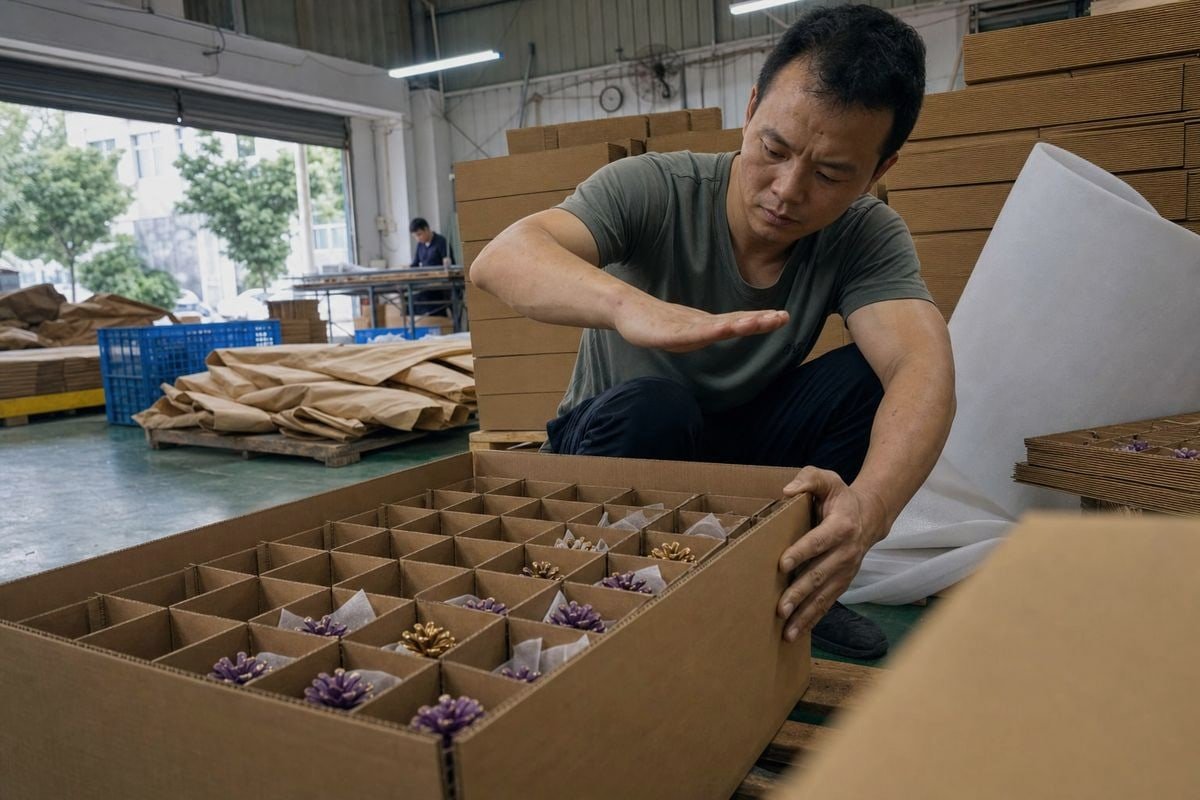
Bulk orders fail for predictable reasons. The carton is too tall, so bottom layers carry too much weight. The carton is overfilled, so the lid presses directly on the top layer. Or there are no dividers, so scales interlock and snap during vibration. Every one of these is a design decision, and every one is preventable at the specification stage.
A practical carton design checklist
Here is the sequence we walk through with buyers before confirming bulk packaging:
- Set the layer count. Three to four layers per carton is our practical ceiling for loose colored cones. More layers concentrate weight on the bottom row.
- Add individual cell packaging where the product justifies it. Egg-carton style trays or wine-divider grids isolate each cone and stop lateral crushing. For premium hand-painted cones, cells are worth the cost.
- Sandwich the layers. A foam sheet or corrugated pad between each layer redirects vertical load onto the divider structure, not the cones' fragile horizontal scales.
- Leave headspace. A small gap at the top ensures the lid never bears down on cones. Fill it with crumpled paper so nothing shifts.
- Define stacking weight limits. Print maximum stack height on the carton. We typically cap pallet stacking at a level the bottom carton can hold without deflection.
- Test before you ship. We run drop tests and compression checks on new carton designs compression testing 6 before any container leaves our Ningbo facility.
Matching carton spec to order type
| Order Type | Recommended Carton | Cushioning Approach |
|---|---|---|
| Retail-ready pouches (resealable stand-up bags) | Standard double-wall carton | Pouches self-cushion; add top pad only |
| Loose bulk cones for repacking | Double-wall carton, 3–4 layers max | Cardboard dividers plus paper void fill |
| Hand-painted premium cones | Double-wall carton with cell trays | Individual cell packaging plus foam sandwiches |
| Mixed sets (cones plus wax-dipped fire starters) | Partitioned carton | Separate compartments, silica packets in each |
One more point from our export experience: climate matters in transit. Ocean containers see wide temperature swings, and repeated expansion and contraction stresses cone scales. Ventilated but moisture-protected packing — kraft paper plus silica, rather than fully sealed plastic around damp product — handles this better than airtight film alone.
What packaging standards should I require from my supplier to ensure shelf-ready, damage-free products?
A purchasing manager from the Netherlands once asked me a question I now put to every new buyer: "How do I know carton fifty looks like carton one?" That question is really about standards, not packaging.
Require documented packing specifications, batch-to-batch quality control on both product and packaging, pre-shipment drop and compression testing, moisture-content verification before sealing, compliant warning labels and barcodes, and certifications such as ISO 9001, BSCI, and third-party SGS or Intertek test reports.

Shelf-ready means more than "arrived intact." It means the retail unit — pouch, jar, or burlap sack — looks exactly as approved, carries correct labeling, and needs no repacking at your warehouse. Repacking is where hidden costs pile up. If your team must open cartons, discard broken cones, and rewrap product, your real landed cost climbs fast, and your damage claims get complicated.
The standards worth writing into your purchase order
At our factory, we encourage buyers to specify packaging requirements in the PO itself, not in an email thread. Here is what belongs there:
| Standard | What to Specify | Why It Matters |
|---|---|---|
| Packing specification sheet | Materials, layer count, divider type, void fill, silica quantity | Makes packaging auditable and repeatable |
| Moisture verification | Cones fully dried before sealing; drying process documented | Prevents mold, odor, and softened scales in airtight storage containers |
| Transit testing | Drop test and compression test reports per new carton design | Confirms real-world survivability before mass production |
| Labeling compliance | Warning labels, usage instructions, barcodes, country-of-origin marks | Fire products face strict retail and customs requirements |
| Certification file | ISO 9001 7, BSCI, CE, SGS/Intertek test reports on request | Non-negotiable for US and EU retail channels |
| Batch consistency | First sample must match mass-production output | Protects your brand from quality drift over reorders |
Why compliance and crush protection are linked
This connection is easy to miss. Colored pine cones are fire products. Retailers and customs authorities 8 in our main markets — the US, Germany, the UK, France — expect proper hazard communication and test documentation. A supplier disciplined enough to maintain ISO 9001 processes and pass BSCI audits is usually disciplined enough to follow a packing spec on carton four hundred. A supplier who improvises on labels will improvise on cushioning materials too. In 17+ years of exporting to more than 30 countries, we have found that packaging failures and compliance failures almost always come from the same root cause: no documented process.
Also insist on clear segregation labeling. Colored cones must never be mistaken for food or plain decoration, so labels should state fireplace use and keep-away-from-children warnings clearly.
Can custom packaging solutions help reduce breakage rates while keeping my private-label branding intact?
When we were developing our stand-up resealable pouch — the kraft-brown bag with the clear window — the design brief had two goals that seemed to compete: protect the cones and showcase them. It turned out the same structure can do both.
Yes. Custom packaging reduces breakage by matching the structure to your product — resealable stand-up pouches, rigid jars, or divided gift boxes — while carrying your private-label branding, logo, colors, barcodes, and warning labels, so protection and shelf presence come from the same design.

Off-the-shelf packaging forces your product into someone else's dimensions. Custom packaging starts from the cone itself — its size, its coating, its fragility — and builds outward. That is where breakage rates genuinely drop. Our OEM/ODM work covers the full stack: structural design, printed branding, warning labels, barcodes, and display packaging, so buyers do not need to coordinate three vendors to get one shelf-ready product.
Three custom formats we build most often
Stand-up resealable pouches. The kraft pouch with a clear product window is our most requested format for camping and outdoor brands. The gusseted base keeps cones upright, the resealable zip protects unused cones from humidity after opening, and the flexible walls absorb minor impacts. The rainbow-gradient print area carries the brand story while the matte, textured finish signals eco-friendly positioning.
Drawstring burlap sacks. For fireplace and gift channels, the rustic burlap sack with a jute tie and printed logo sells the artisanal feel. Structurally, we pair it with an inner liner and recommend cartons with dividers, because fabric alone offers little crush resistance. The sack is branding; the carton does the protecting.
Rigid jars and divided gift boxes. For premium hand-painted cones — purple with metallic gold tips, red, emerald, deep blue — a rigid container with individual cells protects the lacquered finish. Each cone sits wrapped in acid-free tissue paper inside its own compartment. This format commands higher retail prices and survives rougher retail handling.
The customization decision, in practice
A common buyer objection: "Custom packaging raises my unit cost." True at the unit level — but the comparison is incomplete. Compare total landed cost including breakage, repacking labor, returns, and lost shelf appeal. A pouch that cuts damage from noticeable to negligible usually pays for itself within one or two reorders. We also apply protective wrapping techniques and structural reinforcement at the product level — proper drying, optional clear sealing on decorative cones — so the packaging is not fighting a fragile product alone. And because we run complete production lines rather than outsourcing, your approved sample, your printed pouch, and your five-thousandth carton come from the same controlled process.
Conclusion
Crushed cones destroy margins and brand trust. The fix is systematic: rigid cartons, dividers, individual wrapping, moisture control, and documented supplier standards. Get the packaging spec right once, and every reorder arrives shelf-ready.
Footnotes
1. Explains desiccant properties relevant to moisture control claims made in article. ↩︎
2. Background on private-label branding concept referenced for custom packaging services. ↩︎
3. WTO trade facilitation resource relates to export logistics and shipping standards discussed. ↩︎
4. Background on corrugated fiberboard structure explains why it resists crushing forces. ↩︎
5. Defines hygroscopy, the scientific property underlying moisture absorption claims. ↩︎
6. Authoritative Wikipedia article explaining container compression testing used to evaluate packaging strength and stacking durability. ↩︎
7. Authoritative Wikipedia overview of the ISO 9001 quality management standard and its global implementation requirements. ↩︎
8. WTO customs valuation page relates to compliance requirements for export shipments mentioned. ↩︎



 English
  Spanish
  German
  French
  Arabic
  Portuguese
Join the Conversation