






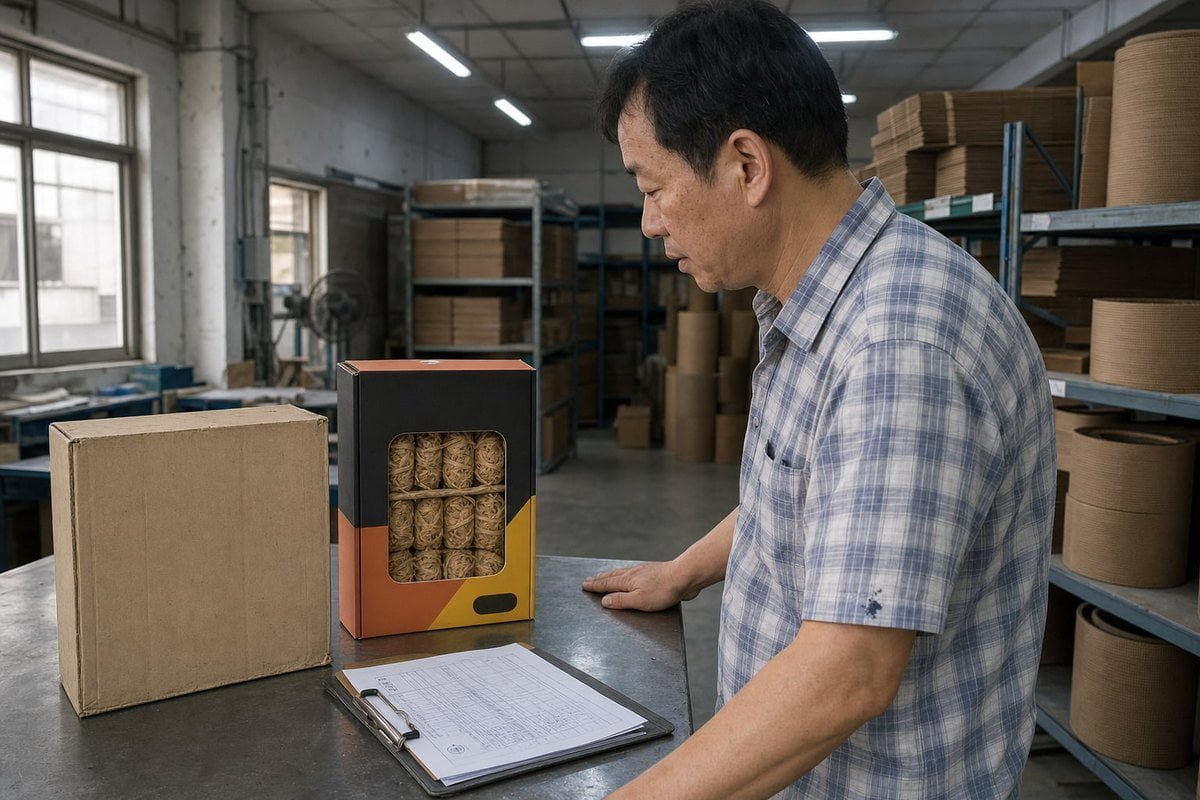
Wood fire starter packaging sells your product before anyone strikes a match cautionary language 1. I learned this the hard way when a distributor returned an early batch from our Ningbo line — the fire starters burned perfectly, but the plain kraft boxes disappeared on the shelf next to bolder competitors. Sales stalled, the buyer got nervous, and reorders stopped. That painful lesson pushed us to treat packaging as a conversion tool, not an afterthought.
To optimize wood fire starter packaging for shelf appeal, lead with one bold benefit claim, use high-contrast colors, add a die-cut window showing the wood wool texture, choose moisture-resistant FSC-certified cardboard, and include required flammability warnings. Test readability at arm's length before mass production.
Let me break this down into the four questions buyers ask us most often. Each one covers a piece of the shelf-appeal puzzle, from materials to compliance to low-MOQ customization.
What packaging materials work best for wood fire starters on retail shelves?
There is a trade-off we weigh on every OEM project: eco-friendly appearance versus real-world durability. A beautiful paper box that warps in a humid garden center helps nobody, so our team tests both sides before recommending a structure.
FSC-certified cardboard with a moisture-resistant coating works best for wood fire starters, because it signals sustainability while protecting wax-dipped products from humidity. Kraft boxes with die-cut windows, corrugated display boxes, and resealable zipper pouches are the top three retail-proven formats.
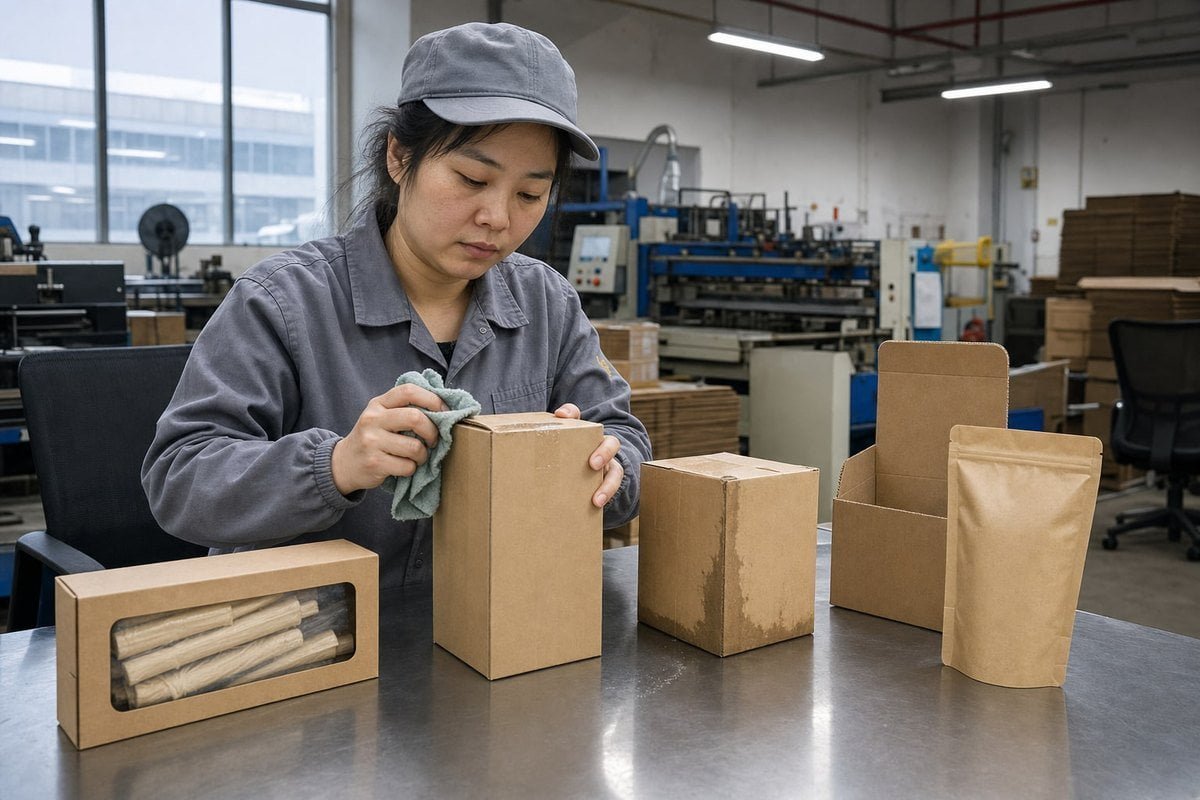
Material choice does two jobs at once. It protects the product, and it tells shoppers what kind of brand you are. For wood fire starters, those two jobs sometimes pull in opposite directions. Here is how we think through it.
Match the material to the sales channel
A fire starter sold in a heated supermarket faces different conditions than one stacked outside a hardware store in November. In our experience exporting to the US and Germany, buyers often underestimate humidity. Wax-dipped wood rolls resist moisture well, but the box around them can soften, scuff, and lose barcode readability 2. That is why we add moisture-resistant barriers or a light varnish to cartons headed for non-climate-controlled retail.
| Material | Best For | Strengths | Watch Out For |
|---|---|---|---|
| FSC-certified cardboard box | Supermarkets, home goods retail | Eco signal, strong face graphics, stackable | Needs coating in humid stores |
| Kraft box with die-cut window | Premium and natural brands | Shows real wood wool texture 3, rustic cue | Window film must be biodegradable film for eco claims |
| Corrugated display boxes | Point-of-purchase displays, pallet programs | Shelf-ready packaging, high visibility | Higher unit cost, needs planned shelf space |
| Resealable zipper pouches | Camping and outdoor channels | Lightweight, hangable, re-closable | Weaker premium feel, harder to stack |
Why windows earn their cost
Shoppers trust what they can see. A die-cut window lets buyers inspect the fibrous excelsior texture of the wood rolls, which instantly separates a natural product from paraffin cubes in a sealed plastic tub. When we run window boxes, we pair them with a thin biodegradable film so the eco story stays honest. On our production line, we also check that the product sits snugly against the window. A fire starter that rattles or shifts looks cheap, even in a premium box.
Finish matters as much as structure
Matte and gloss finishes send different signals. Matte kraft says natural and handmade. Gloss says practical and mass-market. We usually recommend matte for eco-positioned fire starters and reserve gloss accents for the flame graphic or the burn-time badge, so the key claim pops without cluttering the panel.
How can I make my wood fire starter packaging stand out to buyers?
A German importer once lined up our sample box next to six competitors on his conference table and asked, "Which one would you grab from three meters away?" That test changed how we design every front panel.
Make wood fire starter packaging stand out by leading with one 3–5 word benefit claim, using a bold color block that contrasts with rustic category norms, adding a burn-time callout, and keeping a consistent brand signature across all variants for instant recognition.
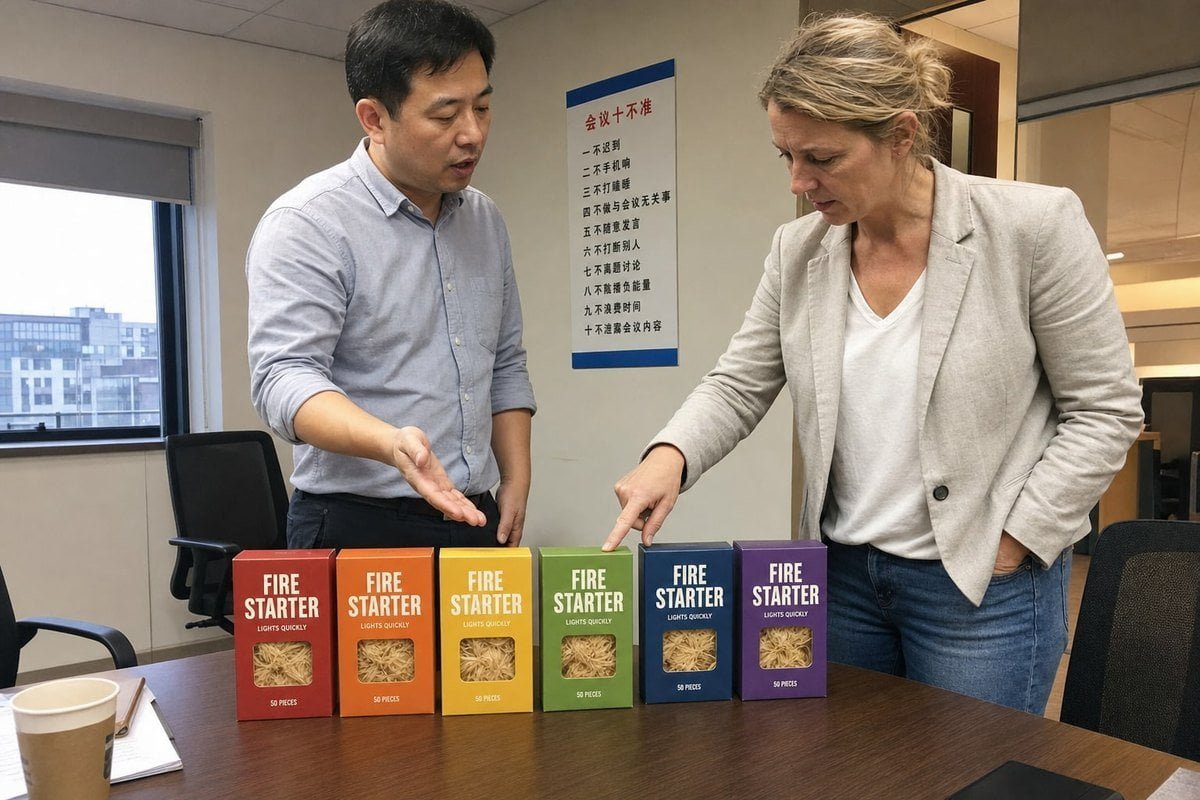
Shelf appeal is a three-second contest. Fire starters are functional impulse products — shoppers rarely plan the brand in advance, so the package must win attention, comprehension, and trust almost instantly. Here is the priority order we follow when developing private-label designs for our clients.
Build a strict front-panel hierarchy
The front panel should carry only three elements in strong hierarchy: brand name, product name, and one core benefit. Everything else moves to the side or back. The strongest claims we see for wood fire starters are short and concrete: "15+ Minute Burn," "One Match Lighting," "100% Natural," or "All-Weather." Pick the one that matches your real product attributes and make it big. A crowded front panel with six claims reads as no claim at all.
Use contrast, not clutter
Most fire starter packaging leans on the same rustic visuals: flames, logs, forest green, terracotta. Those earth tones fit the category, but if every box uses them, none stands out. The trick is category-appropriate contrast. Our own retail box pairs a black-to-orange gradient with bold white text, and it reads clearly from the end of an aisle. You still look like a fire starter — just a more confident one.
Design for shelf and screen at once
Many buyers first meet your product as a thumbnail on a marketplace listing. A package that reads clearly at thumbnail size almost always reads well at arm's length too. We test both before approving print files.
| Standout Tactic | Effort | Shelf Impact |
|---|---|---|
| One bold 3–5 word claim | Low | High |
| High-contrast color block | Low | High |
| Burn-time badge with icon | Low | Medium–High |
| Consistent family system across SKUs | Medium | High over time |
| QR code 4 linking to a fire-building guide | Low | Medium, adds post-purchase value |
| Distinct structure (stand-up, hangable) | Medium–High | Medium, channel-dependent |
Keep variants in one family
If you sell multiple versions — indoor, outdoor, long-burn, color-flame — keep the brand block identical and vary only a secondary color or icon. Shoppers should recognize the brand first, then pick the variant. We apply this same system across our own Magic Fire packets, color-flame pinecones, and wood firestarter lines, and repeat buyers tell us it makes reordering and planogram planning easier.
What compliance labels and warnings must I include on fire starter packaging?
Compliance is the first question our European buyers ask, often before they ask about price. After 17 years of shipping fire products to 30+ countries, we have learned that a missing warning symbol can hold an entire container at customs.
Fire starter packaging must include a flammability warning symbol, "Keep away from children" text, usage and storage instructions, composition disclosure, country of origin, importer details, net quantity, and a scannable barcode. EU markets require CLP-compliant hazard labeling; the US requires clear cautionary statements.

Nobody wins a shelf-appeal contest with a product that gets pulled from shelves. So let me walk through the compliance layer, because it must be planned into the design from day one, not squeezed in later.
The non-negotiable label elements
Every fire starter package we produce carries these elements, positioned so they never fight with the front-panel hierarchy:
- Flammability hazard symbol and signal word. In the EU, this follows CLP regulation 5 with the flame pictogram. In the US, cautionary language must be clear and conspicuous.
- Child safety warning. "Keep out of reach of children" is standard across every market we export to.
- Usage instructions. Short, numbered steps with simple icons reduce misuse and returns. We often add a QR code linking to a lighting guide for extra clarity.
- Composition disclosure. Our own boxes state the wood fiber and paraffin content 6. Transparent composition builds trust and satisfies retailer requirements.
- Net quantity and piece count. A visible count badge — like a "100 pcs" callout — doubles as both compliance information and a value cue.
- Country of origin, importer name and address. Required in the US, EU, UK, Canada, and Australia.
- Barcode with verified scannability. We test barcodes under different retail lighting before mass production, because a glossy varnish over a barcode can kill scan rates.
Certification backing behind the label
Labels are only claims. Retail sourcing channels — especially large chains — want documentation behind them. Our factory holds ISO 9001 7 and BSCI certification, and our products carry CE marking 8 with SGS and Intertek test reports. When a purchasing manager audits a fire product supplier, these reports are a hard requirement, not a nice-to-have. We provide them upfront with every quotation, and we help clients place required warning text correctly for their specific destination market, including sustainable ink options where retailer eco-programs demand them.
Design compliance in, not on
The best approach is to reserve a fixed compliance zone on the back or side panel during the earliest design stage. This keeps the front panel clean for your one bold claim while every regulator and retailer requirement still has its place.
Can I get custom branded packaging for wood fire starters at low MOQ?
A UK camping brand approached us last year wanting private-label fire starters but worried a factory would demand a full container as a first order. That conversation happens weekly, so let me answer it plainly.
Yes. Factory-direct suppliers like Sunrich offer full private-label packaging for wood fire starters at trial-friendly MOQs. Customization covers box design, logo printing, warning labels, barcodes, burn time, product size, and shelf-ready display packaging, with first samples matching mass-production quality.

Low-MOQ customization is realistic when you work directly with a factory instead of a trading company. A trading company adds a margin and a communication layer, and it rarely controls print or production scheduling. A real factory can slot a smaller trial run between larger orders and keep the same quality controls. Here is how the process typically works with us.
The five-step OEM path
- Define the brief. You send your logo, target market, sales channel, and preferred format — carton, kraft window box, pouch, or corrugated display boxes for pallet programs.
- Structure and artwork. Our team proposes a structure sized to your product count and shelf placement, then adapts your artwork with the compliance zone built in.
- Physical sample. We produce a full sample: real fire starters in the real box. You test burn time, fit, scuff resistance, and thumbnail readability.
- Trial order. A smaller first run lets you validate sell-through before committing to volume. We keep batch-to-batch quality control tight so the trial batch reflects exactly what full production will deliver.
- Scale and logistics. We optimize carton dimensions and pallet configuration for your shipping lane, whether that is a US West Coast port or Rotterdam.
What you can customize
| Element | Customization Options |
|---|---|
| Product | Size, burn time, wax formula, roll or puck shape |
| Primary pack | Box, kraft window box, resealable zipper pouches, jar |
| Branding | Logo, colors, full private label, matte and gloss finishes |
| Retail features | Die-cut window features, hang holes, count badges, QR codes |
| Compliance | Market-specific warning labels, barcodes, test reports |
| Display | Shelf-ready packaging, counter units, point-of-purchase displays |
Why trial orders make sense for both sides
We would rather earn a long-term partner through a successful small launch than push a large first order that sits in a warehouse. Buyers who test the market with a trial run, refine their packaging based on real shelf feedback, and then scale up become our most stable accounts. That is the partnership model we built our export business on.
Conclusion
Weak wood fire starter packaging quietly kills good products — shoppers walk past, retailers deprioritize, reorders vanish. Strong shelf appeal fixes this: one bold claim, honest materials, built-in compliance, and factory-direct customization.
Footnotes
1. US federal statute requiring clear cautionary statements on



 English
  Spanish
  German
  French
  Arabic
  Portuguese
Join the Conversation