







Bulk magic fire powder keeps coming up in calls with our hospitality buyers, and I understand why. Campgrounds struggle to differentiate a fire pit that looks like everyone else's.
To offer bulk magic fire powder to campgrounds and rental businesses, source certified, single-use flame color changing packets from a compliant factory, customize private-label packaging, start with a flexible trial MOQ, and lock in batch-to-batch quality control before scaling wholesale orders.
That is the short version. Below, I break down each step in detail, from certifications to packaging, pricing, and quality control, based on what actually works for B2B buyers.
What Certifications Do I Need to Sell Magic Fire Powder to Campgrounds Legally?
A buyer from Germany once told me his insurer rejected an entire shipment of fire accessories because the supplier could not produce a valid safety data sheet 1. That conversation shaped how we handle documentation at our Ningbo facility.
To sell magic fire powder legally to campgrounds, you need an MSDS or safety data sheet, CE marking for European markets, third-party lab test reports such as SGS or Intertek, and compliant warning labels. Factory-level ISO 9001 and BSCI audits strengthen your position with insurers and retailers.

Compliance is not paperwork for its own sake. Campgrounds and rental businesses carry liability insurance 2, and their insurers ask hard questions about any consumable product handed to guests near an open flame. If you cannot answer those questions with documents, the deal usually dies quietly. In our seventeen-plus years exporting wood-burning fire additives to over thirty countries, I have never seen a serious US or European distributor place a repeat order without a full compliance file.
The Core Documents Buyers Ask For
Here is what a purchasing manager will typically request before committing to bulk magic fire powder:
| Document | What It Proves | Who Requires It |
|---|---|---|
| MSDS / SDS | Chemical composition and safe handling | Insurers, customs, retailers |
| CE documentation | Conformity for EU market entry | EU importers and distributors |
| SGS or Intertek 3 test report | Third-party verification of safety claims | Large retail sourcing channels |
| ISO 9001 4 certificate | Consistent factory quality management | B2B buyers vetting suppliers |
| BSCI audit report | Ethical and social compliance | European retail chains |
Labels and Warnings Matter Too
Certification does not stop at the factory gate. Each packet needs printed usage instructions and a caution label. Our team prints warnings directly on the foil pouch and the display box, because campground staff will not read a separate leaflet. For US-bound goods, we also add barcodes and state-specific warning language when the buyer's legal team requests it. My advice is simple: ask your supplier for the full document package before you sample. If they hesitate, walk away. A missing safety data sheet today becomes your liability problem tomorrow, especially when guests use the product around families and shared fire rings.
How Can I Customize Packaging and Branding for Rental Business Bulk Orders?
The trade-off I weigh most often with private-label clients is unit cost versus perceived value. A plain foil sachet is cheapest, but a branded kraft pouch can turn the same powder into a premium guest amenity.
You can customize bulk magic fire powder with private-label foil sachets, branded kraft stand-up pouches, plastic jars, co-branded sleeves, custom display boxes, QR codes, barcodes, and warning labels. A capable OEM factory handles artwork, pack size, and shelf-ready merchandising in one workflow.
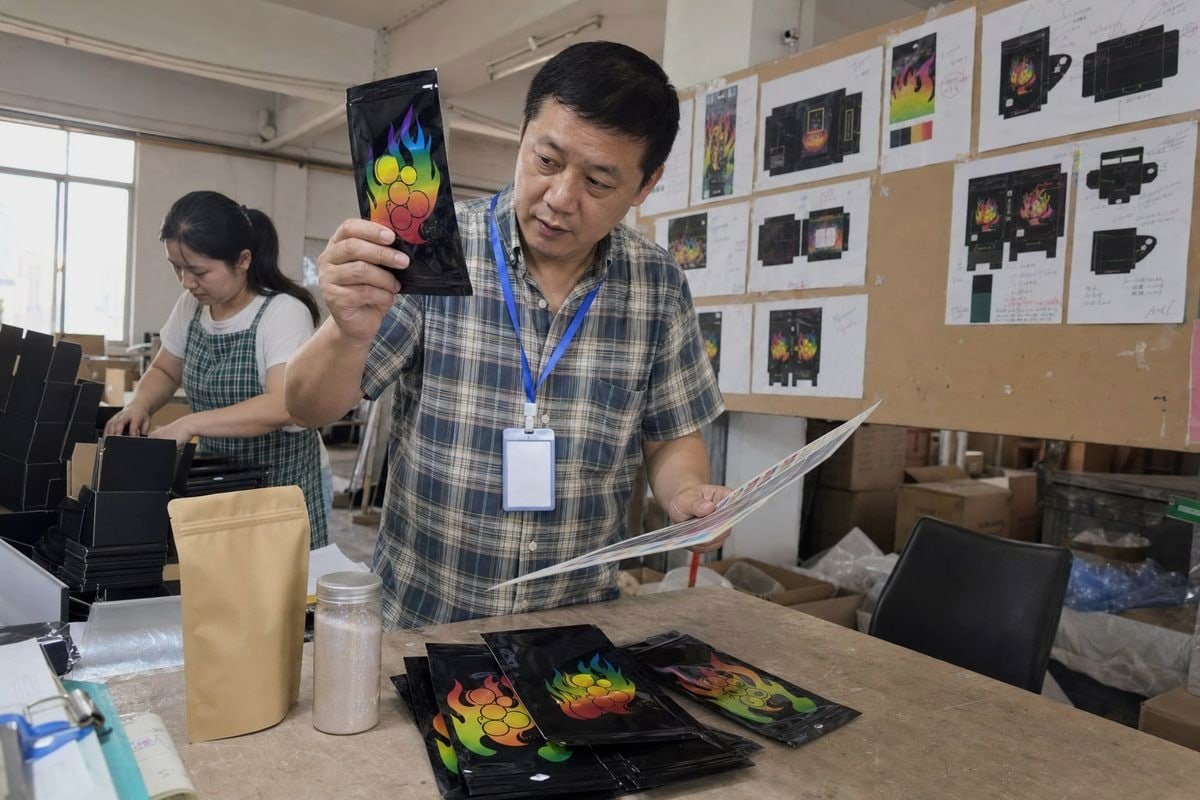
Packaging is where a low-cost novelty becomes a repeatable upsell. Campgrounds do not want a generic packet on their front desk. They want something that looks like their own proprietary souvenir. Our OEM line supports full customization: pouch material, print design, pack weight, burn time, and outer packaging. The glossy black foil pouch with rainbow flame graphics works well for camp-store checkout displays, while the matte kraft-paper pouch with a resealable zip suits glamping welcome kits and cabin amenity baskets.
Packaging Formats That Fit Hospitality Buyers
Different business models call for different formats. Here is how I usually map them:
| Business Type | Best Format | Why It Works |
|---|---|---|
| Campground camp store | Single-serve foil sachets in a counter display box | Impulse buys next to firewood and s'mores kits |
| Glamping site supplies | Branded kraft pouch in welcome kits | Feels like a curated guest amenity |
| Cabin and RV rentals | Co-branded sleeve or multi-pack bundle | Reinforces the property's brand identity |
| Event rental companies | Plastic jar or bulk case with themed colors | Supports birthdays, retreats, and seasonal events |
Branding Ideas Beyond the Logo
Private labeling goes further than printing a name. We have produced themed color collections for clients, such as a blue-dominant mix for stargazing nights and red-and-blue mixes for holiday weekends. QR codes on individual packets are another strong option. They can link to a fire safety video, storytelling prompts, or a digital guestbook page. One European client of ours pairs the packets with wax-dipped wood firestarters and kiln-dried firewood in a fireside bundle. That single move lifted the product from a two-dollar add-on to a full campfire entertainment package. When you brief your factory, ask for shelf-ready output: display packaging, barcodes, and warning labels done at the production line, not added later by hand.
What MOQ and Pricing Options Work Best for Testing This Product With Campgrounds?
Last spring, a Canadian distributor asked us for a trial run small enough to test at three campgrounds before committing to a container. That request is common, and it is exactly how I recommend buyers start.
A trial MOQ of a few hundred to one thousand packets works best for testing with campgrounds. Use tiered wholesale pricing so unit costs drop meaningfully at case and pallet volumes, and position the product as a premium experience add-on rather than a cheap novelty.

Pricing this product is about margin logic, not just unit cost. At wholesale scale, per-unit costs for flame color changing packets are low, which is why the product supports high-margin resale. But I always caution buyers against chasing the absolute cheapest quote. A supplier offering rock-bottom pricing with no test reports transfers all the risk to you. Our positioning has always been reliable long-term partner, not lowest bidder, and the buyers who stay with us for years share that mindset.
A Sensible Tiered Structure
Here is a structure I recommend for buyers building their own wholesale program with campgrounds and rental groups:
| Order Tier | Typical Volume | Buyer Profile | Pricing Approach |
|---|---|---|---|
| Trial order | 300–1,000 packets | Single campground or rental host | Higher unit price, low commitment |
| Case order | 1 case (e.g., 24 displays × 25 units) | Camp store or small chain | Standard wholesale rate |
| Pallet order | Multiple cases | Regional distributor | Volume discount |
| Container order | Full or shared container | National importer or franchise group | Best unit economics, custom OEM |
How to Run the Test Phase
Keep the test simple. Place packets at the front desk next to firewood bundles, price them as a premium campfire accessory, and track sell-through over four to six weekends. Rental businesses can insert one packet per welcome kit and survey guests afterward. For multi-property short-term rental managers, a smart replenishment arrangement works well: a recurring shipment sized to occupancy, so every cabin gets a consistent guest experience without manual reordering. Once the test proves demand, move up a tier and negotiate private-label terms. Flexible MOQs on trial orders are something we deliberately support, because a successful pilot almost always converts into repeat container business within the hospitality supply chain 6.
How Do I Ensure Consistent Quality When Ordering Magic Fire Powder in Bulk?
Quality drift taught me a hard lesson early in my career. A batch that burns green for forty minutes in the sample and only fifteen minutes in mass production will destroy your reputation with campground clients faster than any pricing mistake.
Ensure consistent bulk quality by choosing an ISO 9001 certified factory with batch-to-batch testing, verifying that samples come from actual production lines, requesting burn-time and color test records per batch, and confirming eco-friendly formulations backed by current SGS or Intertek reports.

Consistency is the real dividing line between a factory and a trading company. Trading companies switch source workshops based on price, so your second order may come from a completely different production line than your first. At our facilities, headquartered in Liuyang and producing in Ningbo, the same lines, same raw material specifications, and same QC checkpoints run every order. That is why our first sample reliably reflects mass-production quality, and it is the single question I urge every buyer to press suppliers on.
A Practical Quality Verification Process
Follow this sequence before and during your bulk orders:
- Audit the supplier's identity. Confirm you are dealing with a real factory, not a reseller. Ask for factory photos, audit reports, and a video call from the production floor.
- Test production-line samples. Burn them yourself in a wood fire. Time the color effect. Duration claims in the market range wildly, from twenty minutes to two hours, so verify your specific SKU and market it conservatively.
- Fix the specification in writing. Lock down powder weight per packet, pouch material, seal strength, and expected burn behavior in your purchase agreement.
- Request batch records. A serious factory tests each production batch for color intensity and burn time and can share those records.
- Inspect before shipment. Use a third-party inspection 7 or your supplier's documented pre-shipment QC report for seal integrity, weight accuracy, and label correctness.
Set Honest Guest Expectations
Quality control extends to marketing language. Guests want a quick visual wow around the fire, not a chemistry lecture. Promise instant colorful flames for campfire entertainment, and note clearly that the packets are for wood-burning fires only, never for propane or gas log systems, and never for cooking fires. Our eco-friendly formulations contain no harmful chemicals, but instructions still matter: packets go into the fire unopened, and staff-controlled handout beats open self-serve bins. Consistent product plus consistent messaging is what keeps outdoor fire pit accessories reordered season after season.
Conclusion
Bulk magic fire powder succeeds as a certified, branded, quality-controlled upsell. Verify compliance, customize packaging, test with small MOQs, and partner with a factory that guarantees consistency.
Footnotes
1. Explains the standardized document format insurers and customs require for chemical products. ↩︎
2. Explains the insurance coverage that drives campground and rental business documentation requirements. ↩︎
3. Leading third-party testing and certification body cited for verifying product safety claims. ↩︎
4. Authoritative Wikipedia entry providing a comprehensive overview of the ISO 9001 quality management standard. ↩︎
5. Background on the EU conformity marking required for market entry of consumer products. ↩︎
6. Background concept for how bulk products move from factory to hospitality buyers reliably. ↩︎
7. Background on quality control and inspection practices used to verify manufactured goods before shipment. ↩︎



 English
  Spanish
  German
  French
  Arabic
  Portuguese
Join the Conversation