






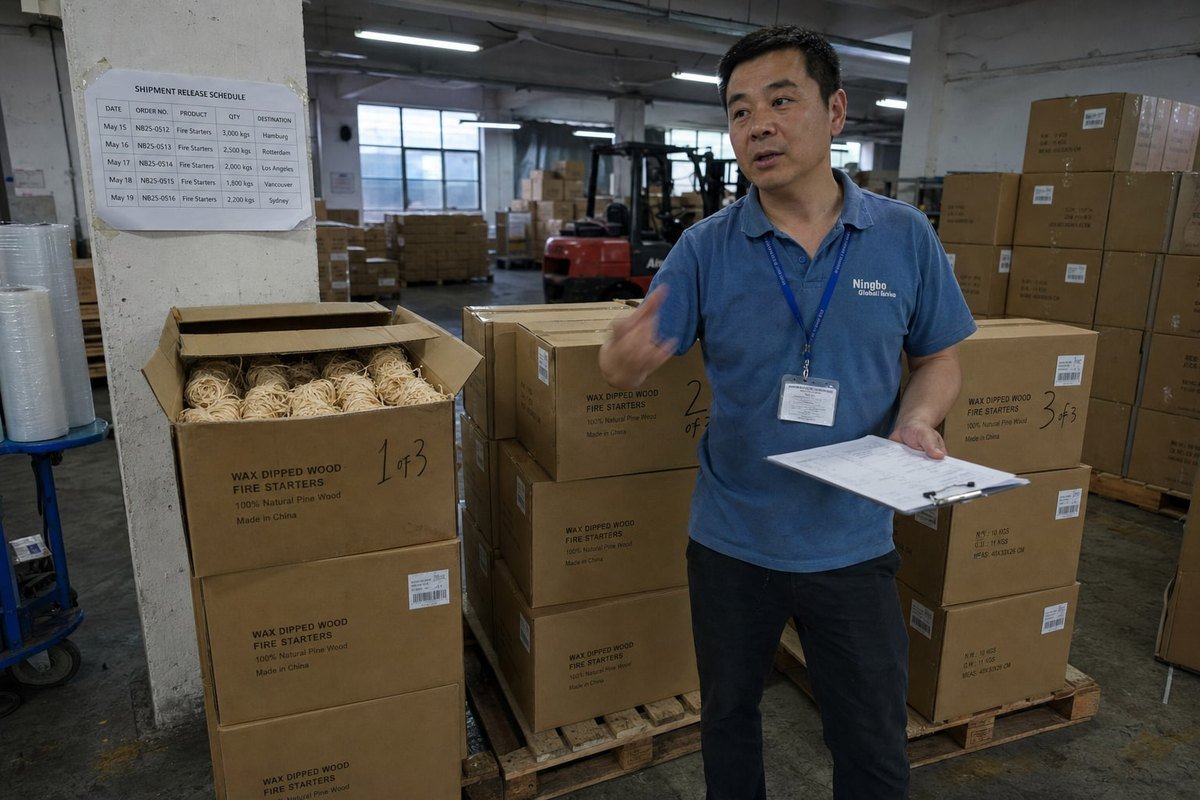
Split shipments for wood fire starters solve a problem I see every season on our production line: buyers overcommit to one bulk delivery, then watch cash and warehouse space disappear. Inventory pressure builds fast. Demand shifts, storage fills, and margins shrink. The fix is negotiating smarter delivery terms — not smaller orders.
To negotiate split shipments for wood fire starters, commit to a larger total volume in a blanket purchase order, then request staged releases — for example 40/30/30 over 60–90 days — tied to your sell-through, with fixed pricing, confirmed lead times, and payment due per shipment.
That is the short answer. But the details decide whether the deal actually eases your inventory pressure or just creates new headaches. Let me walk you through the exact terms, payment structures, MOQ trade-offs, and quality controls I recommend to our own buyers.
What Split Shipment Terms Should I Request From My Wood Fire Starter Supplier?
A German distributor once asked our factory to ship 20,000 wax-dipped wood rolls in one container before winter. We suggested three releases instead. His warehousing overhead dropped, and he reordered the next year without hesitation.
Request a written split release schedule with fixed quantities and dates, a total volume commitment covering all releases, locked unit pricing across batches, defined minimum shipment sizes, agreed storage responsibility for undelivered goods, and a clause covering delays or schedule changes.

The core idea is simple. You separate your total volume commitment from your delivery cadence. Suppliers care most about the total order. If they know the full quantity is committed, most will accept smaller staged deliveries. In our experience exporting to 30+ countries, buyers who present a clear release plan almost always get better terms than buyers who just ask for "flexibility."
The Terms That Matter Most
Put these six points in writing before you sign anything:
| Term | What to Request | Why It Matters |
|---|---|---|
| Release schedule | Fixed dates or trigger events (e.g., 40% now, 30% at day 30, 30% at day 60) | Aligns receiving with seasonal demand fluctuations |
| Total commitment | One blanket purchase order 1 covering all releases | Gives the supplier volume certainty in exchange for flexibility |
| Pricing | Unit price locked for all batches | Prevents mid-schedule price increases |
| Minimum shipment size | Smallest release the supplier will ship | Protects against uneconomical freight |
| Storage responsibility | Who holds finished goods between releases | Shifts warehousing overhead back to the factory |
| Delay clause | Notice periods and remedies if either side slips | Keeps a cash-flow tool from becoming a stockout risk |
Frame It as Risk-Sharing, Not Hesitation
Do not present split shipments as doubt about the product. Present them as a risk-sharing arrangement. The supplier keeps a larger committed order. You avoid dead stock. When buyers show us a forecast or a recurring seasonal pattern, we hold finished goods for later release far more willingly. Predictability is the currency that buys flexibility. Also ask whether the factory can co-load your releases with other fire products — freight consolidation across product lines often offsets the extra shipping cost of splitting.
How Can I Structure Payment Schedules When Splitting Wood Fire Starter Shipments?
The trade-off I weigh most often with buyers is this: they want to pay per shipment, while our finance team wants production costs covered upfront. There is a fair middle ground, and it works for both sides.
Structure payments per release: pay a deposit of 20–30% on the total order to cover production, then pay the balance for each batch before or upon that batch's shipment. This aligns cash outflow with inventory arrival and keeps the supplier's production financed.

Cash flow 2 optimization is the whole point of splitting shipments. If you pay 100% upfront for goods that arrive over 90 days, you have solved your storage problem but not your cash problem. So negotiate the money the same way you negotiate the freight — in stages.
A Payment Model That Suppliers Accept
Here is the structure we use most often at our factory for staged wood fire starter orders:
- Deposit on the blanket purchase order. Typically 20–30% of the total value. This covers raw material — wood wool, paraffin wax, packaging — and proves your commitment.
- Balance per release. Before each batch ships, you pay for that batch only. Your cash outflow now tracks your inventory inflow.
- Final reconciliation. Any adjustments for quantity changes or freight variations settle with the last release.
Compare Your Options Honestly
| Payment Structure | Buyer Cash Impact | Supplier Risk | Best For |
|---|---|---|---|
| 100% upfront, staged delivery | Poor — full cash out on day one | Lowest | Buyers chasing maximum unit discount |
| Deposit + balance per shipment | Good — cash tracks inventory | Moderate | Most split shipment deals |
| Payment on delivery per batch | Best for buyer | Highest | Long-term partners with credit history |
| Letter of credit 3 per release | Neutral, but adds bank fees | Low | Large first orders, new relationships |
One lesson from 17+ years of export: payment flexibility is earned. On a first order, expect the deposit model. After two or three clean seasons — orders confirmed on time, payments made on time — many factories, ours included, will extend more favorable terms. Reliability compounds. Treat the first split order as an audition for better payment terms on the second.
What MOQ and Lead Time Trade-offs Should I Expect With Split Deliveries?
When we quote wax-dipped wood rolls, the Minimum Order Quantity 4 (MOQ) exists for a practical reason: our wax-dipping line runs in batches, and small runs waste setup time and material. Split deliveries change that math — but not always in your favor.
Expect the MOQ to apply per production batch, not per shipment, with a minimum release size of roughly 25–30% of the total order. Lead time for the first release stays standard; later releases ship faster if goods are pre-produced and held by the supplier.

The critical question to ask your supplier is this: will you produce everything at once and release it in stages, or produce each release separately? The answer changes every trade-off in the deal.
Two Production Models, Two Very Different Deals
| Factor | Produce All, Release in Stages | Produce Per Release |
|---|---|---|
| Lead time after batch one | Short — goods are ready and held | Full production lead time each release |
| Batch consistency | Highest — one production run | Requires strict batch-to-batch QC |
| Supplier storage burden | High — factory holds your stock | Low |
| Schedule flexibility | Limited once produced | Higher — can adjust later quantities |
| Typical price impact | Neutral to slight storage fee | Neutral if total volume is committed |
For seasonal goods like fire starters, we usually recommend the first model. Winter demand does not wait for a second production run. Just-in-time delivery sounds attractive, but for a product with a hard selling season, holding pre-produced stock at the factory is safer than betting on repeat lead times.
Realistic Trade-offs to Accept
Be prepared to give ground on three points. First, per-shipment freight rises when you split one consolidated load into three smaller ones — calculate the landed cost per unit before you commit. Second, most factories will cap the number of releases at three or four; ten micro-shipments is not a serious request. Third, lead time management becomes your job too: confirm each release two to three weeks ahead, because a supplier holding your goods still needs booking notice for freight. Handled well, these trade-offs are minor next to the carrying costs you avoid by not sitting on a full season of inventory.
How Do I Ensure Quality Consistency Across Multiple Split Shipment Batches?
Our QC team once caught a wax-coating variance between two production runs of the same fire starter — burn time differed by nearly a minute. We scrapped the second run's coating and re-dipped it. That is exactly the risk split shipments create if you ignore batch control.
Lock a golden sample as the contractual reference, require pre-shipment inspection reports for every release, specify measurable standards — burn time, wax weight, moisture, dimensions — in the purchase order, and confirm the supplier holds ISO 9001 or equivalent batch-control certification.
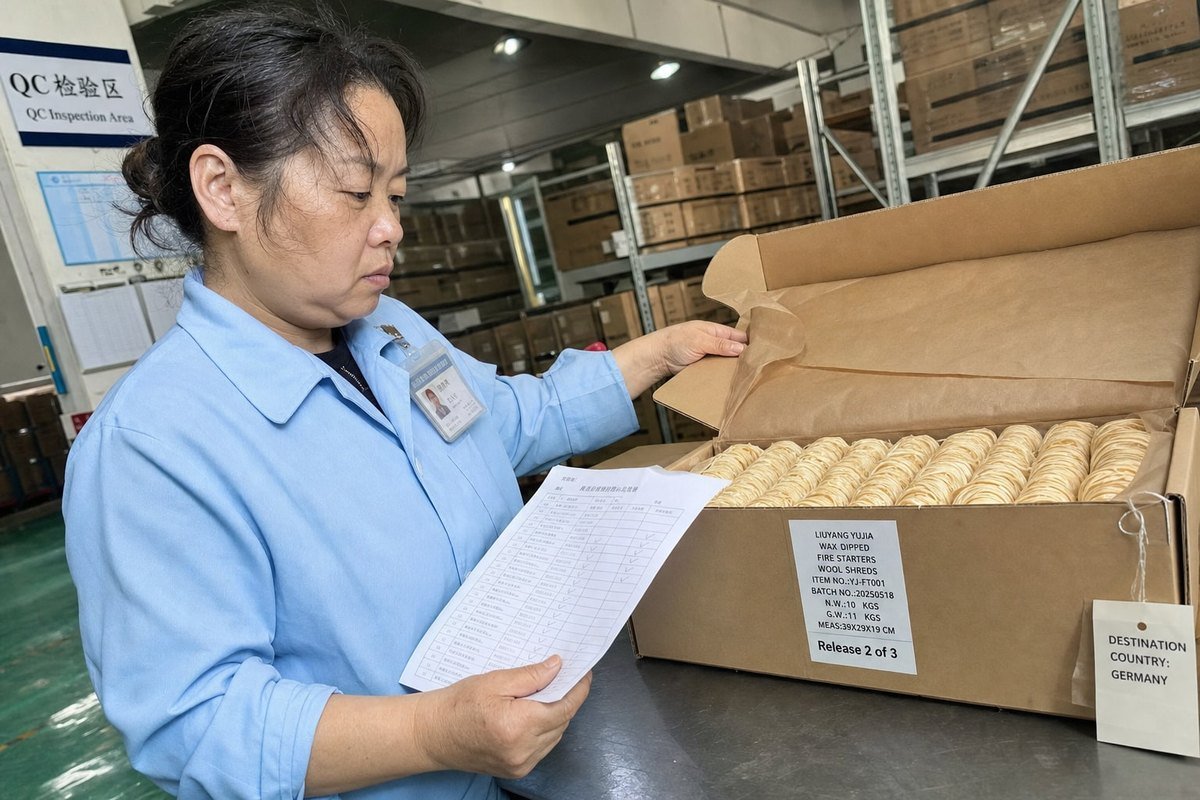
Quality drift between batches is the most underestimated risk in split shipping. If all goods come from one production run and are simply released in stages, consistency is nearly automatic. If each release is produced separately — different wood wool lots, different wax batches, possibly different line workers — you need a system, not trust.
Build a Batch Verification Routine
Follow this sequence for every release:
- Approve a golden sample before production. Keep one sealed reference set at your office and one at the factory. Every batch is judged against it.
- Define measurable specs in writing. For wood fire starters, that means burn time range, wax coating weight, unit dimensions, moisture content 5, and packaging print standards. Vague words like "good quality" protect nobody.
- Require batch documentation. Ask for production date codes on cartons so any issue traces back to a specific run.
- Inspect before each shipment, not just the first. A pre-shipment inspection report — internal QC photos at minimum, third-party SGS or Intertek checks for larger releases — should be a condition of the balance payment.
- Test on arrival. Burn-test a random sample from every release. It takes twenty minutes and catches drift early.
Certification Is Your Insurance Policy
This is where supplier selection matters more than contract language. A factory running ISO 9001 6 batch-control procedures — the standard our own lines follow, alongside BSCI and CE with SGS/Intertek test reports — produces the third release the same way it produced the first. Supply chain 7 agility only works when quality is boring and repeatable. If a supplier resists per-batch inspection, that resistance tells you everything. First samples should reliably predict mass production; if they do not, no split schedule will save the relationship.
Conclusion
Overbuying fire starters ties up cash and shelves; a missed season punishes both. Negotiate split shipments — committed volume, staged releases, per-batch payment and QC — and inventory pressure becomes a managed schedule, not a gamble.
Footnotes
1. Explains the contractual instrument central to structuring split shipment commitments. ↩︎
2. Official SEC (.gov) glossary definition; bypasses bot-blocking issues on commercial sites. ↩︎
3. Background on this payment instrument referenced in the payment structure comparison. ↩︎
4. Defines the MOQ concept discussed extensively in production batch trade-offs. ↩︎
5. Relates to measurable quality standards specified for product batch consistency. ↩︎
6. Official ISO reference for the quality management certification mentioned as supplier insurance. ↩︎
7. Broad background concept for the logistics and agility topics discussed throughout. ↩︎



Join the Conversation