







Negotiating order deadlines for fireplace colored pine cones can make or break a seasonal launch Material Safety Data Sheets 1. On our production line, I have watched buyers win or lose Q4 over a single missed date.
To negotiate order deadlines for fireplace colored pine cones, confirm the supplier's real production capacity, break lead times into milestones, book Q1 or late-summer slots, trade volume or early payment for priority, add a 10-day logistics buffer, and lock every date into the written contract.
That is the short version. Below, I will walk you through each step, using real numbers from our own factory floor and the questions our smartest buyers ask us.
What Lead Times Should I Expect When Ordering Colored Pine Cones from a Manufacturer?
A German distributor once asked me why his colored pine cone order needed five weeks when the cones "already exist in the forest." I showed him our production schedule, and everything changed.
Expect 25–45 days from confirmed order to port for bulk colored pine cone orders: roughly 3–7 days for material sourcing, a mandatory 72-hour chemical saturation and drying cycle per batch, 7–14 days for full production and QA, then packaging, export clearance, and shipping transit times on top.

Lead times for this product are not one number. They are a chain of stages, and each stage has its own floor. In our 17 years exporting color-flame products to 30+ countries, I have learned that buyers who understand the stages negotiate far better than buyers who just ask, "How fast can you go?"
Break the Lead Time into Stages
Here is how a typical bulk order moves through our factory in Ningbo:
| Stage | Typical Duration | Can It Be Compressed? |
|---|---|---|
| Raw cone sourcing and inspection | 3–7 days | Partly, if stock is pre-held |
| Chemical saturation 2 (metal salts) | 72 hours minimum | No — this is a hard floor |
| Drying (kiln or ambient) | 2–5 days | Yes, with forced-air kilns |
| QA and burn testing | 2–3 days | Rarely — skipping QA is risky |
| Packaging and labeling | 3–7 days | Yes, if specs are finalized early |
| Export clearance | 2–5 days | Only with complete documents |
| Ocean or air transit | 5–35 days | Yes, by paying for faster freight |
Notice that the chemical saturation step cannot be rushed. The metal salts must fully penetrate the cone scales, or the flame colors come out weak and patchy. Any supplier who promises to skip this step is promising a product your customers will return.
Seasonality also shapes lead times. Raw cones are best sourced at the late-summer harvest peak, before winter moisture degrades them. And during Q4, peak season demand can stretch every stage in the table above. A 30-day order in March can become a 50-day order in October. Plan your seasonal decor sourcing calendar around that reality, not around the supplier's best-case quote.
How Can I Ensure My Supplier Meets Agreed Deadlines for Bulk Pine Cone Orders?
The hardest lesson I learned early in our export business was this: a deadline that lives only in an email thread is not a deadline. It is a hope.
Ensure deadline compliance by writing a milestone schedule into the purchase order, requiring pre-shipment samples six weeks ahead, confirming raw material stock before signing, setting a weekly update cadence, tying final payment to delivery documents like updated MSDS sheets, and defining remedies for delays.

Vague promises fail. Written controls work. In our experience shipping to the US, Germany, and the UK, the buyers who never get burned all use the same tool: a milestone plan attached to the vendor contract terms, not buried in chat messages.
Build a Milestone Plan, Not a Single Date
A single delivery date gives you no early warning. A milestone plan gives you five or six checkpoints where you can catch a slip while there is still time to fix it. Here is the structure our best wholesale procurement partners use:
- Order confirmation — supplier confirms metal salt stock and raw cone availability in writing before you sign. This hedges against chemical supply chain volatility.
- Sample approval — physical pre-shipment samples arrive six weeks before your deadline. You burn-test them for flame-color accuracy and check that the cones are fully dried.
- Production start — confirmed with photos or video from the line.
- QA completion — batch test results shared, ideally against SGS or Intertek 3 benchmarks.
- Packaging finalized — artwork, labels, and barcodes locked at least 14 days before production ends, so custom packaging never becomes a secondary bottleneck.
- Documents and payment — final payment released against the bill of lading 4 and updated Material Safety Data Sheets, so your warehouse and retail compliance is immediate.
Verify Capacity, Not Just Willingness
Suppliers rarely refuse a deadline. They just miss it. So ask capacity questions: How many kiln batches per week? How many orders are ahead of mine in the queue? A factory with real production capacity 5 can answer in numbers. A trading company reselling someone else's stock usually cannot. That difference matters more than any promise on paper, because our own batch-to-batch quality control only protects you if the party you signed with actually controls the line.
What Factors Cause Delays in Fireplace Pine Cone Production and How Can I Avoid Them?
Every autumn, I weigh the same trade-off on our scheduling board: how many Q4 rush orders can we accept before we start putting existing commitments at risk? The honest answer shapes every quote we send.
The main delay drivers are Q4 demand spikes, raw cone shortages after harvest season, metal salt supply gaps, weather-dependent ambient drying, late packaging artwork, and port congestion. Avoid them by booking off-season slots, confirming material stock upfront, requiring kiln drying, and finalizing packaging 14 days early.
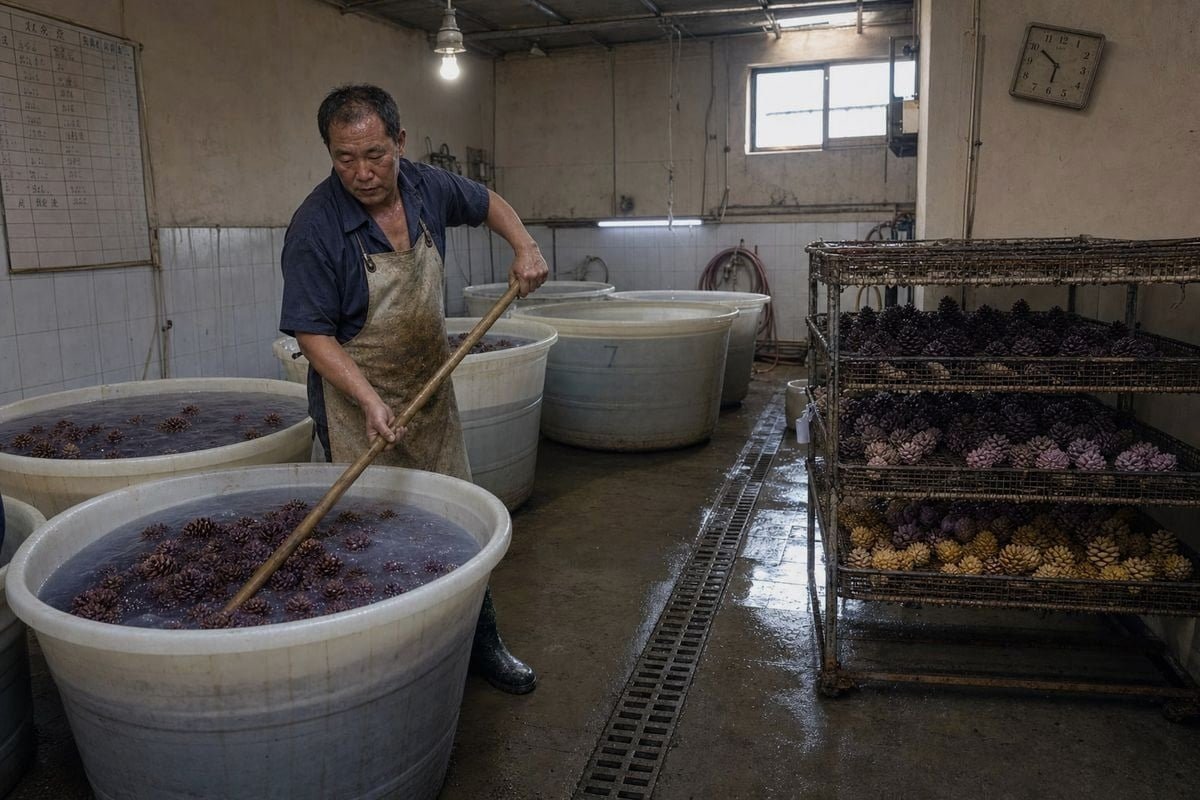
Delays rarely come from laziness. They come from predictable pressure points in supply chain logistics 6. If you know the pressure points, you can contract around them.
The Six Most Common Delay Drivers
| Delay Driver | Why It Happens | How to Avoid It |
|---|---|---|
| Q4 order stacking | Every fireplace brand orders at once | Book production slots in Q1 or Q2 off-season |
| Raw cone shortage | Cones degrade with winter rot | Sync large orders with the late-summer harvest peak |
| Metal salt gaps | Chemical suppliers have their own lead times | Require written stock confirmation before signing |
| Humid-weather drying | Ambient air-drying stalls in wet regions | Stipulate forced-air kiln drying in the contract |
| Late packaging files | Artwork arrives after production starts | Lock labels and barcodes 14 days before production |
| Port congestion | Peak-season freight backlogs | Build a 10-day logistics buffer into every timeline |
The Buffer Question
Some buyers push back on buffers. They tell me a 10-day cushion "just gives the factory an excuse to be slow." I understand the worry, but it gets the logic backwards. The buffer is not for the factory. It is for the ocean. Shipping transit times on seasonal natural products swing widely, and a container stuck at port for a week is nobody's fault and everybody's problem. The buffer protects your shelf date; the milestone plan keeps the factory honest. You need both, and they do different jobs.
The single cheapest fix on this list is timing. When buyers move their inventory management cycle 7 forward and place orders in Q1, they skip the entire Q4 traffic jam. Our off-season lines run with open capacity, drying kilns are never queued, and freight rates are lower too. The same order that fights for priority in October sails through in February.
How Do I Negotiate Flexible Deadlines for Trial Orders Versus Large-Volume Shipments?
A Dutch camping brand recently asked us for a small trial batch of color-flame pine cones with a two-week turnaround, followed by a container-sized reorder if the burn tests passed. That conversation is a perfect template for how this negotiation should work.
Negotiate trial orders around speed and low minimum order quantity, accepting stock packaging and standard colors for a faster date. Negotiate large-volume shipments around certainty: fixed milestone schedules, tiered volume discounts, phased or partial deliveries, and locked production slots reserved weeks in advance.

Trial orders and bulk orders are different animals. If you negotiate them the same way, you will overpay on one and under-protect the other.
Two Orders, Two Playbooks
| Negotiation Lever | Trial Order | Large-Volume Shipment |
|---|---|---|
| Priority | Speed and validation | Certainty and unit cost |
| Minimum order quantity | Ask for flexibility; we routinely lower MOQ for serious trial buyers | Standard MOQ, offset by tiered volume discounts at set case counts |
| Packaging | Accept stock pouches or kraft bags to save 5–7 days | Full private-label pouches, display boxes, barcodes, warning labels |
| Deadline flexibility | Supplier can often slot small batches between big runs | Slot must be booked early; dates are firmer but harder to move |
| Payment | Often full prepayment for speed | Deposit plus balance against documents |
| What you trade for speed | Simplified specs, standard colors | Earlier payment, phased delivery, larger commitment |
Trade Time — Never Just Ask for It
The core rule of deadline negotiation is simple: time is a currency. If you want a faster date, offer something back. The offers that genuinely move our schedule are early payment, a confirmed reorder commitment, accepting partial shipment (air-freight the first 20% for your launch, ocean-freight the rest), or simplifying specs — for example, five stock flame colors instead of a custom palette.
What does not work is artificial pressure. Buyers sometimes invent fake urgency, believing it buys priority. In a tight seasonal market it does the opposite: suppliers learn to discount your deadlines, and real emergencies get treated like cried wolf. Equally, when a supplier says "we need an answer now," test it. Ask what changes if you decide tomorrow. A real deadline has a concrete reason — a kiln slot, a vessel cut-off. A fake one just has adrenaline. Respectful transparency, repeated business, and clean vendor contract terms buy more schedule flexibility than pressure ever will.
Conclusion
Missed deadlines kill seasonal margins. The fix is preparation: know the real lead-time stages, book off-season slots, trade value for speed, and put every milestone in writing.
Footnotes
1. OSHA hazard communication standards govern MSDS requirements for chemically treated products. ↩︎
2. Explains the metal-salt chemistry behind colored flame effects referenced in saturation step. ↩︎
3. SGS is a leading global inspection and certification body used for QA benchmarking. ↩︎
4. Defines this key shipping document tied to final payment release in export deals. ↩︎
5. Authoritative .gov source defining production capacity within manufacturing and plant utilization contexts. ↩︎
6. Background concept explaining pressure points causing manufacturing delays discussed in article. ↩︎
7. Alibaba.com illustrates B2B sourcing timing practices relevant to off-season inventory planning. ↩︎



 English
  Spanish
  German
  French
  Arabic
  Portuguese
Join the Conversation