






Buyers ask me about magic fire powder smoke almost weekly. Confusing it with firewood smoke leads to compliance mistakes, returns, and safety complaints. After 17 years running color-flame production lines, I can clear this up.
Magic fire powder smoke comes from metal salt combustion in an engineered pyrotechnic-style additive, while ordinary firewood smoke is an uncontrolled byproduct of incomplete wood combustion. They differ in chemistry, particle type, color, odor, and safety profile — they only look similar.
That short answer hides a lot of detail. In this article, I will break down safety, chemistry, smell, and compliance. Each section answers a real question our distributors ask us.
Is Magic Fire Powder Smoke Safe for Indoor and Outdoor Use Compared to Regular Firewood?
A German fireplace distributor once refused our first sample until we proved indoor suitability. That pushed us to run third-party emission tests early, and the results shaped how we formulate every batch today.
Quality color-changing flame packets are safe for ventilated indoor fireplaces and outdoor fires when made from certified, eco-friendly formulas. However, no smoke — from powder or firewood — should be inhaled directly, and unverified pyrotechnic fire additives may pose greater inhalation safety risks than seasoned wood.

Let me be direct about this, because "safe" is a word that gets abused in this industry. Safety depends entirely on formulation and use context. Ordinary firewood smoke is a known source of particulate matter emissions. It carries fine soot, irritant gases, and tar vapors. Nobody should breathe it on purpose. Magic fire powder smoke adds a different variable: engineered chemicals. If those chemicals are chosen carelessly, the smoke can carry metal fumes or acidic compounds that firewood smoke does not have.
Where Each Smoke Type Belongs
Our own color-flame packets are formulated with eco-friendly materials and no harmful chemicals, and we verify each production batch through SGS and Intertek testing 1. That is why they can be used in a fireplace with a working flue, a fire pit, or a campfire. But I always tell buyers the same rule: ventilation is non-negotiable, indoors or out.
| Use Scenario | Seasoned Firewood | Certified Color-Flame Packet | Uncertified Fire Powder |
|---|---|---|---|
| Open outdoor campfire | Suitable | Suitable | Risky |
| Vented indoor fireplace | Suitable | Suitable | Not recommended |
| Enclosed unvented room | Never | Never | Never |
| Cooking over the flames | Yes | No | No |
The Cooking Rule
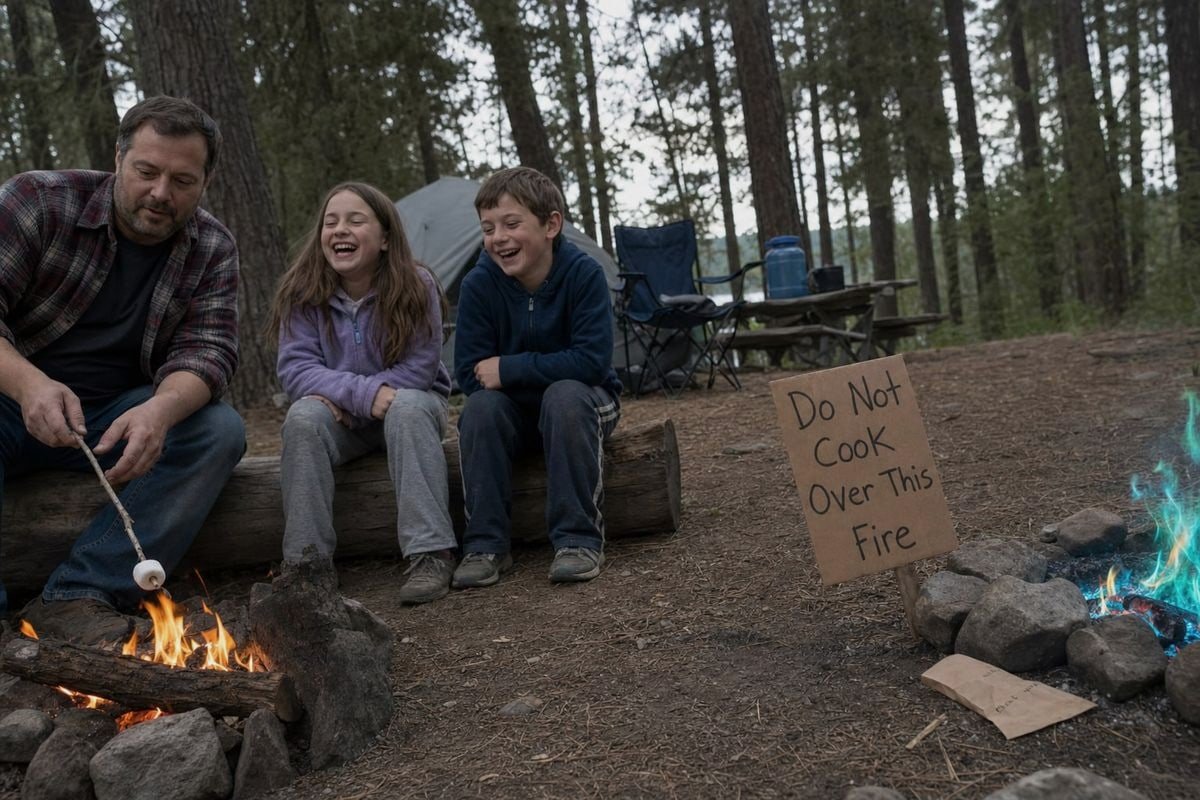
One point matters more than any other. Never cook food over a fire treated with any flame colorant. Metal salts can deposit on food. Firewood smoke, by contrast, is the basis of culinary smoking. This is the single clearest practical difference, and we print it on every warning label we produce.
What Chemical Ingredients Make Magic Fire Powder Smoke Different From Ordinary Wood Smoke?
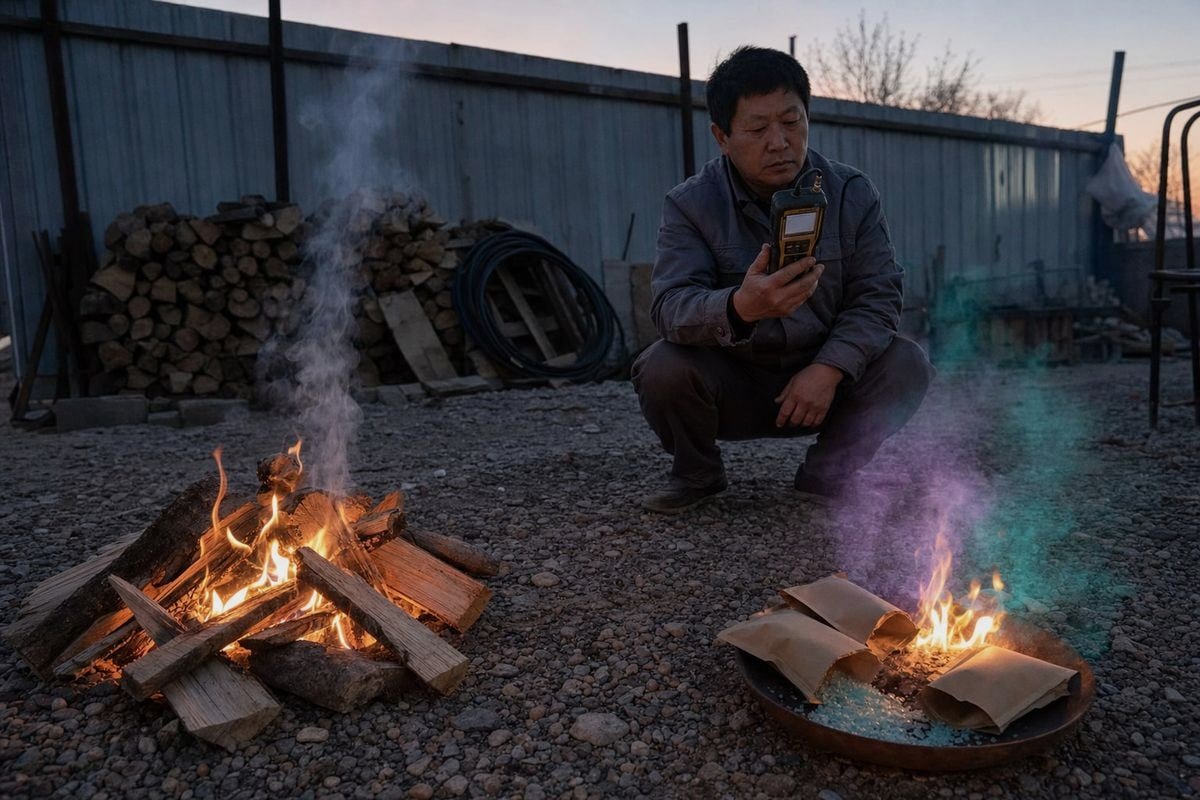
During formulation trials at our Ningbo facility, we compare burn residues under controlled conditions. The contrast between a wood-only burn and a packet-assisted burn is visible even to the naked eye.
Magic fire powder smoke carries reaction products of metal salts, oxidizers, and carrier materials, while ordinary wood smoke contains soot, tar vapors, ash, and combustion byproducts from cellulose and lignin breakdown. One is engineered chemistry; the other is uncontrolled biomass burning.

Here is the core science, in plain terms. Firewood smoke is what happens when wood does not burn completely. As logs heat up, cellulose, lignin, and resins break down. The result is a messy mix: carbon soot particles, tarry organic droplets, water vapor, carbon monoxide, and ash. No two fires produce identical smoke. Moisture, wood species, and airflow change everything. Wet wood also accelerates creosote buildup in chimneys, which is a fire hazard of its own.
Magic fire powder is different by design. It is an intentional blend. Typical consumer products combine chemical flame colorants — usually copper compounds for blue-green effects — with carrier materials and sometimes salts like ammonium chloride 2. Published safety data sheets 3 for similar products list ingredients such as copper sulfate 4, silica, and ammonium chloride, with exact ratios held as trade secrets. This trade-secret culture is exactly why certification matters, and why we hand every buyer full SDS documentation and test reports rather than asking them to trust marketing copy.
Side-by-Side Chemistry
| Property | Firewood Smoke | Magic Fire Powder Smoke |
|---|---|---|
| Source | Incomplete biomass combustion | Engineered metal salt combustion |
| Main particles | Soot, tar droplets, ash | Salt vapors, mineral carriers |
| Color driver | Light scattering by soot | Excited metal ions in the flame |
| Consistency | Highly variable | Batch-controlled by formula |
| Chimney effect | Creosote buildup over time | Minimal tar contribution |
Flame Color vs. Smoke Color
One clarification saves a lot of confusion. The rainbow effect customers love comes from the flame, not the smoke. Metal ions get excited by heat and emit specific colors of light as they relax. The smoke itself stays mostly pale or gray. Colored flames and colored smoke are two different pyrotechnic outcomes, and consumer color packets are built for the first, not the second.
Will My Customers Notice a Difference in Smell Between Magic Fire Powder and Regular Firewood Smoke?
Odor complaints are a retail killer, so we weigh this trade-off in every formulation review: stronger color intensity often means harsher combustion chemistry, and harsher chemistry can mean a sharper smell.
Most customers notice little to no odor change with well-formulated color packets, because the additive volume is tiny compared to the burning wood. Poorly made pyrotechnic fire additives, however, can produce a sharp, acrid, or metallic smell that overwhelms the natural woodsmoke aroma.
Smell is chemistry your nose can detect, so this question is really a formulation question. Natural firewood smoke smells the way it does because of aromatic organic compounds released from lignin and resin. Pine smells resinous. Oak smells earthy. Customers associate that aroma with comfort, and any product that ruins it will generate one-star reviews fast.
A single color-flame sachet 5 weighs a few dozen grams. A campfire burns kilograms of wood per hour. When the formula is clean, the powder's contribution to total smoke volume is small, and the wood aroma dominates. In our experience exporting to the US and Europe, odor complaints almost always trace back to three formulation shortcuts:
- Chlorine donors like PVC. Some cheap formulas add chlorinated plastics to intensify color. Burning them can release hydrochloric acid vapor, which smells sharp and stings the nose.
- Sulfur-heavy fillers. These create a match-like, eggy note that customers immediately detect.
- Contaminated carrier materials. Recycled or impure carriers add unpredictable off-odors batch to batch.
We exclude chlorinated plastics and harsh fillers from our formulas, and our batch-to-batch quality control exists precisely so the sample a buyer smells during evaluation matches container number twenty. For private-label brands, that consistency is the difference between a novelty product that reorders and one that dies after one season.
What to Tell Your Customers
Set expectations on packaging. State that the product changes flame color, not aroma, and that any faint mineral note fades as the packet is consumed. Honest, simple copy prevents most odor-related returns before they happen.
Do I Need Special Compliance Certificates to Sell Magic Fire Powder Compared to Standard Firewood?
A UK importer once told me his customs broker held a full container for three weeks because a competitor's fire powder shipped without proper documentation. That story is why compliance is the first slide in every sales call we make.
Yes. Firewood is largely regulated as a natural fuel, but color-changing flame packets are chemical consumer products. Most markets require chemical safety documentation such as SDS, third-party lab test reports, CE-aligned conformity for the EU, and correct hazard labeling before retail sale.

This is where the difference between the two smoke types becomes a business issue, not just a chemistry issue. Firewood, in most markets, faces pest-control and moisture rules, plus some local air-quality restrictions tied to particulate matter emissions. It is treated as fuel. A powder containing chemical flame colorants is treated as a formulated chemical product, and the documentation burden is completely different.
Typical Documentation Comparison
| Requirement | Standard Firewood | Magic Fire Powder |
|---|---|---|
| Safety Data Sheet (SDS) | Not required | Required |
| Third-party chemical testing | Rarely | Expected by major retailers |
| EU conformity documentation | No | Yes, for EU-bound goods |
| Hazard and warning labels | No | Yes, market-specific wording |
| Heavy metal residue limits | Not applicable | Often tested for retail listing |
| Factory audit (e.g., BSCI) | Uncommon | Frequently demanded by chains |
Why Retailers Check Harder Now
Large retail sourcing channels have tightened chemical product screening. They ask about copper sulfate toxicity thresholds, heavy metal residues 6 in ash, and inhalation safety risks — questions a firewood supplier never hears. They also want proof that combustion byproducts stay within tested limits and that residues will not aggressively corrode customers' steel fire pits. We hold ISO 9001 7, BSCI, CE, and SGS/Intertek certification with current test reports, because for our buyers this is a hard gate, not a bonus. When we prepare a private-label order, we supply the compliance file alongside the goods: SDS, test reports, warning label artwork, and barcodes. My honest advice to any purchasing manager is simple. Ask for the full compliance file before you ask for the price. A cheap powder without paperwork is the most expensive product you will ever import.
Conclusion
Same-looking smoke, very different chemistry. Choosing an undocumented powder risks safety complaints and seized shipments. Choose certified, well-formulated color-flame products, verify the compliance file, and your customers get the magic without the risk.
Footnotes
1. Authoritative testing body page explaining chemical safety and compliance verification services. ↩︎
2. Authoritative NIH PubChem database entry detailing the chemical properties of ammonium chloride. ↩︎
3. Official OSHA Hazard Communication landing page covering SDS requirements. ↩︎
4. Wikipedia entry for copper sulfate, a primary metal salt used to produce blue and green flames. ↩︎
5. Wikipedia page explaining the pyrotechnic chemistry used in color-changing fire products. ↩︎
6. Scientific overview of heavy metal residues and their environmental and safety implications. ↩︎
7. Stable, authoritative overview of the quality management standard. ↩︎



 English
  Spanish
  German
  French
  Arabic
  Portuguese
Join the Conversation