







Every week, buyers ask our sales team the same question about magic fire powder: which colors actually exist, and which ones photograph well but never ship. The confusion is real — listings across Amazon, AliExpress, and DHgate show dozens of color claims, yet very few explain what you actually get inside that foil sachet.
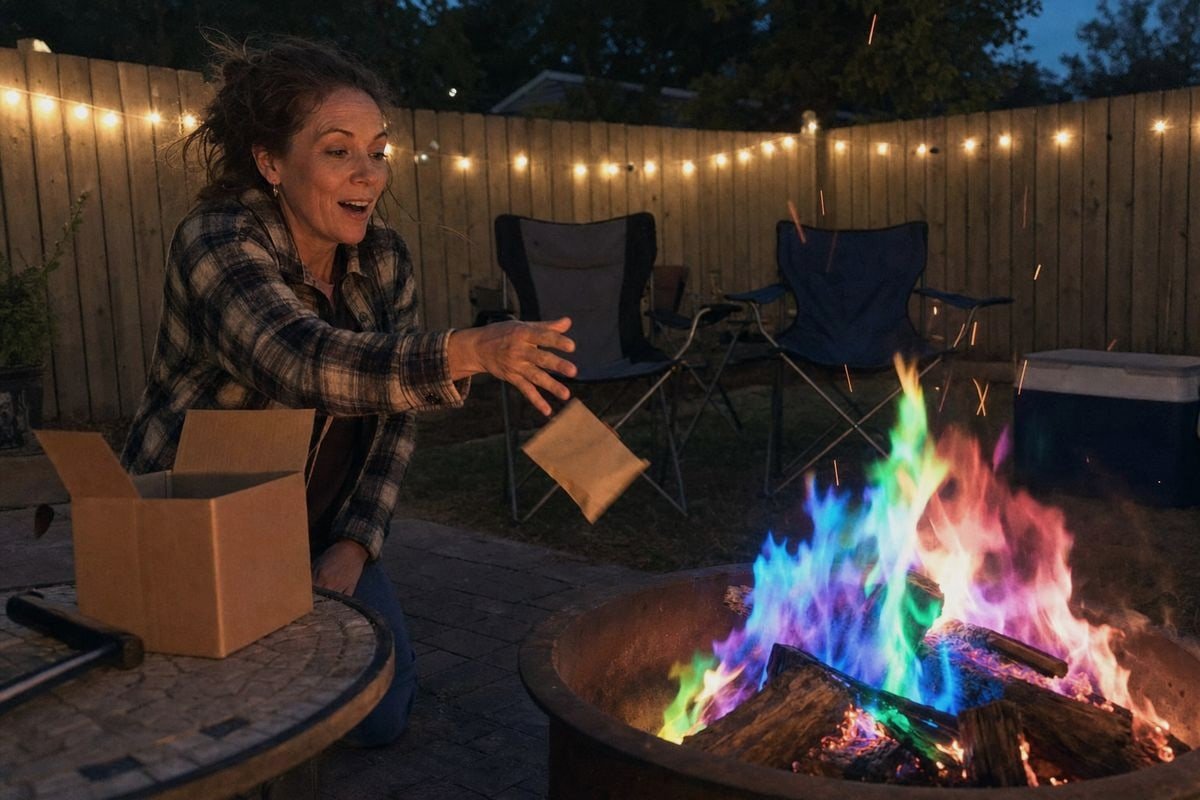
The most common magic fire powder color series on the market is the rainbow or multi-color blend, which typically produces blue, green, red, purple, and yellow-orange flame effects using a mix of metal salts such as copper sulfate, strontium chloride, and lithium compounds in a single campfire colorant packet.
Below, I will walk you through every major color family available today, the chemistry behind each flame, how to evaluate safety compliance, which colors sell strongest in the US and Europe, and how to build your own custom color combinations for private label products.
What Color Options Can I Choose from When Sourcing Magic Fire Powder?
When our production team in Liuyang lays out the full color sample board for visiting buyers, most are surprised by how organized the options really are — the market may look chaotic online, but the actual palette follows clear chemical logic.
When sourcing magic fire powder, you can typically choose from six main color families — blue, green, red or magenta, purple, yellow-gold, and the bestselling rainbow multi-color blend — each produced by specific metal salts that burn at distinct wavelengths in campfires, fire pits, and fireplaces.

The Core Color Families
The color of any flame colorant comes down to one thing: which metal salt is in the powder. When you toss a packet into a fire, the heat excites the metal ions. Each ion emits light at a specific wavelength. That is why copper compounds produce green and blue, strontium chloride 1 gives you red, and lithium salts create magenta. It is basic metal salts combustion 2 — the same principle used in fireworks and pyrotechnic colorants for centuries.
Here is a breakdown of the standard color families we produce and ship globally:
| Color Family | Primary Metal Salt | Flame Appearance | Market Popularity |
|---|---|---|---|
| Blue | Copper chloride / Cupric chloride | Vivid sky-blue to cobalt | Very High — most requested in product photos |
| Green | Copper sulfate 3 / Boric acid blends | Bright emerald to teal | Very High — strong "mystical fire" effect |
| Red / Magenta | Strontium chloride / Lithium compounds | Brick-red to deep pink | High — essential for rainbow blends |
| Purple / Violet | Potassium salts blended with copper | Soft violet to lavender | Medium-High — appears in most multi-packs |
| Yellow / Gold | Sodium compounds / Iron filings | Warm amber to golden sparks | Medium — often blends into natural flame |
| Rainbow / Multi-color | Mixed metal salts in one packet | Shifting spectrum | Highest — dominant retail format |
Why the Rainbow Series Dominates
Most retail listings on Amazon and SHEIN do not sell single-color magic fire powder. They sell a sachet that promises a shifting, multi-color display. From our experience exporting to over 30 countries, the rainbow format outsells single-color packets by a wide margin. The reason is simple. A single packet that produces blue, green, purple, and red over a 30-to-60-minute flame duration gives the end user the best spectacle for the money. Buyers who source outdoor fire pit accessories want maximum visual impact per SKU. The rainbow blend delivers that.
Single-Color vs. Multi-Color Packets
Some distributors, especially those selling to the LARP, medieval event, or festival markets, do request single-color options. A theater group may need only green. A Halloween event planner may want only purple and red. We offer both formats. But for general retail, multi-color dominates because it reduces inventory complexity for the seller and increases perceived value for the consumer.
How Sellers Describe Colors — Marketing vs. Chemistry
On marketplace listings, you will see two types of color language. Consumer-facing listings say things like "rainbow flames" or "mystical fire colors." More technical or B2B-oriented listings describe colors by their chemical source: sodium yellow, calcium brick red, barium yellow-green, lithium magenta, zinc blue, copper green, potassium purple, and iron golden-yellow.
Both descriptions point to the same products. The difference is just the audience. If you are building a retail product page, use the consumer language. If you are writing a safety data sheet or evaluating a supplier's formulation, use the chemistry-based names.
How Do I Know the Color Flame Chemicals Meet Safety and Compliance Standards?
A German distributor once told me during a factory visit that his biggest concern was not price or lead time — it was whether he could prove to his retailer that every chemical in the packet was tested and documented. That conversation shaped how we present our compliance package today.
You can verify safety and compliance of color flame chemicals by requiring SGS or Intertek test reports, MSDS documentation for each metal salt used, CE marking for European markets, and confirming the supplier holds ISO 9001 and BSCI certifications that cover the actual production facility.
What Compliance Documents Should You Request?
Not all magic fire powder suppliers are equal when it comes to documentation. Some marketplace sellers operate without any third-party testing. Others hold full certification packages. Here is what a responsible B2B buyer should ask for:
| Document / Certification | What It Proves | Who Requires It |
|---|---|---|
| MSDS (Material Safety Data Sheet 5) | Lists all chemical components, hazard classifications, handling instructions | All markets — required for customs and warehousing |
| SGS or Intertek Test Report | Third-party lab confirms chemical composition and safety limits | US, EU, and Australian importers |
| ISO 9001 6 | Supplier has a quality management system in place | Most professional B2B buyers |
| BSCI Audit | Social and ethical compliance at the production facility | European retailers and large chains |
| CE Marking 7 | Product meets EU health, safety, and environmental standards | Mandatory for EU market entry |
| UN Shipping Classification 8 | Confirms whether the product is classified as hazardous goods for transport | Freight forwarders and logistics partners |
The Metal Salt Safety Question
Buyers often ask whether the metal salts in campfire colorant packets are toxic. The honest answer is: they are chemicals, and they must be handled properly. Copper sulfate, strontium chloride, and boric acid 9 are all used in many consumer and industrial products. In the small quantities found in a 10g to 30g sachet, they are considered safe for outdoor use when the product is used as directed — tossed into an open fire, not ingested, and not used in enclosed spaces without ventilation.
Our facility runs batch-to-batch quality control to ensure that each production run matches the formulation approved in the original test report. This consistency matters. If a batch uses too much of one salt or substitutes an untested compound, the safety profile changes. That is why working with a certified factory matters more than finding the cheapest listing on a marketplace.
Reading Between the Lines on Listings
Some sellers on AliExpress and DHgate use phrases like "environmentally friendly" or "non-toxic" without providing any supporting documentation. These claims may or may not be accurate. The safest approach for a professional buyer is to request the actual MSDS and test reports before placing a first order. If a supplier cannot or will not provide them, that is a clear signal to look elsewhere.
We have also seen a growing number of listings that mention "residue-neutral" formulations using organic carriers. This is a real trend. Some formulations now use paper-based packaging and carrier materials designed to minimize heavy metal accumulation in fire pit ash. For buyers targeting the "Leave No Trace 10" camping segment, this can be a strong product differentiator.
Which Flame Colors Sell Best with My Customers in the US and Europe?
Last year, we tracked reorder patterns across our top accounts in North America and Western Europe, and a clear preference emerged — not for any single color, but for a specific combination buyers kept requesting again and again.
In the US and Europe, the rainbow multi-color blend is the top seller by a wide margin, followed by blue-green heavy blends for premium positioning; red and purple round out the palette, while yellow-gold packets sell primarily as part of mixed bundles rather than standalone SKUs.

Regional Preferences at a Glance
Buyer behavior differs slightly between the US and Europe. American consumers tend to favor bold, high-impact spectacle — they want the full rainbow. European buyers, particularly in Germany and the Netherlands, often prefer a more curated cool-tones palette and place higher value on eco-friendly packaging and compliance documentation.
| Market | Bestselling Series | Secondary Preference | Packaging Trend |
|---|---|---|---|
| United States | Rainbow multi-color | Blue-green heavy blends | Multi-packs of 12–25 sachets in retail box |
| Germany | Rainbow with cool-tone emphasis | Single-color green or blue | Kraft paper pouches, eco-messaging |
| United Kingdom | Rainbow multi-color | Warm-tone red and gold for bonfire events | Seasonal gift packaging |
| France | Rainbow multi-color | Purple and blue for ambiance events | Premium matte-finish pouches |
| Netherlands | Cool-tones (blue, green, purple) | Rainbow as secondary | Minimal, clean packaging design |
| Canada | Rainbow multi-color | Blue-green for camping season | Resealable stand-up pouches |
| Australia | Rainbow multi-color | Warm-tones for BBQ culture | Outdoor-rugged packaging |
Why Blue and Green Lead Premium Positioning
Blue and green flames look the most dramatically different from a natural fire. When a consumer tosses a packet into a campfire and sees vivid emerald green or deep cobalt blue, the visual contrast is immediate and striking. This is why these colors dominate product photography and social media content. They also perform well on smartphone cameras — the light wavelengths of blue and green flames render more saturated on modern phone sensors than red or yellow tones, which can appear washed out.
Some innovative suppliers are now developing what they call "digital-optimized" formulations. The idea is to tune the chemical blend so the flame colors appear more vivid specifically on camera. While this is still a niche concept, it speaks to how important social media shareability has become in driving retail sales of outdoor fire pit accessories.
Seasonal Demand Patterns
Demand for mystical fire products is not flat across the year. In the US, peak season runs from May through September for camping, with a secondary spike around Fourth of July. In Europe, bonfire season in autumn — especially around Guy Fawkes Night in the UK — drives a surge in warm-tone red and gold packets. Holiday gift bundles sell well from October through December in both markets.
Understanding these patterns matters for inventory planning. If you are sourcing rainbow flame effects packets for the US camping market, your orders need to ship by March or April to arrive in time for Memorial Day promotions. For European bonfire season, August production is the deadline.
The Sparkle Effect Trend
Beyond pure color, a growing number of buyers are requesting "sparkle" or "glitter" effects within the flame. These are achieved by adding iron, aluminum, or magnesium filings to the standard metal salt blend. The result is gold and silver flashes dancing within the colored flames. This secondary effect adds perceived value and helps differentiate a product in an increasingly commoditized market. We have seen particularly strong interest in sparkle effects from festival and event planners.
Can I Request Custom Color Combinations for My Private Label Products?
One of the most common first questions in our initial calls with new distributors is whether they can create their own unique color blend — something their competitors cannot simply copy from a generic marketplace listing.
Yes, you can request custom color combinations for private label magic fire powder products; a capable OEM manufacturer can adjust the metal salt ratios to emphasize specific colors, create branded multi-packs with defined color sequences, and produce custom packaging with your logo, barcodes, and market-specific warning labels.

What Can Be Customized?
The short answer is: nearly everything. But there are practical limits set by chemistry and production efficiency. Here is what falls within the standard scope of OEM and ODM customization for campfire colorant packets:
- Color blend ratio: You can request a heavier blue-green profile, a warm red-gold emphasis, or a balanced rainbow. We adjust the metal salt proportions accordingly.
- Packet size: Standard sizes are 10g, 15g, 25g, and 30g. Custom weights are possible with adjusted MOQs.
- Flame duration: Larger packets or denser formulations can extend burn time. Typical flame duration for a single sachet ranges from 30 to 60 minutes depending on fire conditions and packet size.
- Packaging format: Options include individual foil sachets, kraft paper pouches, resealable stand-up bags, plastic jars, retail display boxes, and bulk cartons.
- Branding: Full private label support includes your logo, product name, ingredient list, safety warnings, UPC barcodes, and multilingual text.
The Sequence-Controlled Powder Concept
An emerging trend in the premium segment is "sequence-controlled" magic fire powder. Instead of producing all colors simultaneously, these formulations use multi-layered coatings on the granules. The outer layer burns first and produces one color. As the fire reaches the inner layers, the flame shifts to a second and then a third color in a planned order. This creates a more theatrical, story-like effect rather than a random color mix.
This is not yet mainstream — it requires more complex production processes and tighter quality control. But for buyers who want a genuinely differentiated product, it is a real option that we can develop through our ODM process.
Minimum Order Quantities and Lead Times
Custom color work does require higher minimum order quantities than buying standard off-the-shelf blends. Here is a general framework:
| Customization Level | Typical MOQ | Lead Time |
|---|---|---|
| Standard rainbow blend, your label | 1,000–3,000 packets | 15–25 days |
| Custom color ratio, your label | 3,000–5,000 packets | 20–30 days |
| New color blend development + your label | 5,000–10,000 packets | 30–45 days |
| Sequence-controlled formulation | 10,000+ packets | 45–60 days |
These ranges are approximate. For a first-time buyer, we typically recommend starting with a standard blend and custom packaging. This lets you test the market with lower risk while still presenting a branded, shelf-ready product. Once your initial orders prove out, you can invest in custom color development with confidence.
Hybrid-Fuel Compatibility
Some buyers serve markets where consumers use charcoal, manufactured fire logs, or high-moisture firewood. Standard magic fire powder formulations can produce weaker colors under these conditions because the fire temperature is lower. Hybrid-fuel additives are a niche solution — modified formulations designed to maintain color vibrancy even in suboptimal burn conditions. If your target market includes backyard charcoal grills or low-temperature fire pits, this is worth discussing during the product development phase.
Conclusion
The magic fire powder market is built around rainbow multi-color blends of blue, green, red, purple, and yellow-gold. Choose a certified manufacturer who can deliver consistent color, full compliance documentation, and true private label customization.
`
Footnotes
1. Provides chemistry background for the compound producing red flame effects. ↩︎
2. Explains atomic emission principle behind metal salt flame coloration referenced in article. ↩︎
3. Background reference for the metal salt used to produce green flame colors. ↩︎
4. Wikipedia background article explaining the chemistry of colorants used in fireworks and flame products. ↩︎
5. OSHA hazard communication standard governs MSDS requirements mentioned in compliance section. ↩︎
6. Official ISO standard page for the quality management certification referenced by buyers. ↩︎
7. EU official source explaining CE marking requirements mentioned for European market entry. ↩︎
8. IMO reference for hazardous goods shipping classification mentioned in compliance table. ↩︎
9. EPA fact sheet on boric acid safety relevant to chemical discussion in the article. ↩︎
10. Background concept for the outdoor ethics movement referenced regarding eco-friendly camping products. ↩︎



 English
  Spanish
  German
  French
  Arabic
  Portuguese
Join the Conversation