







Sourcing Magic Fire Powder looks simple until a shipment gets seized, a batch fails testing, or a retailer pulls your product. Our factory has watched buyers learn this the hard way.
The high-risk stages when sourcing Magic Fire Powder are supplier certification review, sample-to-mass-production quality verification, factory compliance auditing, and shipping and customs clearance. Failures at these points cause mislabeled chemicals, inconsistent flame colorants, seized cargo, and retail recalls, so each stage needs documented verification before payment.
Below, I walk through each stage in order. I will show you what to check, what to ask, and which warning signs mean you should walk away.
What certification gaps should I watch for before approving a Magic Fire Powder supplier?
A buyer from Germany once sent me a competitor's "CE certificate" to review. It was a self-issued declaration with no test report behind it. Our compliance team sees this constantly.
Watch for missing SGS or Intertek test reports, self-issued CE declarations without lab backing, absent ISO 9001 quality systems, no BSCI social audit, and no Material Safety Data Sheet. A legitimate Magic Fire Powder supplier provides all five documents with matching company names and current dates.

Certification gaps are the earliest and cheapest risk to catch. Yet most buyers skim this stage. They see a logo on a website and assume it is backed by paperwork. It often is not.
The documents that actually matter
Start with the Material Safety Data Sheet 1. It tells you what the flame colorant chemicals actually are. If a supplier cannot produce one, they either do not know their own formulation or they are hiding it. Both answers should end the conversation. Next, ask for third-party test reports from a recognized lab such as SGS or Intertek. These confirm chemical purity testing was actually done and screen for heavy metal contaminants 2 that many markets restrict.
Then look at the system-level certificates. ISO 9001 3 tells you a quality process exists. BSCI tells you the factory passed a social compliance audit, which large retail sourcing channels increasingly demand before listing any fire product.
| Document | What it proves | Red flag version |
|---|---|---|
| SDS / MSDS | Chemical identity and hazards | Generic template with no batch data |
| SGS / Intertek report | Independent chemical purity testing | Report older than two years or for a different product |
| CE documentation | EU market conformity | Self-declared with no supporting lab file |
| ISO 9001 | Working quality management system | Certificate from an unaccredited issuer |
| BSCI audit | Ethical, audited production site | Audit belongs to a different legal entity |
Cross-check the details
Verify that the company name on every document matches the company invoicing you. Trading companies often borrow a factory's certificates. In our experience exporting to 30+ countries, mismatched paperwork is the single most common reason customs authorities open an investigation.
How can I spot inconsistent quality control during sample and mass-production stages?
The trade-off I weigh every week is speed versus verification. Rushing a beautiful sample out the door is easy. Making batch 40 identical to batch 1 is the hard part.
Spot inconsistent quality control by comparing sample and production batches for granule size, color, moisture level, and burn behavior. Request batch numbers, retained samples, and in-line QC records. Suppliers who cannot show batch-to-batch traceability will ship you an unstable, unpredictable product.

The gap between a golden sample and mass production is where most sourcing relationships break. A sample is hand-picked. Production is a system. Your job is to test the system, not the sample.
A practical verification sequence
- Request two samples from different production dates. Compare granule texture, color tone, and packet seal quality side by side. Drift between them signals weak process control.
- Ask for the QC checkpoints in writing. At our Ningbo production lines, we log raw material inspection, mixing ratios, moisture checks, and sealed-packet weight for every run. A real factory can send you this format in a day. A trader cannot.
- Demand batch coding on packaging. No batch number means no recall path. Retailers in the US and EU will reject the listing anyway.
- Run a small burn comparison. Colored flames should appear at a consistent time and hold a consistent hue. Erratic sputtering or dull color suggests contamination or uneven mixing.
- Check moisture protection. Flame colorant chemicals are often hygroscopic. If the foil sachet is not truly moisture-proof packaging, the product can clump, weaken, or behave unpredictably by the time it reaches shelves.
Why moisture is the silent failure
Humidity during production and transit changes powder behavior. Some formulations can even self-heat or degrade when moisture reacts with the mix. We hold seal-integrity checks on every heat-sealed pouch for this exact reason. If your supplier cannot explain their drying and sealing protocol, treat that as a quality gap, not a detail.
Some hobby-oriented sellers argue these powders are forgiving as long as end users follow instructions. That is only half true. Careful handling helps, but no user instruction can fix a batch that left the factory contaminated or moisture-damaged. Sourcing discipline has to happen upstream.
What sourcing red flags indicate a factory isn't truly compliant with international safety standards?
Years back, a UK distributor asked me why our quotes ran higher than a marketplace listing at half the price. I asked one question: did that seller name the chemicals inside? They had not.
Red flags include refusal to disclose formulation, no supplier quality audit history, prices far below market, "universal" certificates covering all products, missing warning labels, and vague answers about heavy metal contaminants. Genuinely compliant factories volunteer documentation; non-compliant ones deflect, delay, or improvise.
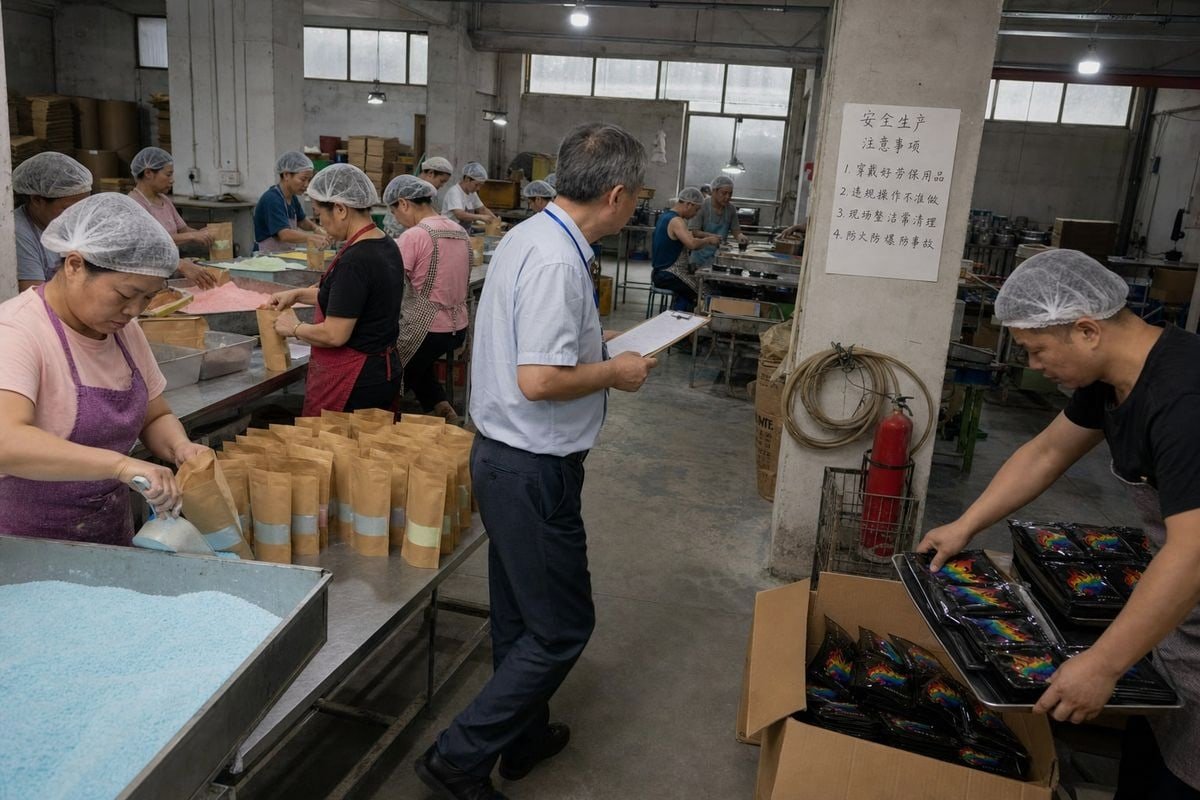
Compliance is a behavior, not a certificate. After 17 years in this industry, I can usually predict audit results from how a supplier answers the first five questions. Evasion at the inquiry stage predicts failure at the audit stage.
Behavior-based red flags
Watch how the supplier communicates, not just what they send. A compliant factory answers formulation questions directly, because their formulation passes testing. A gray-market seller changes the subject, claims the recipe is "secret," or promises paperwork "after the deposit." The term Magic Fire Powder itself is ambiguous. It can describe safe metal-salt flame colorants, or it can be slapped onto far more sensitive pyrotechnic mixtures. Only disclosure and testing separate the two.
| Red flag | What it usually means | Your response |
|---|---|---|
| "Formulation is confidential" | Untested or restricted chemicals inside | Walk away or require lab testing at their cost |
| Price 40–60% below market | Skipped testing, cheap raw materials, or mislabeling | Ask what the price excludes |
| One certificate "covers everything" | No product-specific compliance work | Request the product-level test file |
| No factory audit permitted | Likely a trading company | Require a video or third-party supplier quality audit |
| No warning label or ingredient panel | Product cannot legally sit on US/EU shelves | Reject; relabeling later rarely fixes root issues |
| Vague answer on flammable solid classification 5 | They never classified the goods for transport | Assume shipping problems are coming |
Verify the factory, not the website
Insist on an audit path. We host buyer audits and third-party inspections in Ningbo routinely, and any real factory can do the same. Also ask where raw metal salts come from. Mapping upstream sourcing exposes both quality risk and ethical risk in bulk procurement logistics before you commit to volume.
Which shipping and customs risks should I plan for when importing color-flame products?
A lesson we learned early: the product can be perfect and the shipment can still fail. One misdeclared HS code by a freight forwarder can hold a container for weeks.
Plan for hazardous materials shipping classification errors, incorrect or missing UN numbers, IMDG Code documentation gaps, carrier refusals, humidity damage in transit, and destination-country labeling rules. Confirm the exact transport classification in writing before booking, and use carriers experienced with flammable or regulated goods.

Shipping is where legal risk and physical risk overlap. Get the classification wrong and you face fines, seizure, or an uninsurable loss. Get the packaging wrong and the product degrades before it lands.
Classification comes first
Every color-flame product needs a clear transport determination. Some formulations ship as ordinary goods. Others fall under flammable solid classification and require UN-numbered packaging, dangerous goods declarations, and IMDG Code 6 compliance for sea freight. The determination depends on tested composition, not on what the seller prefers. We provide our buyers the classification paperwork up front, because a surprise at the port costs far more than a document prepared in advance. If your supplier shrugs at this question, assume the risk transfers entirely to you.
Transit conditions matter as much as paperwork
Ocean containers see temperature swings and humidity spikes across a six-week voyage. Hygroscopic colorants 7 absorb that moisture unless sealed in genuine moisture-proof packaging with desiccant protection. Some of our larger buyers now ask about datalogger or IoT sensor monitoring inside containers, and it is a reasonable request for high-value orders.
| Risk point | Consequence | Mitigation |
|---|---|---|
| Wrong HS code or UN status | Customs hold or seizure | Written classification from supplier plus your broker's review |
| Missing DG declaration | Carrier refusal, blacklisting | Book only with DG-experienced forwarders |
| Humidity in transit | Clumped, weakened powder | Foil sachets, desiccants, sealed cartons |
| Non-compliant retail labels | Rejected at destination inspection | Pre-approve warning labels and barcodes before printing |
| Look-alike packaging concerns | Regulatory scrutiny over accidental ingestion | Child-resistant design cues and clear caution text |
Destination rules differ, too. What clears US customs may still fail German retail labeling checks. Confirm market-specific warning text before mass printing, not after.
Conclusion
High-risk stages concentrate where verification is skipped: certification, batch consistency, factory compliance, and shipping. Verify each stage with documents, audits, and testing before committing volume to any Magic Fire Powder supplier.
Footnotes
1. Wikipedia background reference explaining the standard chemical safety document referenced repeatedly. ↩︎
2. EPA authoritative source on hazardous heavy metal contamination relevant to chemical safety testing. ↩︎
3. Official ISO standard reference for quality management system certification mentioned in article. ↩︎
4. European Commission official page on CE marking requirements discussed for supplier certification claims. ↩︎
5. Wikipedia background on dangerous goods classification systems used for transport hazard determination. ↩︎
6. Official IMO reference for the International Maritime Dangerous Goods Code governing sea freight classification. ↩︎
7. Wikipedia explains hygroscopic behavior relevant to moisture damage risk described in the article. ↩︎



 English
  Spanish
  German
  French
  Arabic
  Portuguese
Join the Conversation