






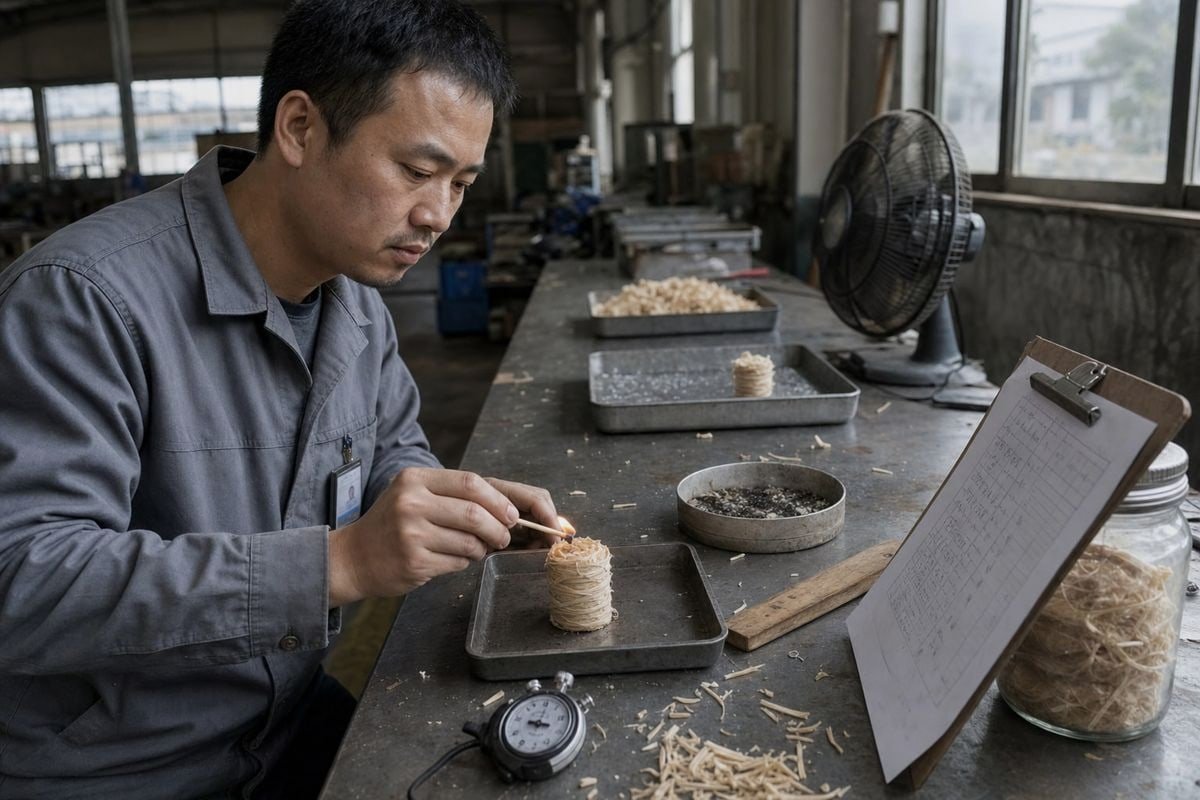
Evaluating wood fire starters' ignition success rate is where I have seen many buyers get burned SGS/Intertek 1. On our production line, we test every batch precisely because claims alone prove nothing.
Evaluate wood fire starters' ignition success rate by running controlled trials: divide successful sustained ignitions by total attempts. Count a trial as successful only when the target fuel keeps burning after the starter dies. Test under dry, damp, and windy conditions, then verify supplier data and certifications.
Marketing claims like "one-match ignition" sound convincing. But they mean little without a defined test method. Below, I will walk you through the exact steps our own buyers use to verify performance before signing a bulk order.
What Testing Methods Can I Use to Verify a Supplier's Claimed Ignition Success Rate?
A German distributor once sent back our first samples with a spreadsheet of forty ignition trials. That level of rigor impressed us — and it is exactly what I now recommend to every buyer we work with.
Verify claimed ignition success rates by running at least 20 identical trials per product: light each starter with one match, record ignition delay, burn time duration, and whether kindling sustains flame independently. Calculate the success percentage, then repeat the trials in damp and wind-exposed conditions.

Good ignition is a chain of events, not a single moment. The starter must catch, burn long enough, transfer heat, and get the main fuel to sustain flame on its own. Your sample testing protocol should measure all four links in that chain, not just the first one.
The Three-Layer Testing Framework
I suggest scoring each trial on three layers. First, ease of lighting: does the starter catch from a single match or ferrocerium strike? Second, burn time duration: consumer testing shows a starter typically needs 5 to 9 minutes of sustained flame to fully ignite surrounding kindling and logs. Third, fuel transfer: does the wood keep burning after the starter is consumed? Only the third layer counts as true success.
Use the same wood species, piece size, arrangement, and moisture content 2 percentage across every supplier's samples. Fire science shows fuels can flip from ignitable to non-ignitable across narrow moisture ranges, so uncontrolled wood ruins your comparison.
Metrics Worth Recording
| Metric | How to Measure | Pass Benchmark |
|---|---|---|
| Ignition delay | Time from match contact to self-sustained flame | Under 10 seconds |
| Burn time duration | Stopwatch from ignition to flame-out | 8–10 minutes minimum |
| Flame height | Visual measure against a ruler backdrop | Tall enough to reach kindling layer |
| Fuel-transfer success | Does target wood burn after starter dies? | Yes, without relighting |
| Success rate | Successful trials ÷ total trials × 100 | 95%+ in baseline conditions |
Then repeat the whole set after a light water soak and again with a fan simulating wind. Real-world resilience matters more than best-case performance. A supplier is not dependable if its product only performs in perfect conditions.
Which Certifications Prove a Wood Fire Starter Meets International Safety and Quality Standards?
In our experience exporting to the US, Germany, and the UK for over 17 years, one truth holds: buyers who skip the certification audit almost always regret it at customs or on the retail shelf.
Look for ISO 9001 for quality management, BSCI for ethical production, CE marking for European market access, and third-party test reports from SGS or Intertek. Request FSC certification for wood sourcing and a complete SDS covering paraffin wax coating and any accelerants.

Certifications do two jobs. They prove the product is safe, and they prove the factory can repeat that safety at scale. When we prepared our own ISO 9001 3, BSCI, CE, and SGS/Intertek documentation, the process forced us to formalize every step of production control. A supplier that has been through that discipline behaves differently from one that has not.
The Core Document Stack
Here is the paperwork I would demand before any bulk procurement decision:
| Document | What It Proves | Red Flag If Missing |
|---|---|---|
| ISO 9001 certificate | Documented quality management system | No process control behind claims |
| BSCI 4 audit report | Ethical and social compliance | Retail chains may reject the product |
| CE / relevant market marking | Meets EU safety directives | Product may be blocked at import |
| SGS or Intertek test report | Independent verification of composition and performance | Claims rest on self-reporting only |
| SDS (Safety Data Sheet) | Chemical stability, handling, and hazard data | Unknown accelerants or fumes |
| FSC certification | Responsibly sourced natural wood wool | Sustainability claims are unverifiable |
Composition Disclosure Matters Too
Ask for the exact composition split, such as wood fiber versus paraffin wax coating 5 percentages. Natural binders like vegetable wax or tree resins avoid the toxic fumes and chemical odors that can taint grilled food or indoor air. If a supplier promotes eco-friendly firelighters but cannot show compositional disclosure, treat the claim as marketing, not fact. Odorless ignition should be verifiable in the test report, not just printed on the box.
How Do I Confirm Batch-to-Batch Consistency Before Committing to a Bulk Order?
The hardest lesson from running complete production lines in Ningbo is this: making one perfect sample is easy. Making the ten-thousandth unit identical to the first is where real manufacturing depth shows.
Confirm batch-to-batch consistency by requesting samples from at least three separate production lots, testing each for burn time and ignition delay, and calculating the Coefficient of Variation. Also demand the supplier's lot-level QC records, moisture content data, and shelf life stability documentation.

A single golden sample tells you what the factory can do on its best day. It tells you nothing about the average day. So never evaluate consistency from one shipment of samples pulled from one lot.
Use the Coefficient of Variation
Batch uniformity testing works like this. Take ten units from each of three or more production lots. Measure burn time duration and ignition delay for every unit. Then calculate the Coefficient of Variation 6, which is the standard deviation divided by the mean. A low CV — ideally under 10% for burn time — means the process is under control. A high CV means the wax dosing, wood wool density, or moisture control drifts between runs, and your customers will feel that drift.
Hidden Variables That Break Consistency
Three factors silently degrade consistency between batches:
- Moisture content percentage. Wood fiber above roughly 20% moisture wastes ignition energy evaporating water instead of reaching flash point. Ask for lot-level moisture records.
- Wax saturation drift. Uneven paraffin wax coating changes both ignition speed and heat output BTU from unit to unit. Subject samples to 40°C storage to check for wax bleed, where fuel migrates out of the fibers into the packaging.
- Packaging permeability. Evaluate the Water Vapor Transmission Rate 7 of the primary packaging. Starters that absorb warehouse humidity over months will show a falling ignition success rate long after your incoming inspection passed them.
On our lines, we hold wax weight and moisture tolerances on every lot precisely so the first sample reliably predicts mass-production quality. Any serious supplier should be able to show you the same kind of records.
What Sample Evaluation Steps Should I Follow to Avoid Low-Performing Fire Starters?
When a Canadian fireplace distributor first approached us, they brought samples from five competing factories and asked how they should compare them fairly. The scorecard we built together is the process I share below.
Follow a five-step sample evaluation: inspect construction and moisture, run baseline single-strike ignition trials, stress-test with soak and wind tests, verify fuel transfer on your actual wood, then score suppliers on a weighted scorecard prioritizing ignition success rate and burn duration.

Work through the steps in order. Each stage filters out weak products before you invest time in the next one.
Step-by-Step Evaluation Process
- Physical inspection. Check the wood wool winding density and geometry. Shredded, wool-style designs give a higher surface-area-to-volume ratio than dense blocks, which means better oxygen contact and a higher flash success rate. Look for even wax distribution and no bleed inside the bag.
- Baseline trials. Run single-strike ignition tests in calm, dry conditions. Record ignition delay and burn time for at least 20 units.
- Stress tests. Soak samples briefly in water and retest. Then test under fan-driven airflow. Comparative testing shows real spread here: some starters light with one match while others need three, and burn times vary from a few minutes to over 50 depending on formulation.
- Fuel-transfer validation. Use your customer's actual scenario — fireplace hardwood, BBQ charcoal, or campfire kindling. Lab ignition and field ignition are not the same thing.
- Score and compare. Convert results into a weighted scorecard.
A Practical Sourcing Scorecard
| Criterion | Weight | What Good Looks Like |
|---|---|---|
| Ignition success rate | 40% | 95%+ sustained fuel transfer in baseline trials |
| Burn time duration | 20% | 8–10 minutes minimum sustained flame |
| Moisture resistance | 15% | Lights after soak test or humid storage |
| Wind resistance | 15% | Flame stabilizes under steady airflow |
| Packaging and storage stability | 10% | Low WVTR packaging, no wax bleed at 40°C |
Adjust the weights for your end use. Indoor fireplace buyers should prioritize clean, odorless ignition and consistency. Camping and BBQ brands should weight wet-weather and wind performance more heavily. Also compare product types honestly: resin-rich fatwood offers natural appeal but may need more strikes and produce more smoke, while wax-and-fiber starters generally deliver faster, more repeatable ignition. Eco-friendly formulations can lag kerosene-based products on raw ignition speed, but for most retail markets, safety and compositional transparency outweigh a few seconds of delay.
Conclusion
Don't source fire starters by marketing claims. A weak product damages your brand with every failed fire. Test ignition success rate, audit certifications, verify batch consistency, and score suppliers objectively.
Footnotes
1. SGS is a leading independent testing and certification body verifying product safety claims. ↩︎
2. Background on how wood moisture content affects combustion and flash point behavior. ↩︎
3. Official ISO standard defining the quality management system referenced for supplier certification. ↩︎
4. amfori BSCI is the recognized ethical trade audit program suppliers should hold for compliance. ↩︎
5. Background on paraffin wax, the common fuel coating used in wood fire starters. ↩︎
6. NIST's statistics handbook explains how Coefficient of Variation measures manufacturing process consistency. ↩︎
7. Explains the packaging permeability metric used to predict humidity-related ignition failure. ↩︎


 English
  Spanish
  German
  French
  Arabic
  Portuguese
Join the Conversation