






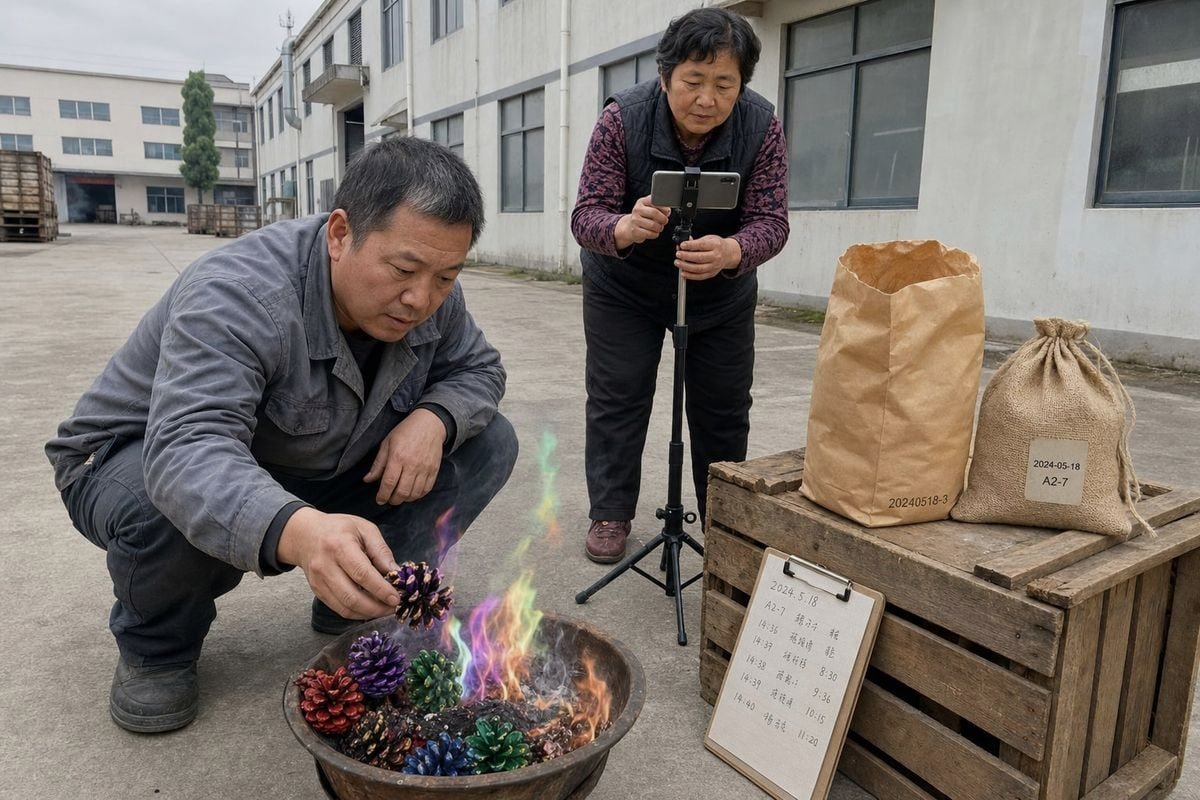
On our production line in Ningbo, I have reviewed hundreds of quality complaints on fireplace colored pine cones — and weak evidence sinks legitimate claims more often than weak products do.
To collect evidence for a quality complaint on fireplace colored pine cones, preserve unused samples and original packaging with batch numbers, save your purchase records and contract specifications, film timed burn tests showing flame color and duration, and request the supplier's certification documents and third-party test reports.
That is the short answer. But each of those steps has details that decide whether your claim gets paid or dismissed CE compliance documentation 1. Let me walk you through them, one by one, from the factory side of the table.
What Documentation Should I Gather Before Filing a Quality Complaint with My Pine Cone Supplier?
A German distributor once sent me a two-line email: "Your cones don't work, refund the container." We resolved it — but only after three weeks of reconstructing paperwork he should have saved from day one.
Before filing a complaint, gather your purchase order and invoice, the agreed product specification sheet, packaging photos showing lot codes, the shipping documents, arrival-condition photos, retained samples from the disputed batch, and a written log of when and how defects were discovered.

The single biggest mistake I see is buyers treating a complaint as a conversation instead of a case file. A supplier — even an honest one — evaluates your claim on paper first. If your paper trail is thin, the discussion stalls. If it is complete, most factories will settle quickly, because complete evidence signals you will escalate competently if they do not.
Build the File in Three Layers
Think of your documentation in three layers: what you agreed to, what you received, and what went wrong. Each layer needs its own records.
| Layer | Core Documents | Why It Matters |
|---|---|---|
| What you agreed to | Purchase order, spec sheet, sample approval emails, listing or catalog claims | Defines the standard the batch must meet |
| What you received | Bill of lading, packing list, arrival photos, carton and inner-bag photos with batch codes | Ties the physical goods to the disputed shipment |
| What went wrong | Defect photos, burn test videos, customer return records, discovery-date log | Proves the failure and when you found it |
The middle layer is where batch number tracking becomes decisive. Every carton we ship carries a printed lot code, and we keep retained samples from each production run for exactly this reason. If your claim references a batch code, we can pull the matching retained sample, the QC record, and the raw material lot within a day. If it does not, we are both guessing.
One more point from experience: do not clean out or resell the disputed stock before the claim closes. Keep at least a few unopened master cartons separate. A supplier inspection or independent lab test needs untouched product, and consumer protection laws 2 in most of our export markets also expect you to preserve the goods in dispute.
How Do I Prove a Batch of Colored Pine Cones Fails to Meet Agreed Certification Standards?
There is a trade-off I weigh every time we quote a private-label order: tighter chemical tolerances cost more, but they make disputes almost impossible. Buyers who insist on documented tolerances rarely need to file claims at all.
To prove a certification failure, compare the disputed batch against the written specification and certificates in your contract, obtain the batch-specific Safety Data Sheet and test reports, and commission an independent lab analysis of retained samples to document any deviation in chemical coating consistency or composition.

A certification claim is different from a "it looked wrong" claim. You are arguing that the product deviates from a defined, documented standard. So your first job is to establish exactly what standard applies. In our contracts, that means the approved pre-production sample, the spec sheet, and the certificates named in the order — for us, typically ISO 9001 process certification 3 plus SGS or Intertek product test reports.
Match the Certificate to the Batch
Here is what many buyers miss: a certificate on the supplier's website proves nothing about your shipment. Certificates and test reports must connect to your production lot. Ask three questions:
- Does the test report reference the same product formulation you ordered?
- Is the report dated within a reasonable window of your production run?
- Does the Safety Data Sheet 4 list the actual flame colorant chemicals used — for example copper sulfate 5 for blue-green tones or strontium chloride for red — rather than a generic composition?
If the answer to any of these is no, that gap itself is evidence. A supplier who cannot produce batch-linked documentation has a traceability failure, which strengthens your position under most consumer protection laws and commercial contract terms.
Use Independent Testing to Close the Argument
When the supplier disputes your findings, an independent lab is the referee. Send sealed, unused samples — never burned remnants — from the retained cartons. Ask the lab to test chemical coating consistency across multiple cones, colorant concentration, and heavy metal content 6. In my experience, a deviation report from a recognized lab ends the debate. Either the batch matches the certified formulation or it does not. This is also the evidence backbone if the matter ever escalates into a product liability claim 7, because courts and insurers weight third-party data far above either party's internal testing.
What Photo and Video Evidence Will Support My Claim About Inconsistent Flame Color or Burn Time?
Years ago, a Canadian camping brand sent us a video that taught me what great complaint evidence looks like: one continuous shot, a visible timestamp, the opened bag with lot code in frame, and a stopwatch running beside the fire.
Film a continuous, unedited video showing the sealed package and batch code, the cones entering an established fire, a running timer, and the full color effect until it fades. Support it with before-and-after photos of the hearth, the residue, and side-by-side comparisons against advertised colors.
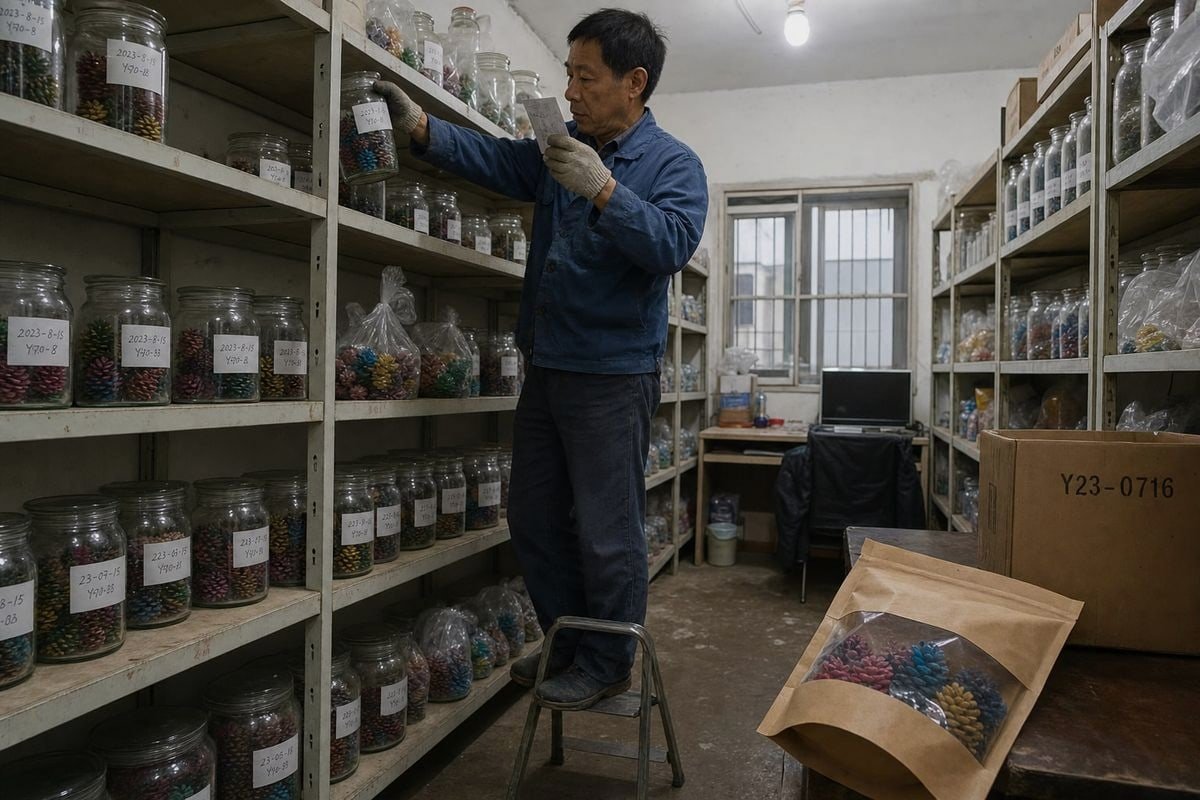
Photo documentation requirements for a burn-performance claim are stricter than most buyers expect, because the supplier's natural defense is misuse: damp fuel, poor draft, a fire that was too small or too large. Your footage has to close those doors before they open. A well-run color-flame test needs an established bed of embers and a normally drafting fireplace — so show that context on camera before the cones go in.
The Timed Performance Log
Flame color claims live or die on numbers, not adjectives. "The color barely lasted" is an opinion. "Color effect ran 4 minutes against a specified 15-minute burn time duration" is data. Run at least three cones from different bags and record each one:
| Test | Cone Source (Bag/Lot) | Time Color Appeared | Time Color Faded | Colors Observed | Notes |
|---|---|---|---|---|---|
| 1 | Bag A, Lot #___ | Fire condition, draft, fuel | |||
| 2 | Bag B, Lot #___ | ||||
| 3 | Bag C, Lot #___ |
Repeating the test across bags matters. One weak cone is variance; the same failure across three bags points to a production-level defect in the chemical coating.
Photograph the Aftermath, Not Just the Flame
Combustion residue tells its own story. Photograph the ash after the fire cools: properly formulated cones from our lines leave fine, light ash, while poor binders or superficial spray coatings leave heavy clumping or metallic flecks. Also photograph any staining on the hearth or unusual soot — secondary damage is separate evidence and may support a larger claim. One advanced step worth the effort: slice an unused cone in half and photograph the cross-section. Deep chemical saturation from a proper infusion soak looks visibly different from a thin surface spray, and that single image can prove a shortcut in manufacturing.
Which Test Reports Should I Request from My Manufacturer to Validate a Product Defect Claim?
When we onboard a new distributor, I always tell them the same thing: request the test reports before you need them. The buyers who hold our SGS files on day one never scramble during a dispute.
Request the batch-linked SGS or Intertek composition and burn test report, the Safety Data Sheet for the colorant formulation, heavy metal and emissions test results, the factory's outgoing QC inspection record for your lot, and copies of ISO 9001 and CE compliance documentation.

A defect claim gets validated by comparing what the product should be — as defined in test reports — against what your disputed batch actually is. So the reports you request fall into two groups: baseline documents that define the standard, and batch documents that show whether your lot met it.
| Report Type | What It Shows | Red Flag If Missing |
|---|---|---|
| SGS/Intertek product test report | Verified composition, burn behavior, safety performance | Supplier relies on unverified self-claims |
| Safety Data Sheet | Exact flame colorant chemicals and handling data | Formulation may be undocumented or changed |
| Heavy metal / emissions test | No toxic fume emission risk at normal use | Product may fail retail compliance checks |
| Outgoing QC inspection record | Your specific lot passed factory checks | No batch-level quality control exists |
| ISO 9001 / CE / BSCI documentation | Systemic process and market compliance | Factory may be a reseller, not a producer |
Why the SDS Matters More Than Buyers Think
The Safety Data Sheet is not bureaucratic filler. It names the actual colorants — and if a supplier quietly switched from a cleaner formulation to a cheaper one between your sample and mass production, the SDS comparison exposes it. Fume safety claims especially depend on this document. If end customers report unusual odor or smoke, the SDS plus an emissions report either clears the product or confirms a toxic fume emission concern that must be escalated immediately, potentially to a recall rather than a refund.
The Sample-to-Mass-Production Gap
Most quality complaints I have handled trace back to one root cause: the approved sample and the shipped batch came off different processes. This is why we run strict batch-to-batch quality control across our 17-plus years of production — the first sample must reliably predict the container. When you request reports, always ask whether they were generated from the golden sample or from your actual production run. Reports from your run are evidence. Reports from the sample are only a baseline.
Conclusion
Weak evidence loses valid claims. Preserve samples and packaging, save purchase records, film timed burn tests, and demand batch-linked reports — a complete file resolves colored pine cone disputes fast.
Footnotes
1. Explains the European conformity marking referenced among required manufacturer certification documents. ↩︎
2. Provides background on legal framework governing product dispute and refund rights. ↩︎
3. Official ISO source explaining the quality management standard referenced for supplier certification. ↩︎
4. Explains standard document format referenced repeatedly for chemical colorant disclosure. ↩︎
5. Background on the chemical compound used to create blue-green flame colors. ↩︎
6. Authoritative OSHA resource providing a comprehensive overview of toxic heavy metals and health effects. ↩︎
7. Defines legal concept referenced when defect evidence escalates beyond a refund dispute. ↩︎



 English
  Spanish
  German
  French
  Arabic
  Portuguese
Join the Conversation