






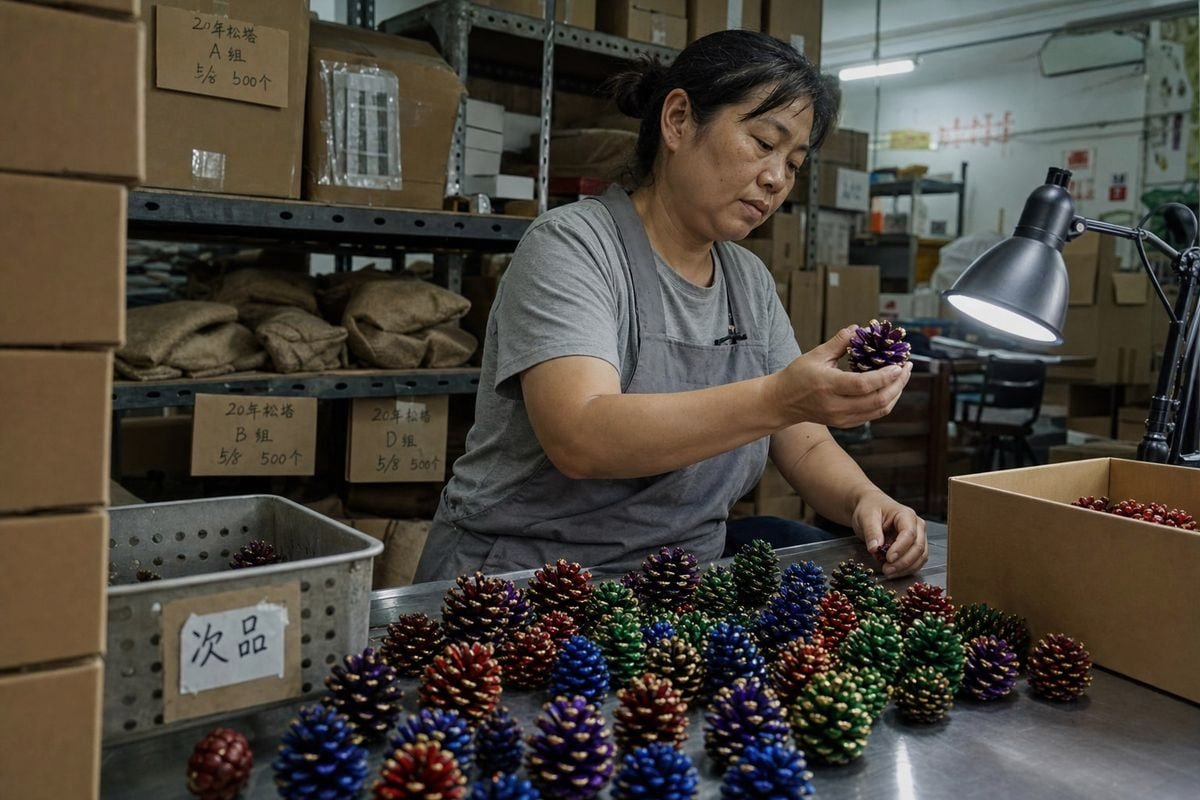
Choosing decorative pine cones not meant for burning sounds simple — until a container arrives with waxed, flammable cones. On our production lines, we see this sourcing mistake constantly.
To choose decorative pine cones not meant for burning, verify the product is labeled for décor or crafts only, request SGS or Intertek test reports, confirm no wax or accelerant coatings, inspect for uniform intact scales, and select a certified manufacturer with proven batch-to-batch consistency.
That is the short answer. Below, I will walk you through certifications, quality consistency, customization, and why manufacturer experience matters more than price.
What Certifications Should I Require to Confirm Decorative Pine Cones Are Truly Non-Flammable and Safe?
A buyer from Germany once asked me a blunt question: "How do I know your painted pine cones will not ignite near a candle?" Documentation, I told him — not promises.
Require third-party test reports from SGS or Intertek confirming the coating contains no accelerants, plus REACH-compliant paint documentation for Europe, CE marking where applicable, and factory-level ISO 9001 and BSCI certificates. Never accept verbal assurances that decorative pine cones are safe near heat sources.

Here is the core problem. Pine cones are sold in two very different categories. One is decorative-only: cleaned, dyed, or painted cones for bowls, wreaths, and ornaments. The other is fire-use: wax-dipped or chemically treated cones designed to burn in a fireplace or campfire 1. Our factory in Ningbo actually produces both types, so I can tell you the difference is invisible to the untrained eye. A glossy painted cone and a wax-coated fire cone can look nearly identical in a product photo.
That is why paperwork matters. When we ship color-flame pinecones, they carry explicit warning labels and fire-use instructions. When a client orders decorative-only cones, the documentation must prove the opposite — no paraffin dip 2, no accelerant coating, no volatile scent oils that raise flammability.
The Documents to Request Before You Order
Ask every supplier for these items, and check the dates on each report:
| Document | What It Proves | Who Issues It |
|---|---|---|
| SGS or Intertek material test | Coating contains no accelerants or banned chemicals | Third-party lab |
| REACH compliance (EU) | Paints and dyes meet European chemical rules | Third-party lab |
| ISO 9001 certificate | The factory runs a documented quality system | Certification body |
| BSCI audit report | Ethical, audited production conditions | Audit body |
| Product spec sheet | Declared treatments: dye, paint, sealant, scent | The manufacturer |
One more practical tip. Even genuinely decorative cones remain organic material. Common guidance says to keep any pine cone at least two feet from open flame 3, and scented versions at least three feet from heat sources. Certification confirms the product carries no added fire risk — it does not make wood fireproof. Your retail packaging should still carry sensible placement guidance, and an experienced supplier will help you word those warning labels correctly for your market.
How Can I Tell If a Supplier's Pine Cone Quality Will Stay Consistent Across Large Production Runs?
Seventeen years of exporting fire-themed goods to more than 30 countries taught our team one hard lesson: the sample is easy. The tenth container is where suppliers fail.
Judge consistency by asking how the supplier grades raw cones, whether they document paint batch numbers, what their per-batch QC sampling rate is, and whether they will contractually match a sealed golden sample. Factories with ISO 9001 systems can show these records; traders usually cannot.

Pine cones are a natural raw material. No two are identical. So consistency does not mean every cone is a clone — it means every cone falls inside an agreed tolerance band. On our lines, we grade incoming cones before any treatment: size range, scale openness, symmetry, and absence of mold, sap buildup, or insect damage. Cones with broken scales or closed tips get rejected at intake, because a chipped cone sheds debris in a retail display bowl and looks messy in a wreath.
The Consistency Checkpoints That Actually Matter
Walk through this sequence with any supplier you are evaluating:
- Raw material grading. Ask for their written size and defect standards. If they hesitate, they are sorting by eye — or not at all.
- Pre-treatment cleaning. Cones should be heat-treated at low oven temperatures to kill insects, eggs, and mold spores 4 before finishing. Skipping this step means pests hatch in your warehouse.
- Coating control. Paint and dye batches should be logged, so cone number 50,000 matches the color of cone number 50.
- Golden sample agreement. A sealed, signed reference sample sits at the factory and with you. Every production run is checked against it.
- Per-batch inspection records. Ask to see actual QC reports from a past order, not a blank template.
| Warning Sign | What It Usually Means |
|---|---|
| No written grading standard | Quality drifts with each harvest season |
| Cannot name their cone source region | They buy from changing brokers |
| Refuses third-party pre-shipment inspection | Something to hide in the run |
| Sample quality far above catalog photos | The sample was hand-picked, not representative |
We hold strict batch-to-batch controls precisely so the first sample reliably reflects mass production. Any serious factory should be willing to prove the same, in writing, before you commit to volume.
What Customization Options Should I Look For When Sourcing Decorative Pine Cones for My Private Label?
One trade-off comes up in nearly every private-label discussion we have: buyers want a unique shelf presence, but they also want trial-order MOQs. The right supplier balances both.
Look for full customization of cone finish — paint colors, metallic accents, flocking, bleaching, and optional sealants — plus private-label packaging including custom pouches, boxes, display units, barcodes, and market-specific warning labels. A true OEM/ODM factory handles all of this in one place.

Customization is where decorative pine cones stop being a commodity and start being your brand. In our own catalog, the same base cone becomes a hand-painted purple ornament with metallic gold-tipped scales for a boutique holiday line, or a whitewashed rustic filler for a Scandinavian-style home décor brand. The base material is identical. The finishing and packaging create the retail value.
Finish Options and What They Suit
| Finish | Best Use Case | Notes for Buyers |
|---|---|---|
| Hand-painted saturated colors with gold tips | Premium holiday ornaments, gift sets | Highest perceived value; confirm REACH-compliant paints |
| Bleached or whitewashed | Winter and minimalist décor | Verify the bleaching process is documented |
| Flocked or frost-sprayed | Christmas trees and garlands | Check flocking adhesion in transit tests |
| Natural cleaned, matte finish | Bowl fillers, rustic table accents | A dry, matte surface signals no accelerant coating |
| Light clear sealant | Humid markets | Prevents scales reopening in indoor humidity |
That last row deserves a comment. Cones absorb moisture and their scales can move, which distorts a carefully arranged product. A light sealant, or shipping with desiccant 5, keeps the decorative shape stable — a small detail that separates experienced factories from casual suppliers.
Packaging Is Half the Product
For our fire-use lines we produce kraft stand-up pouches with clear windows, printed burlap-style sacks, and jars. The same packaging depth applies to decorative cones: custom retail boxes, display-ready cartons, hang tags, barcodes, and multilingual labels. Ask whether your supplier prints packaging in-house or subcontracts it. In-house control means your artwork, your warning text, and your barcode all arrive correct on the first run — and it means one point of accountability when they do not.
Why Does Choosing an Experienced Manufacturer Matter More Than Price When Ordering Decorative Pine Cones in Bulk?
Early in my career, a client came to us after a low-cost supplier shipped him "decorative" cones that turned out to be paraffin-dipped fire starters. His retailer pulled the entire line.
An experienced manufacturer prevents the costly failures cheap suppliers cause: mislabeled flammable products, pest-infested shipments, color drift between batches, and rejected customs paperwork. The price gap on a bulk order is small; the cost of a recall, chargeback, or lost retail listing is not.

Let me break down where the real money sits in a bulk pine cone order. The unit price difference between a bargain supplier and an established factory is often a few cents per cone. The downstream risks are measured in thousands of dollars per incident.
Where Cheap Suppliers Actually Cost You
First, product confusion. Because decorative cones and fire-use cones look alike, an inexperienced supplier may mix inventory, apply the wrong coating, or ship without proper labels. A factory that produces both categories — as we do, with color-flame pinecones on one line and decorative finishes on another — builds strict segregation into the process, because we understand exactly why the distinction matters. That knowledge is not something a trading company reselling forest-floor cones can replicate.
Second, biological risk. Untreated cones carry insect eggs, mold spores, and sap. Experienced factories heat-treat and inspect every batch before finishing. Cheap suppliers skip this step to save energy costs, and the problem only appears weeks later in your warehouse.
Third, compliance failures. Customs in the US and EU can hold shipments of untreated plant material 6 or products with non-compliant coatings. Seventeen-plus years of exporting to markets like the US, Germany, France, and the UK means we already know which documents each border expects. A new supplier learns those lessons on your shipment.
Finally, think in total landed cost 7, not unit price. A reliable partner delivers on schedule, matches the golden sample, supports flexible trial MOQs, and answers emails in clear English within a business day. Those things do not show up on a quotation sheet — but they decide whether your product line survives its second season.
Conclusion
Sourcing decorative pine cones not meant for burning comes down to proof, not appearance: demand certifications, verify batch consistency, secure real customization, and partner with an experienced factory.
Footnotes
1. Background on the fire-use context that decorative cones must be distinguished from. ↩︎
2. Clarifies the wax-based coating buyers must confirm is absent from decorative cones. ↩︎
3. NFPA is the authoritative body for fire safety guidance near combustible decor. ↩︎
4. CDC provides authoritative health guidance on mold risks from untreated natural materials. ↩︎
5. Explains the moisture-control material used to keep pine cone scales stable in transit. ↩︎
6. USDA APHIS governs import rules for untreated plant materials entering the US. ↩︎
7. International Trade Administration explains landed cost factors relevant to bulk sourcing decisions. ↩︎



 English
  Spanish
  German
  French
  Arabic
  Portuguese
Join the Conversation