






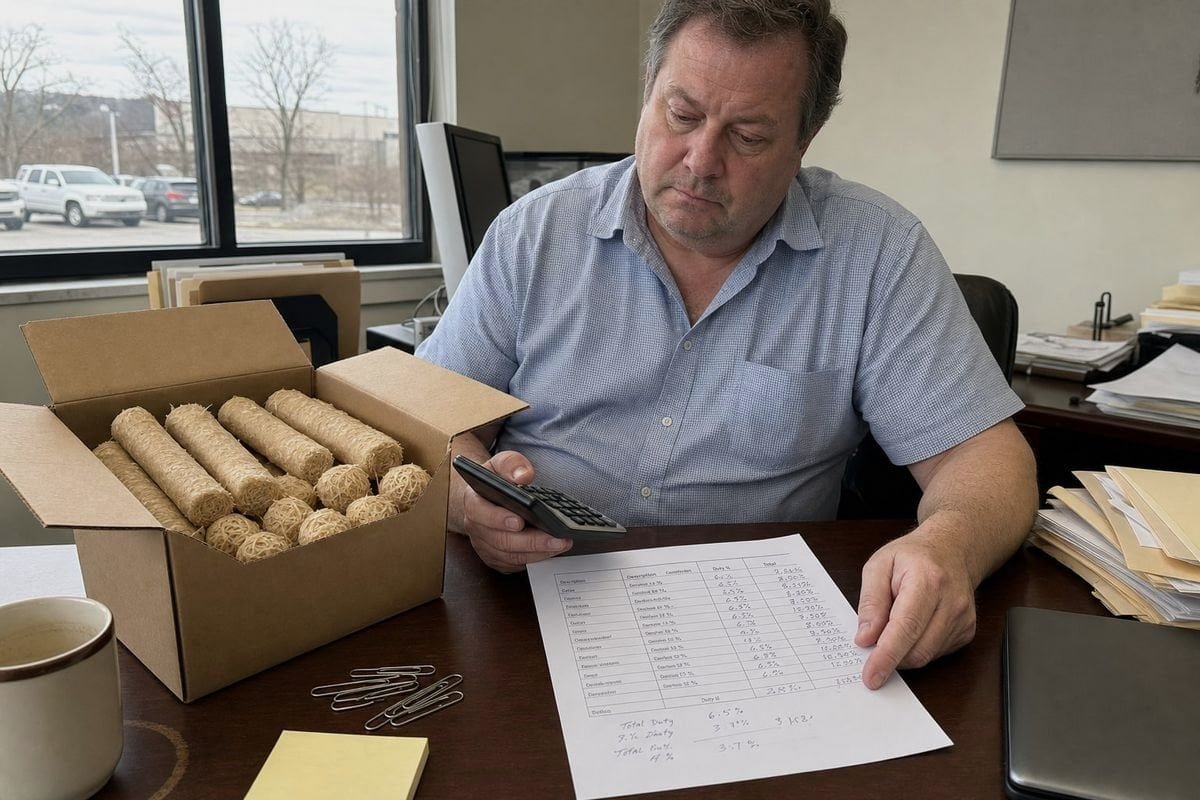
Import duty costs on wood fire starters changed sharply after the Section 232 tariff increase. Several of our US buyers [quoted retail prices before checking the new duty stack](https://sunrichfire.com/how-factor-import-costs-tariffs-into-wholesale-pricing-wood-fire-starters-china/) — and lost margin overnight.
To calculate import duty costs after the Section 232 tariff increase, confirm your HTS code, compute customs value (product + freight + insurance), then stack the base ad valorem duty rate, the Section 232 surcharge (10%–25% if covered), any Section 301 duty, plus MPF and HMF.
That formula sounds simple. The hard part is getting each input right. Below, I walk through classification, the landed cost math, sourcing strategies, and documentation — step by step.
What HS Code Should I Use to Calculate Duty on My Wood Fire Starter Imports?
A German distributor once asked us to relabel our wax-dipped wood rolls as "kindling" to simplify paperwork. We refused — because at our factory, we know the tariff line, not the label, decides the duty.
Most wood fire starters fall under HTS heading 4401 — typically 4401.39 for compressed wood-fiber and wax starters, or 4401.31 for pellet-style products. Your exact 10-digit code determines the base MFN rate and whether the Section 232 wood-products surcharge applies at all.

Here is the point many importers miss: "wood fire starter" is a commercial description, not a legal one. US Customs and Border Protection assesses duty by HTS Code Classification 1, country of origin, and declared value. Two products that look identical on a shelf can land in different tariff lines and face very different duty bills.
Why Composition Drives Classification
Our own fire starter pucks are 50% wood fiber and 50% paraffin wax. That composition matters. A pure wood-wool roll, a wax-heavy firelighter, and a compressed sawdust log may each classify differently under the Harmonized Tariff Schedule. The "essential character" of the product — wood versus fuel — can shift the code, and with it, the Section 232 outcome.
| Product Type | Likely HTS Direction | Section 232 Wood Exposure |
|---|---|---|
| Compressed wood shavings / excelsior rolls | 4401.39 (other wood waste/scrap, agglomerated) | Likely covered as a wood derivative |
| Wood pellets | 4401.31 | Likely covered |
| Wax-dominant firelighters | May shift toward fuel/wax headings | Possibly outside wood coverage |
| Kindling sticks (natural, cut wood) | 4401.1x fuel wood | Check current CBP guidance |
How to Confirm Your Code
Do not guess. Take these steps, in order:
- Get the full bill of materials from your supplier, with percentage weights.
- Review the HTS chapter notes for Chapter 44 and any competing headings.
- Ask your customs broker for a written classification opinion.
- For high-volume programs, request a binding ruling 2 from CBP.
A binding ruling costs time upfront but locks in certainty. When we prepared export documentation for a large US fireplace distributor, their broker's classification review caught a code mismatch before the first container shipped. That single check avoided a re-classification penalty and a duty bill nobody had budgeted.
Also watch the Department of Commerce scope proceedings 3. Derivative wood products can be added to — or removed from — the Section 232 list through administrative review. Your code can stay the same while its tariff treatment changes.
How Do I Factor Section 232 Tariffs Into My Total Landed Cost Per Unit?
Last quarter, a US camping brand asked us to re-quote a 100-piece retail box program because their old landed cost model ignored the new duty layer. We rebuilt the worksheet together, line by line.
Add Section 232 as a separate line on top of your base duty: Landed cost = product cost + freight + insurance + (customs value × base rate) + (customs value × Section 232 rate) + (customs value × Section 301 rate, if Chinese origin) + MPF + HMF.

The mental shift here is important. Before the Section 232 tariff increase, most buyers asked one question: "What is the base duty?" Now the right question is: "What is the total duty stack?" Each layer is calculated against the same base — the customs value — but they are separate charges on your CBP Entry Summary.
Step 1: Establish Customs Valuation
Customs Valuation 4 starts with the price actually paid or payable. For planning purposes, most landed cost calculators use a CIF-style figure: product cost plus international freight plus insurance. Keep this number clean and documented. It is the denominator for every percentage that follows.
Step 2: Stack the Duty Layers
| Cost Layer | Rate | Applies To |
|---|---|---|
| Base MFN ad valorem duty rate | Per your HTS line (often low or free for 4401) | Customs value |
| Section 232 wood surcharge | 10%–25% depending on category | Customs value, if covered |
| Section 301 (China origin) | Per current List rate | Customs value |
| Merchandise Processing Fee (MPF) | 0.3464% (min $27.98, max $538.40) | Customs value |
| Harbor Maintenance Fee (HMF) | 0.125% (ocean freight only) | Customs value |
Step 3: A Worked Example
Take a container of compressed wood-fiber fire starter pucks from China, 50,000 units:
| Item | Amount |
|---|---|
| Product cost (FOB) | $30,000 |
| Ocean freight | $3,500 |
| Insurance | $300 |
| Customs value (CIF) | $33,800 |
| Base duty (assume free) | $0 |
| Section 232 at 10% | $3,380 |
| Section 301 at 25% (illustrative) | $8,450 |
| MPF at 0.3464% | $117.08 |
| HMF at 0.125% | $42.25 |
| Total landed cost | $45,789.33 |
| Landed cost per unit | ~$0.92 |
Compare that to a scenario where classification falls outside Section 232: remove $3,380, and per-unit cost drops by roughly seven cents. On a retail item, that is real margin. Note also: HMF only applies to ocean shipments. If you air-freight samples or urgent replenishment, drop that line. And confirm current rates before every order — Section 232 wood categories have scheduled increases, with some furniture-related lines rising as high as 50% in 2026.
Can I Reduce My Tariff Exposure by Sourcing Certified, Compliant Wood Firestarters?
Over 17 years exporting fire products to 30+ countries, I have watched buyers chase the lowest FOB price and then hand it all back — and more — at the border. Compliance is where the real savings live.
Yes — legal tariff reduction comes from correct classification, verified country of origin rules, First Sale valuation where eligible, Foreign Trade Zone planning, and origin-based rate caps. Certified suppliers with clean documentation make each of these strategies possible; uncertified suppliers make them risky.

Let me be direct about what works and what does not. There is no certificate that exempts a covered product from Section 232. But a compliant, well-documented supply chain unlocks every legitimate cost-reduction lever — and protects you from the penalties that wipe out savings.
Legitimate Levers Worth Exploring
- Origin-based rate treatment. Some trading partners have negotiated caps — reported ceilings around 15% total for EU and Japan-origin goods, and 10% for UK-origin goods on certain lines. Country of Origin Rules determine which treatment you get, so origin must be provable, not assumed.
- First Sale Rule. If goods move through a middleman, you may be able to declare the manufacturer's price rather than the higher resale price. This lowers the taxable base for every duty layer. It requires a documented, arm's-length first sale — which is why we provide full factory invoices, not trading-company paperwork.
- Foreign Trade Zones. Goods subject to Section 232 must generally enter an FTZ under Privileged Foreign Status 5, locking the rate at admission. This helps with timing and inventory strategy, though it rarely eliminates the duty.
- Substantial transformation. Shifting real manufacturing steps — not just repacking — to a third country can legally change origin. Be careful: superficial processing does not pass CBP's substantial transformation test, and origin fraud is a serious offense.
What Certification Actually Buys You
Our ISO 9001 6, BSCI, and SGS/Intertek documentation does not lower a tariff percentage. What it does is make your declarations defensible. When CBP questions valuation or composition, a supplier with batch-level QC records and third-party test reports can substantiate the entry. One of our US wholesale buyers told me their broker cleared a flagged shipment in two days because our composition documentation matched the declared HTS line exactly. Also check whether Antidumping and Countervailing Duties apply to your product and origin — those are separate trade remedy measures that can dwarf Section 232 if triggered.
How Do I Verify My Supplier's Documentation to Avoid Customs Delays and Unexpected Duty Charges?
Early in our export history, a shipment sat at a European port for eleven days over a mismatched net weight on the packing list. That lesson shaped how our Ningbo production team prepares every document set today.
Verify five things before shipment: a commercial invoice matching the purchase order value, a packing list consistent with the invoice, a certificate of origin, composition and safety test reports, and the correct HTS code stated consistently across all documents. Any mismatch invites CBP holds and duty reassessment.

Customs delays rarely come from bad luck. They come from documents that disagree with each other. CBP's systems flag inconsistencies automatically, and once an entry is flagged, your broker's Customs Brokerage Fees climb, storage charges accrue, and your promised retail launch date slips.
The Pre-Shipment Verification Checklist
Work through this before the container leaves the factory:
- Commercial invoice. Confirm the declared value matches what you actually paid. Undervaluation is the fastest route to penalties; overvaluation inflates your duty stack for no reason.
- Composition breakdown. For a product like our 50% wood fiber / 50% paraffin pucks, the stated composition must support the claimed HTS line. Ask for the material spec sheet, not just a verbal answer.
- Certificate of origin. With origin-based rate caps and Section 301 exposure 7, origin proof is now a financial document, not a formality. Verify the certificate names the actual production site.
- Test reports. SGS or Intertek reports confirm the product is what the paperwork says it is. They also matter for retail compliance — warning labels, flammability data, and safety documentation that large US retailers require.
- Consistency check. The HTS code, quantities, weights, and values must match across the invoice, packing list, bill of lading, and the ISF filing.
Red Flags That Predict Trouble
Watch for suppliers who resist providing factory-level invoices, cannot explain their own product composition in writing, or offer to "adjust" declared values. Each of these transfers legal risk directly to you as the importer of record. In our experience supporting private-label programs for US and European distributors, buyers who audit documents on the first trial order almost never face surprises on the tenth container. Keep every supplier invoice and cost breakdown for five years — CBP can request valuation support long after liquidation.
Conclusion
Section 232 turned a simple duty question into a layered calculation. Get the HTS code right, stack every duty layer honestly, and partner with certified suppliers whose documentation holds up.
Footnotes
1. Official USITC tool for verifying tariff classification codes referenced throughout the article. ↩︎
2. Official CBP portal for searching and accessing binding administrative rulings. ↩︎
3. BIS official Section 232 investigation page explains scope proceedings affecting wood tariffs. ↩︎
4. CBP's official guidance on determining customs value, the base for all duty calculations. ↩︎
5. Official eCFR legal definition and requirements for privileged foreign status in FTZs. ↩︎
6. Stable Wikipedia overview of the ISO 9001 quality management system standard. ↩︎
7. USTR's official page explains the Section 301


 English
  Spanish
  German
  French
  Arabic
  Portuguese
Join the Conversation