







Color shedding in fireplace-colored pine cones ruins shelves, stains hands, and triggers returns. I have watched our production line reject entire batches over this exact defect — and buyers rarely spot it until it's too late.
To avoid color shedding when choosing fireplace-colored pine cones, request SGS or Intertek test reports, verify the supplier uses deep-infusion soaking with a wax-sealed finish, insist on moisture-barrier packaging with desiccants, and always run a trial order to test handling, storage, and burn performance first.
Each of those steps deserves a closer look. Below, I break down exactly what to ask for, what to inspect, and how to test before you commit real money.
What certifications should I request to confirm the pine cones are shedding-free and safe?
A German distributor once emailed us in a panic. His previous supplier's cones left blue dust across a retail display, and the store demanded proof the residue was harmless. He had no test reports to show. That single gap cost him the account, and it taught me how much paperwork actually protects a buyer.
Request SGS or Intertek chemical composition and heavy-metal test reports, an ISO 9001 quality management certificate, CE marking for the destination market, and a BSCI social audit. Together, these confirm the chemical flame colorants are non-toxic, properly bonded, and produced under controlled, repeatable conditions.

Certifications matter for two separate reasons. First, they confirm safety — that the pine cones use non-toxic flame dyes rather than raw industrial salts with heavy-metal contamination 1. Second, they confirm process control, which is what actually prevents shedding. A factory that passes ISO 9001 2 audits has documented soaking times, drying protocols, and batch inspection records. A factory without them is guessing on every batch.
In our experience exporting to 30+ countries, buyers in the US and EU treat these documents as a hard requirement, not a nice-to-have. Retail chains will not shelve a fire product without them.
The documents that matter most
| Certification / Report | What it proves | Why it relates to shedding |
|---|---|---|
| SGS / Intertek test report | Chemical composition, heavy-metal limits | Confirms colorants like strontium chloride 3 are food-grade purity and safely bonded |
| ISO 9001 | Documented quality management system | Soak, cure, and drying steps are controlled batch to batch |
| CE marking | EU market conformity | Product meets consumer safety expectations for hearth decor safety |
| BSCI audit | Ethical, audited factory conditions | Signals a real factory with traceable processes, not a reseller |
| Emissions / combustion data | Burn byproducts within safe limits | Protects indoor air quality claims on your packaging |
One more tip: ask for reports dated within the last 12–24 months and matched to the exact SKU. A generic report for "colored fire products" tells you very little about the specific coating on the cones you are buying.
How can I verify a supplier's production process prevents color transfer before placing a bulk order?
There is a trade-off we weigh on every production run: deeper chemical infusion gives stronger multi-color flame effects, but it demands longer curing time before packing. Suppliers who rush that curing window are the number one source of shedding complaints I hear from buyers switching to us.
Ask the supplier to document four process stages: pre-cleaning and baking of raw cones, full-submersion soaking in dissolved colorant solution, a curing period of at least 48 hours in controlled humidity, and a protective wax or binder seal. Request photos, videos, or a live factory audit of each stage.
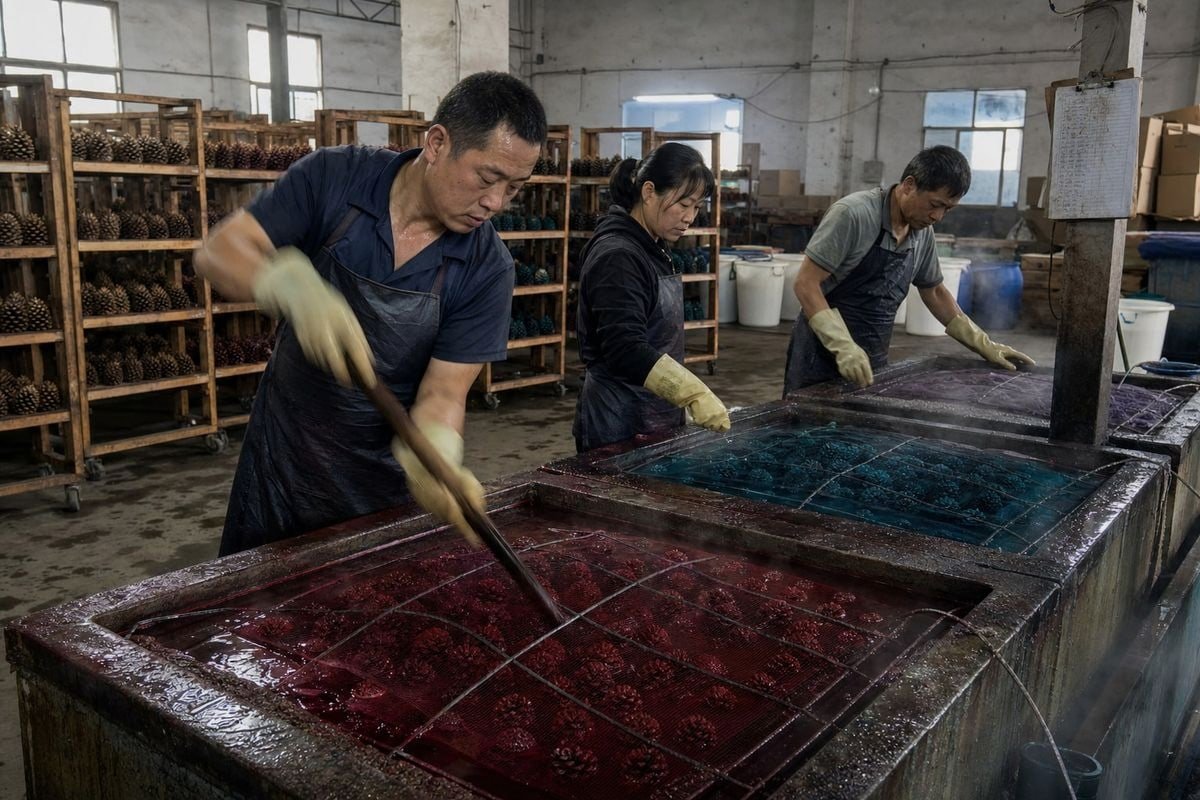
The mechanics are simple. Flame colorants — strontium chloride for red, copper salts for blue-green, potassium chloride for lavender — must be absorbed into the wood fibers, not just deposited on the surface. Surface-only color is exactly what flakes off in transit. So when you vet a supplier, you are really vetting how deep the color goes and how well it is locked in.
The four-stage process to verify
- Preparation. Raw cones should be baked at around 200°F (93°C) to drive out internal moisture and melt away sap. Sap blocks absorption. Some producers add a mild trisodium phosphate 4 wash to strip the natural waxy cuticle and open up bonding sites.
- Full-submersion soaking. Cones must be weighted fully under the solution — typically for 24 hours — so the colorant penetrates the core. Sprinkled or sprayed colorant sits on the exterior and dusts off. Advanced lines use vacuum-assisted infusion to force solution into the cellular structure.
- Controlled curing. A minimum of 48 hours in a ventilated, low-humidity space lets salts crystallize inside the scales. Under-cured cones weep color; over-dried cones can flare too fast for the flame color to develop.
- Sealing. A thin wax dip after drying creates a physical barrier that locks in the salts and prevents dusting, similar to how our wax-dipped fire starters are finished.
One critical question to ask: does the factory process one chemical salt per batch? Mixing copper sulfate crystals and strontium chloride in shared tanks can trigger neutralizing reactions that leave a flaky, non-adherent residue. On our lines, each colorant has dedicated soaking tanks for exactly this reason.
If the supplier cannot explain these stages, or refuses a video walkthrough, treat that as your answer.
What packaging and labeling standards help ensure the pine cones stay shedding-free during shipping and storage?
Years ago, we shipped a container to a humid coastal market in Brazil and learned a hard lesson: hygroscopic salts 5 pull moisture straight out of the air. Cones that left our Ningbo facility bone-dry arrived slightly tacky. Since then, our packaging spec has been non-negotiable, and I recommend buyers demand the same.
Specify moisture-barrier packaging: sealed inner poly liners or resealable stand-up pouches, silica gel desiccant packs in every unit, rigid cartons that prevent cone-on-cone abrasion, and labels covering warnings, single-color-per-fire instructions, and no-cooking-fire notices. Airtight retail packaging is the single biggest shedding safeguard in transit.

Shedding during shipping has two causes: friction and moisture. Friction happens when loose cones tumble against each other in oversized boxes, grinding color off scale tips. Moisture happens because colorant salts are hygroscopic — they absorb humidity, soften, and "weep" liquid color that stains packaging and neighboring cones. Good packaging attacks both problems at once.
Packaging spec checklist
| Element | Standard to request | Problem it prevents |
|---|---|---|
| Inner barrier | Sealed poly liner or resealable kraft pouch with window | Humidity absorption and weeping |
| Desiccant | Silica gel pack per retail unit | Salt re-hydration during ocean freight |
| Cushioning | Dividers or snug-fit cartons | Abrasion and scale breakage |
| Outer carton | Double-wall, moisture-resistant | Crushing and condensation damage |
| Storage guidance printed on pack | Cool, dry, away from sunlight | Fading and moisture uptake at retail |
Labeling deserves equal attention. In our one-stop OEM work, we print warning labels, barcodes, and usage instructions directly for the buyer's market: burn one color at a time so colors do not mix unpredictably, never use on cooking fires or BBQ grills, and confirm wood stove compatibility 6 before use in closed appliances. Clear labels also support creosote buildup prevention advice — instructing users to burn cones in an established, hot fire rather than smoldering embers.
For retail buyers, ask whether the supplier can deliver shelf-ready display packaging. A resealable pouch protects the product after the consumer opens it, which extends the shedding-free window into the home.
Should I request a trial order to test for color shedding before committing to a large purchase?
A Canadian fireplace distributor once told me his rule: "I never trust the sample. I trust the first small production run." I agreed with him completely, and we structured a 200-unit trial before his first container. That trial is why the relationship is still running years later.
Yes — always request a trial order. Test cones for dust transfer with a white-glove rub test, store them for two to four weeks in your warehouse conditions, then burn samples to confirm flame color holds. A trial order verifies real production quality, not a hand-picked showroom sample.

Some buyers push back on trial orders because they add two to four weeks to the timeline. I understand the objection, but the math favors testing. A trial costs a fraction of one container. A shedding failure across a full container costs the goods, the freight, and often the retail relationship. The trial is cheap insurance.
Here is the counterpoint worth addressing honestly: a trial only works if it reflects mass production. Some suppliers hand-finish samples that their production line cannot replicate. This is why manufacturing depth matters — with 17+ years of batch-to-batch quality control behind us, our position is that the first sample must reliably reflect mass-production quality, and a buyer should hold every supplier to that standard in writing.
A practical trial-order test plan
| Test | Method | Pass criteria |
|---|---|---|
| Rub test | Wipe cones with white cotton gloves | No visible color transfer |
| Shake test | Tumble cones in a clear bag for 60 seconds | No dust or flakes at the bottom |
| Storage test | Hold 2–4 weeks in your real warehouse humidity | No weeping, tackiness, or fading |
| Burn test | Burn in a fireplace or fire pit | Strong, even flame color for the stated duration |
| Packaging drop test | Drop carton from waist height | No internal abrasion damage |
Run the burn test in the same appliance type your customers use. A cone that performs in an open fire pit may behave differently in a closed stove, so confirm wood stove compatibility if that is your channel. Also ask the supplier to confirm the trial batch and the bulk order will use identical chemical flame colorants 7, soak times, and sealing — and get that confirmation in the purchase agreement. Flexible MOQs for trial orders are a signal, too. Suppliers confident in their process rarely resist a small first run.
Conclusion
Color shedding is preventable. Demand certified test reports, verify soak-cure-seal production, specify moisture-barrier packaging, and run a real trial order. Do those four things, and your fireplace-colored pine cones will arrive — and sell — clean.
Footnotes
1. CDC resource on heavy metal exposure risks relevant to industrial colorant safety concerns. ↩︎
2. Authoritative Wikipedia entry for the international quality management standard. ↩︎
3. Background on the chemical compound used as a red flame colorant in production. ↩︎
4. Explains the compound used to strip waxy cuticles before colorant absorption. ↩︎
5. Defines hygroscopy, explaining why colorant salts absorb moisture and cause weeping. ↩︎
6. EPA's Burn Wise program covers safe wood-burning appliance use and compatibility guidance. ↩︎
7. Scientific overview of chemical compounds used to produce colored flames. ↩︎



 English
  Spanish
  German
  French
  Arabic
  Portuguese
Join the Conversation