







Pre-shipment inspection for fireplace colored pine cones seems simple until a container of broken, sticky, mislabeled cones lands at your warehouse. On our production lines, we have seen exactly how that happens — and how a proper inspection plan prevents it.
Arrange the pre-shipment inspection when production is 80%–100% complete and packed. Use AQL random sampling under ISO 2859-1, General Inspection Level II, with AQL 0.0 for critical defects, 2.5 for major, and 4.0 for minor. Confirm certifications and burn tests beforehand.
That is the short answer. Below, I will walk you through each step: the documents to collect first, the sampling math, the product-specific defects, and the timing coordination that keeps your shipment on schedule.
What certifications and test reports should I request before scheduling a pre-shipment inspection?
A buyer in Germany once asked us for our SGS report two days before loading. We had it ready — but many factories do not, and that gap becomes your problem at customs.
Before booking a pre-shipment inspection, request the supplier's SGS or Intertek test report confirming heavy-metal compliance (REACH, Prop 65), a Material Safety Data Sheet for the flame colorant chemicals, heat-treatment or phytosanitary records for the natural cones, and factory quality certifications such as ISO 9001 and BSCI.

The inspection itself only verifies what is in front of the inspector on that day. Certifications and lab reports cover what the inspector cannot see: chemical composition, pest treatment, and the factory's underlying quality assurance protocol 1. In our experience exporting to 30+ countries, buyers who skip this step end up paying for it later, either at the border or on the retail shelf.
The core document checklist
Fireplace colored pine cones sit in an unusual category. They are a natural botanical product coated with metal salts and burned indoors. That combination triggers three separate compliance areas.
| Document | What it proves | Why it matters for colored pine cones |
|---|---|---|
| SGS / Intertek chemical test report | Colorants are free from restricted heavy metals like Lead and Cadmium | Required for REACH (EU) and Prop 65 (California) market access |
| Material Safety Data Sheet | Composition and handling of flame colorant chemicals | Needed by freight forwarders, retailers, and emergency responders |
| Heat treatment / phytosanitary log | Cones treated (e.g., 60°C for 30 minutes) against pests and larvae | Untreated botanicals can be refused or destroyed at import |
| ISO 9001 certificate | A working quality management system | Predicts batch-to-batch consistency, not just one good sample |
| BSCI audit report | Ethical production conditions | A hard requirement for many EU and US retail channels |
Why request these before, not during, the inspection
A third-party inspection agency can audit documents on-site, but they cannot generate a missing lab report. Chemical purity testing 2 takes one to two weeks at a laboratory. If you discover a gap on inspection day, your shipment either waits or ships uncertified. At our factory in Ningbo, we keep current CE, SGS, and Intertek reports 3 on file for every product family precisely so buyers can verify compliance before the inspector ever books a flight. Ask your supplier to send scanned copies with the proforma invoice. Then have the inspector verify the originals match during the visit.
What sampling ratio (AQL level) is appropriate for a bulk order of colored pine cones?
Buyers often ask us to "check 10% of the cartons." We always steer them toward AQL instead, because a fixed percentage either wastes money on large lots or misses defects on small ones.
Use random statistical sampling under ISO 2859-1 at General Inspection Level II. Sample size follows lot size: a 10,000-unit order requires 200 samples. Set Acceptable Quality Level at 0.0 for critical defects, 2.5 for major, and 4.0 for minor defects.

The Acceptable Quality Level system is the industry standard for a reason. It gives you statistically valid confidence without inspecting every single cone. The inspector pulls cartons at random from the packed lot — never cartons the factory pre-selects — and then pulls units at random from those cartons. That randomness is the entire point. When we prepare for a client's inspection, we know the inspector will choose cartons from different pallets, different production days, and different positions in the stack.
How the ISO 2859-1 sampling plan translates to real numbers
Here is what General Inspection Level II 4 looks like for typical colored pine cone order sizes:
| Lot size (units) | Sample size (GI Level II) | Max major defects (AQL 2.5) | Max minor defects (AQL 4.0) |
|---|---|---|---|
| 1,201 – 3,200 | 125 | 7 | 10 |
| 3,201 – 10,000 | 200 | 10 | 14 |
| 10,001 – 35,000 | 315 | 14 | 21 |
| 35,001 – 150,000 | 500 | 21 | 21 |
Critical defects always carry zero tolerance. One critical defect fails the entire lot, regardless of sample size.
When to tighten or loosen the plan
These AQL values are industry defaults, not laws. You can and should adjust them based on risk. Some buyers argue that a strict AQL plan is overkill for a simple decorative item. I disagree, and here is why: colored pine cones are a gift and seasonal product. A retail customer who opens a bag of broken, flaking cones in December will return it and leave a review. For a first order with a new supplier, consider Level II plus a destructive burn test on 3–5 units per batch to verify the flame color effect. For repeat orders with a proven supplier, Level I may be enough. For small, high-value custom lots — say, private-label gift sets — a 100% visual check of packaging can be worth the extra cost, because the lot is small enough to make it affordable.
What defects or safety issues should my inspector specifically check for during the inspection?
Early in our color-flame pinecone program, we learned a hard lesson: cones that looked perfect at the factory arrived sticky after a humid sea crossing. Since then, hygroscopic stability has been on every checklist we recommend.
Inspectors should check for chemical leakage and fire hazards (critical), failed color-flame effect, coating flake-off, excess moisture, and wrong pack counts (major), plus cosmetic chips and packaging scuffs (minor). Add a burn test, shake test, and moisture content analysis.
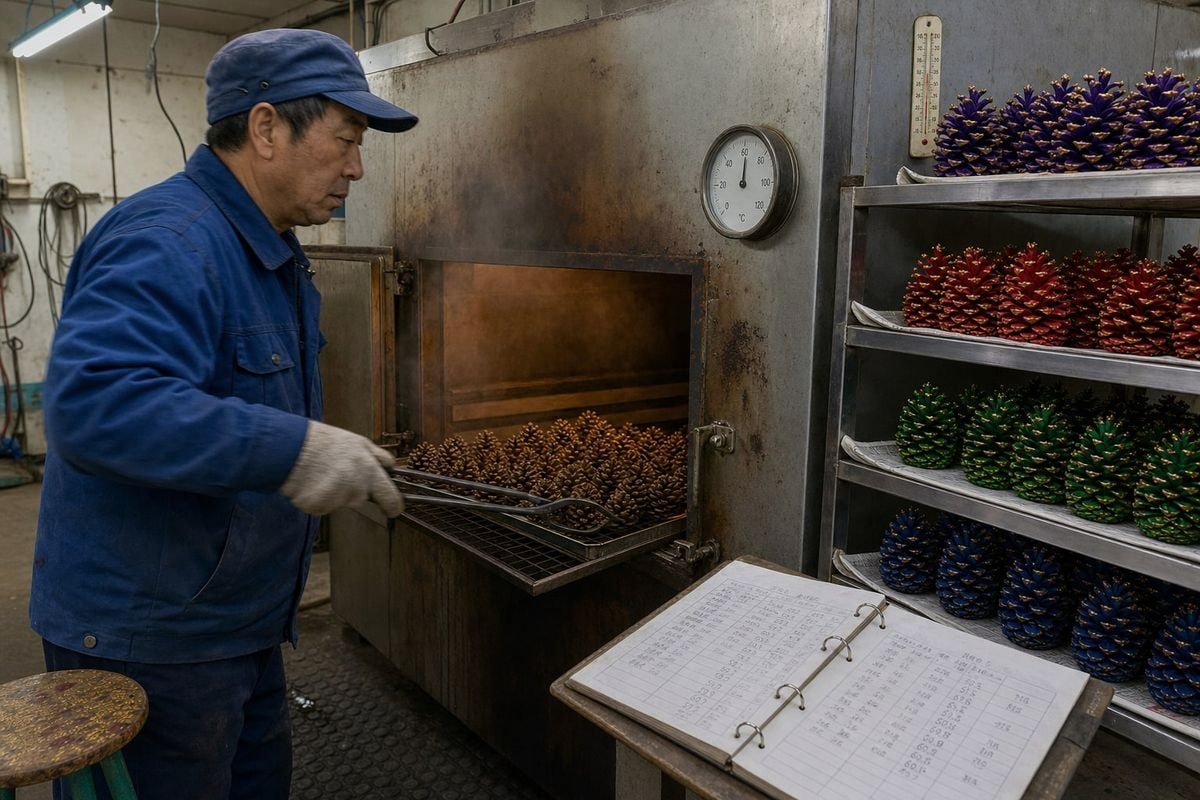
Generic inspection checklists cover carton counts and cosmetics. Colored pine cones need more, because the product has a performance function: producing colored flames safely. Your defect classification criteria should reflect both the visual and the functional side.
Defect classification for colored pine cones
| Severity | Examples | Acceptance |
|---|---|---|
| Critical | Chemical salt leakage, contamination, fire hazard, missing mandatory safety warnings | Zero tolerance — one failure rejects the lot |
| Major | No color-flame effect, missing or flaking coating, severe breakage, strong odor, moisture damage, wrong bag count, incorrect labeling | AQL 2.5 typical |
| Minor | Small chipped scales, slight dust, minor color variation, scuffed pouch, print misalignment | AQL 4.0 typical |
The four product-specific tests worth paying for
- Destructive burn test. Have the inspector burn 3–5 units per batch. The flame color spectrum 5 — blue, green, purple — and its duration must match your product specification. This is the only way to confirm the product actually works.
- Friction shake test. Shake sample cones in a bag to quantify salt shedding. Coating that sheds in the inspector's hands will shed in a customer's hands too.
- Moisture content analysis. A calibrated wood moisture meter 6 should read below 12%. Wet cones smoke heavily and burn poorly.
- Hygroscopic stability check. Expose samples to high humidity. If the metal salts deliquesce and turn sticky, they will do the same in a sea container. At our facility, we control this at the coating stage, but your inspector should verify it independently.
Packaging and labeling audit
The packaging and labeling audit 7 deserves equal weight. Verify barcodes scan, bag seals hold, and mandatory disclaimers appear — specifically "Not for Cooking" and "Indoor Fireplace Only" warnings where your market requires them. We print these warnings directly on our kraft pouches and jars because retailers in the US and EU treat them as non-negotiable.
How can I coordinate inspection timing with my supplier to avoid shipment delays?
One trade-off we discuss with every buyer is timing: inspect too early and there are not enough packed goods to sample; inspect too late and there is no time to fix anything before the vessel cut-off.
Book the inspection when production is at least 80% complete and packing has started. Get written readiness confirmation from the factory, share the test plan and defect criteria in advance, and build a 3–5 day buffer between inspection and container loading for corrections or re-inspection.

The 80% rule is the standard for a practical reason. At that point, the inspector has enough finished, packed cartons for valid random statistical sampling 8 — carton markings, assortment ratios, and shipping weights can all be verified. Yet 20% of production remains open, which gives the factory room to correct issues in the unfinished portion and rework the rest without missing the sailing date. Waiting for 100% completion sounds safer, but it removes that correction window entirely.
A practical coordination timeline
- Order placement. Agree in the purchase order that shipment requires a passed pre-shipment inspection. Fix the AQL levels and defect definitions in writing now, not later.
- Two weeks before target date. Send the inspector your approved sample, spec sheet, packaging artwork, and test plan, including the burn test and moisture check. Copy the supplier so nothing surprises them.
- One week before. Ask the factory for written confirmation that goods will be 80%+ finished and packed on the inspection date. In our own scheduling with clients, this single email prevents most wasted inspector visits — and wasted visits are billed to you.
- Inspection day. The inspector samples, tests, and issues a same-day or next-day report with photos of any breakage, coating flaking, or print issues.
- Buffer window (3–5 days). If the lot fails, the factory sorts and reworks, and the inspector returns for re-inspection. Decide in advance who pays for re-inspection — typically the supplier, if the failure was theirs.
- Loading. Release the shipment only after a passed report.
Most inspections happen at the factory, though some agencies will inspect at a forwarder's warehouse or pier. Factory inspection is better: the people who can fix problems are on-site. During our peak season, from August to November for holiday orders, inspection slots and vessel space both tighten, so we advise buyers to lock the inspection date the moment production starts rather than waiting for a readiness call.
Conclusion
A weak inspection plan turns a cheerful seasonal product into returns and chargebacks. Verify certifications first, sample by AQL, test burn performance, and time the inspection at 80% completion.
Footnotes
1. Authoritative Wikipedia overview of the ISO 9001 quality management standard. ↩︎
2. Official European Commission page detailing REACH regulations for chemical safety and testing. ↩︎
3. Intertek is a major third-party testing and certification body cited for compliance reports. ↩︎
4. Explains the ISO 2859-1 AQL sampling framework referenced for lot inspection levels. ↩︎
5. Explains how metal salts produce characteristic flame colors, relevant to burn testing. ↩︎
6. Background on moisture meter technology used to verify wood moisture content standards. ↩︎
7. CPSC oversees consumer product labeling and safety warning requirements referenced here. ↩︎
8. NIST's statistics handbook explains statistical sampling principles used in AQL inspection. ↩︎



 English
  Spanish
  German
  French
  Arabic
  Portuguese
Join the Conversation