







Buyers asking about magic fire powder production and filling equipment often get vague answers. I have seen orders fail because nobody [verified the line behind the sales pitch](https://sunrichfire.com/how-verify-supplier-production-capacity-magic-fire-powder-orders/). Our factory learned this lesson early, and now we welcome hard questions.
Ask suppliers of magic fire powder production and filling equipment about safety certifications, mixing uniformity, filling accuracy tolerances, batch-to-batch quality control, real daily output, packaging format flexibility, private-label capability, and compliance documentation such as SDS and transport classification before you commit to any order.
These questions sound simple. But each one separates a real factory from a trading company reselling generic machines. Below, I break down the four question areas that matter most, based on what our buyers actually ask us.
What certifications should I request to confirm the production process meets international safety standards?
A German distributor once opened his first call with us by asking for our audit reports before he even asked for pricing. In our experience exporting to 30+ countries, that is exactly the right order of priorities.
Request ISO 9001 for quality management, BSCI for factory social compliance, CE marking where applicable, and third-party test reports from labs like SGS or Intertek. Also ask for the product SDS, transport classification details, and documentation proving the powder contains no restricted chemicals.

Certification questions do two jobs at once. First, they confirm the finished product can legally enter your market. Second, they reveal whether the supplier runs a managed factory or an improvised workshop. A supplier who cannot produce an ISO 9001 1 certificate within a day probably does not have one.
Les documents essentiels à demander
At our Ningbo production site, we keep a standing document pack ready for buyers, because US and EU importers almost always need the same items. Here is the checklist I recommend you send in your first RFQ email:
| Document | Ce qu'elle prouve | Who typically requires it |
|---|---|---|
| Certificat ISO 9001 | Un système de gestion de la qualité fonctionnel | All serious B2B buyers |
| rapport d'audit BSCI | Conditions de travail éthiques et conditions d'usine | EU retailers, large chains |
| SGS / Intertek 2 rapports de test | Independent verification of product safety | US and EU importers |
| FDS (Fiche de Données de Sécurité) | Composition chimique et conseils de manipulation | Customs, freight forwarders, retailers |
| Classification du transport | Whether the product ships as dangerous goods | Freight forwarders, insurers |
| documentation CE | Conformité pour le marché européen le cas échéant | Distributeurs UE |
Questions that go beyond the paperwork
Do not stop at collecting PDFs. Ask when each certificate was last renewed. Ask which lab issued the test reports and whether you can verify the report number directly with the lab. Ask whether the SDS matches the exact formulation you will receive, not a generic version. In Liuyang, where our headquarters sits inside China's fireworks cluster, we see plenty of suppliers borrow documents from related companies. A five-minute verification call to the testing lab closes that loophole completely.
Also ask about the production environment itself. Powder handling lines should have dust control, grounding, and clear separation between mixing and packing zones. If a supplier hesitates to show these areas on a video call, treat that as your answer.
How can I verify the filling equipment ensures consistent color-flame performance across every batch?
Early in our 17 years of making color-flame products, we discovered that flame color problems almost never start at the filling head. They start upstream, in the mixing stage, and the filling machine simply locks the error into every sachet.
Verify consistency by asking about mixing technology and blend time, fill-weight tolerance per sachet, how the line prevents powder segregation between mixer and filler, and whether the supplier burns test samples from the start, middle, and end of each production run.
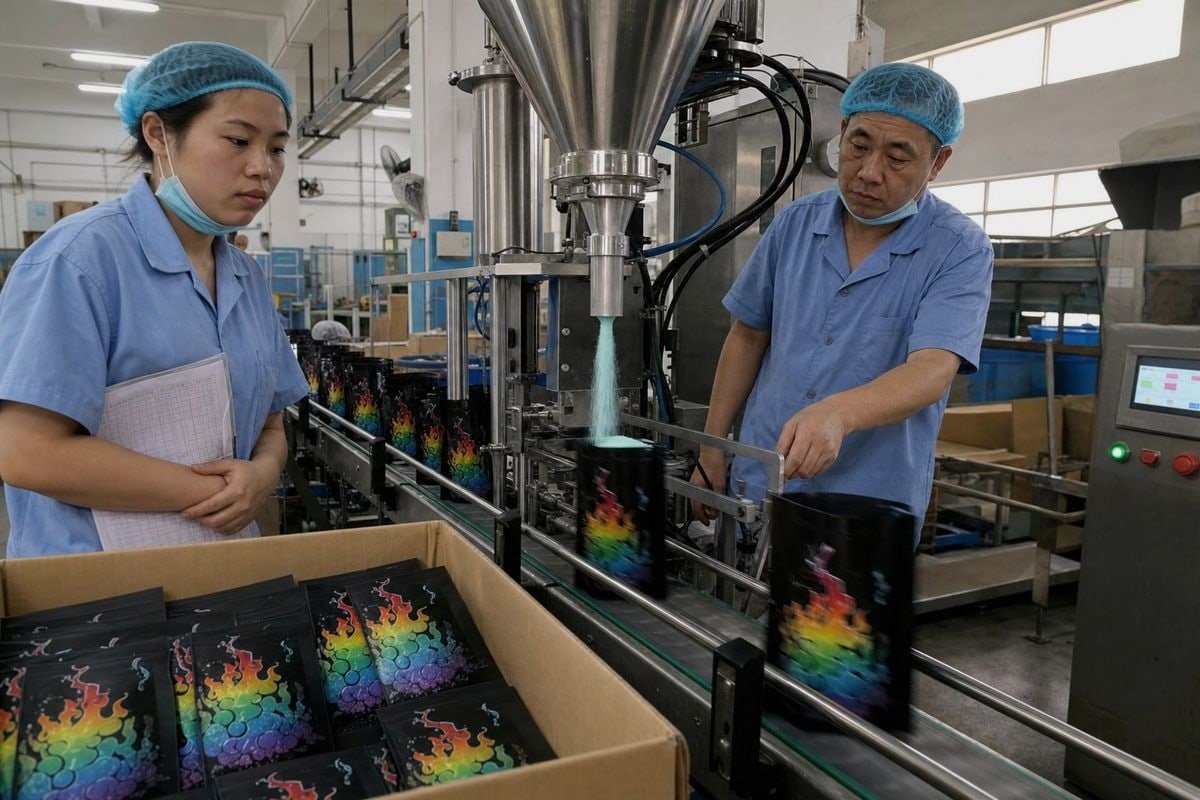
Color-flame performance depends on chemistry staying uniform from the first packet to the last. If the metal-salt colorants 5 settle or separate during production, a 25 g sachet from hour one will burn differently than one from hour eight. Your customers will notice, and your reviews will show it.
Follow the powder through the line
I suggest structuring your questions around the powder's journey, step by step:
- Mixing. What mixer type is used, and what is the validated blend time? Uniform dispersion of colorants is the foundation of consistent flame color.
- Transfer. How does powder move from mixer to filler? Long drops and vibration cause heavier particles to segregate from lighter ones.
- Dosing. What filling method is used for small sachets versus larger jars? Auger fillers and volumetric cups behave differently with granular products.
- Weight control. What is the fill-weight tolerance, and are checkweighers in-line or manual?
- Sealing. How are seals tested? A weak crimp seal lets moisture in, and moisture kills both flowability and flame performance.
Ask for burn evidence, not promises
On our lines, we pull sachets at intervals across a run and burn them side by side. Ask your supplier if they do the same, and request burn videos from an actual production batch rather than a marketing sample. Also ask about changeover cleaning between different colorant formulations. Residue from a previous blend can shift the flame color of the next run, so cleaning validation matters as much as filling accuracy.
What quality control steps should I ask about to avoid inconsistencies between samples and mass production?
One trade-off we refuse to make at our factory is speed over sample fidelity. A buyer's approved sample is a contract, and the mass-production run must match it — that principle has kept our repeat-order rate high across the US and Europe.
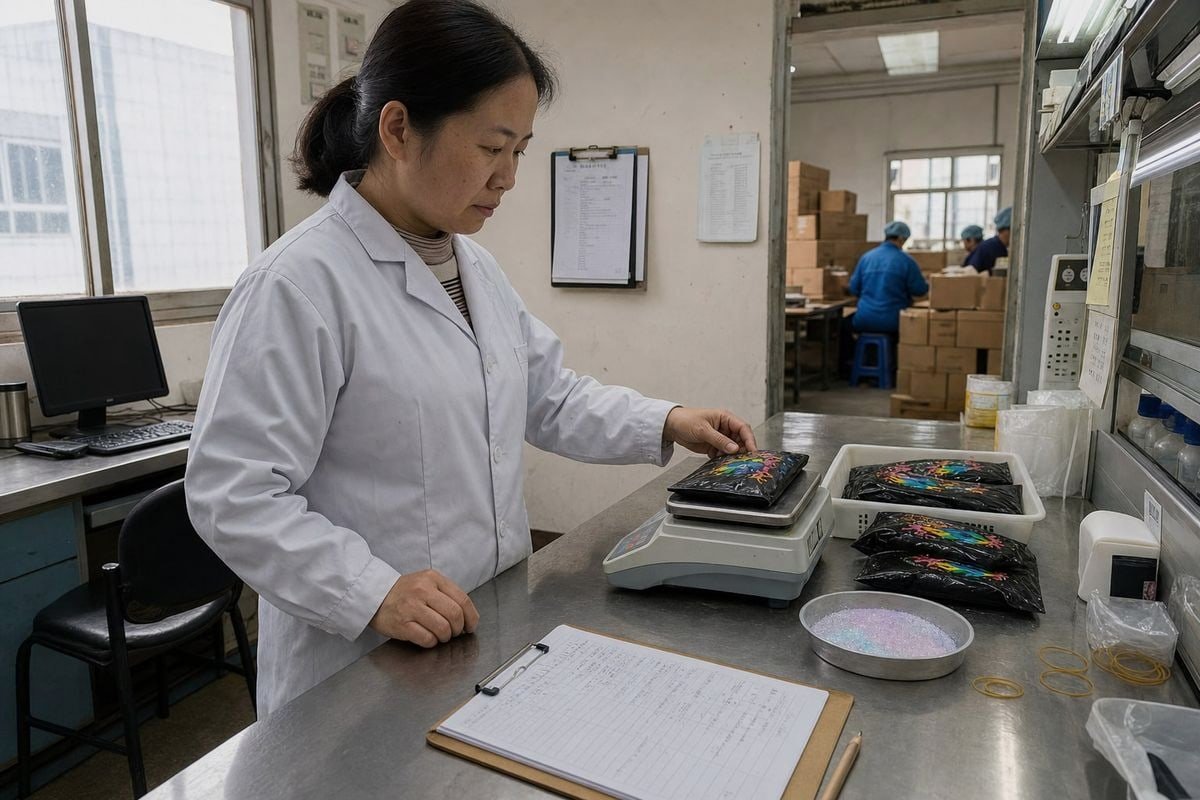
Ask how the supplier documents the approved sample specification, whether raw materials are tested per batch, what in-process checks cover weight, moisture, and seal integrity, and whether each shipped batch is traceable back to its mixing record and burn test.
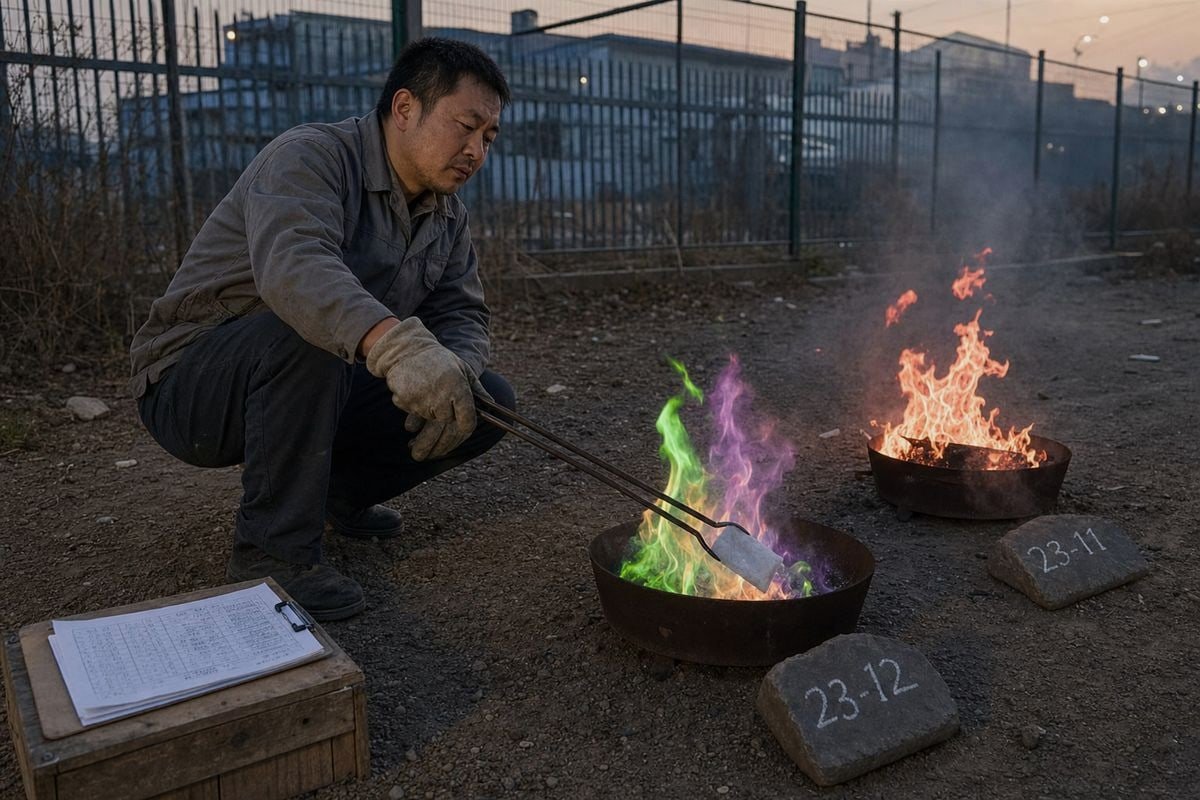
The sample-versus-production gap is the single most common complaint I hear from purchasing managers switching suppliers. A polished sample gets approved. Then the container arrives with lighter fills, clumped powder, or flames that fade too fast. The cause is almost always missing QC discipline, not bad intent.
The QC checkpoints that actually matter
Here is a practical map of what to ask about at each stage. If a supplier can answer all five rows with specifics, you are dealing with a real production operation.
| Étape | QC step to ask about | Risk if skipped |
|---|---|---|
| Incoming materials | Batch testing of colorants and base granules | Color shift between production runs |
| Mixing | Blend uniformity checks and recorded mix times | Uneven flame color within one batch |
| Filling | In-line weight checks and fill tolerance logs | Underfilled or overfilled sachets |
| Scellage | Seal strength and leak testing | Moisture ingress, clumping, shelf failures |
| Pré-expédition | Burn tests from random cartons, retained samples | Product that fails in the end customer's hands |
Traceability closes the loop
Ask whether every batch carries a code linking it to its mixing record, filling log, and burn test result. On our lines, we retain sealed samples from each batch, so if a buyer raises a question months later, we can pull the exact reference and compare. Ask your supplier how long they keep retained samples and records. A supplier without retention samples cannot investigate a complaint — they can only apologize.
Finally, ask who signs off before shipment. A named QC role with authority to hold a batch is worth more than any inspection certificate.
Which questions help me assess a supplier's capacity for private-label packaging and custom formulations?
A UK camping brand recently sent us their full brand guideline before asking a single question about powder. That told me they understood something important: for retail, packaging capability is half the product.
Ask which pack formats and weights the supplier supports, whether artwork, warning labels, and barcodes are handled in-house, the MOQ per custom SKU, changeover time between formats, and whether formulation variables like burn time and color mix can be adjusted for your market.
Private-label depth varies enormously between suppliers. Some can only print your logo on a standard pouch. A true OEM/ODM partner 6 can adjust the product, the pack, and the retail presentation together. The questions below help you find out which one you are talking to.
Map their format range against your plan
Suppliers in this niche commonly offer sachets from around 10 g up to 100 g, plus larger jar or can formats in the 250–500 g range. Ask specifically which of these run on existing tooling, because new tooling means cost and lead time. Our own Magic Fire line runs plastic bags, kraft bags, and plastic jars, and we learned that honest answers about format limits build more trust than promising everything.
| Question area | What a strong answer sounds like |
|---|---|
| Pack sizes | Specific weights on existing tooling, with tolerances stated |
| Matériaux | Foil, kraft, and jar options with moisture-barrier explanations |
| Image de marque | In-house design support, artwork proofing, printed samples before mass run |
| Prêt pour la vente au détail | Display boxes, warning labels, barcodes, multi-language text |
| Formulation | Adjustable burn time, color emphasis, and eco-friendly ingredient confirmation |
| MOQ and changeover | Clear MOQ per SKU and realistic changeover times between formats |
Test their process, not just their catalog
Ask to see a recent private-label project similar to yours, with the client name redacted. Ask how many artwork revision rounds are included. Ask whether semi-automatic packing is available for smaller trial runs, since fully automatic lines often carry higher MOQs. And ask how they handle destination-market label requirements — a supplier who already ships to your country should name the warning text and barcode standards 7 without checking.
Conclusion
Impressive claims are cheap; verified capability is not. If a vague supplier leaves you exposed on compliance, consistency, or packaging, use these question clusters to filter partners before money moves. Our factory answers all of them gladly — yours should too.
Notes de bas de page
1. ISO 9001 is the internationally recognized quality management standard referenced for supplier vetting. ↩︎
2. Intertek is a named third-party testing lab whose verification systems the article describes. ↩︎
3. Official EU source explaining what CE marking actually certifies for products entering the market. ↩︎
4. amfori BSCI is the official body behind the social compliance audit mentioned in the article. ↩︎
5. Background reference explaining how metal-salt colorants produce flame color in pyrotechnic products. ↩︎
6. Explains the OEM/ODM manufacturing model referenced when assessing private-label supplier capability. ↩︎
7. GS1 sets the official global barcode standards suppliers must follow for retail packaging. ↩︎


 English
  Spanish
  German
  French
  Arabic
  Portuguese
Rejoignez la conversation