







Los compradores que preguntan sobre la producción y el equipo de llenado de polvo de fuego mágico a menudo obtienen respuestas vagas. He visto pedidos fallar porque nadie [verificó la línea detrás del discurso de ventas](https://sunrichfire.com/how-verify-supplier-production-capacity-magic-fire-powder-orders/). Nuestra fábrica aprendió esta lección temprano, y ahora damos la bienvenida a las preguntas difíciles.
Pregunte a los proveedores de equipos de producción y llenado de polvo de fuego mágico sobre las certificaciones de seguridad, la uniformidad de la mezcla, las tolerancias de precisión del llenado, el control de calidad lote a lote, la producción diaria real, la flexibilidad del formato de embalaje, la capacidad de marca privada y la documentación de cumplimiento, como las FDS y la clasificación de transporte, antes de comprometerse con cualquier pedido.
Estas preguntas suenan simples. Pero cada una separa una fábrica real de una empresa comercial que revende máquinas genéricas. A continuación, desgloso las cuatro áreas de preguntas que más importan, basándome en lo que nuestros compradores realmente nos preguntan.
¿Qué certificaciones debería solicitar para confirmar que el proceso de producción cumple con las normas internacionales de seguridad?
Un distribuidor alemán una vez comenzó su primera llamada con nosotros pidiendo nuestros informes de auditoría antes de que siquiera pidiera precios. En nuestra experiencia exportando a más de 30 países, ese es exactamente el orden correcto de prioridades.
Solicitar ISO 9001 para gestión de calidad, BSCI para cumplimiento social de fábrica, marcado CE cuando sea aplicable, e informes de pruebas de terceros de laboratorios como SGS o Intertek. También solicitar la SDS del producto, detalles de clasificación de transporte y documentación que demuestre que el polvo no contiene productos químicos restringidos.

Las preguntas de certificación cumplen dos funciones a la vez. Primero, confirman que el producto terminado puede ingresar legalmente a su mercado. Segundo, revelan si el proveedor opera una fábrica administrada o un taller improvisado. Un proveedor que no puede producir un ISO 9001 1 certificado en un día probablemente no tiene uno.
Los documentos principales a solicitar
En nuestro sitio de producción de Ningbo, mantenemos un paquete de documentos permanente listo para los compradores, porque los importadores de EE. UU. y la UE casi siempre necesitan los mismos artículos. Aquí está la lista de verificación que recomiendo enviar en su primer correo electrónico de RFQ:
| Documento | Lo que prueba | ¿Quién lo requiere típicamente? |
|---|---|---|
| Certificado ISO 9001 | Un sistema de gestión de calidad funcional | Todos los compradores B2B serios |
| Informe de auditoría BSCI | Condiciones éticas laborales y de fábrica | Minoristas de la UE, grandes cadenas |
| SGS / Intertek 2 informes de pruebas | Verificación independiente de la seguridad del producto | Importadores de EE. UU. y la UE |
| SDS (Hoja de datos de seguridad) | Composición química y guía de manipulación | Aduanas, transitarios, minoristas |
| Clasificación de transporte | Si el producto se envía como mercancía peligrosa | Transitarios, aseguradoras |
| Documentación CE | Conformidad para el mercado de la UE cuando corresponda | Distribuidores de la UE |
Preguntas que van más allá del papeleo
No se detenga en la recopilación de PDF. Pregunte cuándo se renovó por última vez cada certificado. Pregunte qué laboratorio emitió los informes de prueba y si puede verificar el número de informe directamente con el laboratorio. Pregunte si la SDS coincide con la formulación exacta que recibirá, no una versión genérica. En Liuyang, donde se encuentra nuestra sede dentro del clúster de fuegos artificiales de China, vemos muchos proveedores que toman prestados documentos de empresas relacionadas. Una llamada de verificación de cinco minutos al laboratorio de pruebas cierra esa laguna por completo.
También pregunte sobre el entorno de producción en sí. Las líneas de manipulación de polvo deben tener control de polvo, conexión a tierra y una clara separación entre las zonas de mezcla y envasado. Si un proveedor duda en mostrar estas áreas en una videollamada, considérelo como su respuesta.
¿Cómo puedo verificar que el equipo de llenado garantiza un rendimiento de llama de color constante en cada lote?
Al principio de nuestros 17 años de fabricación de productos de llama de color, descubrimos que los problemas de color de llama casi nunca comienzan en el cabezal de llenado. Comienzan aguas arriba, en la etapa de mezcla, y la máquina de llenado simplemente bloquea el error en cada sobre.
Verifique la consistencia preguntando sobre la tecnología de mezcla y el tiempo de mezcla, la tolerancia de peso de llenado por bolsa, cómo la línea evita la segregación del polvo entre el mezclador y el llenador, y si el proveedor realiza pruebas de quemado de muestras del principio, medio y final de cada corrida de producción.
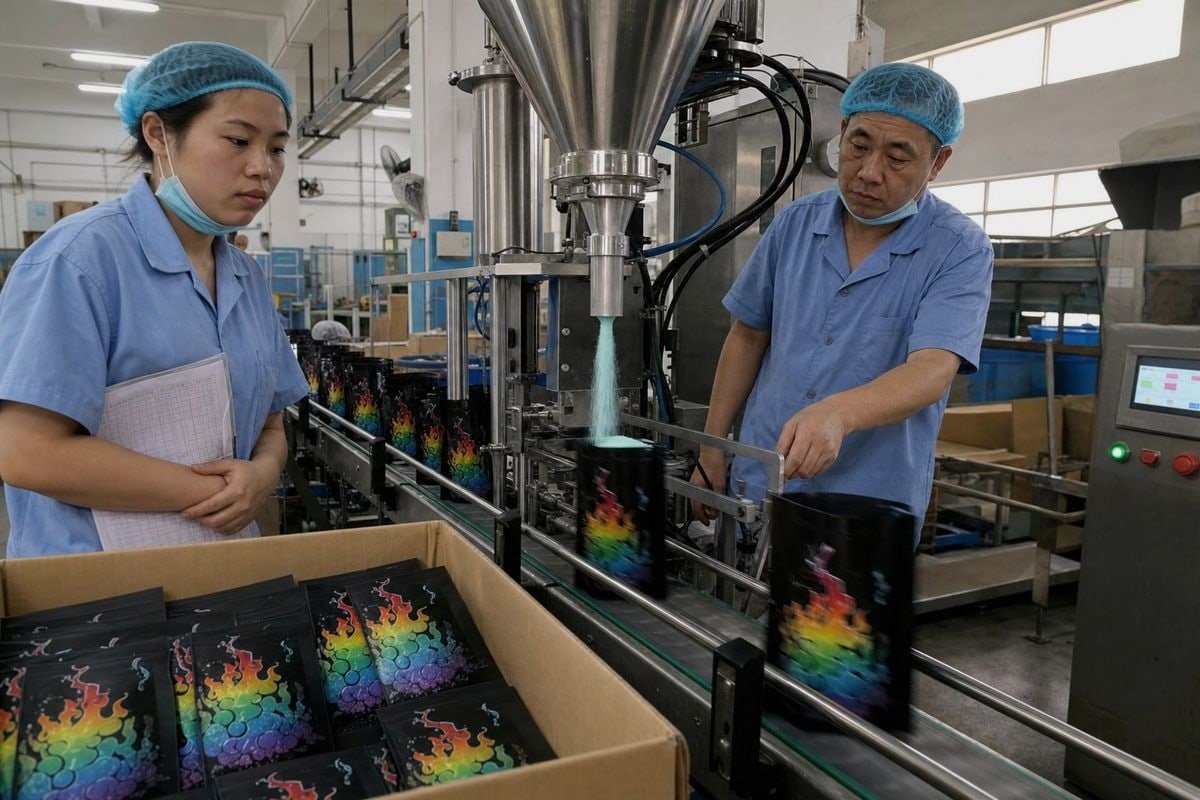
El rendimiento de la llama de color depende de que la química se mantenga uniforme desde el primer paquete hasta el último. Si el colorantes de sales metálicas 5 se asienta o se separa durante la producción, un sobre de 25 g de la primera hora quemará de manera diferente que uno de la octava hora. Sus clientes lo notarán, y sus reseñas lo reflejarán.
Sigue el polvo a través de la línea
Sugiero estructurar sus preguntas en torno al viaje del polvo, paso a paso:
- Mezcla. ¿Qué tipo de mezclador se utiliza y cuál es el tiempo de mezcla validado? La dispersión uniforme de los colorantes es la base de un color de llama consistente.
- Transferencia. ¿Cómo se mueve el polvo del mezclador al llenador? Las caídas largas y la vibración hacen que las partículas más pesadas se segreguen de las más ligeras.
- Dosificación. ¿Qué método de llenado se utiliza para sobres pequeños frente a frascos más grandes? Los llenadores de tornillo sin fin y las copas volumétricas se comportan de manera diferente con los productos granulares.
- Control de peso. ¿Cuál es la tolerancia de peso de llenado y los verificadores de peso están en línea o son manuales?
- Sellado. ¿Cómo se prueban los sellos? Un sello de crimpado débil deja entrar la humedad, y la humedad mata tanto la fluidez como el rendimiento de la llama.
Pide evidencia de quema, no promesas
En nuestras líneas, sacamos sobres a intervalos durante una corrida y los quemamos uno al lado del otro. Pregunte a su proveedor si hace lo mismo y solicite videos de quema de un lote de producción real en lugar de una muestra de marketing. También pregunte sobre la limpieza de cambio entre diferentes formulaciones de colorantes. Los residuos de una mezcla anterior pueden cambiar el color de la llama del siguiente lote, por lo que la validación de la limpieza es tan importante como la precisión del llenado.
¿Qué pasos de control de calidad debería preguntar para evitar inconsistencias entre las muestras y la producción en masa?
Una contrapartida que nos negamos a hacer en nuestra fábrica es sacrificar la velocidad por la fidelidad de la muestra. Una muestra aprobada por el comprador es un contrato, y el lote de producción en masa debe coincidir con él; este principio ha mantenido nuestra tasa de pedidos repetidos alta en EE. UU. y Europa.
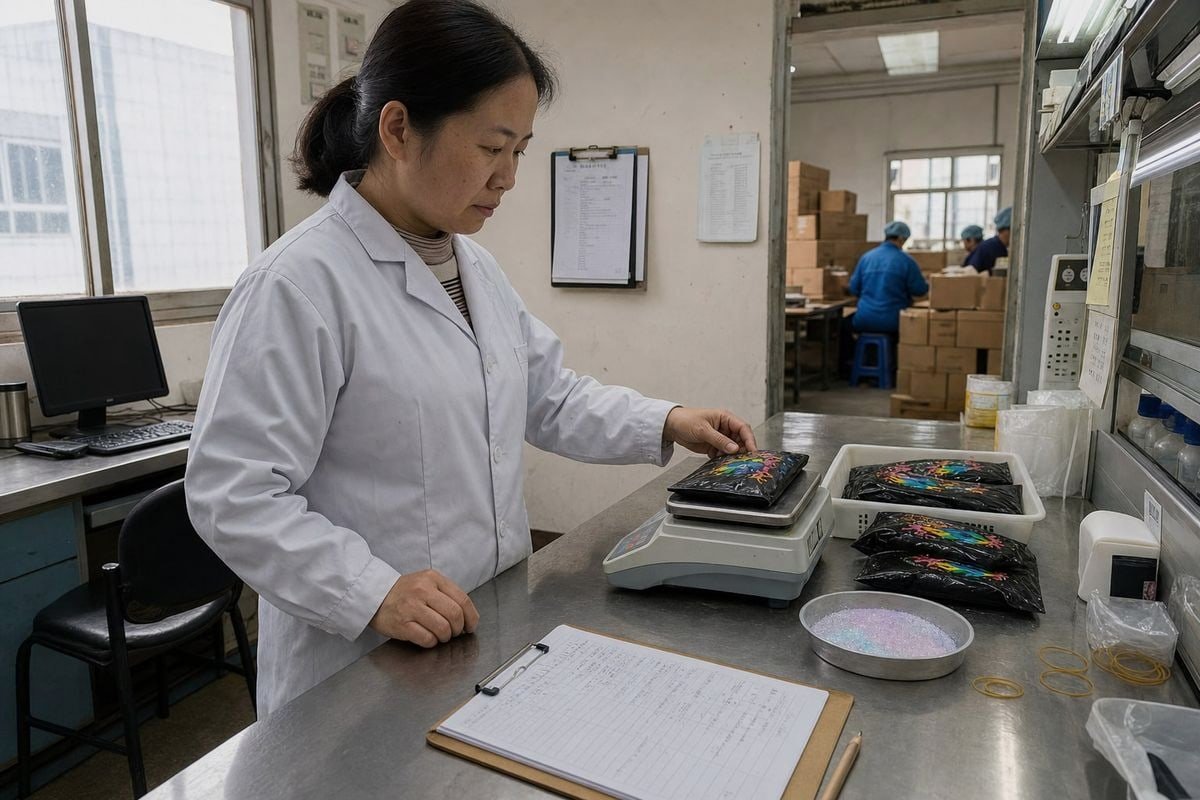
Pregunte cómo documenta el proveedor la especificación de la muestra aprobada, si las materias primas se analizan por lote, qué controles en proceso cubren el peso, la humedad y la integridad del sellado, y si cada lote enviado es rastreable hasta su registro de mezcla y prueba de quemado.
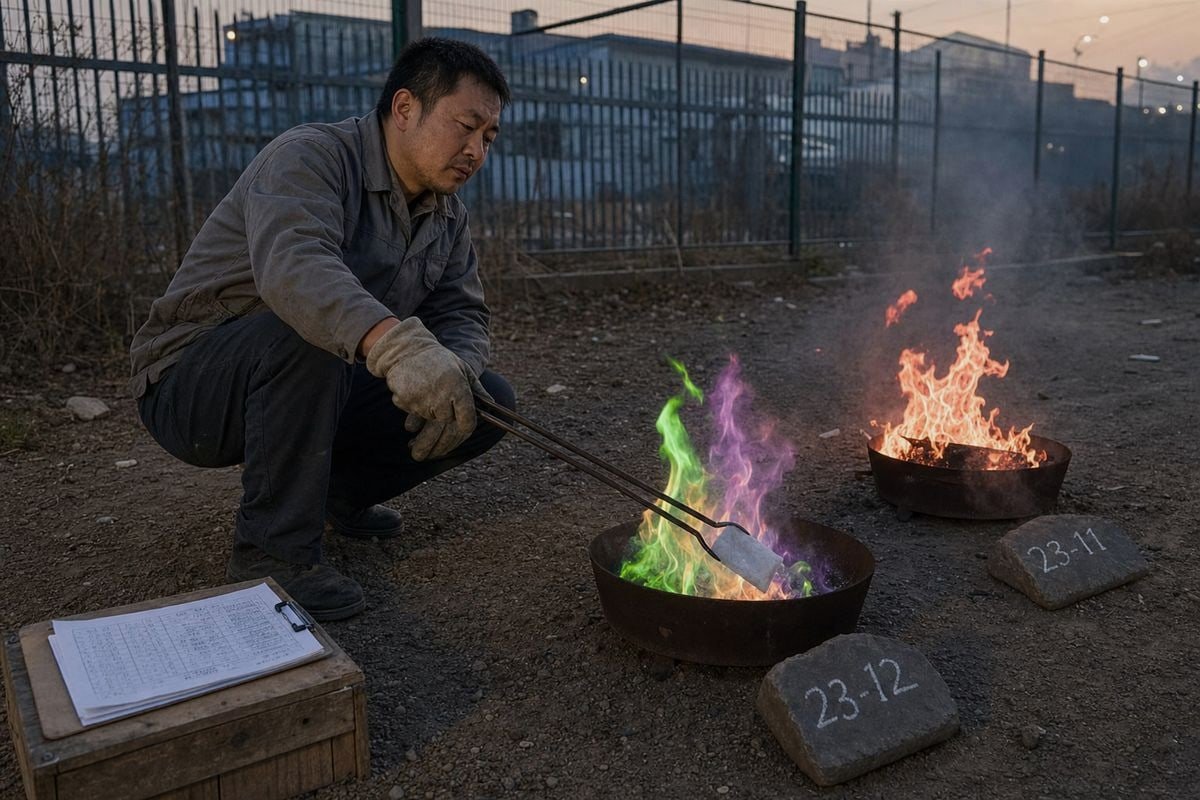
La brecha entre la muestra y la producción es la queja más común que escucho de los gerentes de compras que cambian de proveedor. Se aprueba una muestra pulida. Luego llega el contenedor con llenados más ligeros, polvo apelmazado o llamas que se desvanecen demasiado rápido. La causa es casi siempre la falta de disciplina de control de calidad, no la mala intención.
Los puntos de control de calidad que realmente importan
Aquí hay un mapa práctico de lo que se debe preguntar en cada etapa. Si un proveedor puede responder a las cinco filas con detalles específicos, está tratando con una operación de producción real.
| Etapa | Paso de control de calidad sobre el que preguntar | Riesgo si se omite |
|---|---|---|
| Prueba de contenido de humedad de la fibra de madera, pureza de la cera | Pruebas por lotes de colorantes y gránulos base | Cambio de color entre lotes de producción |
| Mezcla | Controles de uniformidad de la mezcla y tiempos de mezcla registrados | Color de llama desigual dentro de un lote |
| Llenado | Controles de peso en línea y registros de tolerancia de llenado | Sobrellenado o subllenado de sobres |
| Sellado | Resistencia del sellado y pruebas de fugas | Entrada de humedad, apelmazamiento, fallos en el estante |
| Pre-envío | Pruebas de combustión de cartones aleatorios, muestras retenidas | Producto que falla en manos del cliente final |
La trazabilidad cierra el ciclo
Pregunte si cada lote lleva un código que lo vincule a su registro de mezcla, registro de llenado y resultado de la prueba de combustión. En nuestras líneas, conservamos muestras selladas de cada lote, por lo que si un comprador plantea una pregunta meses después, podemos extraer la referencia exacta y comparar. Pregunte a su proveedor cuánto tiempo conserva las muestras y los registros retenidos. Un proveedor sin muestras de retención no puede investigar una reclamación; solo puede disculparse.
Finalmente, pregunte quién aprueba antes del envío. Un rol de control de calidad con nombre y autoridad para retener un lote vale más que cualquier certificado de inspección.
¿Qué preguntas me ayudan a evaluar la capacidad de un proveedor para el envasado de marca propia y formulaciones personalizadas?
Una marca británica de camping nos envió recientemente sus directrices de marca completas antes de hacer una sola pregunta sobre el polvo. Eso me dijo que entendían algo importante: para la venta al por menor, la capacidad de envasado es la mitad del producto.
Pregunte qué formatos y pesos de embalaje admite el proveedor, si las ilustraciones, las etiquetas de advertencia y los códigos de barras se gestionan internamente, la MOQ por SKU personalizado, el tiempo de cambio entre formatos y si las variables de formulación como el tiempo de combustión y la mezcla de colores se pueden ajustar para su mercado.
La profundidad de la marca blanca varía enormemente entre los proveedores. Algunos solo pueden imprimir su logotipo en una bolsa estándar. Un verdadero Socio OEM/ODM 6 puede ajustar el producto, el envase y la presentación al por menor juntos. Las preguntas siguientes le ayudan a averiguar con quién está hablando.
Mapee su gama de formatos contra su plan
Los proveedores en este nicho suelen ofrecer sobres de aproximadamente 10 g a 100 g, además de formatos de tarro o lata más grandes en el rango de 250-500 g. Pregunte específicamente cuáles de estos se ejecutan con la maquinaria existente, porque la maquinaria nueva implica costes y plazos de entrega. Nuestra propia línea Magic Fire utiliza bolsas de plástico, bolsas de papel kraft y tarros de plástico, y aprendimos que las respuestas honestas sobre los límites de formato generan más confianza que prometerlo todo.
| Área de preguntas | Cómo suena una respuesta sólida |
|---|---|
| Tamaños de envase | Pesos específicos en maquinaria existente, con tolerancias indicadas |
| Materiales | Opciones de foil, kraft y tarro con explicaciones sobre la barrera contra la humedad |
| Marca | Soporte de diseño interno, revisión de arte, muestras impresas antes de la producción en masa |
| Preparación para la venta minorista | Cajas expositoras, etiquetas de advertencia, códigos de barras, texto multilingüe |
| Formulación | Tiempo de combustión ajustable, énfasis en el color y confirmación de ingredientes ecológicos |
| MOQ y cambio de formato | MOQ claro por SKU y tiempos de cambio realistas entre formatos |
Pruebe su proceso, no solo su catálogo
Pida ver un proyecto reciente de marca blanca similar al suyo, con el nombre del cliente redactado. Pregunte cuántas rondas de revisión de arte se incluyen. Pregunte si el envasado semiautomático está disponible para tiradas de prueba más pequeñas, ya que las líneas totalmente automáticas a menudo conllevan MOQs más altos. Y pregunte cómo manejan los requisitos de etiquetado del mercado de destino: un proveedor que ya envía a su país debería indicar el texto de advertencia y los estándares de códigos de barras 7 sin comprobar.
Conclusión
Las afirmaciones impresionantes son baratas; la capacidad verificada no lo es. Si un proveedor vago le deja expuesto en cuanto a cumplimiento, consistencia o envasado, utilice estos grupos de preguntas para filtrar socios antes de que el dinero se mueva. Nuestra fábrica responde a todas ellas con gusto; la suya también debería hacerlo.
Notas al pie
ISO 9001 es la norma reconocida internacionalmente de gestión de la calidad a la que se hace referencia para la selección de proveedores. ↩︎
Intertek es un laboratorio de pruebas de terceros con nombre cuyos sistemas de verificación se describen en el artículo. ↩︎
Fuente oficial de la UE que explica qué certifica la marca CE para los productos que entran en el mercado. ↩︎
amfori BSCI es el organismo oficial detrás de la auditoría de cumplimiento social mencionada en el artículo. ↩︎
Referencia de antecedentes que explica cómo los colorantes de sales metálicas producen color de llama en productos pirotécnicos. ↩︎
Explica el modelo de fabricación OEM/ODM al que se hace referencia al evaluar la capacidad del proveedor de marca blanca. ↩︎
GS1 establece los estándares oficiales mundiales de códigos de barras que los proveedores deben seguir para el envasado minorista. ↩︎

 English
  Spanish
  German
  French
  Arabic
  Portuguese
Únete a la conversación