







Every autumn, our factory sees the same crisis: buyers who ordered fireplace colored pine cones too late, watching a single delayed container erase their entire peak season. One missed shelf date costs a whole year.
Plan a phased shipping schedule for fireplace colored pine cones by back-scheduling from your target shelf date: place the first order 14–18 weeks before peak, split inventory into three waves (roughly 60/30/10), and build a 2–3 week buffer for customs and factory backlogs.
That is the short answer. The details matter more. Below, I walk through the timing, the order-splitting math, the production coordination, and the contingency planning we use with our own distributor clients.
How far in advance should I place my first order to hit peak season shelf dates?
Last July, a German fireplace distributor called us in a panic. Their previous supplier had missed a production slot, and their October shelf date was suddenly at risk. We rescued that order — barely.
Place your first order 14–18 weeks before your target shelf date. This covers 3–5 weeks of production, 4–6 weeks of ocean freight, 1–2 weeks for customs clearance, and 2–3 weeks for receiving, labeling, and distribution to stores or fulfillment centers.

Most buyers underestimate total lead time because they only count carrier transit. In our experience exporting color-flame pinecones to the US and Europe for 17+ years, transit is often the shortest piece of the chain. Total lead time includes production queue, curing and drying of treated cones, quality inspection, packing, outbound pickup, ocean or ground freight, port clearance, receiving, and put-away. Skip any step in your calculation and your shelf date slips.
Work backward, not forward
Start with the first week you expect demand to accelerate — not the week demand peaks. For hearth and mantel decor, ecommerce searches usually rise before in-store demand, because shoppers react to holiday content early. Gift-driven demand also starts earlier than fireplace-use demand. Colder regions light fires sooner, so if you serve multiple climate zones, anchor your date to the earliest one.
A back-scheduling example for a November peak
| Jalon | Timing before shelf date | Ce qui se passe |
|---|---|---|
| Purchase order confirmed | 16–18 weeks | Factory books production slot, colorant materials secured |
| Production + curing complete | 11–13 weeks | Cones treated, dried, inspected, packed |
| Fret maritime 1 departs | 10–12 weeks | Booking made early to lock bulk shipping rates |
| Dédouanement 2 | 4–6 semaines | Documentation and test reports ready in advance |
| Warehouse receiving | 3–4 weeks | Labeling, barcoding, put-away |
| Product on shelf / live listing | Week 0 | Early-bird demand window opens |
La prévision de la demande saisonnière 3 should drive the shelf date itself. We advise clients to review last season's weekly sell-through by SKU, then set the target date one to two weeks before the first visible demand uptick. Late summer ordering is not conservative. It is simply on time.
What order-splitting strategy works best for balancing cash flow and inventory risk?
The trade-off I discuss most often with purchasing managers is simple: ship early and heavy to win the season, or ship lean to protect cash. Both extremes have burned buyers I know.
A 60/30/10 wave structure works best: 60% of forecast in Wave 1 for launch, 30% in Wave 2 as sell-through-triggered replenishment, and 10% held as reserve for promotions and late-season spikes. This balances stockout risk against carrying cost and markdown exposure.
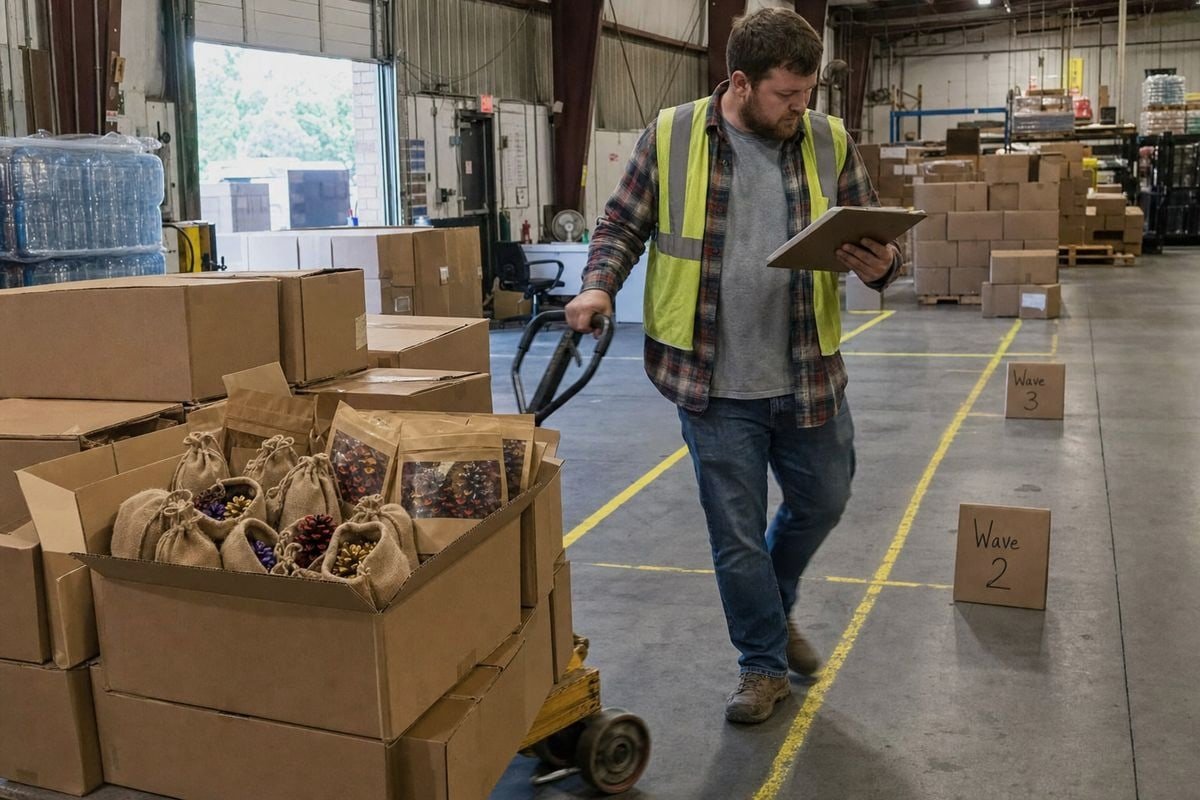
Let me address the two competing objections directly, because I hear both every season. Some buyers argue you should front-load everything: "If I stock out in November, I lose the season." That is true — but colored pine cones are bulky, seasonal, and timing-sensitive. If demand underperforms, you carry dead stock until next winter, tying up warehouse space and cash. Other buyers argue for ultra-lean waves to stay capital-efficient. Also reasonable — but a single delayed replenishment during peak means empty shelves at the exact moment conversion is highest. Neither extreme wins. Phasing does, because it preserves flexibility while protecting service levels.
Splitting by SKU, not just by volume
Demand fragments by pack size and color. Small giftable bags — the format many of our clients position as fire starter gift sets — sell early for gifting. Larger refill bags and value packs sell later, once fireplaces are in regular use. Front-load your proven core colors and best-selling pack sizes in Wave 1. Hold experimental colorways for Wave 2, after real sell-through data arrives.
| Wave | Share | Synchronisation | Contents | Déclencheur |
|---|---|---|---|---|
| Wave 1 | ~60% | Launch stock, arrives 3–4 weeks pre-peak | Core colors, best-selling pack sizes | Fixed calendar date |
| Wave 2 | ~30% | Mid-season replenishment | Winners from Wave 1 data, refill packs | Sell-through hits reorder point |
| Wave 3 | ~10% | Reserve / promotional stock | Promo bundles, BFCM support | Planned promotion or channel spike |
Adjust the ratio by channel
Wholesale accounts need heavier Wave 1 allocations because retail purchase orders are large and inflexible. DTC and marketplace channels can run leaner Wave 1 stock, since their replenishment feedback loop is faster. Good holiday une meilleure gestion des stocks 4 means the ratio flexes; the wave logic does not.
How do I coordinate production runs with multiple shipping batches without delaying my launch?
On our production lines in Ningbo, we run colored pine cone batches in staggered cycles precisely so that multi-wave clients never wait on a cold-start production queue mid-season. That coordination is planned in summer, not October.
Coordinate by booking all production slots upfront when you confirm Wave 1, staggering runs 3–4 weeks apart, and pre-approving quality standards so later batches skip re-sampling. Confirm Wave 2 quantities by a fixed decision date, not an open-ended one.

The single biggest cause of mid-season delay is treating each wave as a brand-new order. If your factory only learns about Wave 2 when you place it, you join the back of the peak-season production queue — behind every other seasonal buyer. The fix is contractual and operational at once.
Book capacity, commit quantities later
We encourage clients to reserve three production slots at the initial PO, with Wave 1 quantities fixed and Waves 2–3 quantities adjustable within an agreed range until a cutoff date. The factory holds materials — including the chemical colorants for flames, which we source and test in advance — and you keep flexibility on volume. Both sides win.
Lock quality once, apply it to every batch
Because we run strict batch-to-batch quality control under our Système ISO 9001 5, the first approved sample defines every later run: flame color intensity, cone moisture level, coating finish, and packaging spec. That means Wave 2 does not need a fresh sampling round, which alone saves one to two weeks. Ask any supplier for this commitment in writing.
Synchronize curing with shipping cadence
Treated cones need proper curing and drying before packing, and humidity swings during autumn can affect finished goods. Micro-batch curing cycles matched to your shipping cadence keep product flowing without piling up finished inventory in the warehouse. Align your pre-season fulfillment strategy with the factory's curing calendar, and confirm private-label packaging, barcodes, and warning labels for all waves at once — artwork changes mid-season are a classic hidden delay.
What contingency buffer should I build in for customs delays or factory backlogs during peak demand?
A lesson we learned the hard way years ago: a client's shipment sat at port for eleven extra days over a documentation query about combustible material shipping regulations. Since then, we pre-attach SGS test reports to every export file.
Build a 2–3 week calendar buffer between planned arrival and your shelf date, hold 10–15% safety stock above forecast, and keep a mid-October buffer window reserved for damage replacements. Ship the majority of goods before mid-November carrier holiday deadlines.

Buffers are not one number. They are layered, and each layer covers a different failure mode. Here is how we advise distributors to structure them.
The three buffer layers
| Buffer type | Recommended size | What it protects against |
|---|---|---|
| Calendar buffer | 2–3 weeks before shelf date | Customs holds, port congestion, freight delays |
| Quantity buffer | 10–15% above forecast | Transit damage, QC rejects, demand spikes |
| Replacement window | Reserved mid-October slot | Damaged-goods reshipments without disrupting Wave 2 |
Why customs deserves special attention
Colored pine cones are fire-adjacent products, so customs officers may request compliance documentation. Shipments backed by Marquage CE 6 and SGS or Intertek test reports clear faster because the paperwork answers questions before they are asked. We prepare full document packs — test reports, material declarations, correctly worded warning labels — for every container, because one missing certificate can cost more time than a storm at sea. Verify your supplier can do the same before you commit a peak-season order.
Respect carrier cutoffs and protect the product
Peak-season surcharges rise and carrier holiday deadlines tighten from mid-November onward, so schedule the bulk of outbound volume before that bottleneck. For domestic legs, slower ground freight to regional hubs during off-peak weeks keeps bulk shipping rates manageable for a bulky, lightweight product, while last-mile delivery logistics 7 stay fast where customers actually feel speed. Finally, insist on moisture-resistant packaging and internal supports; cones can close, deform, or turn brittle with temperature swings in transit, and a damaged Wave 1 without a replacement window is a season-ending problem.
Conclusion
Missing peak season with a seasonal SKU means waiting a full year for another chance. A phased shipping schedule for fireplace colored pine cones removes that gamble.
Back-schedule 14–18 weeks from your shelf date. Split inventory into 60/30/10 waves shaped by SKU and channel. Book all production slots upfront with pre-approved quality standards. Layer your buffers — calendar time, safety stock, and a replacement window — and ship before carrier cutoffs tighten. At our factory in China, we build these phased calendars with distributor clients every summer, backed by full compliance documentation and consistent batch quality. If your current supplier cannot commit to staggered production slots and pre-cleared paperwork, that is the first risk to fix before the next season begins.
Notes de bas de page
1. Provides a foundational definition of the primary transport method discussed for international shipping. ↩︎
2. Authoritative source explaining the regulatory process required for goods entering the United States. ↩︎
3. Explains the methodology behind predicting consumer needs to set accurate shipping timelines. ↩︎
4. Defines the broader business practice of control



 English
  Spanish
  German
  French
  Arabic
  Portuguese
Rejoignez la conversation