






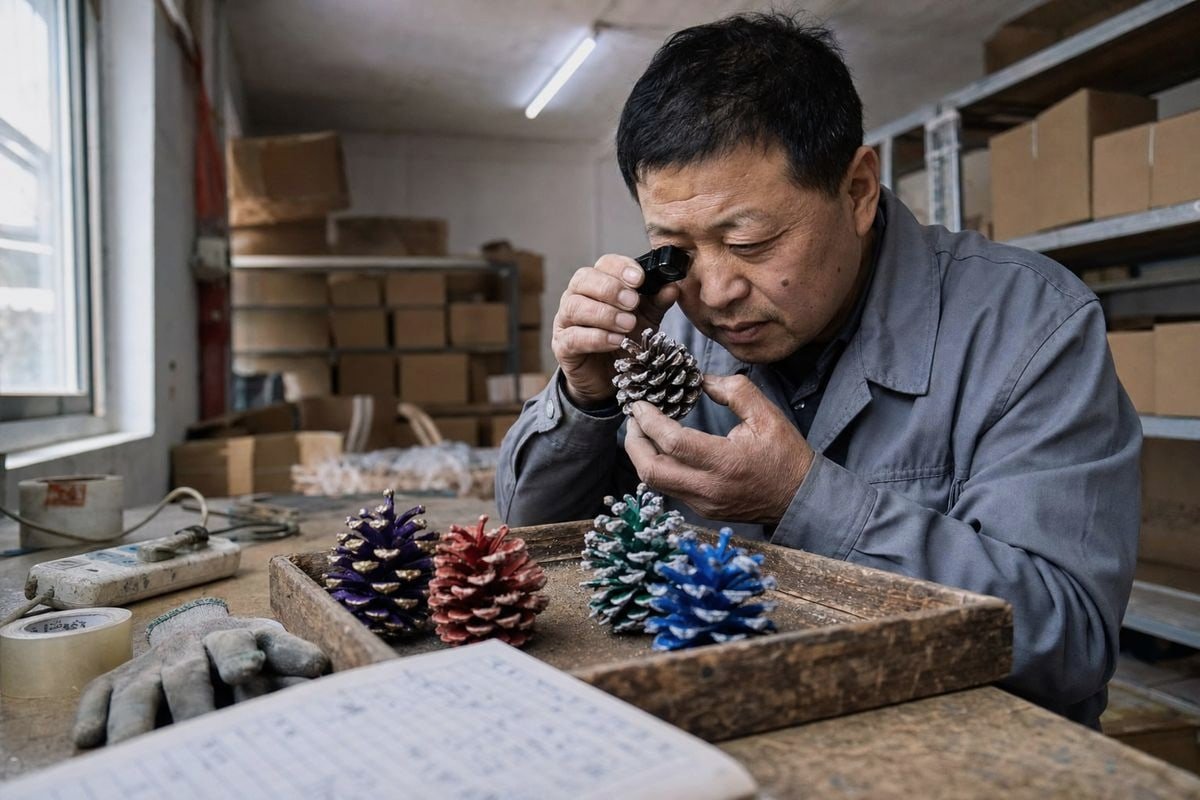
Jede Versandzeit erhält unser Qualitätsteam dieselbe besorgte E-Mail von Käufern: "Auf farbigen Kiefernzapfen befindet sich weißes Pulver – ist das Schimmel und sollte ich die Lieferung ablehnen?"
Weißes Pulver auf gefärbten Kiefernzapfen ist normalerweise harzfreies Kiefernharz, chemische Ausblühungen von Metallsalzen oder wachsartiger Belag – kein gefährlicher Schimmel. Echter Schimmel erscheint flauschig, feucht und muffig. Textur, Lagerungshistorie und Feuchtigkeitsgehalt sind die entscheidenden Faktoren, nicht allein die Farbe.
Dieser Leitfaden erklärt genau, was weiße Rückstände verursacht, wie man sie von echtem Schimmel unterscheidet und welche Standards Sie von Ihrem Lieferanten verlangen sollten, um Feuchtigkeitsprobleme zu vermeiden, bevor sie Ihr Lager erreichen.
Was verursacht das weiße Pulver oder die Blüte, die ich auf Color-Flame-Kiefernzapfen sehe?
Eine Lektion, die wir früh in unserer 17-jährigen Produktionsgeschichte gelernt haben, ist, dass weiße Rückstände auf feuergefärbten Kiefernzapfen selbst erfahrene Käufer verwirren, da mehrere völlig unterschiedliche Substanzen auf den ersten Blick identisch aussehen können.
Der weiße Pulver auf Farbfackeln-Kiefernzapfen ist meist chemische Ausblühung – Metallsalze wie Borax oder Kupfersulfat, die sich aufgrund von Feuchtigkeitsschwankungen auf der Oberfläche rekristallisieren – oder natürliche Harzkristallisation vom eigenen Kiefernharz des Zapfens, das nach der Behandlung trocknet. Beide sind harmlos und ungiftig.
Warum sind farbflammende Zapfen besonders anfällig für weiße Rückstände?
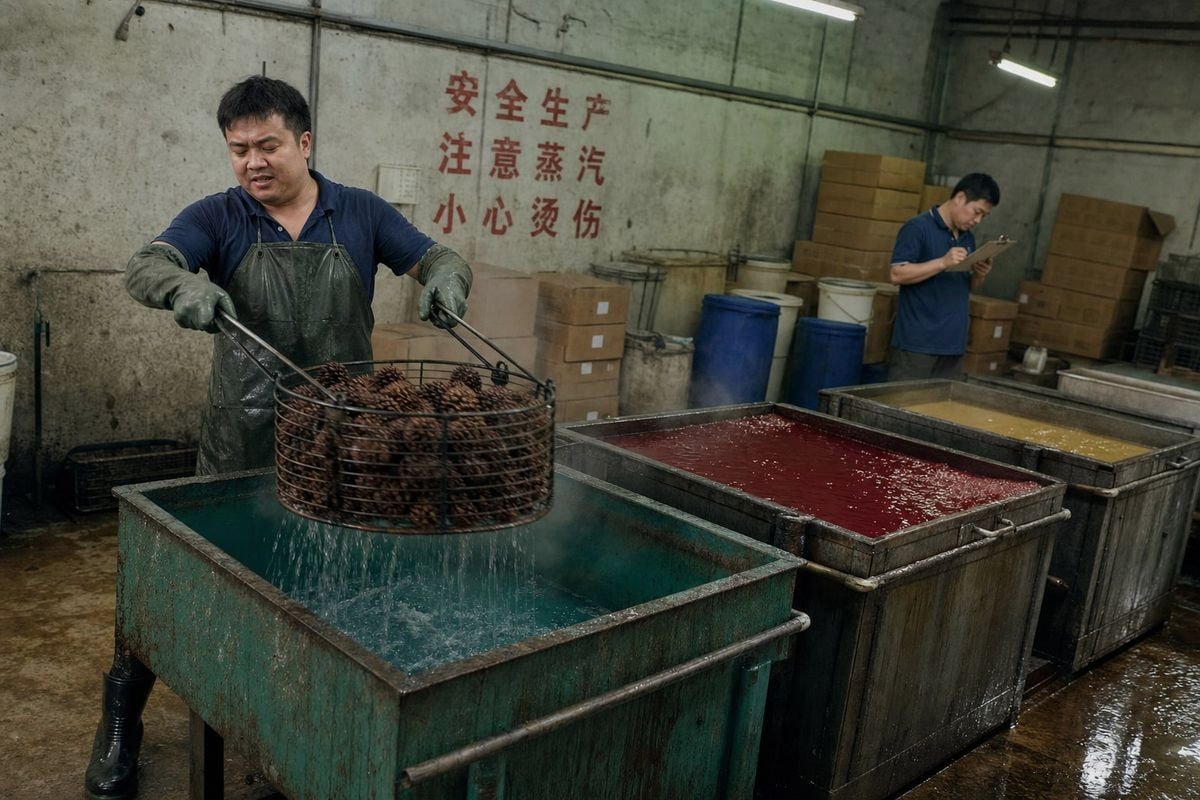
Standard-Dekorationskiefernzapfen stehen auf einem Regal und bleiben stabil. Farbflammende Zapfen sind anders. Während der Produktion weichen wir rohe Zapfen in Metallsalz-Lösungen ein –Kupfersulfat 1 für blaue und grüne Flammen, Lithiumchlorid für Rot, Borax für Gelbgrün. Diese Salze dringen in die Schuppen und Holzfasern ein.
Wenn die Luftfeuchtigkeit während des Transports oder der Langzeitlagerung auch nur geringfügig ansteigt, ziehen Feuchtigkeit gelöste Salze zurück an die Oberfläche. Wenn der Zapfen wieder trocknet, kristallisieren die Salze zu einem feinen weißen oder blassblauen Pulver aus. Dieser Prozess wird Ausblühung genannt und ist die häufigste Ursache für weiße Blüten auf farbflammenden Produkten. Er beeinträchtigt weder die Brennleistung noch die Sicherheit.
Andere häufige Ursachen
Neben Ausblühungen können mehrere andere Substanzen ein weißes Aussehen auf der Oberfläche von Kiefernzapfen erzeugen.
| Ursache | Aussehen | Textur | Ort am Zapfen |
|---|---|---|---|
| Chemische Ausblühung 2 (Metallsalze) | Weißes oder blassblaues Pulver | Trocken, kreidig, wischt ab | Gleichmäßig über die Schuppen verteilt |
| Kristallisation von Harz (Kiefernharz) | Bernsteinfarbene, glänzende Kruste | Hart, spröde, bei Wärme leicht klebrig | Wachsartige Blüte (natürliche Beschichtung) |
| Blasser, gleichmäßiger Film | Glatt, pudrig | Jüngere Schuppen, bestimmte Nadelbaumarten | Oberflächenschimmel oder Mehltauwachstum |
| Weiche, baumwollartige, feuchte Stellen | Fleckig, oft in Spalten zwischen den Schuppen | Weiße Fäden oder Wolle | Wachsartige Fäden |
| An Schuppenspitzen oder in der Nähe von Nadelansatzpunkten | Lösungsmittelbasierte Farbstoffe, die beim Färben verwendet werden, können auch mit den natürlichen Terpenen des Zapfens reagieren. Dies führt dazu, dass Harze austreten und zu einem feinen, pudrigen Film austrocknen, anstatt klare Tröpfchen zu bilden. Auf einer leuchtend violetten oder smaragdgrünen bemalten Oberfläche wird selbst ein dünner Harzschleier sehr sichtbar. | Der schnelle „Hitze-Reibe-Test“ | Wenn unsere QS-Inspektoren eine schnelle Feldprüfung benötigen, verwenden sie eine einfache Methode. Reiben Sie die weiße Stelle fest mit einem warmen Finger. Wenn der Rückstand weich wird und leicht klebrig wird, handelt es sich um Kiefernharz. Wenn er sich zu einem trockenen, staubigen Streifen verschmiert, handelt es sich wahrscheinlich um Schimmel- oder Mehltauwachstum. Wenn er wie Kreide zerbröselt und sich auf einem feuchten Tuch auflöst, handelt es sich um Salzablagerungen. Dies dauert Sekunden und liefert eine zuverlässige erste Antwort ohne Laborgeräte. |
Chemische Ausblühungen von Metallsalzen sind die häufigste Ursache für weißes Pulver auf farbflammenden Kiefernzapfen.
Da farbflammende Zapfen während der Herstellung in Metallsalz-Lösungen getaucht werden, führen Feuchtigkeitsänderungen während des Versands und der Lagerung natürlich dazu, dass sich diese Salze als harmloses weißes Pulver auf der Oberfläche wieder kristallisieren."
Jeder weiße Rückstand auf einem Kiefernzapfen bedeutet, dass er schlecht geworden ist und entsorgt werden muss.
Ist Schimmelwachstum auf meiner Kiefernzapfenlieferung ein Zeichen schlechter Herstellungsqualität?
Trichoderma.
Schimmel auf einer Kiefernzapfenlieferung weist nicht automatisch auf eine schlechte Herstellung hin. Sie signalisiert meist ein Feuchtigkeitsproblem während der Lagerung, Verpackung oder des Transports. Gut hergestellte Zapfen, die unter sicheren Feuchtigkeitsgrenzen getrocknet und mit Trockenmitteln verpackt werden, entwickeln selten Schimmel, unabhängig von der Nadelbaumart.

Penicillium
Arten – benötigt Feuchtigkeit zur Besiedlung. In der Forstforschung werden diese Pilze als oberflächliche Saprophyten beschrieben. Sie ernähren sich von totem organischem Gewebe und besiedeln Zapfenschuppen, ohne die Struktur unbedingt zu zerstören. Aber für ein Dekorations- oder Feuerfärbeprodukt ist sichtbarer Schimmel immer noch ein Qualitätsmangel, den kein Käufer akzeptieren wird. Die eigentliche Frage ist, wo die Feuchtigkeit in den Prozess gelangt ist. Hier verfolgen wir sie in unserer Produktionslinie: 3 oder Potenzielle Feuchtigkeitsquelle Unsere Kontrollmaßnahme.
Rohzapfensammlung
| Phase | Zapfen von feuchtem Boden oder nach Regen geerntet | Unsere Kontrollmaßnahme |
|---|---|---|
| Rohkegelsammlung | Kegel, die von feuchtem Boden oder nach Regen geerntet wurden | Incoming inspection rejects cones above target moisture content |
| Salt-soak treatment | Cones absorb solution during chemical infusion | Mandatory oven drying cycle at controlled temperature post-soak |
| Pre-packing storage | Warehouse humidity spikes in humid seasons | Dehumidified storage rooms with logged humidity data |
| Verpackung | Sealed bags trap residual moisture | Desiccant sachets included; bags not sealed until cones reach safe dryness |
| Seefracht | Container condensation ("container rain") in tropical routes | Kraft-paper inner liners, container desiccants, and ventilated packing |
When Mold Is a Legitimate Manufacturing Defect
If cones leave the factory above safe moisture levels, or if oven drying was skipped or shortened, then mold growth is a fair quality complaint. A reliable supplier will have batch records showing drying times and post-dry moisture readings. If those records do not exist, the factory lacks basic process control.
On the other hand, if cones tested dry at the factory gate but arrived moldy after sitting in a humid port warehouse for three weeks, that is a logistics issue—not a manufacturing one. This distinction matters when you negotiate claims and corrective actions with your supplier.
Fungal Spores Are Everywhere—Moisture Is the Variable
Pine cones naturally carry fungal spores on their surfaces. You cannot sterilize a raw botanical product to hospital-grade cleanliness. What you can control is moisture levels. Below roughly 12–15 percent moisture content, mold spores remain dormant. Above that threshold, they germinate. So the practical standard is not "zero spores" but "zero conditions for growth."
For buyers worried about respiratory irritation, the key reassurance is this: dried cones with dormant spores pose minimal risk during normal handling. Active, fuzzy mold on damp cones is the scenario that can release enough airborne spores to irritate sensitive individuals.
Wie kann ich überprüfen, ob die Kiefernzapfen meines Lieferanten sicher sind und Compliance-Standards wie SGS oder CE erfüllen?
During a factory audit last year, a US buyer's compliance officer asked to see not just our certificates but the original lab test reports with sample numbers, test methods, and pass/fail results. That level of scrutiny is exactly what separates serious importers from casual ones.
Um die Einhaltung der Vorschriften durch Ihren Lieferanten zu überprüfen, fordern Sie Original-Testberichte von SGS oder Intertek an (nicht nur Zertifikate), bestätigen Sie, dass die CE-Kennzeichnung die richtige Richtlinie für Ihren Markt abdeckt, und gleichen Sie die Beschreibung der Probe im Bericht mit dem tatsächlichen Produkt ab, das Sie bestellen. Zertifikate allein sind kein Beweis.
Was jede Zertifizierung tatsächlich abdeckt
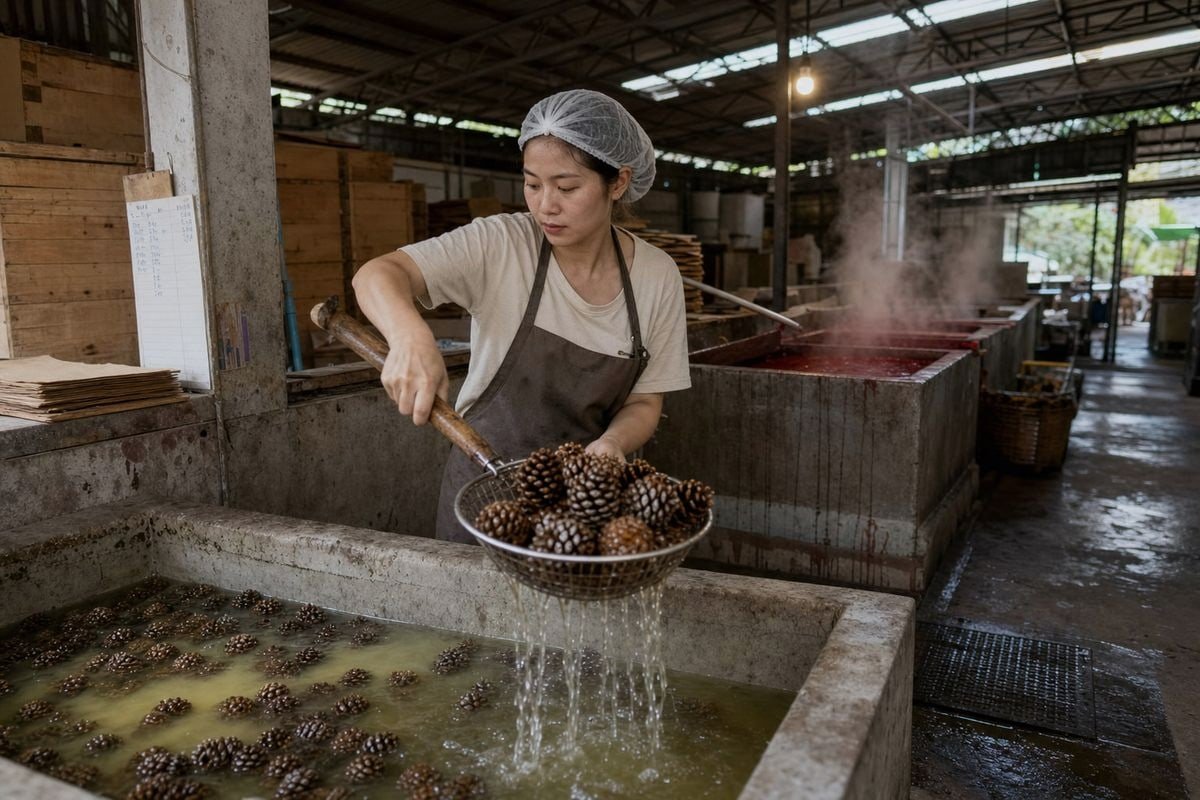
Many buyers treat "SGS-certified" or "CE-marked" as a single stamp of approval. In reality, each certification covers a specific scope, and you need to verify that the scope matches your product and your destination market.
- SGS / Intertek Prüfberichte: These are third-party lab results. They test for specific hazards—heavy metals, flammability, chemical content—against a specific standard (e.g., EN 71 for toy safety, REACH for chemical restrictions). The report is only valid for the sample tested. If your supplier reformulates or changes materials, the old report may no longer apply.
- CE-Kennzeichnung: For fire-coloring products sold in the EU, CE-Kennzeichnung 4 signals compliance with relevant EU directives. But CE is a self-declaration backed by documentation—it is not an independent lab approval. A responsible supplier holds the supporting technical file and can produce it on request.
- ISO 9001: This certifies a quality management system, not a product ISO 9001 5. It means the factory follows documented processes. It does not guarantee the product is safe—only that the factory controls its procedures consistently.
- BSCI: This is a social compliance audit covering labor conditions, not product safety. Important for brand reputation but irrelevant to chemical safety or mold prevention.
Eine praktische Überprüfungscheckliste
Here is what I recommend every B2B buyer request before placing a first order:
- Ask for the full test report PDF, not a summary certificate. Check the lab name, accreditation number, test date, and sample description.
- Confirm the tested sample matches your SKU. If the report tested a plain pine cone and you are ordering gold-painted color-flame cones, the results may not cover paint chemistry.
- Request a REACH-Konformität 6 declaration if selling into the EU. This covers restricted substances including certain heavy metals and Phthalate 7.
- For fire-coloring products specifically, ask whether the metal salts used (copper sulfate, borax, strontium chloride) are within permitted limits for consumer products in your market.
- If your buyer is a large retailer, ask whether the supplier can provide Walmart or Amazon chemical compliance documentation formats, because those chains have their own restricted-substance lists.
Why "We Have SGS" Is Not Enough
A certificate hanging on the office wall tells you the factory once passed a test. It does not tell you when the test was done, what product was tested, or whether current production matches the tested sample. Our approach is to maintain active, product-specific test reports that we update whenever we change a formulation or raw material source, and we share these directly with buyers during the quoting stage—not after a problem surfaces.
Decorative preservation coatings, dye formulations, and salt concentrations can all change between production runs. Each change should trigger a review of whether existing compliance documentation still applies. This is where genuine manufacturing depth matters—a factory with 17 years of process control treats compliance as ongoing maintenance, not a one-time checkbox.
Welche Lager- und Verpackungsstandards sollte ich von meinem Hersteller verlangen, um Feuchtigkeitsprobleme zu vermeiden?
The most expensive lesson in our early export years was a container of color-flame pine cones that arrived in the Netherlands covered in white fuzz. The cones had tested perfectly dry at our Ningbo facility, but six weeks on the ocean through the Strait of Malacca 8 in monsoon season changed everything.
Fordern Sie Ihren Hersteller auf, Kegel auf unter 12% Feuchtigkeitsgehalt zu trocknen, Trockenmittelbeutel in versiegelten Beuteln beizulegen, feuchtigkeitsdichte Innenliner zu verwenden und dokumentierte Feuchtigkeitsmesswerte pro Charge bereitzustellen. Für den Seefrachtverkehr sind Container-Trockenmittel und belüftete Verpackungslayouts unerlässlich, um Kondensationsschäden zu vermeiden.

Packaging Specifications That Actually Prevent Problems
Not all packaging is equal. A standard poly bag will trap moisture. A kraft bag breathes better but offers less protection against port humidity. The best approach depends on your shipping route, transit time, and destination climate.
| Verpackungselement | Zweck | Recommended Standard |
|---|---|---|
| Inner bag material | Moisture barrier around cones | Multi-layer laminate or foil-lined kraft |
| Desiccant sachet (per bag) | Absorbs residual moisture inside sealed unit | Silica gel 9, sized to bag volume |
| Container desiccant | Absorbs "container rain" condensation | Calcium chloride hanging strips, 1–2 per container |
| Inner carton liner | Secondary moisture barrier | PE-coated kraft paper |
| Ventilation gaps | Prevents stagnant humid air pockets | Pallet spacing of at least 5 cm from container walls |
| Moisture indicator card | Visual proof of humidity conditions during transit | Cobalt-free humidity indicator inside carton |
The Problem With Airtight Plastic Containers
Many craft and retail buyers assume airtight containers are the safest option. In practice, sealing cones in airtight plastic often triggers what some handlers call storage-induced osmosis. If the cones are not completely dry when sealed, trapped moisture has nowhere to go. It migrates to the surface, pulls salts along with it, and creates a white "frost" that looks exactly like mold. Over time, if the moisture level stays high enough, actual mildew growth follows.
The fix is straightforward. Either ensure cones are bone-dry before sealing, or use semi-permeable packaging that allows slow moisture exchange without exposing cones to external humidity.
What to Put in Your Supplier Agreement
Beyond packaging materials, the following points belong in your purchase agreement or quality standard document:
- Moisture content specification: Maximum 12% at time of packing, measured with a pin-type or capacitance moisture meter and documented per batch.
- Drying process record: Oven drying temperature, duration, and post-dry moisture reading logged for every production lot.
- Desiccant requirements: Type, quantity, and placement specified per packaging unit.
- White vinegar soak or surface treatment option: If your market requires a pre-treatment step—such as a dilute white vinegar soak before drying—specify this in the manufacturing instructions.
- Claim procedure for moisture-related defects: Define what constitutes a valid claim (e.g., moisture above specification at destination, confirmed by independent testing) and who bears the cost.
Our standard operating procedure now includes photographing moisture meter readings at packing and inserting humidity indicator cards in every carton. When a buyer reports a problem, we can trace back to the exact batch's conditions. This level of documentation does not cost much, but it eliminates ambiguity in claims disputes.
Seasonal and Route-Specific Considerations
Shipping to the US West Coast via the Pacific is a cooler, shorter route than shipping to Northern Europe via the Suez Canal. Monsoon season in Southeast Asia increases container condensation risk dramatically. We adjust our desiccant quantities and inner-liner specs based on the season and route. A one-size-fits-all packaging approach invites trouble.
For buyers who plan to hold inventory in long-term storage, warehouse conditions matter as much as shipping conditions. A climate-controlled warehouse with humidity below 60% will keep cones stable for months. An unheated garage in a coastal city will not.
Schlussfolgerung
White powder on colored pine cones is usually harmless resin or salt efflorescence—not mold. Demand documented moisture controls, proper desiccants, and verified compliance from your manufacturer to keep every shipment shelf-ready.
`
Fußnoten
1. Background on the metal salt compound used in blue and green flame coloring. ↩︎
2. Explains the salt recrystallization process described as the main cause of white powder. ↩︎
3. Provides scientific background on the fungal genus identified as common surface mold. ↩︎
4. Official EU source explaining the self-declaration compliance marking discussed in the article. ↩︎
5. Stable, authoritative Wikipedia overview of the ISO 9001 quality management standard to avoid 403 errors. ↩︎
6. Official European Commission overview of REACH chemical safety regulations and compliance requirements. ↩︎
7. EPA resource on the restricted chemical substances mentioned in compliance checks. ↩︎
8. Geographic context for the shipping route mentioned in the moisture failure story. ↩︎
9. Background on the common desiccant material recommended for packaging. ↩︎

 English
  Spanish
  German
  French
  Arabic
  Portuguese
Diskutieren Sie mit