






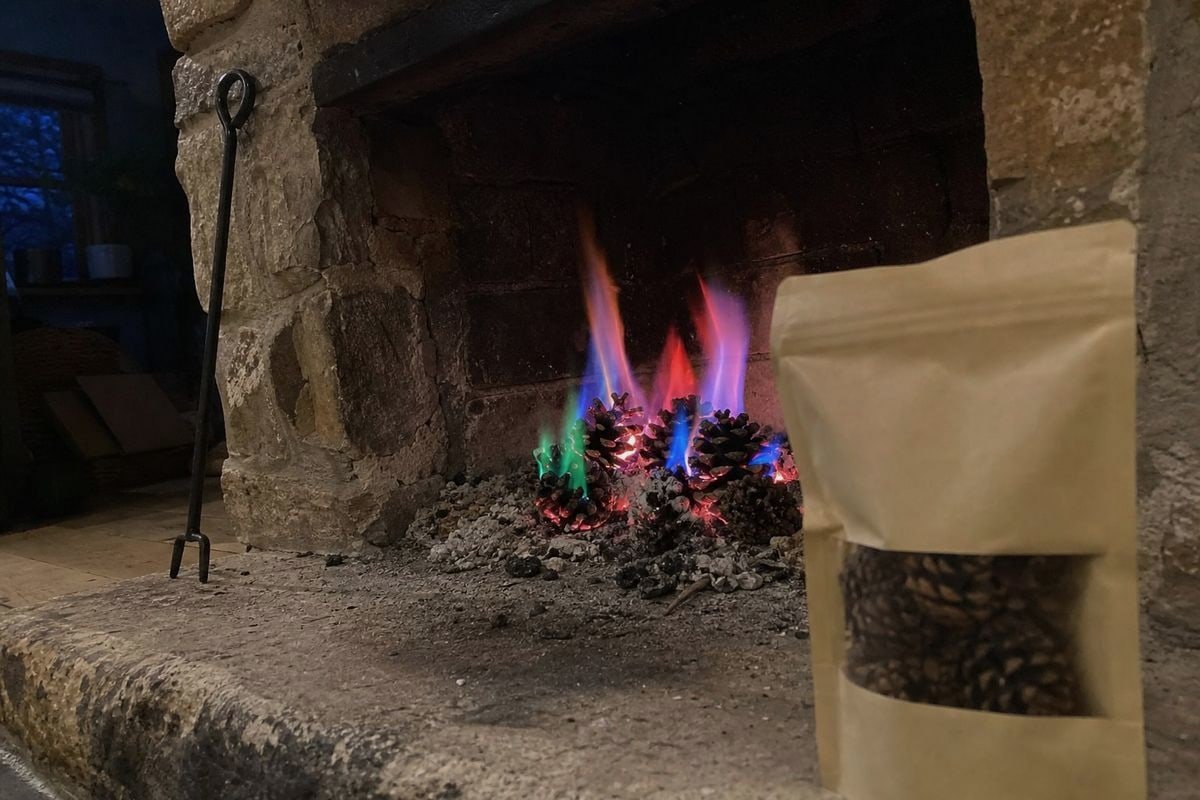
Colored fireplace pine cones look magical, but buyers keep asking me one hard question: are they actually biodegradable? On our production line, we hear it weekly.
Colored fireplace pine cones are only partly biodegradable. The natural pine cone base decomposes, but the mineral salts that create the flame colors do not break down. Environmental friendliness depends entirely on which colorants are used, how the cones are burned, and how the ash is disposed of.
That nuance matters for anyone sourcing these products. Here is how to tell genuinely eco-friendly color cones from greenwashed ones, and what to demand from your supplier.
What materials and certifications should I check to confirm color-flame pinecones are truly eco-friendly?
A German distributor once returned a competitor's sample to us with a lab note attached: copper sulfate 1 levels far above what his retail chain allowed. That moment shaped how we formulate at our Ningbo facility.
Check three things: the base material must be real, untreated pine cones; the colorant must be a low-toxicity mineral salt formulation free of copper sulfate and heavy metals; and the supplier must hold ISO 9001, BSCI, CE, and third-party SGS or Intertek test reports.

The market splits into three product types, and they are not equal. Some listings sold as "pine cones" are actually ceramic fiber or polymer replicas. Those will never biodegrade, no matter what the label says. Real color cones start with dried natural pine cones, which are fully biodegradable on their own. The environmental question then shifts entirely to the chemical treatment.
The three product categories at a glance
| Product type | Base material | Biodegradable base? | Main environmental risk |
|---|---|---|---|
| Natural treated cones | Real dried pine cones | Yes | Colorant residue in ash |
| Wax-bound commercial cones | Pine cone + paraffin binder | Partially | Petroleum-derived paraffin is not carbon-neutral |
| Faux "color cones" | Ceramic fiber or polymer | No | Fully synthetic, often greenwashed |
Notice the paraffin issue. Many commercial versions use paraffin wax 2 as a chemical binder. Paraffin comes from petroleum, so it undermines any "all natural" claim. When we develop OEM formulations for camping brands, we weigh this trade-off openly: a binder improves handling, but it changes the environmental story your packaging can legally tell.
Certifications that actually mean something
Marketing words like "green" and "natural" carry no legal weight in most markets. What matters is documentation. In our exports to the US, Germany, and the UK, buyers treat ISO 9001 3 and SGS or Intertek chemical test reports as hard requirements, not nice-to-haves. CE marking matters for European shelf placement, and BSCI audits 4 confirm the factory behind the product is real and responsibly run. If a supplier cannot show these, the eco-friendly claim is just ink on a kraft pouch.
How can I verify that the chemical additives used for flame color meet international safety and environmental standards?
The colorant recipe is where most sourcing risk hides. When we calibrate a new batch formula in Liuyang, we test it against the strictest destination market first, because a formula that passes everywhere is cheaper than a recall anywhere.
Request third-party chemical analysis from SGS or Intertek identifying every colorant compound, then check each against REACH in the EU and EPA guidance in the US. Reject formulas containing copper sulfate, lead, arsenic, or undeclared heavy metals, and confirm the report matches your actual shipment batch.

Not all flame colorants carry the same risk. This is the single most useful fact for a purchasing manager to internalize. Table salt produces yellow flames and raises almost no concern. Borax and boric acid 5 produce green and are often called fairly eco-friendly, though boron compounds can still harm pond organisms if ash reaches waterways. Copper compounds are where copper sulfate safety becomes a real issue: copper is highly toxic to aquatic life, algae, and invertebrates, and it damages plant roots when it accumulates. Strontium chloride, used for red flames, sits in a middle zone with thinner environmental data.
Colorant risk ranking
| Colorant | Flame color | Environmental concern | Our verdict |
|---|---|---|---|
| Sodium chloride (table salt) | Yellow | Very low | Acceptable |
| Borax / boric acid | Green | Low to moderate; aquatic caution | Acceptable with disposal guidance |
| Strontium chloride | Red | Moderate; limited data | Use in controlled amounts |
| Copper sulfate | Blue-green | High; heavy metal toxicity 6 risk | We avoid it in eco lines |
There is also an indoor air quality angle. Combustion of metal salts releases fine metallic particulates. In small amounts the smoke is generally considered non-toxic, but it can irritate people with asthma. That is why proper eco-friendly fire additives use restrained colorant loads rather than saturating the cone. Ask your supplier for the exact loading percentage. A vague answer is itself an answer. And insist that test reports carry batch numbers matching your purchase order, because a two-year-old certificate for a different formula proves nothing about the container arriving at your warehouse.
Will sourcing biodegradable pinecone firestarters affect burn quality or consistency for my customers?
Trade-offs are where sourcing decisions get real. Early in our 17 years making chemical fire starters and color-flame products, we learned that a cleaner formula which burns unevenly generates more customer complaints than praise.
No, not if the manufacturer controls moisture, colorant loading, and drying uniformly. Eco-friendly formulations can match conventional cones for color vibrancy and burn time of 15 to 30 minutes, provided strict batch-to-batch quality control keeps every cone consistent from sample to mass production.

Burn quality comes down to process control, not chemistry shortcuts. Here is how consistency is actually achieved on a real production line:
- Cone selection and grading. Cones must be similar in size and fully opened. Mixed sizes burn at different rates and produce uneven color displays.
- Moisture control. Treated cones must dry completely before packing. Damp cones smolder, produce weak color, and can grow mold inside retail pouches.
- Colorant loading. The salt concentration must be measured per batch. Too little gives faint color; too much wastes chemical and increases residue in the ash.
- Burn testing per batch. We flame-test samples from every production run, timing color onset and duration before anything ships.
One functional bonus is worth mentioning to your retail customers: borax-based colorants react with heat in a way that helps loosen creosote buildup 7 in chimney flues. That is a modest maintenance benefit conventional wax logs do not offer, and it makes honest marketing copy.
There are also usage limits that protect your brand. Color cones must never go on cooking fires or BBQ grills, because residues should not contact food. Most sellers also warn against gas fireplaces, where residue can clog components. Clear warning labels handle this, and a good OEM partner prints them for you. The one real compromise with fully biodegradable, paraffin-free versions is ignition speed: they may take slightly longer to catch. In our experience exporting to camping brands in Canada and Australia, customers accept that gladly when the packaging explains why.
What documentation or test reports should I request from my manufacturer to prove environmental compliance?
A buyer from a Home Depot-type sourcing channel once told me his rule: "If it's not in the document folder, it doesn't exist." We now build a full compliance dossier before the first container leaves Ningbo, because retail audits assume exactly that.
Request an SDS for the colorant formula, SGS or Intertek chemical composition reports with batch numbers, ISO 9001 and BSCI certificates, CE documentation for EU markets, heavy metal screening results, and written ash disposal guidance. Verify every document is current and traceable to your shipment.

Documentation is your only real defense against greenwashing, and against liability. Ash from color cones concentrates whatever the colorant contained. If copper compounds were used, that ash can cause heavy metal toxicity in garden soil and harm fish if runoff reaches storm drains. Repeated dumping in one outdoor spot leads to soil loading, where accumulated minerals inhibit plant growth and damage the soil microbiome. Your customer-facing instructions must address this, and those instructions should trace back to real test data, not guesswork.
The compliance dossier checklist
| Document | What it proves | Red flag if missing |
|---|---|---|
| Safety Data Sheet (SDS) | Full colorant composition and hazards | Supplier hiding the formula |
| SGS / Intertek test report | Independent chemical verification | Claims rest on the factory's word alone |
| Heavy metal screening | No lead, arsenic, cadmium, or excess copper | Soil contamination and recall risk |
| ISO 9001 certificate | Consistent production quality system | Sample may not match mass production |
| BSCI audit report | Ethical, real factory operations | Possible trading company reselling |
| CE documentation | EU market legality | Products blocked at customs |
| Ash disposal guidance | End-user environmental safety | Liability shifts to your brand |
Reading reports critically
Do not just file these documents. Check the test date, the tested formula name, and the issuing lab. A report older than the current formulation is worthless. When we supply private-label buyers in the US and Europe, we tie each report to a production batch code printed on the packaging, alongside warning labels and barcodes. That traceability is what separates a manufacturing partner from a middleman forwarding PDFs it cannot verify. One more practical tip: ask for the disposal wording in your market's language. Treated cones discarded unburned decompose slowly, because the salt coating acts as a preservative that resists microbial breakdown. Honest documentation acknowledges details like that instead of hiding behind a leaf icon.
Conclusion
Colored fireplace pine cones are biodegradable at the base but not automatically green. Chemistry, certification, and documentation decide the truth. Source from a verified factory, and you can sell the magic honestly.
Footnotes
1. Background on this heavy metal compound used as a toxic flame colorant. ↩︎
2. Explains the petroleum-derived binder that affects biodegradability claims. ↩︎
3. Official standard reference for the quality certification buyers require. ↩︎
4. Official body behind the BSCI ethical factory audit standard cited. ↩︎
5. Background on this green flame colorant compound and its properties. ↩︎
6. Official EPA resource on metals as environmental stressors, replacing the 404 CADDIS page. ↩︎
7. EPA information on creosote, the chimney residue mentioned in the article. ↩︎



 English
  Spanish
  German
  French
  Arabic
  Portuguese
Join the Conversation