







Buyers ask me weekly whether wood fire starters truly meet Leave No Trace 1 ethics. One bad batch with hidden plastics can wreck a brand's reputation. Our production line taught us how to verify this properly.
Wood fire starters meet Leave No Trace ethics when they use sustainably sourced wood fiber, plant-based or fully combustible wax, burn completely to ash with zero synthetic residue, carry third-party certifications like ISO 9001 and SGS test reports, and come in compostable or recyclable packaging.
That answer sounds simple. Verifying it in practice is not. Below, I walk you through the exact checks we recommend to every purchasing manager before a bulk order.
What certifications should I request to confirm eco-friendly compliance?
A German distributor once rejected a competitor's shipment at customs over missing test reports CE marking 2. He then came to us. That single incident shaped how we document every batch leaving our Ningbo facility.
Request ISO 9001 for quality systems, BSCI for ethical production, CE marking for EU market access, and SGS or Intertek test reports confirming no harmful chemicals. For US buyers, USDA Biobased certification adds further proof of renewable, plant-derived content in the starter.

In our seventeen-plus years exporting fire-starting goods to more than thirty countries, we have learned one hard truth USDA Biobased certification 3. Certifications are not marketing decorations. They are the only objective language between a factory in China and a purchasing manager in Chicago or Hamburg material safety data sheet 4. When a buyer wants to minimize campfire impacts across their product line, paperwork is where verification starts.
The core certification stack
Not all certificates cover the same risk. You need to map each document to the specific question it answers.
| Certification | What it verifies | Why it matters for LNT ethics |
|---|---|---|
| ISO 9001 5 | Quality management system | Batch-to-batch consistency; the sample matches mass production |
| BSCI | Social and ethical audit | Responsible production, not just responsible product |
| CE | EU safety compliance | Legal market access and consumer safety |
| SGS / Intertek reports | Chemical composition testing | Confirms chemical-free accelerants and no toxic residue |
| USDA Biobased | Renewable material content | Proves plant-derived wax and fiber claims |
| FSC / PEFC (chain of custody) | Wood sourcing | Confirms sustainable sourcing of the fiber itself |
How to read the reports, not just collect them
A certificate PDF means little if you do not check three details. First, verify the certificate number on the issuing body's website. Second, confirm the scope covers fire starters specifically, not an unrelated product. Third, check the test date. A report from five years ago tells you nothing about the current formula. We reissue test reports because serious buyers ask for current ones, and they are right to do so. If a supplier hesitates on any of these three points, treat that hesitation as your answer.
How can I tell if the wood and wax materials are truly biodegradable?
Material choice is a trade-off we weigh constantly on our line. Pure paraffin ignites reliably and costs less, but blended and plant-based waxes answer the biodegradability question far better for eco-positioned brands.
Truly biodegradable fire starters use untreated wood wool or recycled wood fiber plus beeswax, soy, or vegetable wax. Verify with a material composition sheet, a burn test showing complete combustion to fine ash, and lab confirmation that no petroleum residue or synthetic fibers remain.

Let me be direct about the industry's open secret. Many products sold as "natural" fire starters mix in materials that never fully break down. Our engineers have pulled apart competitor samples and found nylon binding threads, plastic mesh sleeves, and dyed synthetic fillers hiding inside otherwise wooden products. These fragments survive the fire. They stay in the fire ring. That is the opposite of forest floor preservation, and it is exactly what Leave No Trace ethics forbid.
The wood side of the equation
Genuine wood fire starters use wood wool, also called excelsior. It is shaved from timber offcuts or plantation wood. Ask your supplier two questions. Where does the fiber come from? Is it a byproduct of sustainable forestry or freshly cut material? Recycled and byproduct fiber scores highest, because it adds no new harvesting pressure. It also supports the LNT field principle that campers should never strip bark or gather beyond dead, downed, dinky material on site.
The wax side of the equation
Wax is where most greenwashing hides. Here is how the common options compare:
| Wax type | Biodegradable? | Burn quality | Residue risk |
|---|---|---|---|
| Beeswax | Yes, fully | Excellent, slow and hot | Very low when fully burned |
| Soy / vegetable wax | Yes | Good, clean flame | Low; paraffin-free formulas leave fine ash |
| Food-grade paraffin | Combusts fully but is petroleum-derived | Excellent | Low if burned completely; not renewable |
| Industrial paraffin blends | No | Variable | Can leave oily deposits in soil |
A practical field check we teach buyers: burn one unit on a metal plate. A compliant starter leaves only pale, powdery ash. Any waxy puddle, blackened chunk, or fiber skeleton signals incomplete combustion or synthetic contamination. This simple test also screens for microplastic 6 risks that DIY starters made with dryer lint often carry, since polyester lint releases plastic particles and unpleasant fumes.
What documentation proves a supplier's products leave zero harmful residue?
A UK camping brand once sent us their own residue checklist before their first trial order. We appreciated it. Their checklist became part of how we now present documentation to new clients.
Ask for a full material safety data sheet, third-party combustion and emissions test reports, an ash residue analysis confirming no heavy metals or petroleum deposits, and a declared ingredient list. Batch traceability records then prove every shipment matches the tested formula.

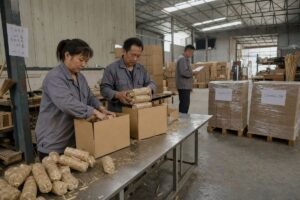
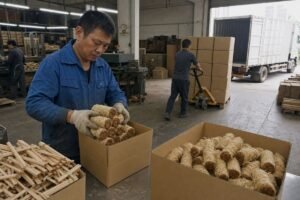
Documentation is where honest factories separate themselves from trading companies. A trading company forwards whatever paper the upstream factory hands over. A real factory generates its own records at every stage. When we produce our wax-dipped wood rolls in Ningbo, each batch gets a production record, a raw material lot number, and a quality control sign-off. That chain is what lets us stand behind a residue claim in writing.
The five documents that actually matter
- Material Safety Data Sheet (MSDS/SDS). This lists every ingredient and its hazard profile. No SDS means no transparency. Full stop.
- Combustion emissions report. Issued by SGS, Intertek, or an equivalent lab. It confirms the smoke contains no toxic compounds beyond normal wood combustion, supporting backcountry fire safety.
- Ash residue analysis. This is the direct answer to the Leave No Trace question. It verifies the post-burn ash is free of heavy metals and oily petroleum deposits that could leach into soil or water.
- Ingredient declaration. A signed statement of composition, such as wood fiber percentage and wax type. Compare it against the SDS. Discrepancies are red flags.
- Batch traceability records. These link your shipment to the exact tested lot. Without them, a clean test report proves nothing about your container.
Why liquid accelerants complicate everything
One more angle worth checking. Some cheap starters rely on absorbed liquid fuels to compensate for poor design. Liquid accelerants can seep into the ground before ignition and contaminate water sources. Well-made eco-friendly tinder needs none of that. The wax itself is the fuel carrier, solid and stable at ambient temperature. If a supplier's documentation mentions any solvent or liquid fuel component, walk away.
How do I verify a factory's sustainability claims before placing a bulk order?
Early in our export history, a Dutch importer flew to Liuyang unannounced to see whether we were a real factory. He placed his order the same week. That visit taught us why verification beats promises.
Verify sustainability claims through a factory audit or live video tour, cross-checked certifications with issuing bodies, pre-shipment samples tested by your own lab, heat-treatment records for wood components, and references from existing buyers in your market. Start with a small trial order.

Sustainability claims are cheap to make and expensive to fake under scrutiny. That asymmetry works in your favor if you know where to press. In our experience exporting to the US, Germany, and Australia, the buyers who verify hardest become the longest-term partners, because they know exactly what they are getting.
A step-by-step verification process
Follow this sequence before committing to a container:
| Step | Action | What it exposes |
|---|---|---|
| 1 | Request business license and factory registration | Trading companies posing as manufacturers |
| 2 | Video or in-person factory tour | Real production lines versus rented showrooms |
| 3 | Cross-check ISO 9001, BSCI, CE certificates online | Expired or borrowed certifications |
| 4 | Order samples and run independent lab tests | Formula gaps between sample and claim |
| 5 | Request heat-treatment records for wood fiber | Invasive species 7 prevention compliance for import |
| 6 | Place a small trial order with flexible MOQ | Batch consistency and lead-time reliability |
| 7 | Audit the trial batch against the original sample | Whether mass production matches the promise |
The details most buyers miss
Two checks deserve special attention. First, heat-treatment documentation for wood-based products. Untreated wood fiber can carry pests or fungal pathogens across borders. Invasive species prevention is both a legal import issue and a core environmental one, and customs authorities in the US and EU take it seriously. Second, packaging claims. Ask whether cartons and inner wraps are recyclable or compostable. Under the pack-it-in, pack-it-out principle, packaging is part of the product's footprint. We offer custom compostable inner packaging for exactly this reason, and buyers focused on minimizing campfire impacts increasingly specify it. Finally, ask for references. A factory with seventeen years of history should name markets and product categories it serves without hesitation, even where client names stay confidential.
Conclusion
Verifying Leave No Trace ethics protects your brand from greenwashing risk. Check certifications, materials, residue documentation, and the factory itself. Then partner with suppliers who welcome that scrutiny.
Footnotes
1. Background concept explaining the core ethical framework the article verifies compliance against ↩︎
2. Official EU source explaining CE marking requirements for market access compliance ↩︎
3. Official USDA program verifying renewable, plant-derived content claims in products ↩︎
4. Background reference explaining the standard document format used to disclose chemical hazards

 English
  Spanish
  German
  French
  Arabic
  Portuguese
Join the Conversation