






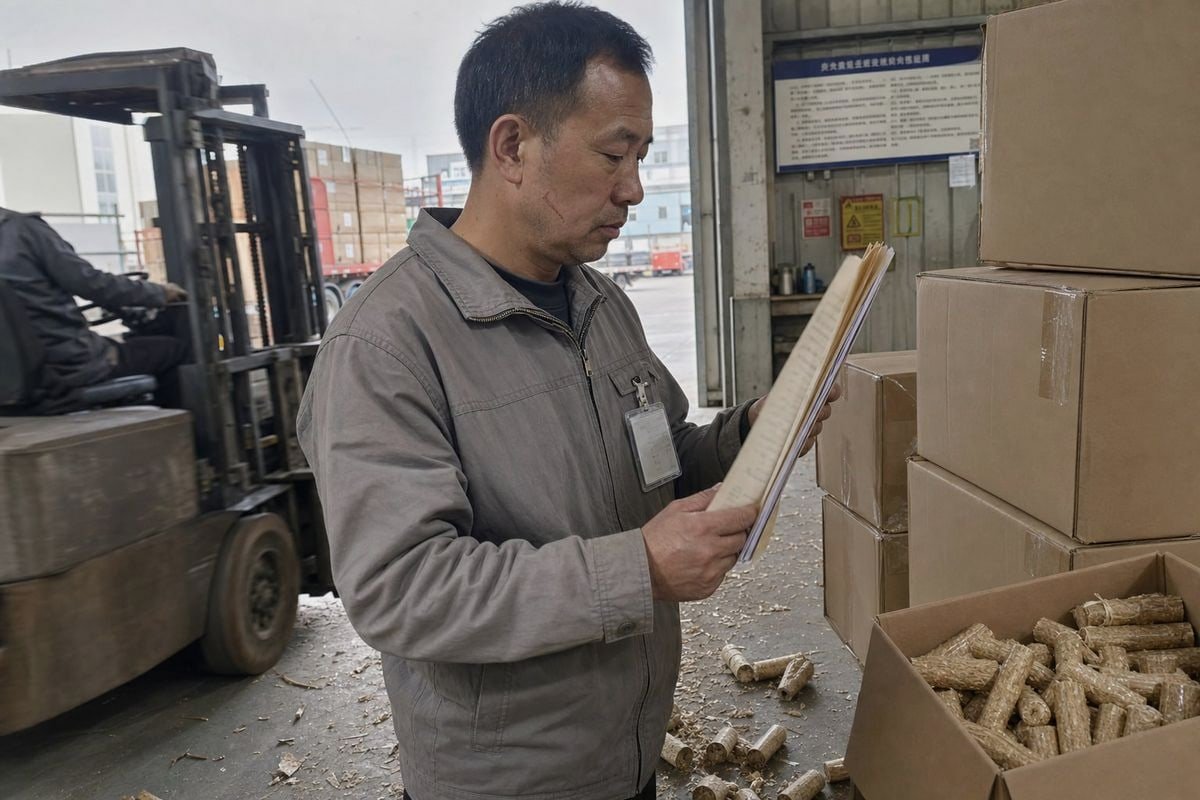
Fire restriction compliance is the first question serious buyers ask me about wood fire starters. On our production line in Ningbo, we learned early that one missing test report 1 can freeze an entire container at customs. That means lost shelf dates, angry retail partners, and margin you never get back. The fix is a documented verification process, and I will walk you through the exact one we use with our import partners.
To verify fire restriction compliance when sourcing wood fire starters, request ISO 9001, SGS or Intertek test reports, and heat-treatment or phytosanitary documents; confirm report authenticity directly with the issuing lab; map US, EU, and Australian restriction rules; and keep dated compliance files for customs and retailers.
That is the short version. Now let me break down each step, because the details are where deals fall apart.
What certifications should I request from wood fire starter suppliers to confirm compliance?
A German distributor once opened our first meeting with a single question: show me the certificates before you show me the product. In our experience, that is exactly the right order.
Request ISO 9001, BSCI, and CE certificates, plus SGS or Intertek product test reports covering flammability and composition. For wood-based starters, also ask for USDA heat-treated certification or a phytosanitary certificate, which prove pest-free processing for cross-border movement.

The certificate stack for wood fire starters splits into three layers, and each answers a different regulator's question. Buyers often confuse them, so I separate them clearly whenever we onboard a new client.
The three certification layers
| Layer | What it proves | Typical documents |
|---|---|---|
| Factory system | The supplier runs consistent, audited production | ISO 9001, BSCI social audit |
| Product safety | The starter burns as claimed and contains no harmful chemicals | SGS/Intertek test reports, CE marking for EU |
| Wood biosecurity | The wood is pest-free and legal to move | USDA heat-treated certification, phytosanitary certificate |
The biosecurity layer surprises many first-time importers. Because our wax-dipped wood rolls contain natural wood fiber phytosanitary standards 2, they can fall under firewood transport laws and invasive species prevention rules in some jurisdictions. Heat treatment to recognized standards, such as 60°C core temperature for 60 minutes, addresses this. Ask the supplier which standard the treatment follows and who verified it.
Composition disclosure matters too. Our starters are typically wood fiber and paraffin, and we state the ratio on packaging. A supplier who cannot tell you the exact composition cannot pass a retailer audit. Also ask about moisture content levels in the wood fiber. Low moisture is not just a burn-quality issue; kiln-dried kindling and starter material dried below pest-survival thresholds often clears agricultural inspection faster.
Finally, ask whether the factory holds any state-level compliance agreement for processed wood products if you sell into US quarantine-sensitive regions. A supplier who has exported to 30+ countries should answer these questions in one email, not three weeks.
How can I verify a factory's test reports are authentic before placing an order?
Fake test reports are more common in this industry than most buyers realize. We once lost a bid to a supplier quoting 30% below us, and the buyer returned six months later after the "SGS report" turned out to be edited.
Verify test reports by contacting the issuing lab directly using the report number, checking the lab's online verification portal, confirming the tested product matches your exact SKU and composition, and cross-checking the report date against the certificate's validity period.
Authentication is a process, not a glance. Here is the workflow I recommend to every purchasing manager, because it takes under an hour and protects a five-figure order.
A five-step authentication workflow
- Get the full report, not a screenshot. A legitimate factory sends the complete PDF with report number, lab letterhead, and signatory. Cropped images are a warning sign.
- Use the lab's own verification channel. SGS, Intertek, TÜV, and similar labs offer online report-check portals 3 or verification email addresses. Enter the report number yourself; never rely on a link the supplier provides.
- Match the tested sample to your product. Check that the description, composition, and model number on the report match the SKU you are buying. A report for a paraffin firelog does not cover a wood-wool starter.
- Check dates and scope. Reports age. Confirm the test standard cited is the current version and the report is recent enough for your retailer's requirements.
- Order a third-party pre-shipment inspection. For a first order, an independent inspection with on-site sampling closes the loop between paperwork and cartons.
Red flags versus green flags
| Red flag | Green flag |
|---|---|
| Report shared only as a photo or crop | Full PDF with verifiable report number |
| Vague product description on report | Exact SKU, composition, and model listed |
| Supplier resists lab-direct verification | Supplier offers the lab contact proactively |
| One report claimed to cover all products | Separate reports per product family |
When we quote a serious buyer, we expect this scrutiny. Frankly, a factory that welcomes verification is telling you something about batch-to-batch quality control. One that stalls is telling you something too.
What fire restriction standards differ across US, EU, and Australian markets I sell to?
Shipping the same starter to Texas, Bavaria, and New South Wales taught our export team a hard lesson: one product, three completely different rulebooks.
The US layers federal, state, county, and land-manager burn ban regulations plus USDA biosecurity rules; the EU requires CE conformity, REACH-compliant composition, and national air-quality burn rules; Australia enforces strict biosecurity import conditions plus state fire-danger and total-fire-ban frameworks.

The critical distinction is between rules that govern whether your product can be sold and rules that govern whether the end user can burn it on a given day. Both affect you as a seller, because retailers increasingly check both.
Market-by-market comparison
| Market | Import/biosecurity focus | Use-side restriction logic |
|---|---|---|
| United States | USDA heat treatment, state quarantine zones, firewood transport laws 4 | Stage 1 fire restrictions and Stage 2 bans by county, sheriff, or land manager; red flag warnings can change status daily |
| European Union | REACH chemical compliance, CE, packaging and labeling directives | National and municipal air-quality no-burn days; appliance-specific rules in some cities |
| Australia | Strict biosecurity screening of wood fiber, treatment certificates | State-declared fire danger ratings and total fire bans covering solid-fuel ignition |
Why the US is the most fragmented
In the US, forest service fire danger levels 5 and local fire ordinances stack on top of state rules. Under stage 1 fire restrictions, solid-fuel fires 6 are often limited to developed sites; under Stage 2, many jurisdictions prohibit burning any solid fuel, including manufactured logs and starters, while pressurized gas devices may remain legal. Your product classification as solid fuel matters here. We advise our US buyers to label products honestly as solid fuel and include check-local-restrictions language, because packaging claims never override a burn ban.
Europe and Australia in practice
In our exports to Germany, France, and the Netherlands, chemical composition scrutiny dominates. Eco-friendly, no-harmful-chemical formulations 7 are not marketing fluff there; they are the price of shelf entry. Australia is the hardest gate on the wood side. Biosecurity officers treat wood fiber seriously, so complete treatment documentation and evidence of sustainable harvesting practices should travel with every shipment.
Which documentation should I keep on file to prove compliance if customs or retailers ask?
A Canadian client once called us in a mild panic: their retailer's compliance team wanted a full document trail within 48 hours. Because we keep organized batch files, they made the deadline.
Keep certificates of origin, heat-treatment and phytosanitary certificates, current SGS or Intertek test reports, safety data sheets, batch production records, packaging and warning-label proofs, import declarations, and dated screenshots of relevant restriction rules for each destination market.

Think of your compliance file as insurance you build before you need it. Customs officers, retail compliance teams, and even liability insurers ask for overlapping but not identical documents. A single organized file answers all three.
The core compliance file
Organize documents by shipment, then by category:
- Origin and biosecurity: certificate of origin, USDA heat-treated certification or equivalent, phytosanitary certificate where required, and treatment method details.
- Product safety: current test reports, safety data sheet, full composition declaration including wax-to-wood ratio and moisture content levels.
- Factory credentials: ISO 9001 certificate, BSCI audit summary, and the factory's business license showing it is a real manufacturer, not a trading company.
- Packaging evidence: approved artwork files showing warning labels, barcodes, and composition text as printed. When we run private-label jobs, we archive the final approved artwork for exactly this reason.
- Transactional records: commercial invoice, packing list, bill of lading, and import declarations.
- Market-rule evidence: dated screenshots of the official restriction pages relevant to your sales regions, proving you checked authoritative sources rather than third-party summaries.
Retention and review discipline
Keep files for at least the product's shelf life plus your market's liability window; many of our buyers use five years as a working rule. Review test reports annually, because retailers reject expired ones. Re-capture restriction screenshots each season, since burn ban regulations shift with red flag warnings and drought conditions. A one-page index at the front of each file turns a 48-hour scramble into a 15-minute email.
Conclusion
Verify the factory's certificates, authenticate every test report with the lab, map each market's restriction logic, and archive dated proof. Do this once systematically, and every future shipment gets easier.
Footnotes
1. Intertek's official page for verifying the authenticity of product test reports and certificates. ↩︎
2. Official IPPC page for international phytosanitary standards (ISPMs) governing wood products. ↩︎
3. Official SGS portal for verifying the validity of inspection and testing reports. ↩︎
4. Authoritative map and guide to US state regulations regarding the movement of wood products. ↩︎
5. US Forest Service explanation of fire danger levels and associated restrictions on public lands. ↩︎
6. Wikipedia entry defining solid fuels, which include the wood fire starters discussed in the article. ↩︎
7. Official European Commission overview of REACH regulations for chemical safety compliance. ↩︎



 English
  Spanish
  German
  French
  Arabic
  Portuguese
Join the Conversation