







Wood fire starters can arrive broken, and I have seen the damage claims myself. After 17 years running our production lines, I know cracked cartons kill reorders faster than price ever does.
Yes, wood fire starters can break during transport and stacking, but breakage depends on material type, binder quality, and packaging. Wax-bound wood wool starters resist damage well, while dry compressed sawdust briquettes crumble easily. Proper cartons and palletization prevent most losses.
The good news is that breakage is predictable. Once you understand which products fail and why, you can prevent nearly all of it. Let me walk you through what we have learned.
What packaging solutions prevent my wood fire starters from breaking during shipping?
A German distributor once sent us photos of a competitor's shipment: crushed cartons, wax dust everywhere. That single email shaped how we design every export carton in our Ningbo facility today.
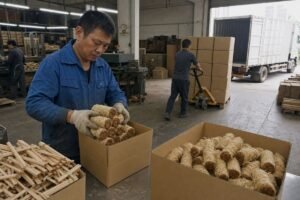
The best packaging combines a moisture-barrier inner bag, a rigid corrugated retail box, double-wall master cartons, and snug palletized shipping protection with corner boards. This layered system absorbs stacking pressure and shipping vibration damage before force ever reaches the fire starters themselves.

Packaging works in layers, and each layer has one job. When any layer is missing, the load transfers stress directly to the product. That is when wood wool firelighters shed fibers and compressed pucks crack at the edges.
The four protective layers we build into every shipment
Here is how the layers stack up, from the product outward:
| Layer | What it does | Common failure if skipped |
|---|---|---|
| Inner poly or kraft bag | Controls fire starter moisture content, contains loose fibers | Humidity softens wax bonds; fines leak into carton |
| Retail box (rigid cardboard) | Absorbs point impacts and light compression | Units rub together, edges crumble |
| Double-wall master carton | Carries stacking weight across the pallet | Carton walls buckle, crushing bottom rows |
| Pallet wrap + corner boards | Stops load shifting and vibration abrasion | Cartons slide, corners collapse in transit |
A rigid cardboard box outperforms a plastic bag alone by a wide margin. The box creates a structural frame, so stacking pressure travels through the cardboard, not through the tumbleweed fire starters inside. We also print carton orientation arrows and maximum stack counts on every master carton, because warehouse staff cannot follow instructions they never see.
One more detail matters: void fill. A half-empty carton is a weak carton. We size our master cartons 1 so retail boxes sit snugly, with no room to shift when the container hits rough roads or ocean swell. For buyers ordering private-label packaging through our OEM program, we run a drop test and a compression check on the final carton design before mass production begins.
How do I test fire starter durability before placing a bulk order?
Before we ship samples from our factory, we run the same simple checks I recommend to every purchasing manager. You do not need a lab. You need a table, a scale, and ten minutes.
Test durability by drop-testing samples from one meter onto concrete, applying stacking weight equivalent to a full pallet layer, checking the firelighter brittle point by hand-flexing, and exposing units to humidity for 48 hours. Reliable products survive all four tests with minimal crumbling.

Sample testing is your cheapest insurance. A trial order of one pallet costs far less than a container of damage claims. So test hard, and test the way freight actually behaves.
A simple five-step durability test protocol
- Drop test. Drop the retail box from one meter onto a hard floor, once on each face. Open it and weigh any loose fines. Under two percent loss by weight is acceptable for wood wool products.
- Compression test. Place weight on a master carton equal to four or five cartons stacked above it. Leave it for 24 hours. The carton should not deform more than a few millimeters, and units inside should stay separate.
- Flex test. Bend a single starter by hand. Wax-dipped wood rolls should flex slightly before snapping. If it shatters instantly, its firelighter brittle point is too low for winter shipping.
- Humidity test. Leave samples unwrapped in a bathroom or humid room for 48 hours, then burn one. Watch for swelling, softening, or slow ignition.
- Burn-after-abuse test. Take the pieces that broke during testing and light them. Fragments that still ignite reliably tell you that cosmetic damage will not become a functional failure.
Ask your supplier for their own QC records too. On our lines, we check batch-to-batch wax saturation and binding tension, because natural firelighter durability 2 starts at production, not at the packing table. A first sample should reflect mass-production quality exactly. If a supplier cannot promise that, the drop test results mean nothing.
What causes wood fire starters to crack or crumble under stacking pressure?
The physics here is unforgiving, and I learned it the hard way early in our export history when a Brazil-bound container came back with photos of powdered briquettes. The root causes were all identifiable, and all fixable.
Cracking under stacking pressure comes from weak fiber binding, moisture absorption that breaks mechanical bonds, excessive bulk storage stacking height, cold-embrittled wax, and vibration-induced inter-particle shear. Binder-free compressed sawdust briquettes fail first; resin-saturated kindling like fatwood almost never fails.

Not all wood fire starters are built the same. Their internal structure determines how they respond to compression, and the differences are dramatic.
Vulnerability by product type
| Product type | Binding method | Stacking vulnerability | Why |
|---|---|---|---|
| Fatwood sticks | Natural resin saturation | Very low | Fatwood structural integrity comes from resin reinforcing the wood grain itself |
| Wax-dipped wood rolls | Paraffin coating + wound fibers | Low | Wax locks fibers in place and cushions impact |
| Wood wool tumbleweeds | Mechanical winding only | Medium | Resist snapping but unravel and shed fibers under friction |
| Compressed sawdust briquettes | Pressure only, often binder-free | High | Inter-particle shear from vibration creates internal fractures |
The hidden accelerators
Moisture is the biggest silent killer. Even modest humidity makes compressed fibers 3 swell, and swelling breaks the mechanical bond holding a briquette together. That is why fire starter moisture content must be locked in at packing with a sealed inner bag.
Temperature works both ways. In sub-zero transit, paraffin binders 4 pass their brittle point and can shatter along grain lines from impacts they would normally absorb. In hot containers, wax-heavy units can suffer cold flow deformation, slowly fusing together under stacking weight until separate starters become one solid block.
Finally, stacking height 5 itself matters. Every bulk storage stacking height has a limit set by the bottom carton's compression strength. Exceed it, and the lowest layer pays the price. We print that limit on our cartons for exactly this reason, and we advise warehouse teams to place heavier goods below fire starter cartons, never on top of them.
Can I request custom packaging to reduce damage claims from my customers?
Custom packaging requests land on my desk every week, and they are some of my favorite projects. One UK fireplace brand cut its damage complaints dramatically after we redesigned their inner tray together.
Yes, most established factories offer custom packaging as part of OEM/ODM programs. You can specify carton wall strength, inner dividers, moisture barriers, individually wrapped units, private-label retail boxes, warning labels, and barcodes, all engineered to reduce transit damage and customer damage claims.

Custom packaging is not just branding. It is damage engineering. When we develop private-label packaging for a client, we start with their sales channel, because e-commerce parcels and retail pallets face completely different abuse.
Match the packaging to the channel
| Sales channel | Main threat | Custom solution to request |
|---|---|---|
| E-commerce / parcel | Last-mile drops and throws | Individually wrapped units, crush-resistant mailer-ready boxes |
| Retail shelf (big-box) | Stacking in stockrooms | Double-wall cartons, printed stack limits, display-ready trays |
| Wholesale bulk bags | Friction and fiber shedding | Inner liners, smaller inner packs to limit unit-on-unit abrasion |
| Cold-climate markets | Wax embrittlement | Thicker cushioning, flexible wax formulation, sealed liners |
What to ask your supplier for
Be specific in your requests. Ask for the carton's edge crush test 6 rating. Ask whether inner dividers separate rows of starters. Ask for a moisture barrier if your market is humid, like Brazil or the Gulf region. Ask for individually wrapped or tray-packed units if you sell online, because last-mile handling is the single most common damage point.
Compliance belongs in the same conversation. Our packaging work runs alongside our ISO 9001 7, BSCI, CE, and SGS/Intertek documentation, so custom boxes ship with correct warning labels and barcodes already in place. For buyers positioning their brand around eco-friendly ignition sources, we can also spec recyclable kraft materials without sacrificing crush strength. Good suppliers will prototype the packaging, abuse-test it, and only then quote mass production. Insist on that sequence.
Conclusion
Broken fire starters cost you reorders and reputation. The fix is layered packaging, real durability testing, and a factory partner who engineers cartons as carefully as the product itself.
Footnotes
1. Technical details on the structural integrity of corrugated fiberboard used in shipping. ↩︎
2. General overview of fire lighter materials and their physical properties. ↩︎
3. Authoritative Wikipedia entry explaining the properties and engineering applications of wood fibers. ↩︎
4. Detailed Wikipedia article on paraffin wax, covering its chemical properties and industrial uses. ↩︎
5. OSHA regulations regarding the safe handling and stacking of materials in storage areas. ↩︎
6. Comprehensive Wikipedia guide to the Edge Crush Test (ECT) for corrugated packaging strength. ↩︎
7. Official standard for quality management systems ensuring consistent product and service quality. ↩︎


 English
  Spanish
  German
  French
  Arabic
  Portuguese
Join the Conversation