







Few complaints frustrate me more than "your wood fire starters die halfway." On our production line, we investigate every case — and most of the time, the fire system fails, not the starter.
Wood fire starters burn halfway then go out when the surrounding wood never reaches ignition temperature. Wet wood, poor airflow circulation, oversized logs, or an inconsistent wax formula all interrupt combustion. The starter produces heat, but moisture, oxygen deprivation, or bad fuel staging kills the flame.
Let me walk you through the real causes. Then I will show you how to verify a supplier's wax formula, check certifications, and test samples before you commit to a bulk order.
What causes wood fire starters to lose flame before fully burning?
A German distributor once shipped us back a "defective" batch. We burned fifty units on camera. All burned fully. His customers had been stacking damp logs directly on top of the flame.
A fire starter loses flame early because of high moisture content in the wood, restricted combustion air, oversized fuel, or a heat-sink cold surface. Less often, the starter itself has uneven wax saturation that causes pooling and premature flame collapse.

Wood does not burn like a candle wick. It must first heat up until it releases flammable gases through pyrolysis 1. Only then can flame sustain itself. If the starter burns out before the kindling reaches that ignition temperature, the whole fire collapses — even if the flame looked healthy for the first sixty seconds.
The four failure points we see most often
In seventeen years of making wax-dipped wood rolls, our QC team has traced nearly every "dies halfway" complaint back to one of these:
| Failure Point | What Happens | How to Spot It |
|---|---|---|
| Wet or green wood | Heat evaporates water instead of igniting fibers | Hissing, steam, heavy smoke, blackened but unlit logs |
| Oxygen deprivation | Tight stacking or closed fireplace damper starves the flame | Flame shrinks steadily, smolders, then dies |
| Oversized fuel jump | Starter cannot heat a thick log's mass in time | Surface chars, but interior never catches |
| Cold heat sinks | Metal grates or stone floors pull heat away | Fire dies faster in cold stoves or wet fire pits |
Moisture is the biggest thief
Unseasoned firewood can hold a large share of its weight in water. Every gram of that water steals heat from your starter through evaporation. Even seasoned firewood retains some moisture, which is why fine kindling matters so much. A cheap wood moisture meter 2 solves most of these mysteries: anything above roughly 20% moisture content will fight your starter.
Airflow finishes what moisture starts
Combustion needs three things: heat, fuel, and oxygen. Logs packed too tightly, thick ash beds, or a cold chimney with no draft will smother a flame that had every chance of surviving. This is why the top-down fire method 3 works so well — it keeps air gaps open and lets heat rise into fresh fuel instead of into a smothering pile.
How can I verify a supplier's wax formula ensures consistent full burns?
Early in our export history, we tested a competitor's sample for a curious buyer. The wax ratio drifted wildly between units — some burned four minutes, others eleven. That lesson shaped our batch-control process ever since.
Ask the supplier for their exact wood-fiber-to-wax ratio, wax type, and dipping process documentation. Then request burn-time test data across multiple batches. A consistent formula — such as 50% wood fiber and 50% paraffin — should produce burn times within a tight, repeatable range.

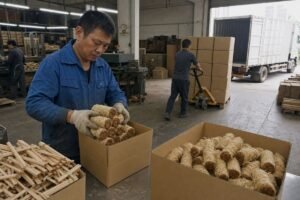
The wax formula is the heart of a wood fire starter. Get it wrong, and even perfect firewood will not save the burn. At our Ningbo facility, we control the fiber-to-paraffin 4 ratio on every batch of wax-dipped wood rolls, because two failure modes hide inside a bad formula.
Too little wax vs. too much wax
Under-saturated starters ignite fast but exhaust their fuel before the kindling reaches ignition temperature. Over-saturated starters do the opposite: the wax melts, pools, and drowns the excelsior fibers that act like a wick. Both look fine on the shelf. Both fail in the fire pit.
Questions that separate real factories from traders
Here is the checklist I recommend purchasing managers use when auditing any supplier's formula:
- What is the declared composition? A transparent supplier prints it on the box — ours states 50% wood fiber, 50% paraffin.
- How is wax uptake controlled? Ask about dipping time, wax temperature, and drainage steps. Vague answers mean no process control.
- What is the burn-time tolerance between batches? A serious factory tracks this per production run, not per year.
- Is the paraffin food-grade or industrial-grade? Cheaper industrial waxes can smoke, smell, and burn unevenly.
- Can they show batch QC records? We keep burn logs precisely because our first sample must match mass-production quality.
Why batch-to-batch consistency matters more than one good sample
A trading company can hand-pick ten perfect samples. Only a factory with complete production lines can guarantee unit ten thousand behaves like unit one. Ask where production actually happens, and ask to see it — we welcome audits at our facility for exactly this reason.
What certifications should I check to confirm burn-time reliability?
Compliance questions come first in almost every inquiry we receive from US and European buyers. Certifications are not paperwork to us — they are the shortest path to trust across an ocean.
Check for ISO 9001 quality management certification, third-party burn and safety test reports from SGS or Intertek, CE marking for European markets, and BSCI social compliance audits. Together, these confirm the factory controls its process well enough to deliver reliable, repeatable burn times.

No certificate directly says "this starter burns for eight minutes." What certifications prove is something more valuable: the factory has a controlled, audited system, so the burn time you tested in samples is the burn time you get in containers. That is the real link between compliance and burn-time reliability.
What each certification actually tells you
| Certification / Report | What It Covers | Why It Matters for Burn Reliability |
|---|---|---|
| ISO 9001 5 | Quality management system | Documented process control means consistent wax ratios and burn times batch after batch |
| SGS / Intertek test reports | Third-party lab testing | Independent verification of composition, safety, and performance claims |
| CE marking 6 | EU safety requirements | Mandatory for many European retail channels; signals regulatory diligence |
| BSCI audit | Social and factory compliance | Confirms a real, audited production site — not an untraceable subcontractor |
Red flags I tell buyers to watch for
Some suppliers wave a single expired PDF as their "certification." In our experience exporting to more than thirty countries, these warning signs predict trouble:
- Test reports issued to a different company name than the supplier.
- Reports older than two or three years with no renewals.
- Refusal to provide the full report, only a summary page.
- ISO certificates from unaccredited certification bodies.
Ask for current documents, verify the report numbers with the lab, and confirm the certified entity is the actual factory. For our buyers at Home Depot–type retail channels, this is a hard gate, not a nice-to-have — and it should be for you too. A supplier who invests in ISO 9001, BSCI, CE, and SGS or Intertek testing has already invested in the process discipline that keeps burn times stable.
Can I request samples to test burn consistency before placing a bulk order?
Nearly every serious buyer we work with starts with a sample burn test — and honestly, I would worry about any who did not. We send samples precisely because our first sample reflects our mass production.
Yes. Any reputable manufacturer will provide samples for burn testing before a bulk order. Request units from a current production batch, test them under controlled conditions with dry seasoned firewood, and record burn duration, flame height, and ignition transfer across at least ten units.

Sampling is only useful if you test properly. A single starter lit on a desk tells you almost nothing. Here is the testing protocol we recommend to purchasing managers, based on how our own QC team validates every batch before it ships.
A simple burn-test protocol
- Request 10–20 units and confirm they come from a recent production run, not a hand-picked showcase batch.
- Control your fuel. Use seasoned firewood verified below 20% moisture content with a wood moisture meter, and consistent kindling size across all tests.
- Control the environment. Test in the same fireplace or fire pit, with the fireplace damper fully open and normal chimney draft. Avoid days with strong wind or unusual weather.
- Time everything. Record time to ignition, total burn duration, and whether the kindling caught before the starter was consumed.
- Check the spread. Consistency matters more than the average. If burn times vary widely between identical units, the wax formula is not under control.
What your results should look like
| Test Metric | Good Sign | Warning Sign |
|---|---|---|
| Burn duration spread | Units burn within a narrow, similar range | Some units burn twice as long as others |
| Ignition transfer | Kindling catches well before starter dies | Starter exhausts first, fire collapses |
| Flame behavior | Steady, upright flame throughout | Wax pooling, sputtering, early smothering |
| Residue | Clean ash, minimal soot | Heavy soot that hints at creosote buildup 7 risk |
One more thing to test: the second order
Consistency between the sample and the bulk shipment is where weak suppliers fail. When you place your trial order, hold back a few original samples and burn them side by side with units from the delivered container. We encourage buyers to do this with our wood firestarters, because genuine manufacturing depth means the comparison holds. We also support flexible MOQs for trial orders and full private-label OEM/ODM customization — size, burn time, packaging, warning labels, and barcodes — so your test order can already look like your retail product.
Conclusion
Wood fire starters that die halfway usually signal wet wood, oxygen deprivation, or a poorly controlled wax formula. Verify composition, demand certifications, and test samples — then choose a factory partner built for consistency.
Footnotes
1. Explains the chemical process by which wood releases flammable gases before ignition. ↩︎
2. Official EPA Burn Wise guide explaining how to use moisture meters for proper wood seasoning. ↩︎
3. Background on fire-building techniques referenced as improving airflow and combustion. ↩︎
4. Explains the paraffin wax used in the fiber-to-wax ratio described in the article. ↩︎
5. Official standard reference for the quality management certification discussed in the article. ↩︎
6. Background on the EU conformity marking mentioned as a certification buyers should check. ↩︎
7. EPA resource on wood burning safety relevant to the creosote and soot warning mentioned. ↩︎


 English
  Spanish
  German
  French
  Arabic
  Portuguese
Join the Conversation