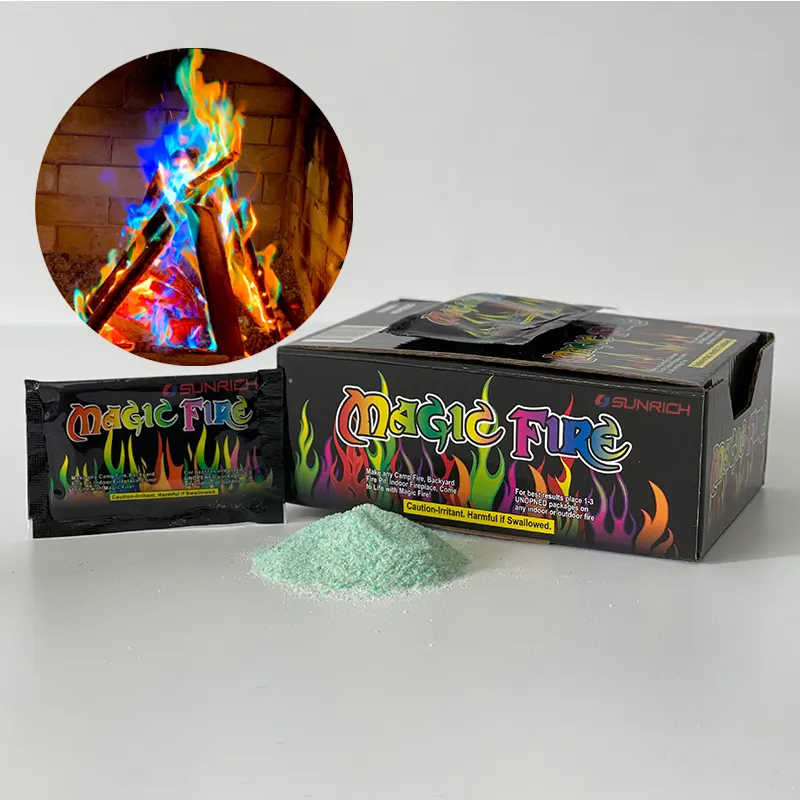




Getting the Prop 65 warning for Magic Fire powder wrong on a California webpage is one of the most common risks I see buyers overlook when listing our color-flame packets.
Place the Prop 65 warning for Magic Fire powder directly on the product display page, near the price or add-to-cart button, or use a clearly labeled "CA WARNING" hyperlink on that same page that shows the full warning before the customer completes the purchase.
A footer notice is not enough. A generic legal page is not enough. Below, I will walk through exactly where the warning goes, what it must say, and how we help our buyers get it right.
Where exactly on my product page does the Prop 65 warning need to appear for compliance?
A US distributor once asked me why his listing got flagged when the warning sat in his site footer. His placement, not his product, was the problem — and it taught us both a lesson.
The warning must appear on the product display page itself, in a conspicuous position near the product title, price, or purchase button, or through a bold hyperlink labeled "WARNING," "CA WARNING," or "CALIFORNIA WARNING" that reveals the full text before checkout is completed.

California's rules for internet sales are specific. OEHHA compliance guidance makes it clear that a Safe Harbor Warning 1 must be clearly associated with the individual product. A general notice posted somewhere on your site does not qualify, the same way a sign at a store entrance does not replace a product-specific label. The warning has to sit close to the buying decision, because the law is designed to inform the shopper before exposure or purchase.
Acceptable vs. risky placements
| Placement | Compliance strength | Why |
|---|---|---|
| On the PDP near price or add-to-cart | Strong | Product-specific and pre-purchase |
| "CA WARNING" hyperlink on the PDP | Strong | Expressly allowed if clearly labeled |
| Cart or checkout process disclosure only | Weak | Shopper may add to cart without seeing it |
| Sitewide footer or legal page | Very weak | Not clearly associated with the product |
| Hidden accordion or collapsed tab | Very weak | Fails the conspicuous standard |
Some buyers argue that a checkout-page warning alone should count, since the customer sees it before paying. In our experience exporting fire products to the US for over 17 years, that argument does not hold up well. The regulations favor the product display page 2 because that is where the purchase decision actually happens. A secondary reminder in the cart is a good belt-and-suspenders move, but it should support the PDP warning, not replace it.
Placement details matter too. Do not bury the warning below long marketing copy. Do not render it as an image without alt text, since screen-reader accessibility is now a practical expectation. Keep the warning in HTML text, at a font size no smaller than other consumer information on the page, so an ordinary customer will see and understand it under normal shopping conditions.
What warning text and format does California require for color-flame powder products?
Every season, our compliance team reviews the warning artwork we print for US-bound Magic Fire packets, because the wording rules under the California Code of Regulations keep tightening.
California requires the yellow triangle exclamation symbol, the bold signal word "WARNING," and text naming at least one listed chemical with its harm type — cancer, reproductive harm, or both — plus the link www.P65Warnings.ca.gov, in text no smaller than other consumer information.

A clear and reasonable warning has two layers: content and format. Get either one wrong and the Safe Harbor protection weakens. For a color-flame powder, the content depends on what your lab testing shows. Prop 65 covers carcinogens and reproductive toxins 3, and a warning is only required when exposure exceeds safe-harbor levels. That is why we always tell buyers to start from test data, not from fear.
Long-form vs. short-form warning label
| Element | Long-form warning | Short-form warning label |
|---|---|---|
| Symbol | Yellow triangle, black exclamation point, left of text | Same symbol required |
| Signal word | "WARNING" in bold capitals | "WARNING," "CA WARNING," or "CALIFORNIA WARNING" |
| Chemical named | Yes, at least one per endpoint | Yes — required under the updated rules |
| Typical use | Product pages, packaging with space | Small labels and compact sachets |
| Minimum type size | No smaller than other consumer info | At least 6-point type |
One gray area deserves attention. Some buyers assume the short-form warning lets them skip naming a chemical. That was once a loophole, but the updated regulations close it: even the short-form version must identify at least one specific listed chemical. So your warning might read, for example, that the product can expose you to a named chemical known to the State of California to cause cancer.
There is also an "exposure by use" angle unique to fire products. Burning anything creates combustion byproducts such as soot and carbon monoxide, which are listed chemicals. Even if the raw powder itself tests clean, counsel often recommends a combustion-related warning 4 for products designed to be burned. Our SGS and Intertek test reports give our buyers the chemical data they need to make that call with their legal advisors.
Do I need Prop 65 labels on both my website and the physical packaging?
Here is a trade-off we weigh on every US order: printing the warning on our foil sachets adds a design constraint, but skipping the webpage warning creates a legal gap the label alone cannot fill.
Yes, for online sales into California you generally need both. The physical label warns the end user at the point of exposure, while the webpage warning must reach the buyer before purchase — a printed label alone does not satisfy the internet sales rule.

The logic is simple once you see it. A shopper buying Magic Fire powder online never touches the pouch until it arrives. If the only warning lives on the foil sachet, the purchase happened without notice, and California treats that as a failure. That is why the internet sales provisions require a warning on the product display page or via a clearly marked link, separate from whatever appears on the pack.
The synchronization rule most sellers miss
Both disclosures must match. If your website warning names one chemical and your physical short-form warning label names another, plaintiffs' firms call this a mismatched disclosure, and it is a growing source of 60-day notice of violation 5 letters. Before any enforcement lawsuit, a private enforcer serves that 60-day notice — and settlements are rarely cheap. Keeping the digital and printed text identical is the easiest litigation insurance you can buy.
A few practical points from our production line in Ningbo:
- We print the warning triangle and text directly on the sachet or kraft bag during the packaging run, so it cannot be forgotten downstream.
- We supply buyers with the exact warning artwork file, so their web team can mirror it word for word on the PDP.
- Some buyers display a photo of the labeled packaging on the listing as a supplement — helpful, but it should sit alongside HTML warning text, not replace it.
- For marketplaces like Amazon, the platform's Prop 65 attribute field must also carry the same chemical name.
One more nuance: some sellers use Geo-IP targeting to show the warning only to California visitors. That can reduce warning fatigue for out-of-state customers, but the physical label still travels everywhere, so most of our US buyers simply warn nationally for consistency.
How can my manufacturer help me get the right compliance documentation and warning labels ready?
When a Canadian camping brand asked us last year for a full California-ready documentation pack before their first trial order, we had everything compiled within days — because we have done this many times before.
A capable manufacturer supplies third-party test reports, a Material Safety Data Sheet, chemical composition data, and pre-approved Prop 65 warning artwork, then prints compliant labels during production — giving you the evidence to decide whether a warning is needed and the files to apply it consistently.

Compliance starts at the factory, not at the point of sale. If your supplier cannot tell you exactly what is in the powder, you cannot write an accurate warning — or defend a decision not to warn. Our Magic Fire color-flame packets are formulated with eco-friendly materials, and we back that claim with SGS and Intertek 6 test reports on every export batch, alongside our ISO 9001 7, BSCI, and CE certifications. For our US and European buyers, this is a hard requirement, not a nice-to-have.
What to request from your supplier
| Document | What it does for you | When you need it |
|---|---|---|
| SGS / Intertek test report | Shows listed-chemical levels against safe-harbor thresholds | Before listing in California |
| Material Safety Data Sheet | Details composition, handling, and combustion behavior | Customs, retailers, legal review |
| Chemical composition declaration | Names the exact chemical for your warning text | Drafting the warning |
| Warning label artwork file | Keeps web and packaging text identical | Before print and web launch |
| Batch QC records | Proves consistency across reorders | Ongoing risk management |
Because we run a true one-stop OEM/ODM operation, warning labels are part of the packaging design conversation from day one. We can place a compliant short-form warning label on a small foil sachet, a long-form warning on a kraft stand-up pouch or display box, and add your barcodes and private-label branding in the same run. Our batch-to-batch quality control means the composition your lawyer reviewed at sampling is the composition that ships at scale — which matters, because a warning is only accurate if the product behind it never drifts.
My honest advice to purchasing managers: ask for the documentation pack before you commit to an order. A factory that hesitates on test reports will hesitate on everything else.
Conclusion
Place the warning on the product display page, match it to the packaging, name the chemical, and demand full documentation from your factory — that is how Magic Fire powder sells safely in California.
Footnotes
1. The lead agency for Proposition 65 implementation and regulatory guidance in California. ↩︎
2. Official guidance from the California government regarding Proposition 65 requirements for online retailers. ↩︎
3. Official site explaining the chemicals listed under Proposition 65, including carcinogens and reproductive toxins. ↩︎
4. Official source for the legal text and regulatory updates of California's Proposition 65. ↩︎
5. California Attorney General's office page detailing enforcement and the 60-day notice process. ↩︎
6. Working authoritative service page for consumer product compliance and testing. ↩︎
7. Authoritative and highly accessible summary of the quality management standard. ↩︎



 English
 Spanish
 German
 French
 Arabic
 Portuguese
Join the Conversation