

Buyers ask us weekly about magic fire powder CE compliance. Many have already lost shipments at EU customs because a supplier's "CE certificate" turned out to be worthless paper.
Magic fire powder imported from China into the EU needs a CE mark where applicable, an EU Declaration of Conformity, a REACH-compliant Safety Data Sheet, CLP hazard labeling in local languages, batch traceability markings, third-party test reports, and a technical file available to authorities.
That is the short answer. The details matter more. Below, I walk through each document, each label element, and each question you should put to your Chinese supplier before wiring a deposit.
What CE Certifications and Test Reports Should I Request Before Placing My Order?
A German distributor once sent me a competitor's "CE certificate" for review. It was a self-printed PDF with no directive named, no test data, and no notified body. Our compliance team spotted it in minutes.
Before ordering, request the EU Declaration of Conformity naming the exact directive, third-party chemical lab test reports from SGS or Intertek, the REACH-compliant Safety Data Sheet, evidence of notified body involvement if the product is classified as pyrotechnic, and access to the Technical Construction File.

The first thing to understand is that "CE certified" is not one single document. It is a compliance stack. A supplier who hands you a one-page certificate and nothing else has not proven anything. In our 17+ years exporting color-flame products to Germany, France, the Netherlands, and the UK, we have learned that serious EU importers audit the full trail.
Why Classification Comes First
Magic fire powder sits in a gray zone. Depending on formulation and marketing, it may be treated as a pyrotechnic article under Directive 2013/29/EU 1, as a consumer chemical mixture, or as a novelty item. The classification decides everything. If it falls under the pyrotechnics regime, conformity assessment by a notified body is mandatory, and standards like EN 15947 become the reference framework for testing and labeling logic. If it is a chemical mixture, REACH Regulation 2 compliance and CLP labeling carry the weight instead. Ask your supplier which regime their product was assessed under. If they cannot answer, walk away.
The Documents to Request, Side by Side
| Document | Who Issues It | What It Proves |
|---|---|---|
| EU Declaration of Conformity | The manufacturer | Legal declaration naming directives and standards met |
| Chemical lab test reports | SGS, Intertek, or equivalent | Composition, flammability, heavy metals results |
| Safety Data Sheet (SDS) | Manufacturer or compliance author | Safe handling, hazards, per Regulation 2020/878 |
| Notified body certificate | EU notified body (if pyrotechnic) | Third-party conformity assessment |
| Technical Construction File | The manufacturer | Full evidence trail; authorities can demand it |
One more point. CE marking must be affixed before the product is placed on the EU market, not after. It must be visible, legible, and indelible. A supplier promising to "add CE later" is telling you they do not have the assessment done.
How Do I Ensure Product Labels Meet EU Warning and Language Requirements?
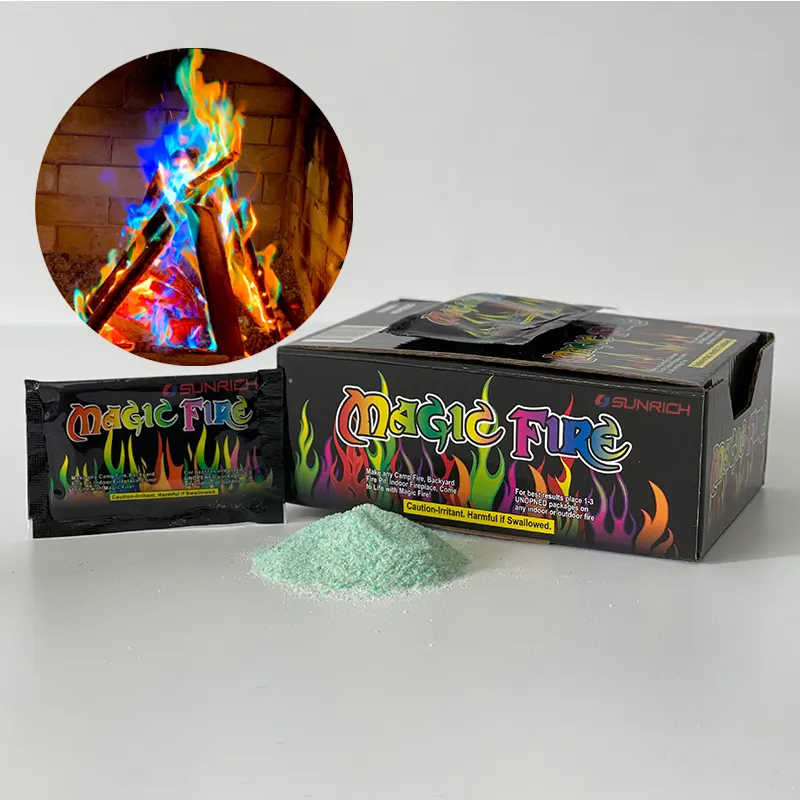
When we redesigned our Magic Fire foil pouches for a Dutch retail chain, the artwork went through four revisions. Not for the rainbow flame graphics — for the warning panel, pictograms, and Dutch-language text.
EU labels for magic fire powder must carry CLP-compliant GHS hazard pictograms, signal words, hazard and precautionary statements in the official language of each destination country, batch traceability numbers, the EU importer's address, usage warnings, and the CE mark with notified body number where applicable.

Labeling is where most novelty fire products fail. The product itself may be perfectly safe, but a glossy pouch with only English text and no pictograms is non-compliant the moment it lands in Hamburg or Rotterdam. In our OEM work, we print custom warning labels, barcodes, and multilingual panels directly into the packaging artwork, because stickers applied after arrival look cheap and often get rejected by retail buyers anyway.
The Mandatory Label Elements
CLP labeling requirements under Regulation EC 1272/2008 3 drive most of the layout. Based on the chemical classification of the powder, the label needs the correct GHS hazard pictograms 4, a signal word such as "Warning," and the matching hazard and precautionary statements. On top of that, EU rules add traceability and identity demands.
| Label Element | Requirement | Common Mistake |
|---|---|---|
| GHS pictograms | Correct symbols per chemical classification | Missing or wrong pictogram size |
| Language | Official language of each member state | English-only packaging |
| Batch/lot number | On the smallest sales unit | Only printed on the master carton |
| EU importer address | Registered postal address on the pack | Listing only the Chinese factory |
| CE mark | Visible, legible, indelible; on packaging if the article is unsuitable | Faded print or mark on outer box only |
| UFI code | Where CLP poison-centre notification applies | Omitted entirely |
Language Is Not Optional
Selling into Germany, France, and Poland from one SKU? You need German, French, and Polish text — or separate label versions per market. We usually recommend multi-language back panels for pan-EU distributors and single-language versions for country-exclusive retail programs. Also plan physical space early. Our small foil sachets are compact, so the flip-top display box often carries part of the required text, with the sachet carrying the core warnings and batch code.
Finally, under the General Product Safety Regulation 5, you need an EU-based Responsible Person overseeing safety documentation for both online and offline sales. Their details increasingly belong on or with the packaging too.
What Documentation Do I Need for Customs Clearance and Import Compliance?
A trade-off we weigh on almost every EU shipment: declare conservatively and clear smoothly, or let a forwarder guess the tariff line and risk a hold. After shipping color-flame packets to 30+ countries, we always choose the first path.
For customs clearance, you need a commercial invoice, packing list, correct HS Code for pyrotechnics or chemical preparations, the Safety Data Sheet, dangerous goods declarations if applicable, the EU Declaration of Conformity, test reports on request, and proof of an EU Importer of Record.

Customs paperwork and compliance paperwork are two different files, but at the border they merge. A customs officer who sees "fire powder" on an invoice will often ask for the SDS and conformity documents before releasing the container. Having them ready in one organized package is the difference between a two-day clearance and a three-week inspection.
Build the Import File in This Order
- Confirm the HS Code 6 for pyrotechnics or chemical mixtures with your broker before booking. Flame colorants can classify differently from consumer fireworks, and the code drives duty rates, licensing, and inspection probability.
- Obtain the Safety Data Sheet authored to Regulation 2020/878, in the language your customs authority expects.
- Secure the transport classification. Some formulations ship as non-dangerous goods; others need UN numbers and DG declarations for sea freight. Your supplier's chemical lab test reports should support whichever claim is made.
- Collect the EU Declaration of Conformity and keep the Technical Construction File accessible. Authorities can request it for up to ten years.
- Name your Importer of Record 7. Under EU law, when the manufacturer sits outside the EU, the importer carries the legal duty to ensure the product complies. Importer of Record responsibilities include verifying markings, keeping documents, and cooperating with market surveillance.
Do Not Confuse Chinese Standards with EU Rules
One buyer objection we hear often: "The factory says it passed China's national fireworks standard, so it must be fine." It is not. China is updating its mandatory domestic firework standards, with new rules taking effect in 2026, but Chinese domestic certification does not satisfy EU conformity requirements. The two systems test different things for different regulators. Our Liuyang headquarters sits in China's fireworks cluster, so we know both systems well — and we treat them as entirely separate compliance tracks.
Can My Supplier Provide Batch-Specific SGS or Intertek Reports for Every Shipment?
The hardest lesson from our early export years: one clean test report does not guarantee the next batch. That is exactly why we built batch-to-batch quality control into our Ningbo production lines and made SGS and Intertek verification a standing process, not a one-time marketing exercise.
A capable factory can provide batch-specific SGS or Intertek reports, though most buyers negotiate a practical cadence — full third-party testing annually or per formulation change, plus internal batch QC records and batch traceability codes linking every shipment back to tested production runs.

Here is the honest picture. Testing every single production batch at SGS or Intertek is possible, but it adds cost and one to three weeks of lead time per shipment. Some large retail programs demand it and price it in. Most distributors instead agree on a layered system that balances assurance against speed and cost.
A Practical Testing Cadence
| Testing Layer | Frequency | Who Performs It | What You Receive |
|---|---|---|---|
| Full third-party chemical testing | Annually, or when the formula changes | SGS / Intertek | Complete lab report with heavy metals, composition |
| Batch verification testing | Per shipment or per PO, if contracted | SGS / Intertek | Batch-referenced report matching lot numbers |
| Internal batch QC | Every production run | Factory lab | Batch records: color intensity, burn behavior, moisture |
| Pre-shipment inspection | Per shipment | Third-party or buyer's agent | Inspection report against approved sample |
Questions That Separate Real Factories from Traders
Ask whether the report's product name, formulation, and applicant match the factory you are paying. Trading companies often circulate reports borrowed from other suppliers. Ask whether the lot number on your foil pouches can be traced to a specific tested run — our traceability markings on the smallest sales unit exist precisely for this. Ask about emerging REACH restrictions too: forward-looking buyers now request PFAS-free verification and confirmation that no intentionally added microplastics act as carriers in the powder, ahead of Regulation 2023/2055 enforcement. A factory with real manufacturing depth will answer in specifics. A reseller will stall.
Also write testing into the purchase contract. Specify the lab, the scope, the batch-matching requirement, and who pays. In our experience, buyers who define this upfront never face surprises; buyers who assume it get whatever the supplier finds cheapest.
Conclusion
Magic fire powder is not a simple commodity. Verify the full CE compliance stack — DoC, SDS, CLP labels, test reports, traceability — before ordering, and partner with a factory that documents everything.
Footnotes
1. Official EU legal text defining pyrotechnic article classification referenced in the article. ↩︎
2. ECHA's authoritative explanation of REACH compliance requirements mentioned for chemical mixtures. ↩︎
3. ECHA source explaining the CLP regulation governing hazard classification and labeling. ↩︎
4. UNECE is the source body for the Globally Harmonized System pictograms cited in labeling rules. ↩︎
5. Official EU legislation establishing the Responsible Person and safety documentation duties. ↩︎
6. Wikipedia overview of the Harmonized System used for customs tariff classification. ↩︎
7. Background concept explaining the legal role and duties assigned to EU importers. ↩︎



 English
 Spanish
 German
 French
 Arabic
 Portuguese
Join the Conversation