
Preparing multilingual instructions for magic fire powder trips up many importers. On our production line, we have seen good products blocked at customs over one missing warning line.
To prepare multilingual instructions for magic fire powder, translate mandatory safety warnings into every official language of your target market, follow GHS labeling requirements and CLP regulation compliance, verify translations against your CE and SGS test reports, and use a layered label layout with icons plus short imperative text.
That is the short answer. The longer answer involves language law, translation strategy, layout design, and supplier support. Let me walk you through each part, step by step.
What languages and safety warnings do I need to include for my target export markets?
A German distributor once returned a whole trial order to us because the sachet carried English-only warnings. That lesson shaped how we build every label today.
Include every official language of the destination country: English for the US and UK, English plus French for Canada, and the local member-state language for each EU market. Every version must carry the core warnings: do not open the sachet, do not cook over colored flames, and adult supervision required.

Language requirements are set by law, not by preference. In our seventeen-plus years exporting color-flame packets to more than thirty countries, we have learned that regional labeling standards differ sharply. The EU requires the language of each member state where the product is sold. Canada requires bilingual English and French text under the CCCR 1. The Middle East often expects Arabic alongside English. Getting this wrong means retail rejection or, worse, a recall.
The non-negotiable warning set
Some warnings must appear in every single language version, without exception. These are safety-critical, and they map directly to how the product is used: the unopened packet goes straight into a wood-burning fire.
| Warning | Why it is mandatory |
|---|---|
| Do not open the packet before use | Prevents dust inhalation and skin contact with flame colorant chemicals |
| Do not cook food over colored flames | Metallic salts can contaminate food and are hazardous if ingested |
| For wood-burning fires only | Prevents misuse in gas fires, stoves, or enclosed appliances |
| Adult supervision required | Pediatric ingestion is a leading cause of regulatory recalls |
| Keep out of reach of children | The powder can resemble candy or drink mixes |
Language checklist by region
| Market | Required languages | Extra notes |
|---|---|---|
| USA | English | Consumer safety warnings prominent on front panel |
| Canada | English + French | Both languages must have equal prominence |
| Germany, France, Netherlands | Local language | CLP regulation compliance 2 for hazard text |
| Poland | Polish | Growing enforcement on imported novelty fire goods |
| Middle East | Arabic + English | Right-to-left layout affects design |
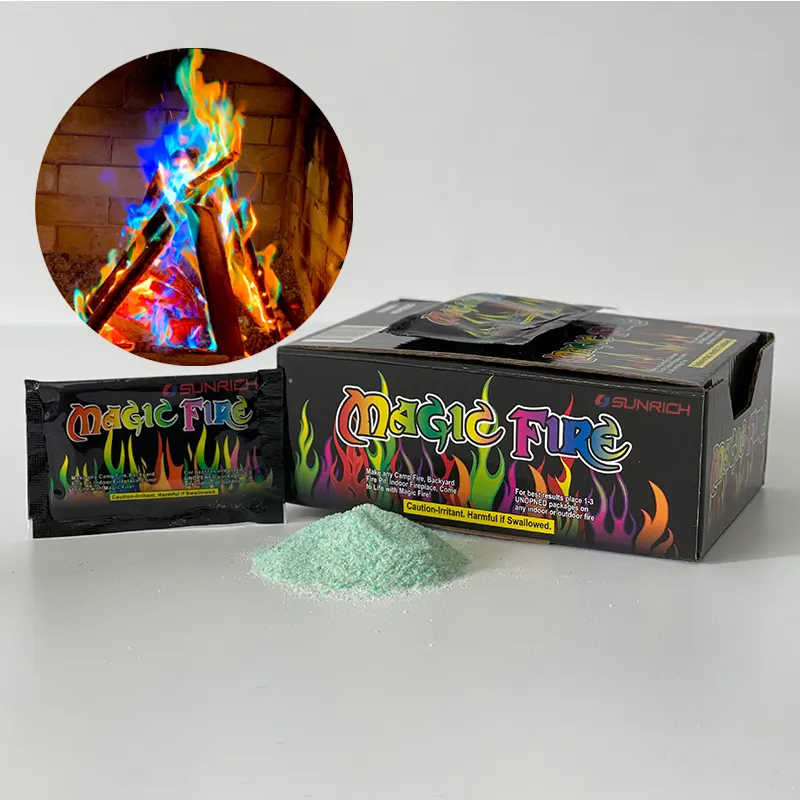
That look-alike risk deserves emphasis. Our Magic Fire crystals look like pastel sugar. So a clear "not food" statement, in every language, is not optional. It is your first line of defense.
How do I make sure translated instructions still meet CE and SGS compliance requirements?
When we prepare CE documentation at our factory in Liuyang, translation review happens before printing plates are made — never after. That sequencing has saved buyers from costly reprints many times.
Anchor every translation to the exact hazard statements, precautionary statements, and signal words in your Safety Data Sheet and SGS test reports. Use certified technical translation services, back-translate each version, and have your certification body or importer confirm the wording before mass printing.

Compliance text is not creative writing. Under GHS labeling requirements 3, six elements are mandatory: signal words, hazard pictograms, hazard statements, precautionary statements, product identifiers, and supplier contact information. These phrases are standardized. So your translator must use the official published wording in each language, not a free translation. A translator who writes "be careful with children" instead of the official "Keep out of reach of children" equivalent has broken your CLP regulation compliance, even if the meaning feels close.
A verification process that works
Here is the sequence we follow with our own buyers before any private-label run:
- Pull the exact hazard and precautionary codes from the Safety Data Sheet (SDS).
- Match each code to its official translated phrase in the target language database.
- Translate only the remaining free text — usage steps and marketing copy — with technical translation services 4 experienced in consumer chemicals.
- Back-translate every version into English and compare against the certified original.
- Have a native reviewer from the actual distribution region check tone and clarity.
- Send final artwork to the importer or notified body for written sign-off.
- Archive the approved files with the SGS or Intertek test report for audit traceability.
One more point buyers often miss: REACH compliance 5 applies to the substances inside the sachet, not just the label. If your supplier cannot show substance-level documentation behind the SDS, translated warnings will not save you during a port inspection. We keep test reports batch-linked for exactly this reason — the paperwork and the powder must tell the same story.
Can my supplier provide ready-made multilingual label templates instead of me translating from scratch?
A Dutch wholesaler recently asked us this exact question during a sample negotiation. His previous supplier had handed him a bare foil pouch and wished him luck with the legal text.
Yes — an experienced OEM factory should supply pre-approved multilingual label templates covering major export markets, complete with hazard pictograms, standardized warning text, and barcode zones. You then verify the templates against your local regulations rather than translating every line from scratch.

This is where supplier choice really matters. A trading company resells whatever the factory prints. A genuine factory with one-stop OEM/ODM capability maintains a template library built from past compliance projects. At our Ningbo production site, we hold approved label artwork for the US, Germany, UK, France, Netherlands, Poland, Canada, Australia, and Brazil — because our buyers in those markets already forced every wording question through their own legal review. New customers inherit that groundwork.
What a proper template package includes
A ready-made template is more than translated text. Ask your supplier for all of the following before you commit to a trial order:
| Template element | What to check |
|---|---|
| Standardized warning text | Matches official GHS and CLP phrase catalogs, not free translation |
| Hazard pictograms 6 | Correct symbols at the legally required minimum size |
| Product identifier and supplier block | Space for your company name and address as importer |
| Barcode and batch code zones | Positioned to survive heat-seal crimping on foil pouches |
| Certification references | Aligned with current CE and SGS/Intertek test reports |
Where you still carry responsibility
Now for the honest caveat. Some buyers assume a supplier template transfers all legal risk to the factory. It does not. As the importer of record, you remain responsible for compliance in your market. So treat templates as a strong starting point that cuts eighty percent of the work — then have your local counsel or certification consultant confirm the final artwork. Our best long-term customers do exactly this, and their approval cycles keep getting shorter with each new SKU because the shared template library grows.
What's the best way to fit multiple languages onto small packaging without losing readability?
Fitting five languages onto a pouch smaller than a smartphone is the layout puzzle our packaging team solves most often. There is a proven hierarchy, and it starts with ruthless prioritization.
Use a three-layer structure: one universal icon row at the top, a single-line action instruction per language, then condensed warnings in matching blocks. Push detailed content to a QR code linking to localized instructions, and reserve bold type for the highest-risk warnings only.

Small-format labels force trade-offs. You cannot fit full paragraphs in six languages on a 50 g foil sachet. But you also cannot cut mandatory warnings. The answer is hierarchy, not shrinking font size until nothing is readable at a campsite in fading light.
The three-layer model in practice
Layer one is visual. Icons for "do not open," "do not cook," "adult supervision," and "wood fires only" work across all languages at once. Pictograms should supplement translated text, never replace it — symbols read differently across regions, and regulators know it. But icons buy you enormous space savings on the repeated concepts.
Layer two is the action line. Each language gets one short imperative sentence: "Throw the unopened packet into the fire." One action, one sentence, identical position in every language block. Users can find their language instantly because every block looks the same.
Layer three is compliance detail. Batch codes, supplier contact, SDS reference, and disposal notes sit in smaller type near the seal edge. For content that simply will not fit — usage videos, full precautionary text, effect duration guidance of roughly 20 to 60 minutes depending on fire size — a QR code 7 linking to a localized safety portal solves the space problem. Modern portals can even detect the phone's system language and serve the right version automatically.
A few practical rules from our print runs: keep body text at a minimum readable size even outdoors, avoid dense justified paragraphs, use a controlled glossary so "packet," "pouch," and "sachet" never mix within one label, and test the printed proof under low light before approving mass production. Late-stage customization also helps — we print the universal icon base at the factory, and regional text can be overprinted closer to distribution, which keeps your inventory flexible across linguistic zones. That is part of a broader product localization strategy: design once, adapt many times, and never let layout convenience dilute a warning.
Conclusion
Multilingual instructions for magic fire powder are a risk-control system, not a translation chore. Get the languages, warnings, and compliance verification right, and your product ships confidently anywhere.
Footnotes
1. Official Canadian regulation text mandating bilingual consumer product labeling requirements. ↩︎
2. ECHA's official page detailing EU classification, labeling and packaging requirements. ↩︎
3. Explains the international hazard classification system underlying mandatory label elements. ↩︎
4. General background on translation practice supporting the article's certified translation guidance. ↩︎
5. Authoritative European Commission guide to REACH regulations for chemical registration, evaluation, and safety. ↩︎
6. OSHA's official reference for standardized hazard pictogram symbols used on labels. ↩︎
7. Background on the technology used to link packaging to extended localized instructions. ↩︎

 English
 Spanish
 German
 French
 Arabic
 Portuguese
Join the Conversation