






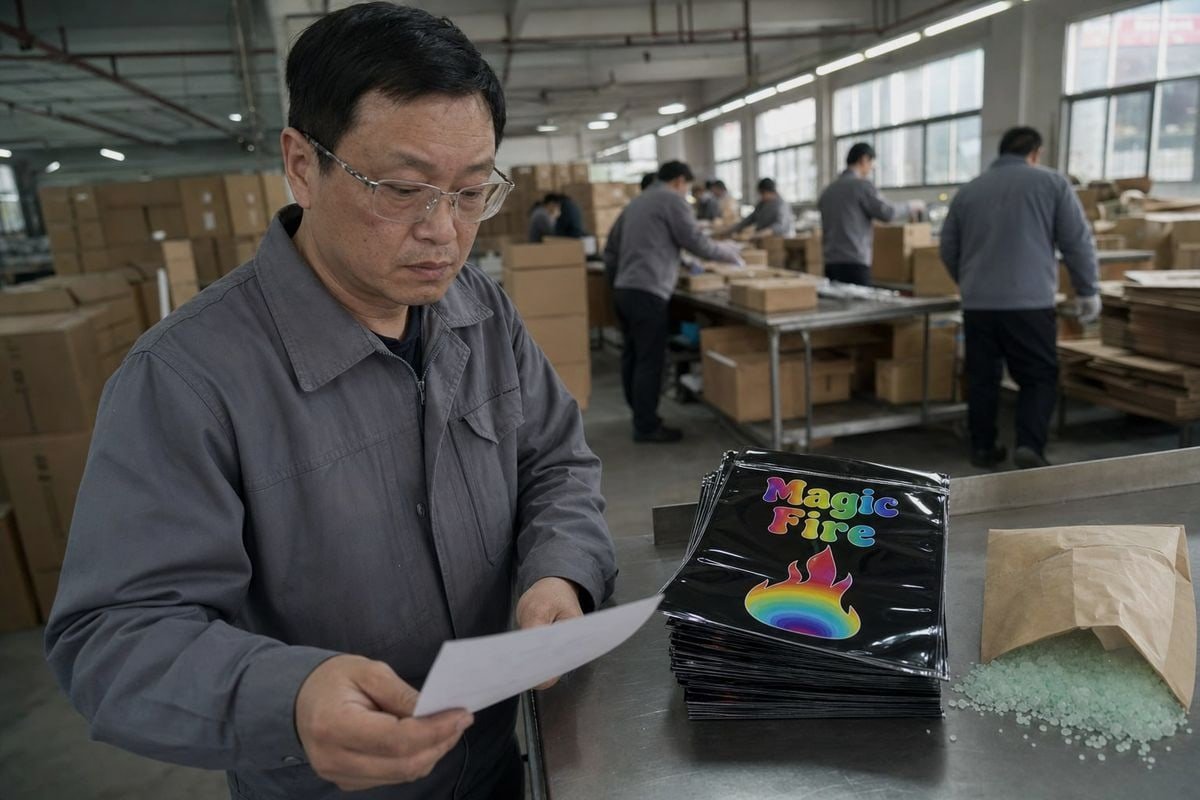
Buyers ask me about fire safety instructions for Magic Fire powder almost weekly, and on our production line in Ningbo, we treat that question as the most important one.
Before buying Magic Fire powder, request a product-specific Safety Data Sheet, exact use instructions, warning label copy, extinguishing guidance, ventilation and distance rules, storage requirements, and third-party test reports. If a supplier cannot provide these documents for the exact formulation, do not place the order.
That answer sounds simple. In practice, most import problems start when a buyer skips one of those documents. Below, I break down each request, why it matters, and how to verify it.
What certifications should I ask suppliers to provide before importing Magic Fire powder?
One of our German distributors once lost six weeks at customs because a previous supplier gave him a generic certificate that did not match the product batch. We rebuilt his documentation from scratch.
Ask suppliers for a product-specific Safety Data Sheet, SGS or Intertek test reports, CE marking documentation, ISO 9001 quality certification, and BSCI social compliance audits. Every certificate must name the exact product formulation and batch, not a similar or generic item.

The single most important document is the Safety Data Sheet 1, sometimes still called a Material Safety Data Sheet. Here is the key point: Magic Fire powder is not one standardized product. Different brands use different flame colorant chemicals 2. Some formulations rely on copper compounds. Others use different metal salt composition 3 entirely. The hazards, and even the correct extinguishing method, change with the chemistry. A generic SDS tells you nothing about the pouch you are actually importing.
The core document checklist
| Document | What it must cover | Red flag if missing |
|---|---|---|
| SDS / Material Safety Data Sheet | Exact formulation, hazards, first aid, extinguishing media | Supplier sends a "similar product" SDS |
| SGS or Intertek test report | Heavy metals, restricted substances 4, burn behavior | Report is older than 2–3 years |
| CE documentation | Conformity for the EU market | No technical file behind the mark |
| ISO 9001 certificate | Consistent batch-to-batch quality control | Certificate belongs to a trading company, not the factory |
| BSCI audit | Ethical production standards | Buyer's retail channel requires it and it is absent |
In our experience exporting to 30+ countries, large retail sourcing channels treat this stack as a hard requirement. A Home Depot–type buyer will not even review samples without it. We hold ISO 9001, BSCI, CE, and SGS/Intertek reports precisely because our US and European customers cannot sell without them.
One more angle buyers miss: ask whether the certificates belong to the actual factory or to a middleman. Trading companies often borrow paperwork. If the factory name on the SDS does not match the name on the invoice, ask why before you pay a deposit.
What warning labels and safety instructions are required on the packaging?
Label design is where I push back on clients most often. A festival gift trader once asked us to remove the caution text to keep the pouch "fun." We refused, then showed him why regulators would too.
Packaging must carry warnings to keep the sealed packet intact, use wood-burning fires only, avoid cooking food over colored flames, use outdoors or in ventilated fireplaces, keep away from children and pets, and store in a dry place, plus emergency and extinguishing instructions.

The playful rainbow-flame packaging that sells the product also creates its biggest risk: children can mistake the pouch for candy or a drink mix. That is why child-safety warnings are non-negotiable, and why we advise buyers to require locked, dry storage guidance on every retail unit we private-label.
The warnings that matter most
Consumer guidance across markets clusters around a consistent set of instructions. Your label copy should include all of them:
- Toss the entire unopened packet into an established wood fire. Never tear the foil. This prevents skin contact and inhalation of fine chemical dust.
- Never cook food or roast marshmallows while colored flames are visible. Combustion residues make food safety precautions essential — the metal salts are not food-safe.
- Wood-burning fires only. Never use the product in propane, natural gas, or ethanol fire features. These are firm outdoor use restrictions for most formulations.
- Ventilation guidance. Outdoor use, or an efficient fireplace meeting normal fireplace ventilation standards 5. Avoid standing downwind; the smoke can irritate airways, and toxic fume inhalation is a real risk in enclosed spaces.
- Adult supervision. Keep children and pets away from the fire and the packets.
- Storage. Keep dry, cool, and away from ignition sources.
On our OEM line, we print custom warning labels, barcodes, and multilingual caution text as part of the packaging service, because a shelf-ready product is only shelf-ready if the label survives a compliance review. If your supplier treats warning text as optional decoration, that tells you everything about their quality culture.
How can I verify a supplier's test reports are accurate and up to date?
A UK fireplace distributor once forwarded me a competitor's "test report" for review. The report number did not exist in the lab's database. That five-minute check saved him a container-load mistake.
Verify test reports by checking the report number directly with SGS or Intertek's online verification portals, confirming the tested product name matches your exact SKU, checking the issue date is within two to three years, and requesting fresh batch testing before large orders.

Faked or borrowed test reports are common in this category. The good news is that verification is straightforward if you follow a process. Both SGS and Intertek 6 allow you to confirm a report's authenticity using the report number. We encourage every new buyer to do this with our documents — a legitimate factory welcomes the check.
A five-step verification process
| Step | Action | What it proves |
|---|---|---|
| 1 | Enter the report number on the lab's official verification page | The report actually exists |
| 2 | Match the product name and description to your quoted SKU | The report covers your product, not a cousin |
| 3 | Check the applicant name against the factory name | The supplier is not borrowing another company's paperwork |
| 4 | Confirm the test date and any expiry | The data reflects the current formulation |
| 5 | Order a pre-shipment batch test for large orders | The mass-production batch matches the sample |
Step five deserves emphasis. In 17+ years of production, the pattern we see across the industry is this: the sample passes, but a cheap supplier quietly changes raw materials for the bulk run. That is why we run strict batch-to-batch quality control, so the first sample reliably reflects mass-production quality. You should also ask what the report actually tested. A heavy-metals screen does not cover burn behavior. If the report is silent on copper sulfate hazards or restricted substances relevant to your market, request the specific test protocols your regulators expect. Finally, ask about chemical stability data for long-term storage in high-humidity environments — clumping or leaching in a warehouse can invalidate old test results.
What usage and storage guidelines should I include for my customers' safety?
When we developed our kraft-bag and jar packaging options, the trade-off we weighed was shelf appeal versus moisture protection. Fine crystalline powder absorbs humidity fast, and a clumped product burns unpredictably.
Include guidelines covering wood-fire-only use, unopened-packet application, outdoor or ventilated settings, no cooking over colored flames, adult supervision, locked dry storage away from children, safe spill cleanup, cool-ash disposal, and what extinguishing method applies to the specific formulation.

Your end customers will never read the SDS. They will read the pouch and, maybe, a small insert card. So the guidelines you include must compress the essential safety story into plain language. I recommend structuring customer guidance into three phases: before the fire, during the fire, and after the fire.
Before, during, and after
| Phase | Key guidance |
|---|---|
| Before | Store sealed packets in a locked, dry cabinet away from heat and children; do not repackage; check the pouch is intact |
| During | Toss the unopened packet into established wood flames; keep a safe distance; no food prep; supervise children and pets; stay upwind |
| After | Let ashes cool fully; follow chemical ash disposal guidance rather than dumping residue on garden soil; sweep spills dry — do not hose porous stone or decking |
A few points deserve extra depth. First, spills. Fine powder on natural stone, masonry, or wood decking should be swept up dry. Ask your supplier for a spill protocol; some formulations stain porous surfaces or react with moisture. Second, equipment care. Some buyers should request data on whether repeated use causes pitting or corrosion on stainless steel fire pits 7 — a fair question for premium fire-feature brands. Third, handling. Consumers do not need protective handling equipment when the packet stays sealed, which is exactly why the "never open the foil" rule anchors everything else. Fourth, extinguishing. Guidance differs by chemistry: some powders must never meet water, while typical consumer color-flame packets tolerate normal water or foam suppression. Your insert should state which rule applies to your specific product, taken directly from the SDS. Our eco-friendly formulations avoid harmful chemicals, but we still print full guidance, because good instructions protect your brand as much as your customer.
Conclusion
Weak documentation sinks import deals faster than weak pricing. Demand the SDS, verified test reports, compliant labels, and clear usage rules — and walk away from any Magic Fire powder supplier who cannot deliver them.
Footnotes
1. Official OSHA landing page for Hazard Communication and Safety Data Sheet standards. ↩︎
2. Explains how metal-based colorants produce flame colors, relevant to formulation hazards. ↩︎
3. Background on metal salts explains why different formulations carry different hazards. ↩︎
4. ECHA defines restricted substances relevant to chemical compliance testing for EU markets. ↩︎
5. EPA indoor air quality guidance supports ventilation warnings for burning fire products. ↩︎
6. Official testing lab site where buyers can verify report authenticity directly. ↩︎
7. Background on stainless steel helps buyers understand corrosion concerns raised in the article. ↩︎



 English
  Spanish
  German
  French
  Arabic
  Portuguese
Join the Conversation